
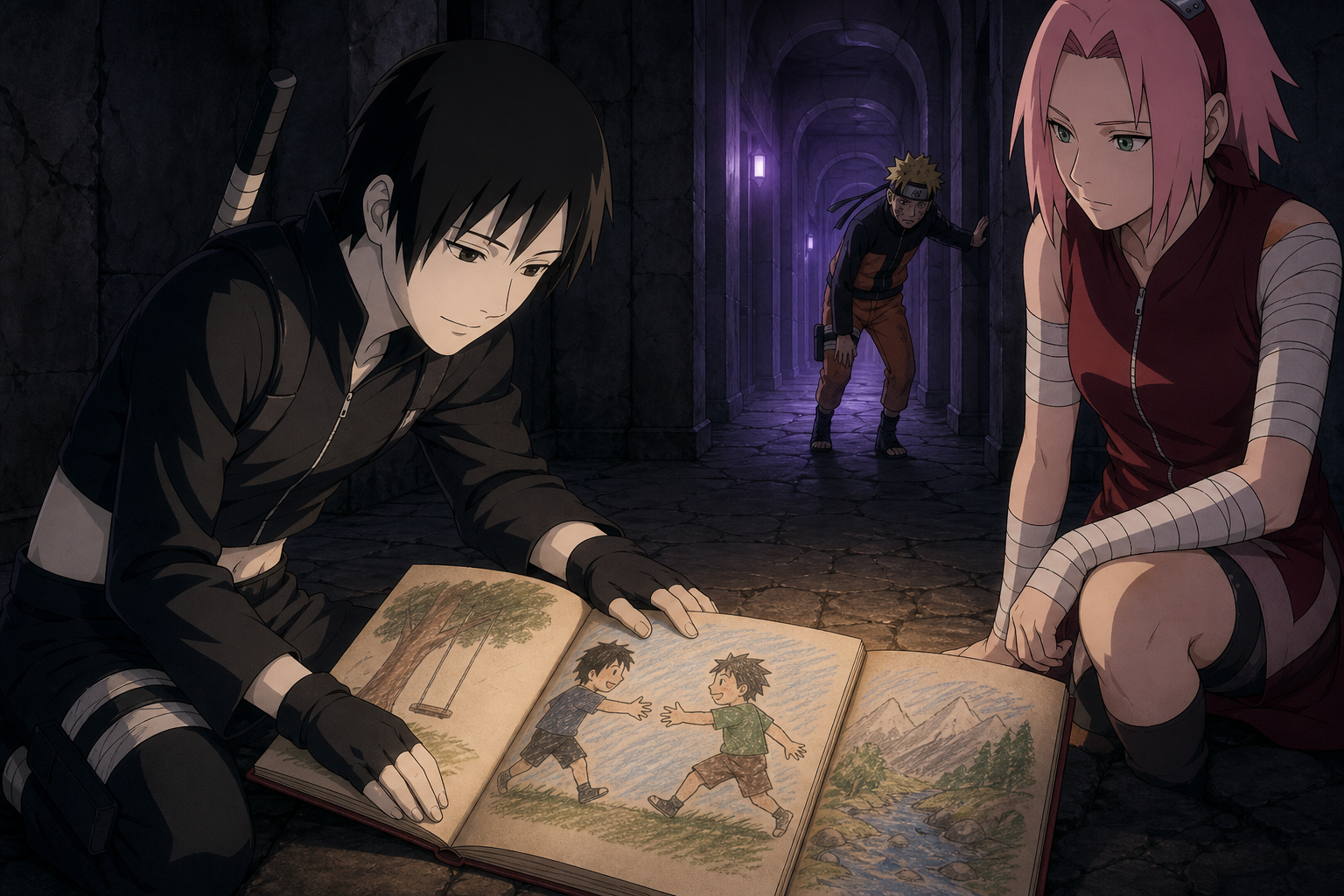
The Picture Book’s Story
Sai finally draws the feeling Root could not erase.
Naruto keeps searching while his body is asking him to stop
Episode 50 places Naruto's determination beside its physical cost. He is still recovering from the Nine-Tails transformation, yet he pushes through Orochimaru's corridors looking for Sasuke. Every step says the promise remains active even when Naruto's strength is failing.
The episode does not present that persistence as uncomplicated heroism. Naruto has already learned that losing control injured Sakura. His body is damaged, his team is inside enemy territory, and urgency can become another way of refusing necessary limits. What Sai sees is not perfect devotion. It is devotion powerful enough to move a person and dangerous enough to consume one.
Sai recognizes a feeling before he can explain it
Naruto's search brings back Sai's memory of his older brother. Root taught Sai to sever the language of attachment, but memory survived in images, habits, and the book he never discarded. Watching Naruto refuse to treat Sasuke as replaceable gives those fragments a shape.
Sai does not suddenly acquire Naruto's emotional vocabulary. He recognizes a pattern. Naruto's bond with Sasuke resembles the importance Sai's brother once held for him. That recognition lets Sai stop describing the past as irrelevant and admit, at least through art, that the relationship changed him.
The breakthrough works because it belongs to Sai. Naruto does not order him to feel. Sakura does not complete the page for him. Sai sees, remembers, and chooses to draw.
The blank center page was never empty
Sai's picture book follows two boys through parallel adventures until their paths should meet in the center. That page remained unfinished because the reunion required Sai to represent a feeling Root told him to erase.
The blank space was therefore full of grief. It held the ending Sai and his brother never received, the words Sai could not safely use, and the conflict between memory and training. Calling it empty made the absence easier to carry.
Completing the picture does not rewrite his brother's death. It allows Sai to acknowledge what the relationship meant. The page becomes a memorial and a statement of selfhood at the same time.
Art returns ownership of the story to Sai
Danzo writes missions for Sai. Root assigns targets, identities, expressions, and acceptable responses. The picture book is different because Sai created it with his brother and must decide how it ends.
That makes the final drawing an act of agency. It is small compared with the political threat surrounding the team, but it reaches the foundation of Danzo's control. A person who can author the meaning of his own past can also question the meaning imposed on his present.
Sai's ink techniques have often turned drawings into tools for orders. Here, drawing serves memory instead of obedience.
Naruto's bond with Sasuke changes someone Sasuke has never met
Naruto does not know Sai is completing the page while he searches. His influence arrives through behavior rather than persuasion. Sai has heard Naruto talk about Sasuke, but the sight of Naruto continuing through pain makes the bond legible in a way argument could not.
This does not prove every part of Naruto's pursuit is healthy. It proves the connection is real. Sai recognizes that Naruto is not performing loyalty for approval or rank. The promise has become part of how Naruto understands himself.
That sincerity helps Sai recover a part of himself Root could not categorize.
Sakura becomes witness to a change she helped begin
Sakura was the person who named Sai's contradiction. She saw that someone who claimed to feel nothing still protected a book about his brother. In Episode 50, she can see the result without taking ownership of it.
Sai's growth does not happen because Sakura patiently absorbs every insult. It happens partly because she challenged him directly and refused to call the false smile genuine. Her honesty gave him a problem he could not solve with another practiced expression.
Watching him complete the page confirms that boundaries and compassion can exist together. Sakura did not have to excuse Sai in order to reach him.
The completed picture is not instant redemption
Sai has still betrayed Team Kakashi, delivered sensitive information, and concealed an order whose full purpose remains dangerous. One sincere drawing cannot repair those choices. What it can do is establish that the person making future choices is no longer completely sealed inside Root's design.
Redemption requires action over time. Episode 49 gave Sai one decisive action against Kabuto. Episode 50 gives the emotional truth underneath it. The two pieces support each other: he protected the team because something in him had changed, and finishing the page allows him to understand what that change is connected to.
Trust can begin there without pretending it is finished.
A smile finally belongs to the person wearing it
Sai's early smiles were techniques. They were meant to lower tension and imitate social ease, even when the emotion behind them was absent. Completing the picture opens the possibility of a smile that is not assigned.
The distinction is subtle but essential. A genuine expression does not need to look dramatically different from the practiced one. Its meaning comes from ownership. Sai is no longer arranging his face because a manual says connection requires it. He is responding to a memory he has allowed himself to value.
For someone trained to be unreadable, that private honesty is enormous.
RaeRae's reaction
The picture book lands because the story lets it remain simple. Sai does not need a speech about rediscovering love. He sees Naruto searching for Sasuke, remembers his brother, and finally knows what belongs in the blank space. The drawing says what he cannot yet say cleanly.
I also appreciate that Naruto's influence is indirect. Naruto can be overwhelming when he tries to force another person to understand bonds exactly as he does. Here, he is just moving through the corridor in pain because Sasuke still matters. Sai draws his own conclusion from that evidence.
My favorite part is that the completed page does not belong to Danzo, Orochimaru, or the mission. It belongs to Sai and the brother he lost. Root took control of so much of his life, but it did not get to finish this story for him.
The finished page creates another beginning
Episode 50 resolves the book's missing image without resolving Sai's entire future. He now understands that his brother remains important and that Naruto's devotion awakened the memory. The question becomes what he will do with that understanding when Danzo's order collides with Team Kakashi's search for Sasuke.
The page closes one emotional gap and opens a harder choice. Sai can no longer claim that bonds are meaningless. He has drawn proof in his own hand. From this point forward, obedience will have to compete with a self that has begun remembering what it values.
Official episode reference: Naruto Official episode guide
Licensed episode route: Crunchyroll licensed episode page
The completed page is an ending Sai had to survive long enough to make
Sai and his brother imagined parallel adventures meeting at the center. Illness and Root training interrupted that design. The blank survived because Sai did, carrying a relationship he could not finish and was not allowed to grieve openly.
Completing the page does not restore the future they expected. It gives the lost relationship a form that death and conditioning no longer control entirely.
Closure here is not forgetting. It is choosing how memory will continue.
The book proves art can preserve knowledge outside official language
Root supplied mission reports, targets, codes, and approved emotional discipline. Sai’s drawings preserve another archive: companionship, competition, shared imagination, and the older brother who mattered beyond function.
Because Sai lacks easy words for those experiences, the images become evidence his official identity cannot absorb.
Institutions can regulate what people say and still fail to erase what they make, carry, and protect.
Naruto’s search gives Sai a living translation for the drawings
Sai knows the sequence of the book but has lost access to the feeling needed for its center. Watching Naruto pursue Sasuke through exhaustion translates the old images into present behavior.
Another person is important enough to organize movement, risk, memory, and refusal. Sai recognizes that pattern because his book has been holding the same structure.
Naruto does not explain Sai’s brother to him. He gives Sai a current example through which Sai can interpret his own past.
Recognition is different from imitation
Sai does not need to become Naruto, adopt his volume, or pursue every bond with the same recklessness. The breakthrough belongs to Sai because he draws his own conclusion.
Naruto’s loyalty illuminates the existence of attachment. His recent transformation also demonstrates why feeling needs judgment and boundaries.
Sai can accept that bonds matter without treating self-destruction as their required proof.
Naruto’s body is still paying while his example inspires someone else
The corridor search is physically costly. Naruto has not recovered from the four-tailed transformation, and determination cannot replace damaged stamina.
Sai sees devotion. The audience must also see injury. Romanticizing only the persistence would repeat Naruto’s habit of measuring loyalty by how much of himself he can spend.
The useful lesson is that Sasuke matters. The dangerous lesson would be that limits make the bond less real.
Sakura witnesses without claiming authorship
She named the contradiction in Sai and protected space for the book’s meaning to emerge. She does not finish the drawing, supply the correct emotion, or demand credit for his change.
That restraint matters. Supporting someone’s growth does not mean owning the result.
Sakura can recognize her influence while allowing Sai’s final line to belong to the person whose memory the page holds.
The smile becomes credible because the drawing comes first
Sai’s practiced smile was meant to simulate connection without exposing interior life. The completed page reverses that order. He allows interior meaning to exist, and expression follows.
The face may look similar, but the source has changed. One smile executes a social technique. The other responds to a memory Sai has chosen to value.
Authenticity is not a special shape of the mouth. It is ownership of what the expression communicates.
Root’s conditioning failed because it misunderstood memory
Danzō’s system assumes emotion can be removed by suppressing language, punishing attachment, and training operatives to act without hesitation. Sai’s book reveals what the system missed.
Memory can persist through muscle habit, protected objects, unfinished work, and reactions too quick to discipline. The emotional connection survived without announcing itself in approved vocabulary.
Root produced silence and mistook silence for absence.
Sai’s brother does not become important only because Naruto notices
Naruto’s example helps Sai recognize the bond. The brother’s value existed before that recognition. This distinction protects the story from making Naruto the creator of Sai’s humanity.
Sai was always a person shaped by love and loss. Root restricted access to that knowledge. Team Kakashi provides conditions where the knowledge can return.
Recognition reveals value. It does not grant value retroactively.
The book connects grief to moral agency
Remembering his brother changes more than Sai’s emotional self-understanding. It gives him a reason to resist treating Naruto, Sakura, and others as disposable mission pieces.
Grief teaches that losing a person cannot be translated cleanly into operational data. Once Sai admits one life mattered beyond function, Danzō’s entire model becomes harder to accept.
Personal memory becomes a basis for political and moral refusal.
Completing the page does not complete Sai
The image is a breakthrough, not a finished identity. He still lacks emotional fluency, has consequences to repair, and remains tied to an institution that may punish disobedience.
One sincere moment cannot carry every future choice. The importance lies in creating a self capable of making those choices differently.
The book closes a narrative gap while opening responsibility.
The page offers connection without demanding replacement
Naruto and Sakura do not become substitutes for Sai’s brother. New bonds do not erase or replace the dead. They allow what the old relationship taught to continue in another form.
Sai can care for teammates because his brother mattered, not because teammates fill the same role.
This protects grief from the idea that healing means finding another person to occupy an empty position.
Sasuke remains the absent center of everyone else’s story
Naruto searches for him. Sakura organizes hope and guilt around him. Sai rediscovers his brother through witnessing Naruto’s devotion. Orochimaru designs his future around Sasuke’s body.
Yet Sasuke’s own voice remains outside these interpretations. The approaching reunion must make room for him as more than the object that gives other people emotional development.
A bond includes another person whose understanding may disrupt the story everyone has built in his absence.
The picture book models a form of reunion Naruto cannot force
Sai cannot physically recover his brother. He can reunite parallel stories through memory, authorship, and acknowledgment.
Naruto wants Sasuke physically home, and that hope remains possible. The book suggests another requirement: reunion must also involve integrating what separation changed.
Putting two figures on the same page means little if neither person’s journey toward the center is respected.
The center page joins stories without making them identical
The brothers approach from opposite ends through separate illustrated adventures. Their paths meet while retaining distinct histories.
That structure offers a healthier image of bonding than fusion or possession. Connection does not require one person to disappear into another’s goal.
Team Kakashi needs the same principle as it pursues Sasuke: shared relationship with room for separate agency.
Sai’s authorship challenges Danzō’s ownership
Danzō assigned Sai a name, role, mission, emotional code, and acceptable future. The completed book contains meaning Danzō did not authorize.
Drawing the ending proves Sai can create purpose instead of only receive it. That capacity makes future disobedience possible and makes Root’s claim on him less complete.
A private page becomes a political act because controlled people recovering authorship threaten every order built on their presumed emptiness.
The team should not demand emotional performance as proof
Sai may still speak awkwardly, misunderstand social cues, and use expressions that feel practiced. The completed page and his action against Kabuto offer stronger evidence than whether he performs warmth correctly.
Recovery from conditioning cannot be measured by how quickly someone becomes comfortable for everyone else.
The meaningful standard is whether Sai recognizes people, tells the truth, respects boundaries, and changes harmful choices.
Naruto needs the same permission to revise his story
He has treated the promise to save Sasuke as fixed, with self-sacrifice written into every chapter. Sakura’s injury proves that script needs revision.
Sai’s page shows that changing an ending does not betray the original bond. It can honor the bond more truthfully.
Naruto can remain devoted while adding survival, consent, teammate safety, and Sasuke’s present voice to the picture.
Art succeeds where interrogation could not
Questions uncovered Sai’s mission, but they could not command him to understand his brother. The book created a route into knowledge that direct demand could not produce.
Art allows contradiction to remain visible long enough for meaning to emerge. Two journeys, one blank center, and a final drawing carry more than a forced confession.
Not every truth becomes available through pressure. Some need a form the person can inhabit safely.
The emotional breakthrough remains grounded in action
Episode 49 showed Sai restraining Kabuto. Episode 50 connects the choice to remembered attachment. Behavior and understanding reinforce each other.
Without action, the page could remain private sentiment while others face the consequences of Sai’s betrayal. Without understanding, the action could be dismissed as tactical convenience.
Together they create the beginning of accountable change.
The center page gives both brothers equal space
The image does not place Sai beneath his brother or ask one figure to disappear into the other. Their separate journeys meet. That composition matters after Root trained Sai to understand relationship through hierarchy and obedience.
The page imagines connection without domination. Each brother arrives as himself, carrying a distinct path, and the meaning exists where those paths touch. Team Kakashi can offer Sai the same possibility if belonging does not become another demand that someone else author him.
RaeRae’s full take
The completed center page works because the blank was never empty. It was carrying grief Sai had no safe language to touch. Root saw silence and congratulated itself for erasing a bond that had been living in his hands the entire time.
Naruto helps without delivering a speech. He searches for Sasuke while hurt, and Sai recognizes the shape of someone remaining important after separation. I need us to see the damage in Naruto’s persistence too. Devotion is real, and the body is still asking him to stop.
Sakura deserves credit for naming the contradiction without claiming the resolution. She saw the book, saw Sai protect it, and refused his lie that none of it mattered. Then she lets the final drawing belong to him.
The page does not redeem the ANBU list or erase betrayal. It gives Sai the emotional knowledge required to understand why those choices harmed people. Repair still has to follow.
I love the small rebellion of art serving memory instead of mission. The same ink Root turned into an operational tool becomes the medium through which Sai says his brother mattered and Danzō did not get to write the ending.
A finished picture creates a beginning because Sai can no longer pretend he contains nothing capable of choosing. The next time obedience and relationship collide, he has proof in his own hand that the relationship is real.
RaeRae checkpoint: Root did not leave Sai’s center page empty. Grief did. Completing it lets Sai turn memory into authorship, and authorship is where Danzō’s control starts to fail.
Receipts and official routes
- Episode placement, Naruto continuing the search, Sai remembering his brother, and completion of the picture book’s center page: Naruto Official Site episode guide.
- Licensed episode route: Crunchyroll.