
Bonds
Sai’s first honest answers reveal what Root failed to erase.
Team Kakashi finds Sai, but not the answer they expected
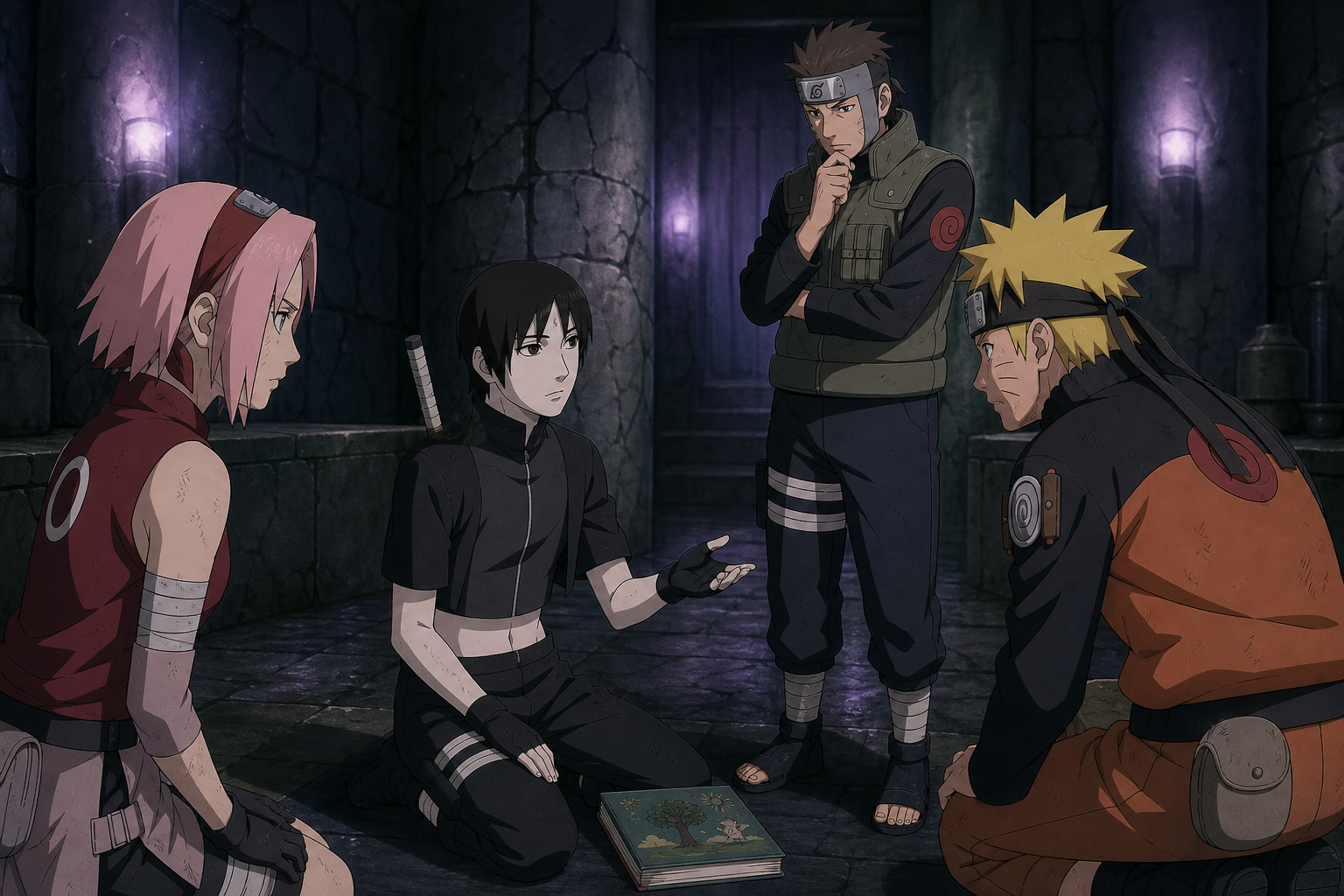
Episode 48 brings Team Kakashi into Orochimaru's hideout and places Sai within reach. Naruto, Sakura, and Yamato arrive ready to confront a traitor. Sai surprises them by answering their questions instead of defending Danzo's plan.
That disclosure does not repair trust. It changes the conditions under which trust might eventually become possible. Sai has spent the mission controlling what his teammates know, smiling when he does not understand the feeling a smile is meant to carry, and treating Danzo's order as a sealed compartment. Speaking honestly is the first choice that interrupts that training.
Danzo's plan treats the village as his property
The team learns more about the objective Sai carried into the hideout. Danzo's willingness to work with Orochimaru is tied to his own vision for the Leaf, one built around removing the current leadership and remaking power on his terms.
The word “protect” cannot clean that up. A leader who exposes ANBU operatives, collaborates with an enemy responsible for attacking the village, and withholds the plan from everyone affected is not asking the village to survive. He is asking it to become an instrument of his authority.
Sai was trained inside that worldview. Orders arrive without moral context because context might produce refusal.
Sai's honesty is a decision, not proof of innocence
It would be easy to treat Sai's confession as an instant redemption. The episode is more careful. He still delivered the documents. He still entered the hideout under false pretenses with his teammates. The danger created by those choices does not disappear because he now explains them.
What matters is that Sai begins acting outside the narrow function Danzo assigned him. He provides information that helps Team Kakashi understand the threat. In Root, openness creates vulnerability. Here, it creates the possibility of shared action.
Accountability begins with an accurate account. It does not end there.
Naruto recognizes a bond Sai keeps denying
Naruto has been arguing with Sai about bonds since they met. At first, the argument seemed almost impossible because Sai lacked the emotional vocabulary Naruto uses instinctively. The picture book gives Naruto something more concrete. Sai preserved a story about himself and his brother even while claiming the relationship no longer affected him.
Naruto understands that contradiction because he knows what it means to organize a life around an absent person. His pursuit of Sasuke is reckless in places, but it also makes him alert to grief disguised as indifference. Sai's book is not decoration. It is a bond stored in images because words became unsafe.
The episode does not say Sai and Naruto's losses are identical. It shows why Naruto can see through a defense Sai barely recognizes as a defense.
Sakura notices the gap between Sai's words and behavior
Sakura has less patience for Sai's performance, and that makes her observation valuable. She points toward the contradictions in him: a person who claims not to feel should not have protected the book, reacted to its damage, or continued carrying it through a covert mission.
Her skepticism is not cruelty. Sai's actions have endangered the team, and she is entitled to question him. At the same time, Sakura recognizes evidence of attachment when it appears. She does not need to trust Sai completely to acknowledge that Root failed to erase him.
That combination of boundaries and perception gives Sai more room to change than automatic forgiveness would.
Yamato keeps the conversation attached to the mission
Yamato allows Naruto and Sakura to question Sai, but he does not forget where they are. Orochimaru's hideout remains hostile territory, Sasuke is nearby, and Kabuto may return at any moment. Information has to become a plan quickly.
His steadiness prevents the scene from becoming either a sentimental breakthrough or an uncontrolled interrogation. Sai's disclosure matters because it affects what the team does next. The possibility of an alliance against the Leaf raises the stakes beyond Naruto's personal reunion, while Sai's knowledge may provide the path to Sasuke.
Yamato holds both objectives without pretending they are easy to reconcile.
Bonds can constrain, expose, and save
The title is not arguing that every bond is automatically good. Danzo binds Sai through obedience. Orochimaru binds Sasuke through access to power. Naruto's bond with Sasuke can push him toward self-destruction. Relationships become dangerous when they erase choice or demand harm as proof of loyalty.
But isolation is not freedom either. Sai's Root training made him useful by cutting him off from the feelings that could challenge an order. His brother's memory survived as a quiet resistance to that design. Naruto and Sakura's concern gives that resistance a language.
A healthy bond does not make a person easier to control. It gives them a reason to question control.
The unfinished picture becomes a live question
Sai's book has a blank central page where the two brothers' stories should meet. He has carried that absence without completing it because the ending requires an emotional truth Root taught him to suppress.
Inside the hideout, the blank page becomes more than memory. Sai is standing at another unfinished crossing. Danzo's order points one way. The teammates who pursued him point another. Sasuke, whose severed bond brought everyone here, represents a third possibility: choosing isolation and calling it strength.
Sai has not completed the page yet. His willingness to tell the truth suggests he may finally be able to choose what belongs there.
RaeRae's reaction
I do not forgive Sai just because he talks, but I absolutely notice that talking is dangerous for him. Root trained obedience into his body and taught him that emotion interferes with function. Giving Team Kakashi the truth is a small act with enormous meaning because it makes Danzo's control less complete.
Naruto's ability to recognize attachment in the picture book also works for me. He can be reckless about Sasuke, but his stubborn belief that bonds leave evidence is exactly what Sai needs. Naruto does not accept the claim that a dead brother has become irrelevant when Sai has carried an entire illustrated story about him into enemy territory.
Sakura keeps the scene honest. She sees the contradiction without pretending it cancels the harm. That is the balance I want from the team: curiosity about why Sai became this way, alongside clear recognition of what he has done.
Truth creates a possible team, not a finished one
Episode 48 does not transform Sai into a trusted friend. It creates the first honest foundation on which that relationship could be built. The team knows more about Danzo's purpose. Sai has heard his own contradictions named. The picture book has become part of a conversation instead of a private relic.
They are still inside the den of the snake, with Sasuke close and danger approaching. The difference is that Sai is no longer only the secret they are chasing. He has begun, however unevenly, to stand inside the truth with them.
Official episode reference: Naruto Official episode guide
Licensed episode route: Crunchyroll licensed episode page
Finding Sai does not automatically restore the team
Naruto, Sakura, and Yamato catch up to Sai inside enemy territory, but physical reunion is not relational repair. He delivered classified material, left during a medical crisis, and entered Orochimaru’s hideout without telling them why.
The team has every reason to restrain and question him. The fact that Sai begins answering does not erase the conduct that made the interrogation necessary.
This episode earns its emotional movement by allowing truth to become a beginning rather than pretending one confession can finish the work.
Sai’s first honest disclosure costs him the protection of the role
As long as he performs the obedient Root operative, every decision can be attributed to mission parameters. Speaking openly introduces a personal choice. Sai decides Team Kakashi should know what Danzō ordered and what danger may follow.
That choice makes him more vulnerable to Root, Orochimaru, and the teammates who may reject his explanation. Honesty removes the safety of being only an instrument.
Agency often feels less comfortable than obedience because agency means the consequences finally belong partly to the person choosing.
The truth does not require the team to trust him immediately
Naruto can recognize a crack in Sai’s conditioning while remaining angry about the betrayal. Sakura can see attachment in the picture book while refusing to minimize the risk he created. Yamato can use his information while maintaining restraint and surveillance.
This is a healthier response than instant forgiveness. Trust is not a prize awarded for revealing one secret. It is a pattern built when later behavior remains accountable to the truth disclosed.
Sai needs room to change and boundaries strong enough that change does not demand new harm from everyone else.
Danzō calls domination protection because he controls the definition
His plan can be described as service to Konoha only if Konoha means the political order he wants to create. The actual people of the village are denied knowledge, consent, and protection from the risks he trades.
ANBU identities become currency. Team Kakashi becomes transportation. Sai becomes a courier. Orochimaru becomes a temporary tool. Every person is assigned a use inside Danzō’s private definition of necessity.
A community cannot meaningfully be protected by a plan that treats community members as objects belonging to the planner.
Root’s emotional suppression is a system of information control
Feelings provide information about harm, attachment, conflict, and value. Training Sai not to feel, or at least not to recognize and express feeling, makes certain questions harder to ask.
If grief cannot be named, the loss of his brother cannot challenge Root. If care cannot be trusted, Naruto and Sakura’s danger cannot outrank Danzō’s order. If anger at exploitation remains inaccessible, obedience feels like the only neutral state.
Emotional recovery is politically dangerous to Root because emotion can reconnect Sai’s decisions to the people affected by them.
The picture book is an archive Root failed to destroy
Each drawing preserves sequence and relationship. Sai and his brother move through shared trials toward a center page that remains blank. The book stores a self Root’s official narrative says no longer exists.
Archives do not have to be public to resist erasure. Sai carried this one privately because the bond mattered before he possessed language safe enough to say so.
Naruto and Sakura recognize the evidence because they know absence can organize a life even when the absent person is never named aloud.
The missing page contains grief, not emptiness
Sai describes himself as unable to remember the feeling required to complete the book. The blank is therefore easy to mistake for lack.
In reality, the unfinished center marks the point where loss overwhelmed the emotional tools available to him. His brother died, Root demanded suppression, and the narrative stopped where connection should have become explicit.
The page is full of an absence too consequential to draw. Naming that absence is the first step toward completing it honestly.
Naruto recognizes grief because he refuses to accept its disguise
He has spent years listening to people tell him Sasuke chose departure and should be treated as unreachable. Naruto’s refusal becomes unhealthy when it ignores agency, yet it also gives him sensitivity to bonds hidden beneath defensive language.
When Sai claims the book means little, Naruto compares the statement with the care required to preserve and carry it. The behavior is stronger evidence than the denial.
Naruto’s gift here is not magical emotional certainty. It is insisting that Sai’s actions deserve interpretation.
Sakura asks sharper questions because trust has already been broken
She does not approach the book as proof Sai must be innocent. She notices contradiction and asks what it means. Her skepticism protects the team from sentimentality while leaving room for new evidence.
Sakura has been hurt by Naruto’s uncontrolled power and endangered by Sai’s controlled mission. She has no reason to reward either boy for feeling bad. She needs changed behavior.
Her presence keeps bonds from becoming a story where women absorb damage so men can discover emotion.
Yamato creates a container for disclosure
He controls the room, monitors the external threat, and allows questioning without turning the encounter into revenge. Sai can speak because Yamato has established boundaries strong enough to make speech possible.
Containment serves restoration again. Earlier, Yamato suppressed the Nine-Tails so Naruto could return. Here, he contains operational danger so truth can emerge.
Authority becomes protective when it creates conditions for agency rather than replacing everybody else’s judgment.
Bonds are not automatically virtuous
Danzō binds Sai through command. Orochimaru binds Sasuke through access to power and revenge. Naruto’s attachment to Sasuke recently became a trigger that injured Sakura.
The episode does not celebrate connection without qualification. It asks what a bond demands, whether choice remains possible, and who carries the cost.
A healthy bond can challenge authority, survive disagreement, and include the safety of every participant. A controlling bond treats sacrifice as proof of loyalty.
Isolation is not freedom merely because nobody can disappoint you
Sai’s emotional distance protects him from visible grief while making him available to Root. Sasuke’s severed bonds protect his revenge from competing priorities while making Orochimaru’s path appear necessary.
Both boys gain narrowed effectiveness. Neither gains a full life.
Avoiding attachment removes some vulnerability and also removes people who might tell you when power is using your pain.
Sai’s brother remains present through what Root could not explain
The older boy’s influence survives in the drawing practice, the book, and Sai’s incomplete emotional memory. Death ended direct relationship without eliminating consequence.
Root’s doctrine treats a dead bond as operationally irrelevant. Sai’s entire private archive contradicts that doctrine.
Grief is not a malfunction that proves training incomplete. Grief is evidence that another person mattered beyond function.
Naruto’s bond with Sasuke gives insight and creates blind spots
He can see through Sai’s denial because he knows what an absent brother can mean. He can also assume every severed bond should be restored according to his preferred ending.
The same commitment that helps Sai feel recognized may later make Sasuke feel unheard. Naruto has to distinguish refusing emotional erasure from refusing another person’s present voice.
Bonds require persistence and the humility to learn how the other participant understands them now.
Sai’s disclosure changes the mission from retrieval to choice
Before the conversation, Team Kakashi’s immediate problem was locating and restraining a teammate who had defected into enemy space. Afterward, they must decide what to do with information he voluntarily provides and whether he can participate in the search for Sasuke.
Sai is no longer only an object to recover. He becomes a person whose next decision can alter the mission.
That change increases uncertainty, but uncertainty is part of respecting agency.
Accountability includes what Sai does with the ANBU list
Explaining Danzō’s objective does not protect the people whose identities were exposed. The packet remains in enemy hands, and the possible harm extends beyond the room.
If Sai is changing, repair must include action toward preventing or limiting those consequences. Emotional awakening without material responsibility would center his growth over the people endangered.
The story’s next test is whether his emerging bond produces a different operational choice.
The hideout makes honest connection physically dangerous
Every minute spent talking risks discovery by Kabuto or Orochimaru. The group has limited privacy inside a structure controlled by the enemy.
That pressure gives the conversation weight. Sai does not wait for perfect safety before speaking because perfect safety does not exist.
Sometimes truth begins in the exact environment built to prevent it, protected only by people deciding the risk of silence has become greater.
A bond becomes visible when it changes the order of priorities
Sai can describe his brother, protect the book, and disclose Danzō’s plan. The decisive evidence will be what he places first when Root’s assignment conflicts with Team Kakashi’s safety.
Feeling is not measured only by tears or fluent confession. Sometimes feeling appears as a revised mission choice: refusing to spend another person, returning when departure would be easier, or protecting a relationship no superior authorized.
Choice makes connection.
RaeRae’s full take
I do not need Sai forgiven in this episode. I need the story to let his honesty matter without pretending honesty pays every debt, and that is exactly where “Bonds” works.
Sai tells them what Danzō intended even though Root trained him to keep the order sealed away from feeling. That is a choice. It is also only the first choice in a much longer repair.
The picture book is the emotional receipt. Sai carried an entire history with his brother while insisting attachment no longer existed. Root did not erase the bond. Root took away the language that would let him understand what he preserved.
Naruto sees through the denial because absence is practically his native language. Sakura keeps the moment from becoming instant absolution because she knows consequences do not disappear when a boy finally identifies his pain.
Danzō calls his plan protection while spending ANBU lives, using Team Kakashi as cover, and treating Sai as disposable. A bond to the village that requires the village to have no voice is not loyalty. It is possession.
The episode’s title is plural in spirit even when the word is simple. Bonds can save, restrain, manipulate, expose, or give someone a reason to disobey. The moral question is never only whether connection exists. It is whether the connection leaves people more able to choose and care.
RaeRae checkpoint: Sai’s confession does not finish his redemption. It proves Root did not completely own the ending. The next page belongs to what he chooses after the truth is shared.
Receipts and official routes
- Episode placement, Team Kakashi finding Sai, Danzō’s plan, Sai’s disclosure, and the unfinished picture book: Naruto Official Site episode guide.
- Licensed episode route: Crunchyroll.