
The Secret of the Battle!
One quiet exchange changes the meaning of the entire mission.
Sai chooses the meeting nobody else was meant to see
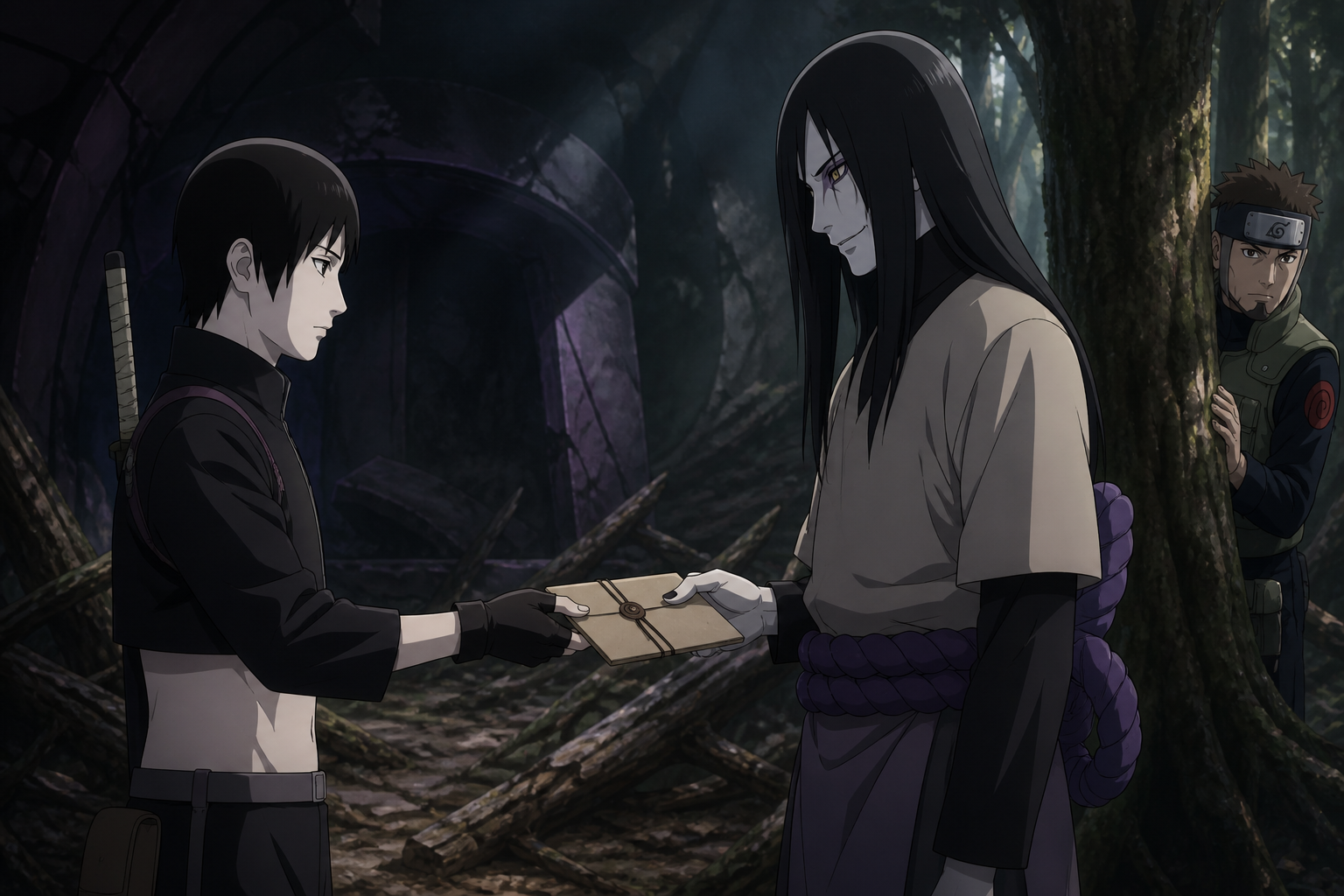
The battlefield has barely gone quiet when Episode 44 changes the kind of danger Team Kakashi is facing. Naruto's transformation was loud, physical, and impossible to misunderstand. Sai's decision is the opposite. He moves inside the confusion, finds Orochimaru, and offers him the documents Danzo entrusted to him. There is no dramatic confession and no speech explaining where his loyalty sits. The exchange itself is the answer.
That restraint makes the scene colder. Sai has traveled beside Naruto, Sakura, and Yamato long enough to learn their rhythms, but he still treats them as pieces outside the mission he was actually given. Teamwork has begun to affect him, yet it has not erased the Root conditioning that taught him to separate orders from attachment.
The secret of the battle is not a hidden technique
The title sounds as though the episode will reveal a combat trick. Instead, its secret is political. The fight gave Sai cover to contact the enemy, and the wreckage becomes camouflage for an operation planned before Team Kakashi ever reached the bridge. Orochimaru studies the documents and decides Sai is useful enough to bring back to the hideout.
That invitation matters more than a victory pose. Sai has crossed from observing Orochimaru to entering his territory. For Yamato, who watches the exchange from concealment, the mission suddenly has a second route. Sasuke may be at the end of Orochimaru's trail, but following Sai means accepting that their assigned teammate may be leading them into a trap.
Yamato does the difficult work of watching before judging
Yamato's strongest choice is patience. He has every reason to intervene. Sai is exchanging sensitive material with a wanted enemy, Naruto is exhausted, and Sakura is injured. An immediate confrontation would feel decisive, but it would also destroy the only lead into the hideout.
So Yamato watches. That is not passivity. It is discipline under emotional pressure. He gathers enough information to understand the shape of the betrayal before deciding how to respond. The episode quietly distinguishes leadership from reaction: a captain cannot afford to spend the team's future just to satisfy the anger of the present moment.
Sai's blank expression is no longer emotionally neutral
Earlier, Sai's practiced smile could be read as awkwardness. Here, the same emotional distance becomes threatening. He can hand over Danzo's packet while his temporary teammates are recovering nearby because Root trained him to divide the self into sealed compartments. The mission belongs in one compartment. Naruto and Sakura belong in another. Nothing is supposed to leak between them.
But the audience has already seen small cracks in that system. Sai has watched Naruto risk himself for Sasuke, listened to Sakura defend the bond between them, and encountered a kind of loyalty Root cannot easily categorize. His choice to continue Danzo's mission does not mean those encounters were meaningless. It means change is slower and messier than one sincere conversation.
Orochimaru understands the value of divided loyalty
Orochimaru does not need to trust Sai in order to use him. He only needs to recognize that Sai has information, an official connection to Danzo, and enough secrecy surrounding him to be useful. That is how Orochimaru builds leverage. He finds the fracture inside another institution and makes space for it inside his own plans.
The scene also shows why information can be more dangerous than force. Naruto's transformed power tore through the landscape, but it could not reveal where Sasuke was. A quiet packet of documents earns Sai access that an entire battle could not secure. The route forward opens through negotiation between people whose motives remain deliberately obscured.
Sakura wakes into a mission that has changed shape
Sakura's injury keeps the previous episode present. The story does not allow Sai's secret meeting to erase what Naruto's loss of control cost her. She is recovering from harm caused by someone she loves while the teammate she distrusts disappears with the enemy. Both problems challenge the same comforting idea: good intentions are enough to keep a team safe.
They are not. Naruto never intended to hurt Sakura, and Sai may believe that carrying out Danzo's order serves a larger purpose. Consequences still arrive. Sakura's medical knowledge can treat the body, but the team also needs truth, boundaries, and accountability if it is going to survive the journey to Sasuke.
The documents turn Danzo into a presence without putting him on the field
Danzo's influence reaches the Tenchi Bridge through Sai's hands. That makes the mission feel larger than a pursuit of Orochimaru. Hidden Leaf politics are now moving underneath the rescue effort, and Team Kakashi has not been told enough to understand the game it has entered.
This is one of the episode's smartest structural choices. Danzo does not need to stand beside Orochimaru for their possible cooperation to feel dangerous. The sealed packet carries his authority into the scene. Sai's obedience makes the unseen order physical, and Yamato's surveillance gives the audience a witness who understands that the official mission briefing was incomplete.
Following Sai requires trust in observation, not trust in Sai
The team does not need to decide that Sai is innocent before pursuing him. They need to decide whether the trail he creates is worth the risk. That distinction keeps the story from forcing a false reconciliation. Sai has not earned trust, and Yamato has evidence that makes suspicion reasonable.
Still, the route to Orochimaru's hideout may also be the route to Sasuke. The pursuit therefore becomes an uneasy calculation. They can follow because Yamato saw what happened, because they know Sai's destination, and because abandoning the trail would surrender their best lead. Evidence, not optimism, supports the next move.
RaeRae's reaction
What gets me here is how quiet the betrayal looks. Naruto's four-tailed rampage announced every ounce of danger, but Sai can alter the entire mission with one envelope and a flat expression. It is a sharp reminder that the most damaging action in a team does not always arrive with an explosion.
I also appreciate Yamato refusing the easy confrontation. He does not pretend the exchange is harmless, and he does not waste the lead just to prove he noticed it. He watches long enough to give Team Kakashi a path forward. That is the kind of adult decision this mission desperately needs after Naruto and Sakura have both paid for acting from raw emotion.
Sai is difficult to read, but I do not think the episode wants us to call him empty. It wants us to see how thoroughly he has been trained to obey without integrating what he feels. The real question is not whether he has begun to care. It is whether that emerging care can survive the moment when Root's orders demand the opposite.
The next danger is a choice made on purpose
Episode 44 closes the distance between Team Kakashi and Sasuke, but it does so through a teammate's concealed agenda. Orochimaru's invitation gives Sai access. Yamato's observation gives the others a trail. Neither fact makes the road safe.
The battle's secret is that the violence was only the surface. Beneath it, Danzo and Orochimaru are testing what they can gain from one another, and Sai is the point of contact. The next episode has to deal with the consequences of that choice, not merely the possibility of betrayal.
Official episode reference: Naruto Official episode guide
Licensed episode route: Crunchyroll licensed episode page
One envelope reveals who was allowed to know the real mission
Sai’s packet is small enough to hold in one hand and large enough to expose the lie beneath Team Kakashi’s formation. Naruto, Sakura, and Yamato believed they shared an intelligence objective. Sai carried another objective whose success depended on their ignorance.
The sealed papers are not only information for Orochimaru. They are evidence that Danzō designed two levels of participation: one operative received purpose, while the remaining teammates supplied access, protection, and plausible cover.
Secrecy can be necessary in shinobi work. This secrecy removes informed choice from the people bearing the risk. That is the difference between protecting information and exploiting colleagues.
Yamato witnesses enough to distrust and not enough to understand
He sees Sai exchange material with Orochimaru and leave willingly. The observation justifies suspicion. It does not reveal the contents of the packet, Danzō’s end goal, or whether Sai has plans beyond the visible handoff.
A weaker captain might fill those gaps with certainty because certainty feels easier than ambiguity. Yamato preserves the distinction between evidence and inference. Sai made unauthorized contact. The meaning must still be investigated.
That restraint allows the team to follow a usable lead rather than convert incomplete knowledge into an immediate execution.
Watching is an active form of leadership
Action stories train us to read intervention as courage. Yamato’s courage here is tolerating the urge to intervene. If he attacks, Orochimaru escapes, Sai’s purpose remains hidden, and the route to Sasuke may disappear.
Observation asks him to live briefly with betrayal in motion. He must protect the larger mission without pretending the conduct is acceptable.
Good leadership is not measured by how quickly authority becomes visible. Sometimes leadership means gathering enough truth that the eventual decision addresses the real problem.
Danzō uses deniability as armor
If Sai succeeds, Root gains whatever the contact was designed to secure. If Sai fails, Danzō can distance himself from a young operative accused of acting alone. The covert structure protects its architect by concentrating visible responsibility in the subordinate.
Sai’s obedience may feel like power because he possesses information nobody else has. In practice, he is the most disposable participant. Orochimaru can kill him, Team Kakashi can classify him as a traitor, and Danzō can deny him.
Root calls this freedom from attachment. The freedom belongs primarily to the superior who never has to stand beside the consequences.
Sai’s lack of expression does not settle his motive
The blank face prevents the team and audience from knowing whether he feels fear, doubt, satisfaction, or conflict. Root built that unreadability as protection against interrogation and attachment.
It also protects institutions from accountability. When a subordinate shows no visible pain, people can pretend the order caused none. Sai’s expression cannot tell us the assignment is harmless or that obedience costs him nothing.
We have to judge the action through relationships and effects, not wait for a face to authorize concern.
Orochimaru does not confuse access with trust
He has no reason to believe Sai is loyal to him. He understands that a channel can be useful without being trustworthy. The packet, Danzō’s name, and Sai’s willingness to travel are enough to continue testing the opportunity.
That sophistication makes him dangerous. He does not require emotional allegiance before exploiting a divided institution. He only needs each faction to believe cooperation might advance a private goal.
Orochimaru welcomes contradiction because contradiction gives him leverage. A unified Team Kakashi would be harder to manipulate than four people operating under unequal knowledge.
The bridge fight becomes a diversion after the fact
Naruto’s transformation was not planned by Danzō as far as the episode shows, yet Sai converts the disaster into cover. That conversion changes how we read the battle’s aftermath.
While Sakura bleeds and Naruto’s body recovers, Root’s mission advances. Their suffering becomes an operational advantage for someone who did not ask permission to use it.
Exploitation does not require causing the original crisis. It can begin when a person sees crisis and decides the injured are more useful as distraction than as people needing help.
Sakura and Naruto are denied the information needed for consent
They chose to participate in a mission to meet Sasori’s spy and find Sasuke. They did not choose to deliver Danzō’s operative into a private negotiation with Orochimaru.
Because the second goal was hidden, they could not weigh its risks, set boundaries, or refuse. Their emotional commitment to Sasuke was used to move them toward a destination serving another agenda.
This is why undisclosed purpose changes the ethics of teamwork. Sharing a road does not mean sharing a mission when one person knows where the road is really supposed to lead.
Sai carries classified information in both directions
He gives Orochimaru a packet, but he also brings knowledge of Team Kakashi, Konoha, and Root into enemy space. The human courier cannot be separated from everything he has observed.
Orochimaru gains the opportunity to question, study, or manipulate him. Danzō may believe Sai’s conditioning makes that exposure manageable. Believing a subordinate is emotionally sealed is not the same as eliminating vulnerability.
Every secret contact creates two flows of information. The side initiating the exchange does not control both simply because it wrote the first instructions.
The trail to Sasuke is valuable because it is contaminated
Following Sai may finally bring Naruto and Sakura closer to Sasuke. The route exists through Root’s concealed agenda and Orochimaru’s willingness to permit access. That origin makes the lead dangerous, not useless.
Yamato has to hold value and contamination together. Refusing every compromised lead would end the search. Trusting the lead because it is valuable would expose the team to manipulation.
The correct response is not faith. It is surveillance, contingency planning, and clear acknowledgment that the guide may be serving someone else.
Team Kakashi has to investigate one of its own
A team normally directs attention outward. Here, Yamato must treat Sai as both colleague and subject of investigation. That split damages cohesion even before a formal accusation occurs.
Sai’s hidden order created the split, but Danzō created the conditions. Blaming only the operative makes the institutional design disappear.
Accountability will require asking what Sai chose, what he was trained to believe, what Danzō ordered, and who benefited from keeping Yamato uninformed. One answer cannot replace the others.
The documents may contain names, but the people are not paper
Danzō’s intelligence practices turn human relationships into lists, leverage, and exposure. Orochimaru receives a package that may help him act against people who never know they were traded in a covert bargain.
Administrative harm often looks less dramatic than Naruto’s transformed attack. The absence of a crater does not make the exchange bloodless. Information can redirect violence toward bodies far from the scene.
The packet’s cleanliness is part of its danger. Paper allows decision makers to feel removed from what the information will enable.
Naruto’s collapse and Sai’s composure form a false contrast
Naruto lost control visibly. Sai appears completely controlled. The episode does not invite us to treat composure as automatic moral superiority.
Naruto’s uncontrolled state harmed Sakura. Sai’s controlled decision abandons the team and advances a hidden arrangement. Agency increases responsibility, not innocence.
The series is asking what kind of control a village wants from its shinobi. Emotional regulation can protect others. Conditioning that removes reciprocal obligation can make a calm person useful to abusive power.
Sakura’s recovery should change the mission plan
She is not background damage to be patched before pursuit continues. Her injury reveals what the team lacked: a shared safety protocol for Naruto’s transformation and reliable participation from Sai.
Moving forward without incorporating that evidence would repeat the same vulnerabilities. Yamato must plan around Naruto’s exhaustion, Sakura’s condition, Sai’s divided loyalty, and Orochimaru’s awareness of their abilities.
Resilience is not returning to the original plan as fast as possible. Resilience is allowing harm to teach the group what the original plan failed to account for.
The episode makes politics intimate
Danzō and Tsunade’s competing visions could remain abstract village politics. Episode 44 puts the conflict inside four people attempting to function as a team.
Tsunade’s command gave Yamato responsibility. Danzō’s intervention denied him information. Naruto and Sakura supply commitment to the public mission. Sai supplies obedience to the concealed one.
Political structure becomes intimate when it determines who can trust a teammate, who gets hurt without knowing why resources are missing, and who is expected to answer for an outcome designed elsewhere.
RaeRae’s full take
Sai handing over that packet makes me angrier than a dramatic villain speech would. The exchange is quiet because Danzō’s entire method depends on making harm look administrative. An envelope changes hands, and suddenly everyone else’s risk belongs to a deal they were never allowed to evaluate.
Yamato is excellent here because he refuses two easy mistakes. He does not excuse Sai, and he does not destroy the lead just to perform authority. He watches until the team has a route forward and enough evidence to name the problem honestly.
I do not believe Sai’s blank face proves he feels nothing. Root trained the evidence of feeling out of his expression because unreadable children are easier to deploy. That history explains him. It does not make leaving Sakura and Naruto during an emergency harmless.
Danzō is the person I hold at the center of the betrayal. He used Tsunade’s mission as transportation for his own, left Yamato responsible without the relevant facts, and placed Sai where every visible consequence could land on the subordinate.
Orochimaru recognizes the fracture immediately because exploiting divided loyalty is practically his favorite language. He does not have to trust Sai. He only has to keep the opening useful.
The route to Sasuke is finally getting clearer, but clarity is arriving through compromised evidence. Team Kakashi cannot follow because faith has been restored. They follow because Yamato saw the exchange, understands the risk, and knows an unsafe lead may still be the only lead.
RaeRae checkpoint: The packet is proof that Team Kakashi was never given one shared mission. Danzō kept the purpose, Sai carried the order, and everyone else supplied the risk.
Receipts and official routes
- Episode placement, Sai’s exchange with Orochimaru, Danzō’s packet, and Yamato observing the contact: Naruto Official Site episode guide.
- Licensed episode route: Crunchyroll.