
The Consequences of Betrayal
Sai’s secret mission exposes a fracture inside the village itself.
The betrayal becomes larger than Sai
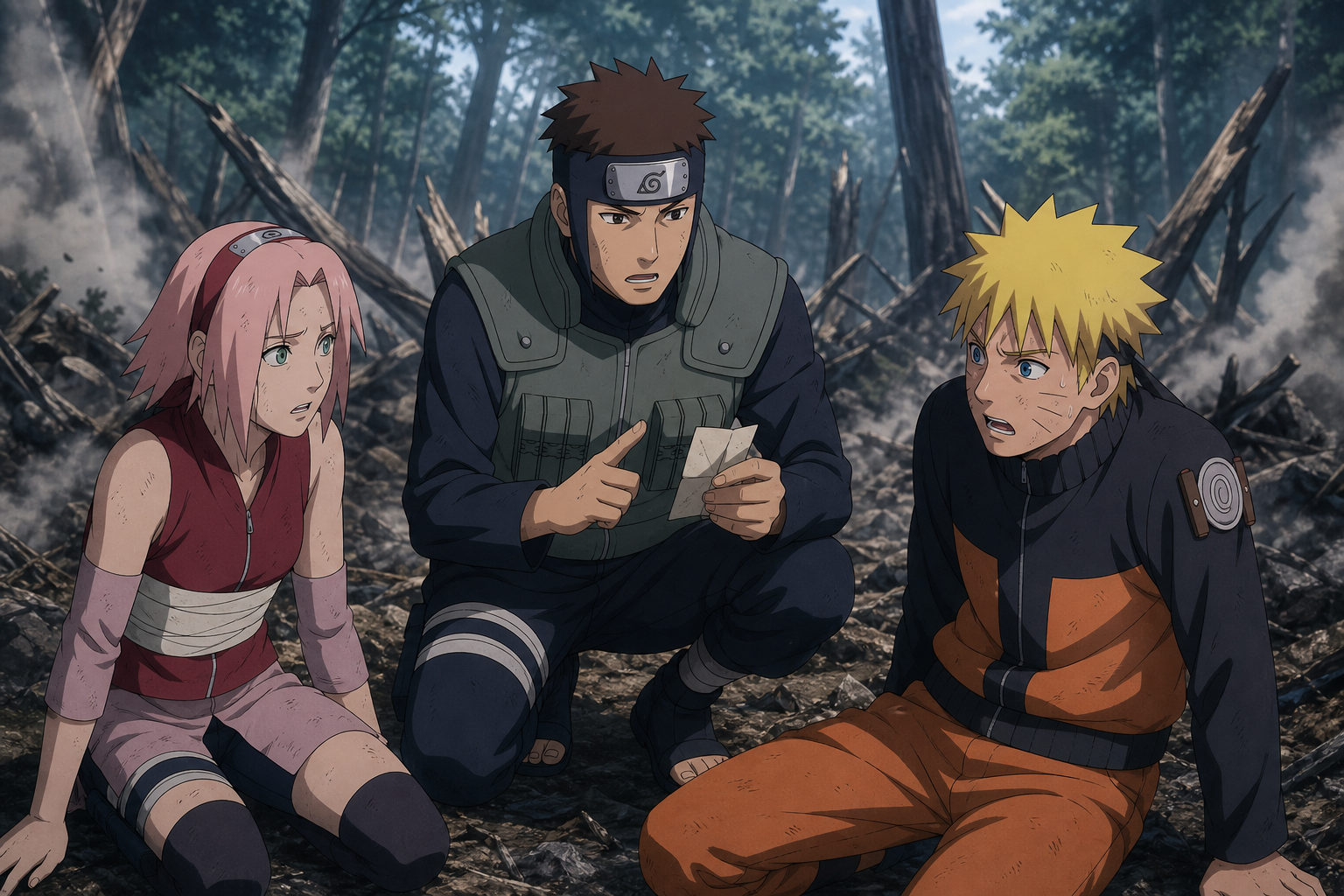
Episode 45 begins with a necessary correction. Sai's private exchange with Orochimaru looked like the central betrayal, but Yamato's explanation reveals a deeper problem: Sai may be carrying out Danzo's plan to cooperate with Orochimaru against the Leaf Village. The danger is no longer one teammate slipping away. It is a conflict inside the village reaching directly into Team Kakashi's mission.
Naruto and Sakura react with shock because the possibility violates the foundation they thought they were defending. Orochimaru attacked the Leaf, killed the Third Hokage, and took Sasuke. Treating him as a usable partner turns those losses into bargaining chips. Danzo's strategy may call itself protection, but it asks everyone else to accept that loyalty can be suspended whenever power seems useful.
Yamato gives the team truth without pretending it is complete
Yamato does not know every detail of Danzo's arrangement. What he has is observation, experience with covert operations, and enough evidence to identify the likely stakes. He explains what Sai's documents may mean while keeping the difference between fact and inference visible.
That distinction is good leadership. Panic would flatten every uncertainty into certainty, while denial would minimize an obvious threat. Yamato does neither. He gives Naruto and Sakura the clearest version of the situation available, then turns that knowledge into a plan. The team can act without lying to itself about what remains unknown.
Naruto has to hear this while confronting his own damage
Naruto wakes after losing control without a full memory of what happened. His first instinct is still to continue toward Sasuke, but Sakura's injury and Yamato's account make the cost of the previous battle impossible to ignore. The promise driving Naruto forward did not protect Sakura when the Nine-Tails took over.
That makes Danzo's betrayal land beside a more personal reckoning. Naruto is furious at a leader willing to endanger the village through secrecy, yet he has also endangered a teammate through power he could not govern. The motives are different, but both situations show why intention cannot replace responsibility.
The episode does not use that parallel to equate Naruto with Danzo. It uses it to mature Naruto's idea of loyalty. Saving Sasuke cannot mean treating every consequence as acceptable. If Naruto wants his promise to represent care, he has to remain present enough to care for the people beside him too.
Sakura protects Naruto from guilt, but the silence has a price
Sakura does not immediately tell Naruto that he caused her injury. Her choice is compassionate. She can see how devastated he would be, and the team has little time before its trail disappears. Still, withholding the truth also delays the conversation Naruto needs if he is going to understand the danger of the Nine-Tails.
This is one of Sakura's recurring burdens: she tries to manage the emotions of everyone around her while carrying her own pain quietly. Medical competence makes that pattern easy to overlook. Because Sakura can stand, heal, and keep moving, other people may assume the harm has already been resolved. It has not. Healing a wound does not settle what caused it.
Danzo's version of loyalty depends on secrecy
Danzo presents himself as someone willing to do what softer leaders will not. Episode 45 exposes the weakness inside that claim. A policy that cannot survive the knowledge of the people it supposedly protects is not simply strong leadership. It is unaccountable power.
Working with Orochimaru may offer Danzo leverage, intelligence, or a weapon against political rivals. It also gives Orochimaru access to the village's internal fractures. Danzo assumes he can control the arrangement because he sees people as assets with assigned functions. Orochimaru operates by the same logic, which makes their possible partnership dangerous to everyone caught between them.
Sai is especially vulnerable because both men understand how to use a person who has been trained not to question the mission.
The pursuit becomes a test of method
Team Kakashi still has a reason to follow Sai. Orochimaru's hideout may lead them to Sasuke, and Yamato's Wood Clone gives them a way to track the group without immediately exposing themselves. But the mission can no longer be framed as a straightforward reunion attempt.
They are now entering territory shaped by competing secret orders. Yamato must balance the chance to find Sasuke against the possibility that Sai is facilitating an attack on the Leaf. Naruto and Sakura must pursue someone they cannot trust while recovering from a battle that showed how fragile their own teamwork remains.
The answer is not blind faith. It is controlled observation, shared information, and a willingness to revise the plan when evidence changes.
Sai's absence says what his false smile could not
Sai is not present for the team's discussion, but every part of it revolves around his choice. That absence matters. Earlier episodes invited the audience to wonder whether his awkwardness concealed a good person learning how to connect. Episode 45 does not erase that possibility, but it refuses to let potential growth excuse current harm.
Sai left without warning, transferred protected material, and entered Orochimaru's custody. Whatever private conflict he may feel, his teammates have to respond to what he did. Trust cannot be built from the person someone might become. It has to account for the decisions they are making now.
RaeRae's reaction
I love that the episode makes betrayal feel institutional instead of reducing it to one suspicious new teammate. Sai is responsible for his actions, but Danzo designed the secrecy around him. That changes the question from “Can Sai be trusted?” to “What kind of system taught him that this was loyalty?”
Naruto and Sakura's shock also feels earned. They have been risking themselves to bring Sasuke back from Orochimaru, only to learn that someone inside their own village may be treating Orochimaru as a strategic partner. It is hard not to hear the contempt inside that calculation. Their grief, the Third Hokage's death, and Sasuke's exploitation become acceptable costs to a man who believes his hidden plan matters more than consent.
Yamato is the stabilizing force again. He tells them enough to understand the danger without turning uncertainty into melodrama. After two episodes driven by uncontrolled power and concealed orders, his steady reasoning is exactly what keeps the mission from breaking apart.
Consequences begin before anyone reaches the hideout
The episode's title is plural for a reason. Sai's decision damages the team's trust. Danzo's plan threatens the village he claims to serve. Naruto's transformation leaves Sakura injured and Naruto ashamed even before he knows the full truth. Every concealed choice creates work someone else must do.
Following Sai may still bring Team Kakashi closer to Sasuke, but they are no longer chasing only a missing friend. They are chasing the consequences of a political bargain, a damaged team, and a mission built from incomplete information. The hideout will not simply reveal where Sasuke is. It will reveal what each person is willing to sacrifice to reach him.
Official episode reference: Naruto Official episode guide
Licensed episode route: Crunchyroll licensed episode page
Betrayal begins when one mission borrows another team’s trust
Sai’s exchange with Orochimaru is the visible act, but the betrayal began earlier. It began when Danzō placed Sai inside Team Kakashi while withholding the purpose that would eventually outrank their shared safety.
Naruto and Sakura did not merely fail to discover a secret. Their willingness to work with a replacement teammate was used as camouflage. Yamato’s authority was made conditional by information kept above and outside his command.
The consequence is not only suspicion of Sai. It is the realization that official structures can look unified while powerful people conduct private policy through them.
Yamato tells the truth at the speed the team can use it
He does not unload every fear as though speculation were evidence. He explains what he saw, what Danzō’s possible alliance could mean, and why following Sai remains strategically necessary.
That pacing respects Naruto and Sakura as participants rather than emotional liabilities. They need enough truth to understand the danger and enough clarity to keep moving.
Leadership does not require certainty before communication. It requires marking the boundaries between observation, inference, and unanswered questions so the team can make decisions without being manipulated by either panic or false reassurance.
Naruto wakes with urgency but without the missing hours
His body is exhausted, the landscape is destroyed, Sakura is injured, and Sai is gone. Naruto has to reconstruct the event from consequences because the four-tailed state did not preserve his conscious memory.
That makes his instinct to resume pursuit understandable. Action offers escape from the unbearable gap between what he intended and what apparently occurred.
Moving quickly cannot replace knowing. If Naruto continues without understanding the transformation, Orochimaru can use Sasuke’s name as the same trigger again. The team needs urgency and an honest safety reckoning, not one at the expense of the other.
Sakura’s silence protects Naruto from pain and from information
She hides the source of her wound because she knows guilt could crush him. Her compassion is real. The choice also keeps Naruto from learning the most personal evidence of how far his control disappeared.
This is not a simple demand that Sakura confess immediately. She is injured, frightened, and still processing what happened. She does not owe perfect emotional management while the mission clock runs.
The problem is the pattern in which Sakura absorbs pain to keep other people functional. Silence may stabilize the next hour while making later trust harder. Somebody will eventually have to tell Naruto, and Sakura deserves support in deciding how.
Protecting someone’s feelings can become another form of managing them
Naruto cannot participate in preventing future harm if crucial facts about his own body are withheld. The decision to spare him also decides what he is allowed to know.
Care sometimes requires timing and gentleness. Care cannot indefinitely substitute another person’s judgment for his. Naruto needs the opportunity to respond, accept boundaries, and help build the containment plan.
The distinction rests in whether silence creates a path toward honest conversation or becomes the permanent price of keeping peace.
Danzō treats historical grief as reusable material
Orochimaru attacked Konoha, killed the Third Hokage, experimented on children, and continues preparing Sasuke’s body as a vessel. Any proposed cooperation carries those facts into the room.
Danzō’s approach asks the village to treat that history as negotiable if the current advantage appears large enough. Other people suffered the losses. He reserves the power to decide those losses can be converted into leverage.
Strategic language does not neutralize the contempt. A leader cannot claim to protect a community while privately bargaining with the person who produced its grief and denying the community any knowledge of the bargain.
Danzō and Orochimaru speak the same language of usefulness
They differ in goals and institutional position, but both reduce people to functions. Sai is a courier and access point. Yamato is the surviving result of an experiment. Sasuke is a future vessel. Naruto is a jinchuriki whose instability can be studied or contained.
Cooperation becomes possible because neither man needs to agree that the other is trustworthy. They only need overlapping use.
A partnership built on mutual exploitation may eventually collapse, but the people treated as resources can be harmed long before that collapse arrives.
Sai may be loyal according to the wrong definition
From Root’s perspective, he is not betraying his duty. He is fulfilling it. Team Kakashi was the cover assignment, and Danzō’s order was the real obligation.
That does not erase Sai’s responsibility. It reveals why loyalty cannot be evaluated only by consistency or sacrifice. A person can obey faithfully inside a structure asking him to betray everyone outside it.
The moral question is not whether Sai can follow orders under pressure. Root has proven that. The question is whether he can judge an order against human consequences and choose differently.
Naruto’s anger at Sai contains recognition he has not reached yet
Naruto cannot tolerate a teammate abandoning bonds for a secret objective. His entire identity is organized around refusing to abandon Sasuke.
The anger is justified, but the preceding battle complicates it. Naruto also lost access to the bonds guiding him and injured Sakura. Sai surrendered relationship through controlled obedience. Naruto surrendered it through uncontrolled chakra.
The parallel does not make their choices equal. It gives Naruto a reason to understand that loyalty requires more than fierce feeling. Loyalty must remain present in the methods used to pursue it.
Sakura’s injury should remain visible in the plan
Her ability to stand and continue does not mean the team has returned to baseline. She is carrying physical pain and the knowledge that Naruto caused it while unaware.
A mission culture can turn recovery into a performance: if someone can move, everyone behaves as though care is complete. Sakura’s medical status, emotional state, and consent to continue should matter beyond whether she can keep pace.
Yamato’s planning is strongest when it treats the people available now, not idealized versions untouched by the last encounter.
The Wood Clone makes pursuit possible without pretending trust exists
Yamato’s surveillance technique gives the team distance, evidence, and a route into Orochimaru’s territory. They do not have to accept Sai’s intentions to use the trail he creates.
This is an important distinction for a story about bonds. Trust is not mandatory when evidence supports cautious action. Forgiveness is not a prerequisite for investigation.
The team can pursue Sasuke, monitor Sai, and remain alert to Danzō’s agenda at the same time. Complexity does not require emotional confusion if the plan names each risk clearly.
The Leaf is not one moral actor
Naruto often speaks of protecting the village as though Konoha possesses a single will. Episode 45 exposes competing authorities, histories, and visions operating under the same symbol.
Tsunade sends a team to recover intelligence and protect its members. Danzō inserts a covert objective that may involve the village’s enemy. Both actions come from inside Konoha.
Loving a community cannot mean obeying every official who claims to embody it. Sometimes protecting the village requires confronting power exercised in the village’s name.
The consequences reach people who never approved the risk
The Third Hokage cannot consent to his killer becoming a strategic contact. The families affected by Orochimaru’s invasion have no seat in Danzō’s calculation. Yamato was never asked whether his abuser should become a partner.
Secret policy concentrates decision-making while distributing harm. The person who chooses receives potential advantage. Everyone else inherits exposure and moral cost.
That distribution is why secrecy is not merely a plot device. It is the mechanism that prevents the affected from interfering with the plan.
Finding Sasuke now means entering two traps at once
Orochimaru’s hideout is an obvious physical trap. Team Kakashi expects surveillance, ambush, and manipulation. Danzō’s hidden agenda creates a second trap inside their own assumptions.
If the team treats every clue as part of the rescue mission, it may unknowingly advance Root’s purpose. If it rejects the trail because Root contaminated it, Sasuke remains beyond reach.
Yamato has to navigate both by keeping information shared inside his remaining team and refusing to let urgency erase skepticism.
Betrayal produces labor long after the act
Sai’s exchange took moments. The response requires surveillance, medical care, explanation, revised planning, emotional containment, and pursuit through enemy territory.
This imbalance is common. Betrayal feels efficient to the person committing it because the betrayed perform the work of making life possible afterward.
Danzō’s strategy looks decisive only because Team Kakashi absorbs the repair costs he excluded from his calculation.
A shared plan is the first repair betrayal requires
Yamato cannot restore trust by ordering Naruto and Sakura to feel differently about Sai. He can restore a workable foundation by sharing what he knows, inviting them into the risk calculation, and making the next objective explicit. Danzō created the fracture through unequal information. Yamato begins repairing it through common knowledge.
The team remains hurt and suspicious, but nobody has to guess what success currently means: follow the trail, locate Sai, assess the alliance, protect one another, and preserve the chance to reach Sasuke.
RaeRae’s full take
The title says consequences, plural, because nobody gets to put this on Sai alone and call the problem solved. Sai handed over the packet. Danzō built the mission that made betrayal look like loyalty. Orochimaru recognized an opening. Team Kakashi gets every bill.
I appreciate Yamato refusing to lie just because the truth is incomplete. He tells Naruto and Sakura what he observed, marks what he suspects, and creates a plan that does not require trusting Sai. That is leadership with receipts.
Sakura hiding the wound hurts because I understand every reason. Naruto is already exhausted and would drown in guilt. She also should not have to make herself smaller so he can keep moving. Her pain is not an obstacle to the mission. It is part of the truth the mission must account for.
Naruto’s anger at Danzō is right. A man does not get to bargain with Orochimaru in everyone else’s name after Orochimaru killed, experimented, manipulated, and stole from the village. Calling the deal strategy does not clean it.
Sai is still responsible. Conditioning explains why he can leave people in crisis and call obedience discipline. Explanation becomes meaningful only if it eventually helps him choose against the conditioning.
The Leaf has spent years asking young people to prove loyalty through sacrifice. Episode 45 asks the question the adults avoid: loyalty to whom, decided by whom, and paid for with whose body?
RaeRae checkpoint: Sai committed the visible betrayal, but Danzō designed the arrangement. Accountability has to follow the hand carrying the packet and the authority that decided everyone else’s trust was expendable.
Receipts and official routes
- Episode placement, Yamato’s briefing, Danzō’s suspected cooperation with Orochimaru, and Team Kakashi’s pursuit decision: Naruto Official Site episode guide.
- Licensed episode route: Crunchyroll.