
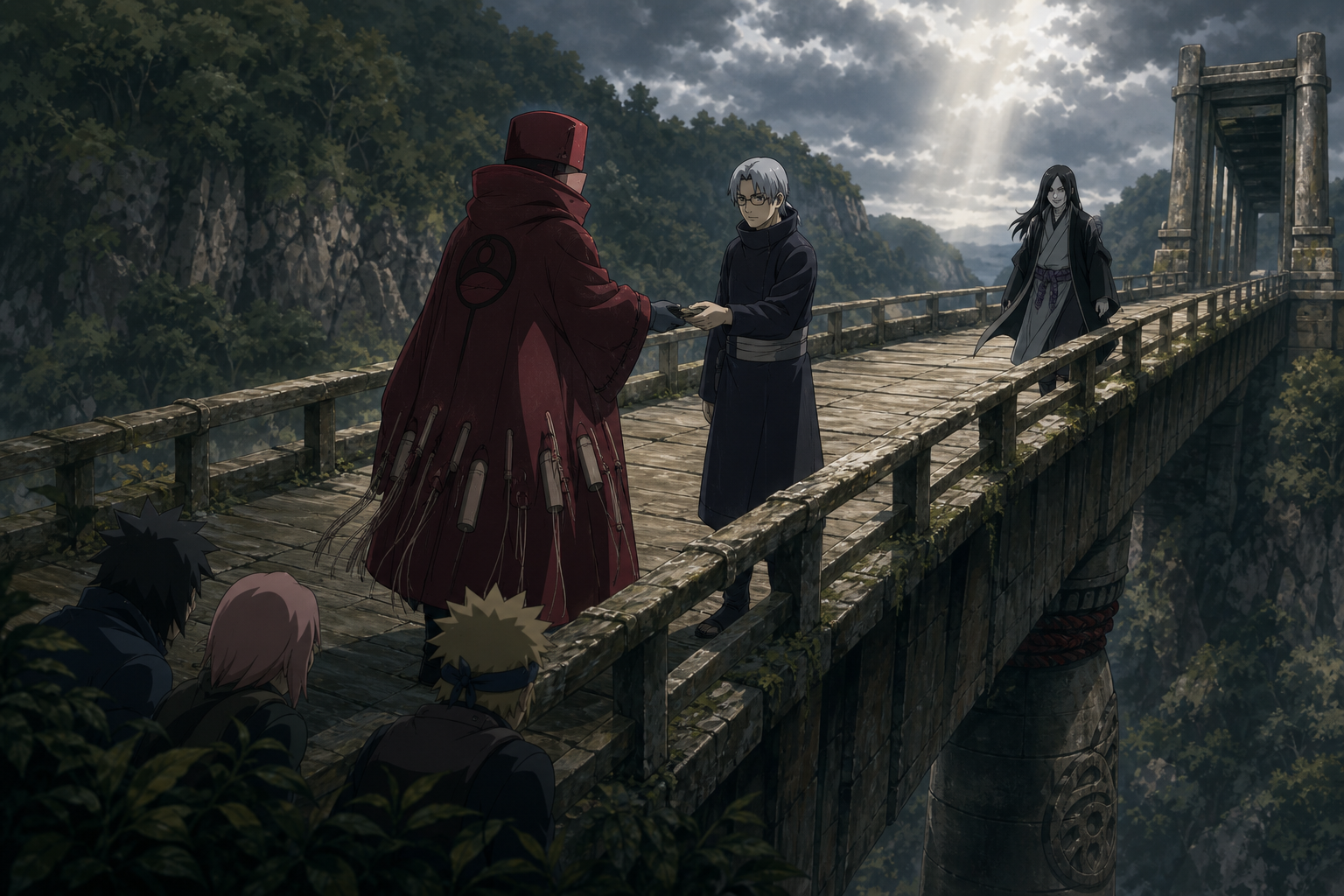
The Tenchi Bridge
The bridge connects every lie in the operation and drops Orochimaru in the middle.
Every lie arrives at the same bridge
Episode 39 brings the Tenchi Bridge operation out of rehearsal and into the field. Yamato assumes Sasori’s appearance and approaches the rendezvous alone. Naruto, Sakura, and Sai remain concealed, waiting for a signal and trying to behave like the coordinated team the simulation proved they are not.
The spy arrives, and the reveal immediately changes the meaning of the mission. Kabuto, Orochimaru’s closest visible aide, is the person Sasori believed he controlled inside the organization. His presence confirms that the intelligence was real while raising a more dangerous question: whose agent is Kabuto now?
Before Yamato can turn the meeting into a clean capture, Orochimaru appears. The secret exchange becomes an exposed trap. A bridge that was supposed to connect Team Kakashi to information about Sasuke instead connects every deception in the operation.
Yamato’s disguise is technically perfect and strategically fragile
Yamato’s transformation into Sasori is the visible center of the plan. He has to reproduce more than a face. Kabuto knew Sasori as a superior and handler. The posture, voice, expectations, and rhythm of the exchange all have to survive scrutiny.
The disguise demonstrates why preparation mattered. Yamato approaches alone because additional figures would change the scene. The others remain hidden because the spy must believe Sasori still controls the rendezvous. Every member has a position designed to protect the performance.
Yet the best disguise cannot compensate for information the team does not possess. Yamato can imitate Sasori. He cannot know everything Sasori and Kabuto shared privately. He cannot know whether Kabuto remains under Sasori’s influence, has broken it, or has been feeding information in both directions.
Espionage fails at the boundary between appearance and knowledge. Yamato has the appearance. Orochimaru arrives with the knowledge needed to expose the lie.
Kabuto belongs wherever he can remain useful
Kabuto’s identity is a perfect fit for the episode because he has spent his life moving between systems. He can appear loyal to a village, a handler, or a master while preserving a private layer beneath each role.
Sasori believed Kabuto was his spy near Orochimaru. Orochimaru treats Kabuto as a trusted subordinate. The Hidden Leaf remembers him as a familiar participant in the Chūnin Exams before his allegiance became clear. Each version contains enough truth to function.
That adaptability makes Kabuto dangerous in a way straightforward enemies are not. He does not merely hide information. He creates belonging. People accept him inside a structure long enough for him to learn how it works.
Sai’s false smile has already taught New Team Kakashi to distrust performance, but Kabuto represents a far more advanced version. Sai’s social imitation feels artificial. Kabuto can make deception feel natural because he understands what each audience expects.
The bridge meeting therefore places the team in front of the kind of operative it is least prepared to read.
Orochimaru turns the operation into theater
Orochimaru does not simply attack from hiding. He enters the meeting with the confidence of somebody who wants everyone to understand that the trap belongs to him. His presence strips away the quiet intelligence operation and replaces it with open psychological pressure.
This is one of Orochimaru’s defining habits. He treats information as a stage. He reveals only enough to destabilize the other person, then watches the reaction. Naruto’s attachment to Sasuke gives him an obvious subject. Yamato’s disguise gives him an obvious humiliation. Kabuto’s role gives him an obvious demonstration of control.
The interruption proves that Team Kakashi was never operating alone. They followed Sasori’s lead, but Orochimaru had time to discover or anticipate the rendezvous. The bridge is not neutral ground. It is a place where Orochimaru can expose the mission while controlling the emotional terms of the confrontation.
His arrival also collapses the distance between Naruto and the person holding Sasuke. The lead is no longer abstract. Orochimaru is standing within reach, and that proximity threatens Naruto’s control before the fighting even begins.
The bridge connects more than two sides
Bridges usually promise passage. Tenchi Bridge is supposed to carry the team from uncertainty toward Sasuke’s location. Instead, it becomes an intersection of competing loyalties.
Yamato answers to Tsunade and the official mission. Naruto and Sakura answer to that mission while carrying their personal commitment to Sasuke. Sai stands with them physically while remaining connected to Danzō’s hidden objective. Kabuto arrives through Sasori’s intelligence while serving Orochimaru. Orochimaru controls the trap and Sasuke’s current environment.
No person on the bridge belongs to only one purpose. That complexity is why the operation cannot be reduced to heroes catching a spy. Every participant has information the others need and motives the others cannot fully see.
The structure of the bridge makes the tension visible. Two ends suggest two sides, but the meeting creates far more than two alignments. Everyone is crossing between official roles and private commitments.
Concealment tests the new team’s discipline
Naruto, Sakura, and Sai have to remain hidden while Yamato conducts the exchange. For Naruto, waiting is its own test. The mission finally places him close to a path toward Sasuke, yet he cannot rush forward without destroying the plan.
Sakura understands the cost of premature movement. She helped secure Sasori’s information and knows how rare the opportunity is. Her discipline has to hold even when Kabuto’s identity and Orochimaru’s arrival make the situation personal.
Sai’s concealment carries another uncertainty. The official plan tells him when to move, but his private orders may define a different priority. The simulation showed he will abandon a teammate to complete the objective he recognizes. The others do not know whether they recognize the same objective now.
Yamato’s signals and contingencies give the team a shared framework, but the bridge proves why procedure cannot replace trust. A signal only works if everyone intends to answer it for the same reason.
Sasori’s last intelligence remains valuable even inside a trap
Orochimaru’s intervention does not make Sasori’s information false. Kabuto appears at the appointed place and time. The lead succeeds in bringing Team Kakashi into contact with exactly the network they sought.
The problem is that intelligence can be accurate and still dangerous. Knowing where a person will appear does not reveal who controls the encounter. Sasori’s death froze his understanding at one moment. Kabuto and Orochimaru continued acting after that moment.
This distinction matters throughout espionage stories. Information is not a guarantee. It is a snapshot that must be interpreted inside changing relationships.
Team Kakashi reaches the correct bridge and meets the correct spy. They still walk into an operation Orochimaru is ready to disrupt. Accuracy gets them to the scene. Judgment determines whether they survive it.
The long-awaited reunion starts with the wrong person
Naruto wants Sasuke, but the bridge delivers Orochimaru. That substitution is emotionally brutal. Orochimaru represents everything Naruto believes stands between Sasuke and home. He is the adult who exploited Sasuke’s grief, offered power, and turned departure into dependency.
Seeing him makes the search immediate in the worst possible way. Naruto no longer has to imagine the force influencing Sasuke. It has a face, a voice, and the confidence to speak as though Sasuke belongs to it.
The arc title promises a reunion, but Episode 39 delays it through confrontation with the person who shaped the separation. Naruto has to face what Orochimaru’s presence does to his control before he can face Sasuke himself.
That is why the bridge matters beyond plot mechanics. It is the threshold where pursuit becomes exposure. Naruto is close enough to the truth for the truth to hurt him directly.
RaeRae’s reaction
Kabuto being the spy is one of those reveals that makes perfect sense and solves almost nothing. Of course he can occupy multiple loyalties. That is his entire skill set. The important question is never whether Kabuto is lying. It is which layer of the lie is useful to him right now.
Yamato deserves credit because the operation is disciplined. The disguise, concealed positions, and controlled approach all reflect serious preparation. The failure does not come from laziness. It comes from Orochimaru possessing information the team could not reproduce.
I love the bridge as a setting because it makes everybody look like they should belong to one side or the other while the actual loyalties are tangled. Sai stands with the Leaf team and carries Danzō’s agenda. Kabuto approaches from Orochimaru’s side through a connection to Sasori. Naruto follows Tsunade’s mission for a promise no order created.
Orochimaru’s entrance is infuriating because he enjoys taking control of the scene. He does not need to shout. He knows Naruto will react to any suggestion that Sasuke is his possession. The trap is psychological before it becomes physical.
This is also where the previous episodes earn their place. Yamato rehearsed the team because the bridge leaves no room for improvised trust. Sai’s false smile and hidden book taught us that appearances conceal different kinds of truth. Naruto’s repeated anger showed exactly which subject Orochimaru can weaponize.
The operation fails as a quiet capture, but it succeeds in bringing every hidden problem into one location. That is terrible for the team and excellent for the story.
The bridge does not deliver passage, only exposure
By the end of Episode 39, Yamato’s disguise is compromised, Kabuto’s position is more complicated than Sasori’s label suggested, and Orochimaru has turned the rendezvous into confrontation.
The team is closer to Sasuke geographically and farther from a controlled outcome. Naruto’s discipline is about to face its most dangerous test. Sai’s hidden agenda remains active. Sakura and Yamato must manage an enemy operation and the threat inside Naruto at the same time.
Tenchi Bridge connects the team to the people they sought, but connection is not safety. Sometimes a bridge only ensures that every lie can reach you at once.
Official episode reference: Naruto Official episode guide
Licensed episode route: Crunchyroll licensed episode page
The bridge turns every direction into exposure
Tenchi Bridge offers no comfortable room for improvisation. Yamato has to stand in the open as Sasori while Naruto, Sakura, and Sai watch from concealment. Kabuto approaches across a narrow route where any wrong movement can collapse the disguise.
The location makes the intelligence exchange visible and still impossible to read completely. Everyone can see the meeting. Nobody knows who controls it.
Yamato impersonates a dead man whose authority still works
Sasori is gone, but Kabuto expects his voice, posture, and command relationship. Yamato borrows that identity because the dead Akatsuki member left behind access no living Leaf operative possesses.
The disguise proves that institutional power can survive the person who held it. Kabuto responds to the role before he can verify the body inside it.
Kabuto arrives as a spy with divided ownership
Sasori believed Kabuto worked under a technique that secured obedience. Orochimaru has his own hold over Kabuto. The Leaf team hopes the meeting will produce independent intelligence.
Every side describes Kabuto through who controls him. The episode keeps the more difficult question open: what does Kabuto choose when multiple systems claim his loyalty?
Intelligence obtained through coercion carries hidden failure points
Sasori’s method assumed a controlled agent would remain predictable. Orochimaru’s intervention exposes the weakness. A person manipulated by one power can be manipulated, persuaded, or reclaimed by another.
Control creates information that looks reliable until the controlled person’s circumstances change outside the controller’s view.
Yamato has to perform confidence while managing incomplete facts
He cannot ask Kabuto openly whether the trap has changed. He must maintain Sasori’s authority, extract information, monitor the hidden team, and prepare for violence.
This is leadership under concealment. Any hesitation may expose him, but false certainty can walk everyone deeper into danger.
Sakura watches a possible route toward Sasuke become unstable
The bridge contact matters because it may connect Orochimaru’s network to Sasuke. Sakura has to remain hidden while the person carrying that possibility meets the disguised captain.
Waiting becomes active discipline. Moving too early could destroy the only intelligence route they have.
Naruto’s chakra reacts before the mission can absorb the surprise
Orochimaru’s appearance brings Sasuke’s captor into view. Naruto’s anger and Nine-Tails chakra begin rising because the enemy is no longer an abstract target.
The reaction is emotionally inevitable and tactically dangerous. The whole operation depends on concealment, and Naruto’s body is becoming a signal nobody can ignore.
Orochimaru arrives because he expects deception
He does not stumble onto the exchange. His presence tells the team that their plan exists inside another person’s planning. Kabuto’s role, Sasori’s absence, and the bridge meeting have already been assessed from the other side.
A trap becomes most effective when the target still believes it is conducting surveillance.
Sai’s hidden orders gain new weight near Orochimaru
The team already knows Sai is difficult to read. They do not know the mission Danzō placed beneath Tsunade’s mission. Orochimaru’s arrival creates the exact environment where secret objectives can split a team.
Operational trust cannot survive indefinitely when members answer to authorities the others cannot see.
The bridge is named for heaven and earth, but the politics live underneath
Its grand name contrasts with the covert bargains taking place on it. Akatsuki, Root, Orochimaru, and the Hokage’s team all send representatives or consequences into one narrow space.
The visible confrontation rests on years of hidden programs, experiments, defections, and manipulated loyalties.
Kabuto’s calm is not proof that he lacks fear
He has survived by becoming useful, adaptable, and difficult to classify. Meeting Sasori should activate one relationship of control. Arriving with Orochimaru signals another.
Reading his composure as emotional emptiness would repeat the mistake people make with Sai. Performance reveals training before it reveals the whole person.
Yamato’s disguise tests more than transformation skill
Looking like Sasori is only the outer requirement. Yamato must reproduce the social hierarchy Kabuto expects, including authority, impatience, and knowledge he may not possess.
Disguise succeeds through relationship patterns, not appearance alone. One wrong assumption about how Sasori treated Kabuto could expose the operation.
The hidden team must decide when observation becomes abandonment
Naruto, Sakura, and Sai are ordered to wait for Yamato’s signal. If the situation turns lethal before that signal arrives, obedience may leave their captain isolated.
Good teamwork requires knowing when a plan’s conditions have changed enough to justify action. That judgment cannot be automated.
Orochimaru turns Sasuke into leverage without bringing him to the bridge
He knows Naruto and Sakura came because Sasuke matters. The missing boy shapes their reactions while remaining physically absent.
This is how leverage works. A person does not need to be present when everyone’s fear, hope, and guilt already organize the room around him.
The mission’s success criteria change in real time
The original goal was contact, intelligence, and a route toward Sasuke. Once Orochimaru appears, survival, identity protection, and containment of Naruto’s chakra become equally urgent.
Plans fail when teams protect the original checklist after reality has rewritten the problem.
The bridge reveals why the simulation mattered
Yamato needed to know whether Sai would prioritize an objective over teammates and whether Naruto could control reactions tied to Sasuke. Both concerns now sit inside an enemy trap.
The practice did not fix the team. It gave the captain evidence about the failures most likely to become fatal.
The intelligence route was compromised before Team Kakashi arrived
The Leaf team approaches the bridge as if timing and disguise can preserve Sasori’s old arrangement. Orochimaru’s presence reveals that the arrangement has already changed somewhere outside their view. No amount of flawless acting can restore information that is no longer current.
This is the danger of inherited intelligence. A source can be accurate when obtained and still become lethal after loyalties shift, handlers die, or another organization discovers the channel. Sasori’s final disclosure gave Team Kakashi a route, not ownership of the conditions surrounding it.
Yamato therefore has to recognize when completing the original plan would become obedience to a dead premise. Staying in character may produce another sentence from Kabuto, but it may also keep him exposed while Orochimaru studies the disguise. Good intelligence work includes knowing when the collection opportunity has turned into enemy collection.
Kabuto’s position cannot be understood through one label
Spy, subordinate, medical ninja, prisoner of influence, and willing collaborator may all describe parts of Kabuto’s history. Choosing one label too early makes his behavior look inconsistent when the inconsistency belongs to the competing systems around him.
That ambiguity does not remove accountability. It tells the team what kind of evidence they need. Who gives orders? What does Kabuto conceal from Orochimaru? Which actions protect himself, and which advance a project he has chosen? The bridge supplies a confrontation before it supplies those answers.
RaeRae’s full take
Tenchi Bridge is a perfect intelligence location if your goal is to place every unresolved trust problem over open water and invite Orochimaru to inspect it. Yamato performs Sasori while Kabuto performs obedience and the hidden team performs patience. Everybody has a mask. Nobody has complete control.
Kabuto is treated like property by every organization discussing him, which is exactly why assuming ownership makes the intelligence fragile. Sai carries another hidden authority into the bushes. Naruto’s body starts announcing the Sasuke wound before he says a word.
The trap is not only that Orochimaru appears. The trap is that New Team Kakashi arrived with enough secrecy inside its own formation for the enemy to widen every fracture. Yamato can maintain the disguise for only so long. After that, the team has to prove it learned something from the simulation.
RaeRae checkpoint: A bridge connects two sides and exposes everyone crossing it. At Tenchi Bridge, the most dangerous gap is between the mission each teammate was given and the mission the others know about.
Receipts and official routes
- Episode placement, Yamato’s Sasori disguise, Kabuto’s contact, and Orochimaru’s arrival: Naruto Official Site episode guide.
- Licensed episode route: Crunchyroll.