
An Unnecessary Addition
Yamato makes the team’s internal danger part of the mission plan.
Yamato stops pretending this is a normal team
Episode 35 begins with the conflict New Team Kakashi carried out of its first meeting. Naruto learns that Sai attacked him to test his strength, and the explanation makes him angrier rather than calmer. Sai treats the admission as if it were a neutral mission detail. Naruto hears proof that the new teammate has been measuring him from the beginning.
Sakura pulls them apart, but the pause does not solve anything. Sai has already attacked Naruto, mocked Sasuke, and entered the team through Danzō. Naruto has already decided that Sai is an intruder. Sakura can interrupt the next punch. She cannot create trust between two people who understand each other’s behavior as a threat.
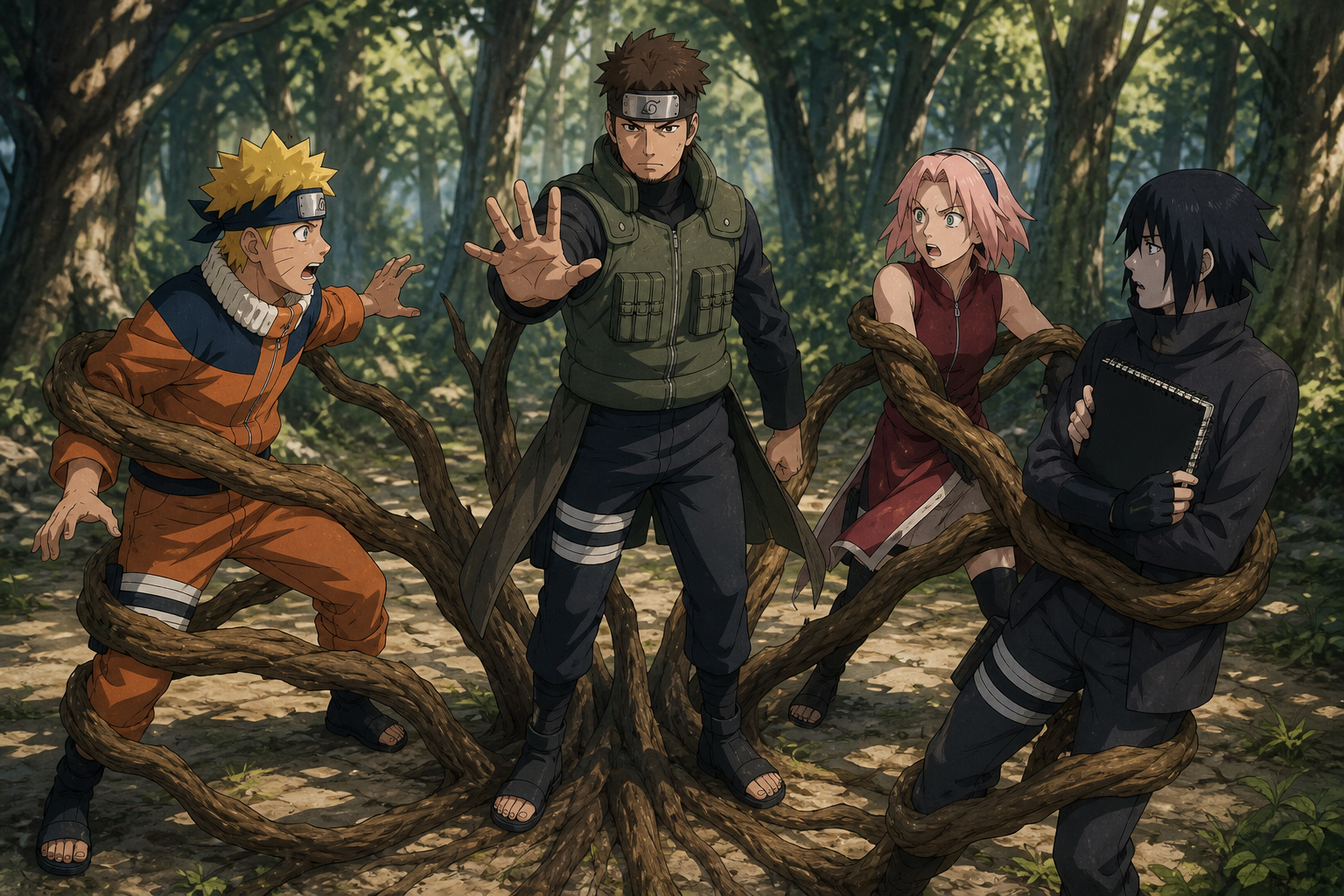
Yamato responds by abandoning the idea that goodwill will appear on its own. When the argument overwhelms the mission briefing, he uses Wood Release to restrain Naruto, Sakura, and Sai. The moment is funny because of his terrifying expression, but the authority behind it is real. This team will function, and Yamato is prepared to make cooperation a physical condition if words fail.
The test was never harmless
Sai’s decision to attack Naruto before their formal assignment says a great deal about how Root operates. He does not approach a potential teammate through conversation. He gathers information by provoking a response. Strength, speed, temperament, and attachment all become data.
Naruto’s reaction confirms several things at once. He is quick to defend his friends, especially Sasuke. He will pursue conflict when angered. He does not separate an insult from the person being insulted. For Sai, those may be weaknesses to record. For Naruto, they are evidence that his bonds are real.
The difference is moral as much as tactical. Root values a shinobi who can complete an order without emotional interference. Naruto’s greatest victories have come from refusing to treat emotion as interference. His loyalty has changed enemies, saved allies, and given him power when calculation alone would have failed.
Sai therefore tests the exact quality that makes Naruto himself. The problem is not merely that he provokes Naruto. It is that he approaches attachment like a flaw to be exploited.
Wood Release establishes a different kind of captain
Yamato’s Wood Release immediately separates him from Kakashi. Kakashi could dominate the original Team 7 through experience, speed, and psychological insight. Yamato can change the physical space around the team. Trees and restraints emerge where he needs them, turning the environment itself into his command.
That ability matters specifically because Naruto is the Nine-Tails jinchūriki. Kakashi relied on a suppression tag provided by Jiraiya during the previous mission. Yamato’s unique power offers a more direct means of containing the Nine-Tails’ chakra. Tsunade did not select him only because Kakashi needed a substitute. She selected a captain whose abilities match the greatest internal risk on the assignment.
The story lets the explanation sit beneath the humor. Yamato’s frightening face becomes a quick way to silence the group, but his real warning is that he can restrain them. He does not need Naruto and Sai to like him. He needs them to understand that their feud will not be allowed to endanger the mission.
This is leadership by containment before it can become leadership by trust. The team has no shared history with Yamato, so he establishes boundaries first. Whether affection ever follows is secondary to reaching Tenchi Bridge alive.
The team’s internal danger belongs in the mission plan
Sasori’s intelligence creates a narrow objective: meet Orochimaru’s spy at Tenchi Bridge and use the contact to locate Orochimaru and Sasuke. On paper, the danger lies outside the team. The spy may be hostile. Orochimaru may discover the operation. The rendezvous may be a trap.
Episode 35 insists that the internal danger is equally real. Naruto’s anger can destabilize the Nine-Tails’ chakra. Sai may answer to orders the others have not seen. Sakura is caught between defending Naruto, defending Sasuke, and preserving the mission. Yamato has authority but no established relationship with any of them.
A competent captain has to plan for both categories of threat. Yamato cannot assume everyone will become professional once they leave the village. Their hostility is already shaping decisions before the mission begins.
That is why his intervention is more than discipline. He is demonstrating the chain of command and showing that he has accounted for their volatility. Naruto and Sai may continue to hate each other. They may not turn that hatred into a tactical weakness.
“Unnecessary” depends on who gets to define the team
The episode title reflects Naruto’s view of Sai. If Sasuke is still a member of Team 7 in Naruto’s heart, then Sai is not merely a temporary addition. He is an unnecessary one. The team should be finding Sasuke, not filling his place.
From Tsunade’s perspective, however, the addition is necessary. Kakashi is hospitalized. A standard field team needs enough members to protect the mission. Sai possesses useful skills, and political pressure has already made his placement part of the arrangement.
From Danzō’s perspective, Sai may be the most necessary person there because he extends Root’s reach into a mission involving the jinchūriki and Orochimaru. The official goal and Danzō’s private interest overlap without being identical.
Sai himself appears to reject the emotional meaning of the question. He has an assignment. Whether Naruto considers him necessary has no bearing on the order. That detachment makes him look confident, but it also reveals how little personal agency Root expects him to exercise.
The title therefore exposes four competing definitions of necessity. Naruto defines the team through bonds. Tsunade defines it through operational need. Danzō defines it through control. Sai defines it through obedience.
Sakura cannot mediate forever
Sakura’s attempt to separate Naruto and Sai shows both her growth and the unfair role she is being pushed toward. She has become the person expected to translate emotional reality into mission discipline. Naruto will listen to her when he will not listen to Sai. Sai watches her reactions as carefully as Naruto’s. Yamato can impose order, but Sakura carries the history of the old team.
That makes her valuable and vulnerable. Every insult to Sasuke affects her too. She is not a neutral mediator, and asking her to behave like one ignores her own loss.
Her restraint in this episode should not be mistaken for softness. Sakura understands the stakes. Sasori’s lead may be their best chance to find Sasuke. If the group destroys itself before reaching the bridge, they waste the information Chiyo’s final mission helped make available.
She is therefore protecting something larger than the argument. The irony is that Sai’s contempt for Sasuke attacks the exact motivation holding Naruto and Sakura to the mission.
Yamato explains the objective without promising comfort
Once control is established, Yamato lays out the Tenchi Bridge operation. The team must intercept Sasori’s spy inside Orochimaru’s organization. The contact may lead them toward Orochimaru’s current hideout and, by extension, Sasuke.
The objective gives Naruto what he wants while forcing him into conditions he hates. He can pursue a real lead, but only under Yamato’s command and beside Sai. The village is offering movement without emotional reassurance.
That bargain defines the early Long-Awaited Reunion arc. Naruto cannot wait for the perfect team. Kakashi cannot recover faster because Naruto is impatient. Sai will not disappear because Naruto rejects him. The bridge rendezvous will not pause until everyone learns to communicate.
Yamato’s briefing makes the choice simple: cooperate imperfectly or lose the opportunity.
RaeRae’s reaction
Yamato’s scary face is hilarious, but I love that the joke works because everybody understands he is not bluffing. He does not walk into this disaster hoping friendship will bloom. He looks at three shinobi who are seconds from turning a mission briefing into a brawl and grows a physical boundary around them.
Honestly, that may be the healthiest leadership decision anybody makes in the episode. Naruto’s anger is understandable. Sai’s behavior is intentionally provocative. Sakura should not have to absorb the full responsibility for keeping them apart. Yamato steps in and makes the rule visible: personal conflict does not get to commandeer the mission.
Sai still bothers me because he treats the attack as a test instead of a violation. That is Root speaking through him. People are assignments, reactions are measurements, and pain is useful if it reveals a weakness. Naruto cannot explain why that worldview is wrong while he is trying to hit Sai, but the story has already shown the answer. Bonds are the reason Naruto keeps choosing people when institutions abandon them.
I also appreciate that the episode does not make Yamato a warmer copy of Kakashi. The team does not need a Kakashi impersonator. It needs someone capable of controlling Naruto if Orochimaru or Sasuke pushes him toward the Nine-Tails. Yamato’s difference is the point.
The title calls Sai unnecessary, but the episode quietly asks whether any of them can judge that yet. Sai is cruel and suspicious. He is also a person shaped by a system built to erase the very attachments Naruto defends. If this arc is going to change him, it cannot happen because the team pretends his behavior is harmless. It has to begin with boundaries.
The first rule of the new team
By the end of Episode 35, New Team Kakashi has not developed trust, but it has acquired a rule: the mission comes before their feud. Yamato enforces that rule with Wood Release because discussion alone cannot hold the group together.
It is a low starting point, yet it is real progress. The team now understands the objective, the chain of command, and the consequences of losing control. Naruto still considers Sai unnecessary. Sai still treats Naruto as a subject to test. Sakura still carries too much of the emotional mediation. Yamato still knows he may have to restrain the people he leads.
They are not ready in the comforting sense. They are ready in the only sense the deadline permits: they know where they are going, why it matters, and who will stop them if they sabotage themselves.
Official episode reference: Naruto Official episode guide
Licensed episode route: Crunchyroll licensed episode page
Yamato makes the first boundary impossible to ignore
Naruto, Sakura, and Sai keep treating the briefing space like an extension of their personal fight. Yamato answers with Wood Release, physically restraining all three before hostility can become mission failure.
The display is intimidating on purpose. He does not have Kakashi’s history with them, and calm suggestions have no foundation yet. His first task is to establish that nobody gets to sabotage the assignment merely because their feelings are real.
Containment is necessary and still not trust
Yamato can stop a punch, pin a body, and make the consequences of disobedience visible. None of that resolves Naruto’s grief, Sakura’s anger, or Sai’s contempt. Control creates a pause. The people inside the pause still need to choose what happens next.
The episode is strongest when it leaves that difference intact. A captain who can force quiet has not automatically built cooperation.
Sai admits the attack was a test
Sai’s earlier strike was not an accidental clash. He wanted to measure Naruto. Root trained him to gather information through provocation and to treat another person’s reaction as usable data.
Naruto is right to be angry about the manipulation. Sai did not request a spar or explain the stakes. He created danger so he could observe the result. Institutional conditioning explains the method without making consent irrelevant.
The title insults Sai before the team knows him
“An Unnecessary Addition” captures Naruto’s view of the new member, but the phrase also reproduces the logic Root uses. Both reduce Sai to whether he is useful inside somebody else’s plan.
Naruto wants the old team preserved. Danzō wants an operative inserted. Neither position begins by asking who Sai is beyond the vacancy and the mission. The title should make us uncomfortable with both reductions.
Naruto’s loyalty becomes a button Sai can press
Sai insults Sasuke because the response is reliable. Naruto’s anger confirms exactly where his judgment can be disrupted. Every enemy with access to that information gains a tactical advantage.
Loyalty does not need to become smaller. Naruto needs more control over how it enters action. Otherwise protecting Sasuke’s memory can repeatedly endanger the mission meant to find him.
Sakura’s punch cannot teach emotional literacy
Sakura responds to Sai’s behavior with the physical force the series often uses as comedy. The frustration is understandable. The lesson is uncertain. Sai has been trained to disconnect expression from feeling and obedience from ordinary attachment.
Pain may establish that a boundary exists. It cannot explain why another person matters. If the team wants more than compliance, someone eventually has to communicate beyond punishment.
Yamato’s fearsome face is performance with a purpose
Yamato threatens the team through an exaggerated expression that immediately becomes part discipline and part awkward comedy. He is consciously building a leadership persona because the group does not know him well enough to respond to subtler cues.
Unlike Sai’s practiced smile, the performance openly signals its function. Yamato wants them to understand the boundary. Sai wants observers to mistake surface smoothness for ordinary feeling.
The inn forces proximity before intimacy
Travel removes the familiar spaces where Naruto and Sakura can retreat into old routines. Shared rooms, meals, and mission logistics keep placing Sai near them. Proximity is not friendship, but it prevents everyone from maintaining a clean fantasy about the others.
They will see habits, reactions, and contradictions that a single hostile meeting could not reveal.
Sai’s book of social advice reveals effort beneath the insult
His reliance on instructions for making friends can look absurd after he deliberately antagonizes the team. It also exposes a person trying to perform a skill Root denied him the chance to develop naturally.
The effort does not make him secretly gentle. It makes him legible as unfinished. He is learning from rules because relationships do not yet feel intuitive.
A false smile can still be a survival tool
Sai’s expression protects him from scrutiny and helps him move through social expectations without revealing what he cannot name. Root benefits when its operatives remain unreadable.
The team should not confuse the mask with honesty, but stripping it away by force would not create safety. Trust requires conditions where Sai can risk a response that was not assigned.
Yamato carries another hidden mandate
He is not only replacing Kakashi. His Wood Style gives Konoha a direct answer to Naruto’s Nine-Tails chakra. That makes him captain, safeguard, and potential restraint mechanism at once.
Naruto deserves to know when care includes containment. A secret ability aimed at his body can protect him during crisis and still reproduce the village’s habit of making decisions about him without him.
The team photograph keeps the old formation present
Naruto looks at the original Team 7 image and renews his promise to recover Sasuke. The photograph preserves a real bond, but it also freezes four people before betrayal, training, grief, and the time skip changed them.
Bringing Sasuke home cannot mean returning everyone to that exact picture. The promise has to survive growth or it becomes another form of possession.
Cooperation begins as a rule before it becomes a value
Yamato demands that personal conflict stop interfering with the mission. At first, the team may obey only because he can enforce the order. That is still a useful beginning.
The next step is understanding why cooperation protects each of them, including the people they do not yet like. Rules can hold the floor while values develop.
The mission cannot afford emotional perfection
The Tenchi Bridge contact will not wait for a healthy group dynamic. Naruto, Sakura, Sai, and Yamato must operate while distrust remains active. Requiring complete healing before action would surrender the intelligence.
The answer is not pretending the wounds disappeared. It is building enough honesty and restraint to keep them from steering every decision.
Calling someone unnecessary can become permission not to see them
Naruto uses the phrase because Sai’s presence feels like an insult to Sasuke’s absence. Sai behaves as if people are measurements and weak points. Both reactions encourage distance, and distance makes it easier to keep interpreting the other person through one hostile moment.
The team does not owe instant intimacy. Naruto does not have to pretend Sai’s test was harmless, and Sai does not have to perform a convincing friendship before he understands what friendship means. They do owe the mission enough restraint to notice when new evidence contradicts the first verdict.
That is where Yamato’s boundary can become more than fear. He creates a pause in which nobody wins the argument by force. If he uses that pause to demand silence only, resentment will travel with them. If he uses it to establish clear expectations, honest information, and consequences that apply to everyone, the formation may eventually become something Root did not design.
RaeRae’s full take
Yamato’s Wood Release makes the briefing stop looking optional, and honestly, somebody had to end the nonsense before New Team Kakashi fought itself out of existence. But pinning three people to the wall is crowd control, not team building.
Sai tested Naruto without consent, mocked the person he knew would trigger him, and hid behind a smile designed to reveal nothing. Root made those habits useful. Sai still owns the harm they cause.
Naruto also has work to do. Sasuke matters. The old photograph matters. Neither truth gives grief permission to run the mission. The team does not need instant affection. It needs boundaries strong enough for four damaged people to gather better evidence about one another.
RaeRae checkpoint: Yamato can restrain bodies in one move. The harder mission is keeping Root, grief, and suspicion from deciding who those bodies are allowed to become.
Receipts and official routes
- Episode placement, Sai’s test, Yamato’s restraint, and Naruto’s renewed promise: Naruto Official Site episode guide.
- Licensed episode route: Crunchyroll.