
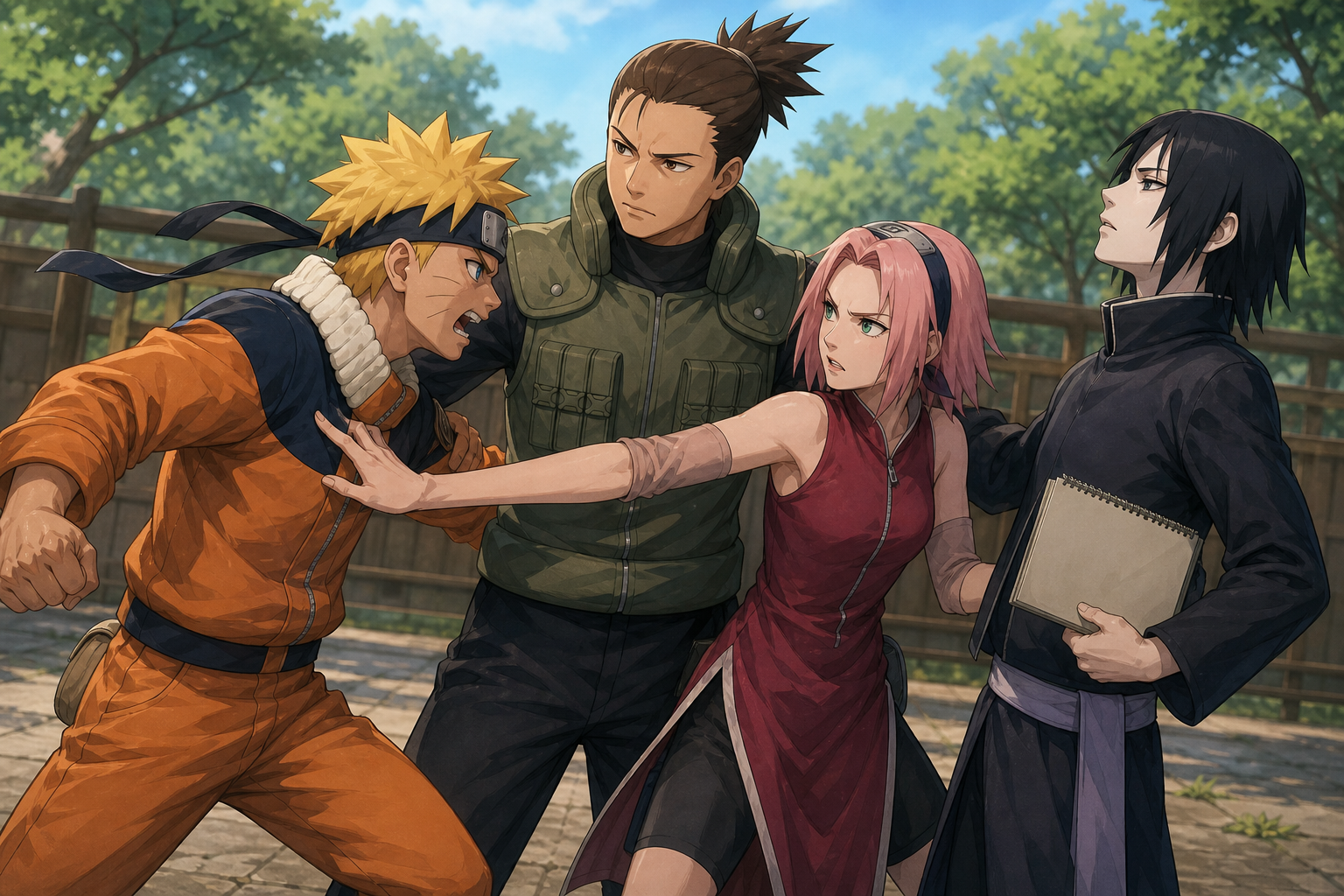
Formation! New Team Kakashi
A mission order can assemble four shinobi, but it cannot turn hostility into trust.
A reunion that begins with a fight
The new Team Kakashi does not begin with introductions around a mission table. It begins with Naruto recognizing Sai as the stranger who attacked him and insulted Sasuke. That history arrives before Tsunade’s official announcement can make anybody sound like a teammate. Naruto already sees Sai as an enemy wearing a Leaf forehead protector. Sai sees Naruto as an emotional target who reacts exactly when provoked.
Sakura stands between those instincts. She has the same loyalty to Sasuke, but she also understands that the Tenchi Bridge lead will expire whether she likes Sai or not. Her anger is therefore held under a thinner layer of discipline. Sai’s remarks eventually cut through that layer too.
Episode 34 calls this the formation of New Team Kakashi, but “formation” is almost sarcastic. Four names can be placed on the same assignment. That does not create trust, shared purpose, or even basic respect. Yamato inherits a team whose newest member has hidden orders and whose returning members experience his presence as an insult to somebody absent.
Sai knows exactly where to press
Sai’s first encounter with Naruto establishes his method. He attacks, assesses the response, and leaves while predicting they will meet again. When that prediction comes true, he offers no meaningful repair. Instead, he continues using Sasuke as leverage.
The cruelty is deliberate. Sai has learned to observe emotional attachments without sharing them. Naruto’s bond with Sasuke is visible, intense, and easy to test. One remark produces anger. A sharper remark produces a fight. To somebody trained by Root, that reaction can look like useful information rather than pain.
Sai’s smile makes the exchange worse because it is disconnected from warmth. He has been taught the shape of social behavior without the emotional habits beneath it. The result is a performance that feels insulting even before his words become openly hostile. Naruto does not merely distrust him. Naruto senses that the smile is a mask and responds to the emptiness behind it.
There is also an uncomfortable resemblance between them. Both boys were isolated. Both learned skills because adults wanted to turn unusual children into useful shinobi. The difference is what they did with loneliness. Naruto reached outward until he formed bonds that could not be ignored. Sai was trained to cut inward until personal attachment became a forbidden weakness.
That contrast is why their conflict matters beyond an abrasive first meeting. Sai represents the version of a shinobi that Naruto has spent the entire story refusing to become.
The elders turn urgency into leverage
While the younger shinobi clash, Tsunade faces pressure from Homura and Koharu. The village elders do not treat the mission as a private search for Sasuke. Naruto is the Nine-Tails jinchūriki, Orochimaru remains a major threat, and Akatsuki has just demonstrated how aggressively it will pursue tailed beasts. Sending Naruto toward an enemy network carries consequences for the entire village.
That concern is not irrational, but it gives Danzō room to influence the team. Sai’s placement is framed as a practical condition. Tsunade needs the mission authorized and staffed before Sasori’s deadline. The elders want control. Root offers a shinobi who appears obedient, capable, and emotionally detached.
The arrangement reveals the difference between authority and freedom. Tsunade is Hokage, yet she cannot make every decision without negotiation. She can appoint Yamato and define the official mission. She cannot keep Danzō’s operative out without risking delay or political resistance.
Tsunade accepts Sai because the lead matters and because waiting is not neutral. Every day lost brings the Tenchi Bridge rendezvous closer. The decision is strategic, but it means sending Naruto and Sakura into the field with a teammate neither chose and a sponsor Tsunade does not trust.
Yamato takes command of an emotional demolition site
Yamato introduces himself with none of Kakashi’s lazy theater. He is direct, controlled, and clear that the mission will proceed. His authority is not built on affection because there is no time to earn it. He has to establish a boundary before Naruto and Sai turn their hostility into a failed operation.
The title “captain” carries a special burden here. Yamato is not replacing Kakashi emotionally, any more than Sai can replace Sasuke. He is taking responsibility for the operational team while the original relationships remain intact beneath it. That distinction may be obvious to an adult, but Naruto hears replacement wherever the village sees necessity.
Yamato’s challenge is larger than stopping arguments. Naruto’s anger can trigger the Nine-Tails’ chakra. Sakura’s investment in Sasuke can pull her judgment toward the same emotional edge. Sai’s training makes him obedient to orders the others may not know exist. The mission leads toward Orochimaru, whose entire method depends on exploiting bodies, loyalties, and desire.
Yamato therefore needs to control both the team’s visible conflict and its concealed risks. His calm is not passivity. It is the posture of somebody measuring how much force will be required to keep four people moving in one direction.
Sakura’s patience has limits
Sakura initially tries to manage the meeting with more restraint than Naruto. That restraint is not acceptance. She knows what Sasuke means to both of them, and Sai’s casual contempt reaches the same wound.
Her reaction matters because it prevents the episode from reducing the conflict to Naruto being irrational. Sai is not innocently misunderstood. He chooses words designed to hurt. Sakura recognizes the manipulation and eventually answers it with force.
At the same time, Sakura’s position has changed since the original Team 7. She is no longer watching Naruto and Sasuke fight while waiting for Kakashi to intervene. She is a capable medical ninja who survived the battle with Sasori and helped secure the information driving this mission. Her voice carries operational weight now.
That growth makes the new formation more complicated. Sakura can restrain Naruto, challenge Sai, and contribute to the mission, but she cannot make the group trust one another. Strength does not erase grief. Competence does not make an insult harmless.
Sasuke controls the room without being there
Sasuke is absent from every official introduction, yet he determines nearly every emotional response. Naruto rejects Sai because of him. Sakura loses patience because of him. Tsunade authorizes the mission because Sasori’s spy may lead to Orochimaru and therefore to him. Sai’s easiest weapon is saying his name with contempt.
This is what makes “replacement” such a dangerous word. To the village, Sasuke is a missing-nin who chose Orochimaru. To Naruto and Sakura, he remains their teammate and the center of an unfinished promise. Those truths coexist, but the people making administrative decisions are not carrying them with equal weight.
Sai steps into a position defined by somebody else’s absence. That is unfair to him in one sense, yet he deepens the problem by treating the bond as foolish. He cannot join Team 7 while mocking the reason Naruto and Sakura still call it a team.
The episode understands that a missing person can have more influence than someone physically present. Sasuke shapes the team before they take a single step toward him.
A mission sheet cannot manufacture teamwork
Traditional shinobi teams are built around complementary skills and a commanding jōnin. New Team Kakashi technically satisfies that structure. Naruto brings unpredictable power and shadow clones. Sakura brings medical expertise and precise strength. Sai brings Root training and ink-based techniques. Yamato brings leadership and control.
On paper, the unit is versatile. In practice, its members do not share enough trust to use those strengths together. Naruto would rather fight Sai than coordinate with him. Sai treats the conflict as an experiment. Sakura is protecting the mission while defending Sasuke. Yamato is enforcing cooperation before he understands every hidden order in play.
That gap between structure and relationship is the episode’s real subject. The village can supply uniforms, ranks, and instructions. Teamwork is something the members have to build, and all four enter the process with reasons to resist.
The urgency of Tenchi Bridge prevents a gentler solution. There will be no long training period or comfortable series of low-risk assignments. Their first meaningful task points directly toward Orochimaru. The team must become functional while already moving into danger.
RaeRae’s reaction
Sai is exhausting here, and that is exactly what the episode needs. His politeness has the texture of sandpaper. He watches Naruto’s pain, identifies Sasuke as the pressure point, and keeps pressing because the reaction interests him. I do not blame Naruto for wanting to hit him. I also know that giving Sai the reaction he expects hands him control of every exchange.
Sakura’s response is the one I appreciate most. She understands the practical situation better than Naruto, but understanding does not mean she will tolerate cruelty. Her restraint has a line. Sai finds it.
Yamato arrives like a substitute teacher who has been handed the most emotionally combustible class in the village, except one student contains a tailed beast, another has secret orders, and the lesson plan is an infiltration mission connected to Orochimaru. His calm deserves hazard pay.
What makes the episode work is that nobody can solve the central problem with one speech. Naruto cannot be ordered to stop loving Sasuke. Sai cannot instantly develop the emotional language Root removed from him. Sakura cannot absorb every insult to keep the peace. Yamato cannot turn a mission assignment into belonging.
The new team is necessary, but necessity is not trust. That distinction gives the arc room to grow. We are not watching four people discover that they secretly get along. We are watching them decide whether a shared objective can survive competing loyalties.
What formation actually means
By the end, New Team Kakashi exists because the village says it does. Yamato is captain. Naruto, Sakura, and Sai are its members. The Tenchi Bridge mission provides direction.
Emotionally, the formation remains unfinished. Naruto and Sakura still define the team through Sasuke and Kakashi. Sai remains connected to Danzō and Root. Yamato carries Tsunade’s authority without the history Kakashi earned.
That unfinished quality is not a flaw in the episode. It is the engine. A team assembled under pressure reveals what each person protects when cooperation becomes uncomfortable. Naruto protects his bond with Sasuke. Sakura protects the mission and that same bond. Sai protects his orders by revealing almost nothing. Yamato protects the operation by imposing control.
They leave the meeting with one destination and four different internal maps. The bridge ahead may connect them to Orochimaru’s spy, but the first distance they have to cross is between one another.
Official episode reference: Naruto Official episode guide
Licensed episode route: Crunchyroll licensed episode page
A formation order cannot manufacture a team
Tsunade can assign Yamato, Naruto, Sakura, and Sai to one mission. The paperwork can establish authority, destination, and operational need. It cannot create trust between people who arrive carrying grief, suspicion, secret orders, and no shared language for any of it.
The episode understands that formation is a beginning, not an achievement. New Team Kakashi exists officially before it exists emotionally.
Naruto begins by looking for anyone except Sai
Naruto’s attempt to recruit familiar peers reveals how desperately he wants the vacancy to feel voluntary. If Shikamaru, Choji, or Kiba joined, the team might preserve some connection to the village relationships he already trusts.
Mission schedules and other assignments close those options. Naruto is forced to confront the stranger chosen through the political process he already resents.
Sai’s smile is learned camouflage, not warmth
Sai presents a pleasant expression because Root taught him that a smile makes interaction smoother. The expression does not automatically carry affection, curiosity, or safety. It is a social tool separated from the feeling people expect behind it.
That gap unsettles Naruto and Sakura because they read faces as evidence. Sai exposes how easily performance can imitate the outer shape of connection while protecting the person underneath from being known.
Cruelty still counts when it comes from emotional damage
Root’s conditioning explains why Sai struggles to understand bonds and why he uses rehearsed social behavior. It does not make his insults harmless. Calling Naruto ugly and insulting Sasuke are deliberate provocations with predictable effects.
Explanation should guide accountability, not erase it. Sai deserves recognition as someone shaped by institutional abuse. Naruto and Sakura still deserve boundaries around how he speaks to them.
Naruto takes the Sasuke insult exactly where Sai aims it
Sai attacks the relationship Naruto already fears everyone else will dismiss. Naruto responds physically because the comment hits grief, loyalty, shame, and the promise he made to Sakura.
The reaction is understandable and dangerous. If Sai can control Naruto by mentioning Sasuke, then Naruto has handed a stranger access to the mission’s most sensitive trigger.
Sakura’s anger carries more than defense of Naruto
Sakura also refuses Sai’s treatment of Sasuke as a joke. Her feelings are not identical to Naruto’s, but the absence belongs to her too. She has trained under Tsunade while carrying guilt about how the retrieval promise began.
Her intervention shows that Team 7’s history cannot be reduced to Naruto’s obsession. Multiple people lost the same teammate in different ways.
Yamato stops the fight because leadership starts with containment
Yamato arrives to lead people who are already one insult away from violence. His immediate task is not inspiring unity. It is preventing the new unit from injuring itself before leaving the village.
Containment can look cold, but this team needs a boundary strong enough to hold conflict while trust remains absent. Yamato’s authority becomes useful when it protects the mission without pretending everyone likes each other.
The captain’s code name announces another layer of concealment
Yamato is not the leader’s original name. Sai is also a name assigned within Root. The new team begins with two members introduced through institutional identities rather than personal histories.
Naruto and Sakura know each other through years of shared experience. Their new teammates arrive as official surfaces. The imbalance makes suspicion almost inevitable.
Kakashi’s absence changes the emotional temperature
Kakashi knew Naruto and Sakura before the time skip, survived Sasuke’s departure with them, and understood how their arguments fit inside attachment. Yamato has mission files and a specialized ability, not that accumulated context.
The difference does not make him a bad captain. It means the team must explain wounds Kakashi once recognized without explanation.
Sai enters with a mission the others cannot consent to
Danzō placed Sai on the team for purposes Tsunade, Naruto, and Sakura do not fully control. The assignment asks them to build operational trust while one member answers to a hidden authority.
That is not a personal communication problem. It is a structural breach designed into the formation.
Naruto’s refusal to replace Sasuke risks freezing Team 7 in time
Loyalty can preserve a bond across absence. It can also make every new relationship look like betrayal. Naruto has to learn that caring about Sai would not reduce what Sasuke means.
A team can change shape without declaring the missing person interchangeable. Growth requires more than leaving an empty chair forever.
Sai should not have to become lovable before receiving personhood
The audience can see his insults and still reject Root’s treatment of him as a tool. Human worth is not a prize he earns after learning the correct facial expressions.
Accountability and care can begin at the same time. The team can demand better behavior while remaining curious about what made ordinary connection so foreign to him.
The mission begins before reconciliation
The Tenchi Bridge meeting will not wait for Naruto, Sakura, and Sai to complete a friendship arc. They have to travel, share information, and respond to danger while distrust remains active.
This is common to real cooperation. People often need workable boundaries before they have affection. The question is whether the structure gives trust room to grow or keeps exploiting the fractures.
The new team mirrors Konoha’s unfinished political argument
Tsunade’s authority, Danzō’s hidden program, Yamato’s ANBU experience, Sai’s Root conditioning, and Naruto’s jinchuriki status all meet inside four assigned positions.
The team is not merely a cast adjustment. It is a small version of the village’s argument about whether people are relationships to protect or assets to manage.
First impressions become dangerous when the mission rewards speed
Naruto, Sakura, and Sai meet under a deadline. Nobody has time to separate awkwardness from hostility, institutional conditioning from personal contempt, or defensiveness from actual threat. Every reaction becomes evidence before anyone has enough information to interpret it well.
That pressure helps Danzō. Distrust keeps the team focused on one another instead of asking why Sai was inserted, what orders he carries, and which authority benefits if the group never builds honest communication. The first fight is personal, but the conditions producing it are political.
Yamato’s job is therefore larger than stopping fists. He has to slow the team’s judgments without weakening necessary caution. Sai is hiding something. Naruto is volatile around Sasuke. Sakura can weaponize her temper. Treating every concern as prejudice would be reckless; treating every concern as final truth would make cooperation impossible. Leadership starts by creating enough space for better evidence.
RaeRae’s full take
This is not a cute meet-disaster where everybody trades insults and becomes friends by dinner. Sai knows how to wear a smile without offering safety. Naruto knows how to defend Sasuke without noticing when grief turns him predictable. Sakura carries the same absence and refuses to let either boy make it trivial.
Yamato gets handed a team designed by competing authorities and told to make it functional before the intelligence expires. Good luck, sir.
The important boundary is simple: Root’s abuse explains Sai, but it does not make his cruelty harmless. Naruto’s love explains his anger, but it does not make violence wise. New Team Kakashi will become a team only when these people can see the wounds without letting every wound issue orders.
RaeRae checkpoint: The Hokage can form a unit on paper. Trust begins when four people stop treating one another as a vacancy, a trigger, a tool, or a containment problem.
Receipts and official routes
- Episode placement, the new team’s formation, Yamato’s command, and Sai’s first conflict with Naruto and Sakura: Naruto Official Site episode guide.
- Licensed episode route: Crunchyroll.