
The New Target
An urgent lead forces Tsunade to rebuild Team Kakashi, but Naruto will not call Sasuke replaceable.
The team comes home without coming back together
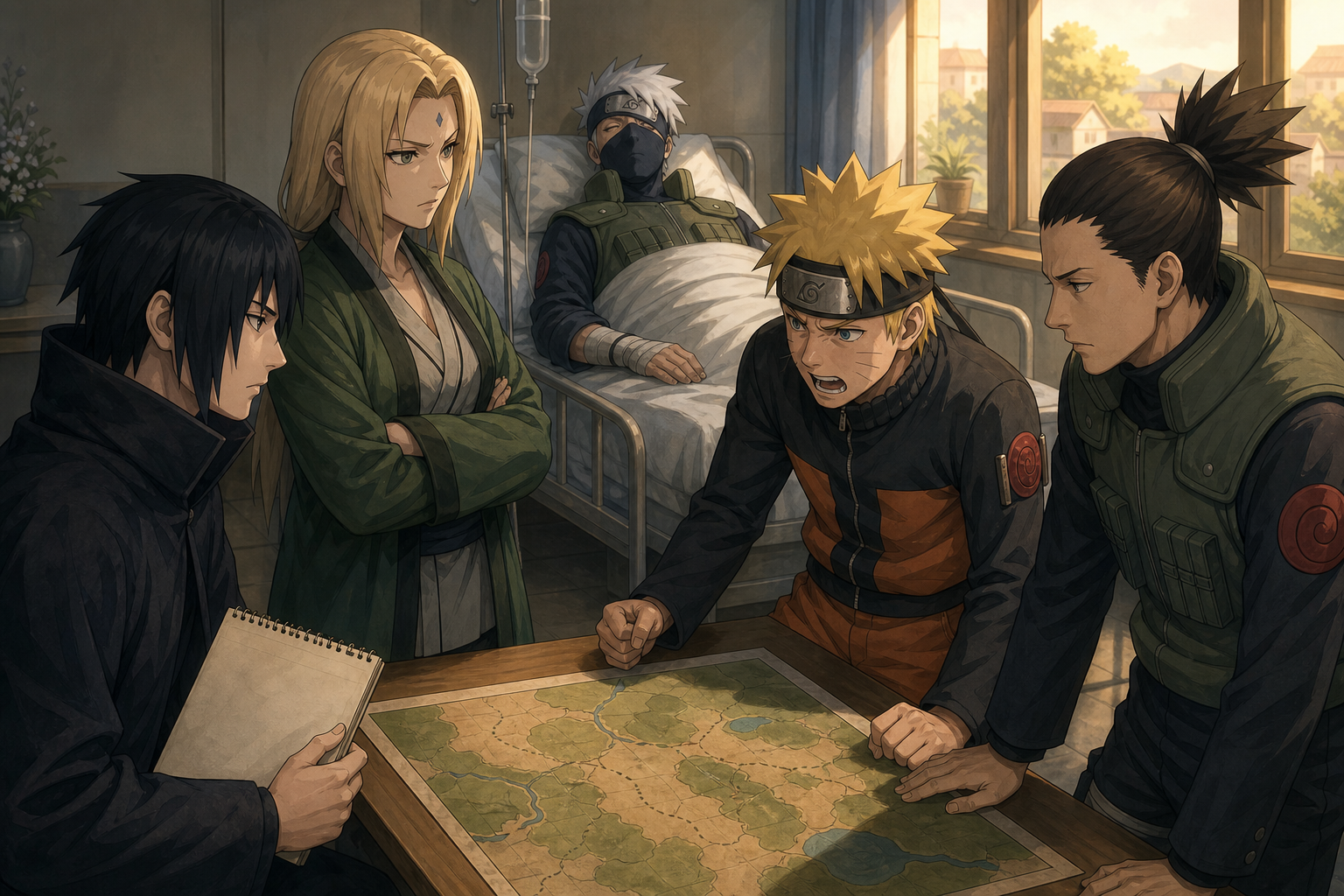
Episode 33 opens after a victory, but it does not feel victorious. Gaara is alive, the Sand has its Kazekage back, and Team Kakashi has returned to the Hidden Leaf. Yet Kakashi is in a hospital bed because the Mangekyo Sharingan pushed his body beyond its limit. Sakura and Naruto are carrying everything they learned in the rescue mission, including Sasori's final piece of intelligence: in ten days, one of Orochimaru's spies will appear at Tenchi Bridge.
That lead changes the temperature immediately. This is no longer a distant promise that Naruto will someday find Sasuke. There is now a place, a deadline, and a person who may know where Orochimaru is hiding. Naruto hears possibility in all three. Tsunade hears a mission that cannot wait for Kakashi to recover.
The episode's title, “The New Target,” works in more than one direction. Orochimaru's spy is the obvious target, but the mission also makes Team 7 a target for competing powers inside the village. Tsunade wants to act on Sasori's intelligence. Danzō sees an opening to place one of his own shinobi inside the Hokage's team. Naruto, meanwhile, fixes his attention on the one absence nobody else is allowed to treat as routine.
Kakashi's empty place becomes a political opening
Kakashi's hospitalization is not played as a dramatic brush with death. He needs time, rest, and recovery. That ordinary limitation matters because the mission has a clock. A week in bed is manageable for Kakashi, but the rendezvous will not move itself to accommodate him. Tsunade therefore has to build a functioning unit around Naruto and Sakura before the deadline expires.
This is where the story turns team composition into politics. A replacement captain is not merely the strongest available adult. A replacement member is not merely another body who can complete the standard four-person formation. Team 7 carries unusual history, unusual power, and an unusually sensitive objective. Anyone placed beside Naruto and Sakura will gain access to their mission, their loyalties, and their search for Sasuke.
Tsunade chooses Yamato as acting captain. His calm manner does not resemble Kakashi's casual lateness or teasing evasions. He feels measured, watchful, and deliberately difficult to read. Even before the team leaves the village, his appointment signals that this operation requires control as much as strength.
Danzō's contribution is Sai, a young operative from Root. His introduction changes the balance further because he does not arrive through the relationships that formed the rest of the team. He is placed there by an elder whose vision for the village stands apart from Tsunade's. Sai's blank expression and careful manners do not reassure Naruto. They make the distance between them feel sharper.
Naruto refuses the language of replacement
Naruto's anger is immediate because everyone around him uses practical language for something he experiences as personal. The mission needs four shinobi. Kakashi is unavailable. Sasuke deserted the village. From an administrative perspective, the gaps must be filled.
Naruto cannot accept that framing. Sasuke's place is not an empty chair on an organizational chart. It is the place of a teammate Naruto promised to bring home. Calling Sai a replacement sounds, to Naruto, like surrender disguised as efficiency. He does not yet know Sai well enough to judge him fairly, but fairness is not the emotion driving the scene. Grief is.
That distinction keeps Naruto's reaction from being simple hostility toward a stranger. He is defending the meaning of Team 7 as he understands it. Sakura's presence complicates the moment because she shares the loss without expressing it in the same way. She knows the mission needs to move. She also knows why Naruto cannot hear the word “replacement” without feeling that Sasuke is being erased.
Naruto has spent years being told that bonds can be assigned, measured, or dismissed by people with more authority than he has. Team 7 taught him otherwise. Kakashi, Sakura, and Sasuke became family through danger, conflict, failure, and choice. Episode 33 asks what happens when the village tries to repair that family with appointments.
Sai enters with a smile that explains nothing
Sai is designed to frustrate first impressions. He looks composed where Naruto is expressive. He speaks with a politeness that can turn cutting without warning. His sketchbook suggests observation rather than participation, as though he is studying the people around him instead of joining them.
That distance is not accidental. Root trains shinobi to suppress identity and attachment in service of the mission. Sai's social instincts have been shaped by an institution that treats emotion as vulnerability. Naruto reads his detachment as arrogance, and Sai reads Naruto's emotional openness as something easy to provoke. Their early friction is not just a clash of personalities. It is a collision between two incompatible ideas of what a shinobi should be.
Danzō's role makes every neutral detail suspicious. He does not place Sai on the team because Naruto needs a friend. He places Sai where Root can observe and influence an operation tied to Orochimaru, Sasuke, and the Nine-Tails jinchūriki. Tsunade accepts the arrangement because the mission cannot proceed without a fourth member, but acceptance is not trust.
The viewer therefore enters the new team with more information than Naruto has and less information than Sai possesses. We know that Danzō has an agenda. We do not yet know the full order Sai carries. That imbalance gives even a smile or a polite introduction the weight of surveillance.
Yamato is chosen to hold a dangerous center
Yamato's assignment answers a problem larger than Kakashi's recovery. Naruto's power has become harder to contain. During the pursuit of Deidara, his rage pushed the Nine-Tails' chakra dangerously close to the surface. Kakashi could interrupt that escalation with the seal Jiraiya provided, but the next mission may bring Naruto closer to Orochimaru and Sasuke, the two people most capable of driving him past restraint.
Yamato's presence promises a different kind of control. He is not asked to imitate Kakashi. He is asked to keep a volatile team alive while navigating an intelligence operation shaped by secrecy on every side. Naruto wants speed. Sakura wants results without losing Naruto. Sai has hidden orders. Tsunade and Danzō do not share the same objective. Yamato stands in the middle of all of it.
That is why his quietness matters. Kakashi's calm often felt like confidence born from long familiarity. Yamato's calm feels procedural. He watches before he reacts, and his authority arrives without the warmth Team 7 once learned to find beneath Kakashi's mask. The new captain may be capable, but capability is not yet belonging.
The mission turns Sasori's last secret into a deadline
Sasori's information is the thread connecting the Kazekage Rescue Mission to the next arc. His death does not close the story neatly. It leaves behind a rendezvous with a spy planted near Orochimaru, and that rendezvous offers the first concrete path toward Sasuke in years.
The detail also complicates Sasori's final moments. Whether he intended the information as a gift, a calculated move, or something he no longer cared to protect, Team Kakashi can use it. Chiyo's sacrifice brought Gaara home. Sasori's disclosure may lead Naruto toward someone he still believes can be brought home. The transition between arcs is therefore built from what the previous mission left behind.
Ten days is long enough to assemble a team and short enough to prevent hesitation. It forces Tsunade to accept imperfect personnel. It forces Naruto to work beside someone he rejects. It forces Sakura to step into a formation whose familiar shape now contains two strangers.
The target is information, but the real danger is everything the team carries toward it.
RaeRae's reaction
What lands hardest here is how quickly a village can use the word “replacement” when a person is still alive in somebody else's heart. Naruto is not being reasonable about Sai, and Sai certainly does not make it easy for him, but I understand the wound underneath the anger. Naruto has built his entire sense of family around refusing to discard people. Asking him to treat Sasuke's place as available was never going to sound like routine staffing.
I also love that the episode does not pretend Tsunade has an easy alternative. Kakashi cannot go. Sasori's lead expires. Naruto and Sakura are the people most invested in finding Sasuke, and the mission needs a captain plus a fourth shinobi. Every practical decision she makes creates an emotional cost, and Danzō uses that pressure to put Sai exactly where he wants him.
Sai's entrance is uncomfortable in the right way. His smile does not reach the scene. His words feel tested rather than felt. Naruto responds to him at full volume, which only makes Sai's restraint look colder. They are both products of loneliness, but they have learned opposite survival skills. Naruto makes bonds loudly. Sai has been trained to live without them.
Yamato interests me for a similar reason. He is introduced as the person expected to maintain order, yet the team he inherits is built from unresolved loyalties. He cannot command Naruto out of loving Sasuke. He cannot order Sakura to forget the old Team 7. He cannot assume Sai's orders begin and end with Tsunade's mission. His real job is not simply leading four shinobi to a bridge. It is keeping several hidden agendas from tearing the group apart before they arrive.
Episode 33 is a transition episode, but it is not empty setup. It takes Kakashi out of the field, places Root inside Team 7, establishes a new captain, and gives the search for Sasuke a ticking clock. The Kazekage Rescue arc proved that Naruto could help bring someone back from the edge of death. The Long-Awaited Reunion arc now asks what that determination will cost when the person he wants to save may not want to return.
What this episode changes
Team 7 now exists in two forms at once. The emotional team is Naruto, Sakura, Sasuke, and Kakashi. The operational team is Naruto, Sakura, Sai, and Yamato. The story will not let those versions fit together cleanly.
That fracture gives the new mission its energy. Naruto is pursuing Orochimaru's spy while resisting his assigned teammate. Sakura is moving toward Sasuke while protecting Naruto from the consequences of that pursuit. Yamato is responsible for a unit whose strongest bond reaches toward an absent enemy. Sai is inside the group without yet being part of it.
The episode ends with forward motion, but not unity. That is exactly the point. A mission order can assemble people in one place. It cannot make them a team.
Official episode reference: Naruto Official episode guide
Licensed episode route: Crunchyroll licensed episode page
Kakashi’s hospital bed creates a political opening
Kakashi is not merely absent from the next mission. His physical recovery creates a vacancy inside one of Konoha’s most sensitive teams. Danzō recognizes that opening immediately. Where Naruto and Sakura see an injured teacher, he sees access.
That difference defines the episode’s new conflict. Akatsuki attacked bodies from outside the village. Root works through the administrative spaces inside it. A team assignment can become surveillance, influence, and control without anyone drawing a weapon in the Hokage’s office.
Tsunade has authority without complete freedom
Tsunade is Hokage, yet the elders and Danzō pressure her decisions. She can choose Yamato to lead the mission, but she must accept Sai as the replacement member. The compromise shows how office power gets narrowed by institutions that outlast any one leader.
Her frustration matters because it prevents the arrangement from looking voluntary. She is responsible for the mission and still operates inside a government where competing authorities can place a person on her team.
Danzō calls Sai a shinobi and treats him like a delivery system
Sai enters as a highly trained Root operative, but Danzō’s language reduces him to function. He has a mission, a cover position, and an expectation of obedience. His interior life only matters if it affects performance.
That treatment prepares the real question around Sai. The problem is not whether he can fight. The problem is what prolonged institutional control has done to his ability to recognize, express, and choose relationships.
Naruto hears “replacement” as an attack on memory
When Naruto rejects a fourth member, he is defending more than an empty chair. Team 7 is tied to his first sustained experience of belonging. Sasuke left, but Naruto refuses to let bureaucracy convert that loss into a routine personnel change.
The reaction is emotionally honest and unfair to the stranger who did not create the vacancy. Naruto’s loyalty gives the anger meaning. It does not give him permission to decide that Sai is less of a person before meeting him.
Sasuke is not replaceable, and neither is Sai
The episode’s cleanest moral answer refuses the false choice. A new teammate cannot become Sasuke because relationships are not job titles. Sai also cannot be treated as a disposable stand-in whose only purpose is restoring the team’s old shape.
Naruto will have to protect the specificity of his bond with Sasuke without denying Sai the possibility of a different bond. Grief becomes harmful when preserving one person requires erasing another.
Sakura understands the mission and the wound
Sakura wants Sasuke back too, but she is more prepared to hear the operational need. Kakashi cannot lead while hospitalized. The bridge intelligence has an expiration date. A four-person formation requires another member.
Her position is not proof that she cares less. It shows that loyalty can include adapting the route toward the person you refuse to abandon.
Yamato is selected because control has become part of care
Naruto’s transformation during the Deidara pursuit changed the mission calculus. The next captain needs tactical judgment and an answer when Nine-Tails chakra overwhelms Naruto. Yamato’s Wood Style makes him useful for both.
That usefulness carries danger. A leader capable of suppressing Naruto can protect him, but the village may also view Naruto more openly as a weapon requiring a specialized handler. The ethics depend on whether Yamato protects Naruto’s agency or only the mission’s stability.
The Tenchi Bridge intelligence gives grief a deadline
Sasori’s final information points toward a spy connected to Orochimaru. The team cannot pause until everyone feels ready. Intelligence work runs on timing, and a missed meeting may close the only route toward Sasuke.
The deadline explains the rapid reorganization without making it emotionally easy. Konoha is asking wounded people to move because the target will not wait for their recovery.
Kakashi remains part of the team while unable to lead it
Hospitalization removes Kakashi from the field, not from the relationships he built. Naruto and Sakura visit him, mission planning accounts for his condition, and the choice of Yamato responds to knowledge Kakashi helped gather.
This distinction matters in a culture that often equates value with immediate combat capacity. Kakashi does not become disposable when his body needs time.
Danzō’s intervention reveals the village Naruto wants to lead
Naruto dreams of becoming Hokage because he imagines recognition and the ability to protect people. Episode 33 shows the office entangled with elders, secret factions, historical bargains, and operatives shaped outside public view.
Wanting the title will not be enough. Leadership means deciding what to do when official systems produce harm while still calling that harm security.
Sai’s blank affect should not be mistaken for absence
People around Sai read his limited expression as coldness, arrogance, or emptiness. Those judgments ignore the institution that trained emotional attachment out of him. A survival adaptation can look rude when observers only see the result.
Understanding the cause will not excuse every choice Sai makes. It will keep the story from blaming a young operative for having the exact traits Root demanded.
The new team begins with competing hidden missions
Naruto and Sakura want Sasuke. Tsunade wants reliable intelligence and safe return. Yamato must manage the team and Naruto’s chakra. Sai answers to Danzō in ways the others do not know.
Calling them one unit cannot create trust by decree. The mission begins as a structure full of different loyalties, incomplete information, and political interference.
The target changes while the original promise remains
The immediate objective is no longer chasing Akatsuki or rescuing Gaara. It is reaching the Tenchi Bridge contact and finding a route toward Orochimaru. Naruto’s larger promise to bring Sasuke home remains underneath that assignment.
A new target does not mean a new emotional story. It changes the method and exposes what the old promise now demands from everyone around Naruto.
Replacement language protects institutions from grief
Organizations prefer positions that can be filled because continuity is necessary. People experience relationships that cannot be reproduced. Trouble begins when administrative language pretends those two truths are identical.
Konoha needs another capable shinobi on the mission. Naruto needs adults to acknowledge that Sasuke’s absence is not solved by staffing. Both needs can exist without turning Sai into office furniture.
RaeRae’s full take
Naruto is right that Sasuke cannot be replaced. He is wrong if that truth becomes permission to treat Sai like a counterfeit person. Team 7’s history belongs to Naruto, Sakura, Sasuke, and Kakashi. The next team has to become something else instead of forcing a stranger into the exact outline of the boy who left.
Danzō understands that vacancy before anyone else because he does not see a grieving team. He sees a route into Tsunade’s mission. Sai arrives carrying that political purpose and the emotional damage of an institution that trained obedience as identity.
The new target is Sasuke’s trail, but the episode’s real warning sits inside Konoha. Naruto wants to lead this village one day. He needs to learn that danger does not always wear a missing-nin cloak. Sometimes it brings official approval and a personnel recommendation.
RaeRae checkpoint: Sasuke is not replaceable. Sai is not disposable. Any system that insists one young person can simply occupy another’s wound has already stopped seeing both of them.
Receipts and official routes
- Episode placement, Kakashi’s hospitalization, the new mission, and Team Kakashi’s staffing conflict: Naruto Official Site episode guide.
- Licensed episode route: Crunchyroll.