
Aesthetics of an Instant
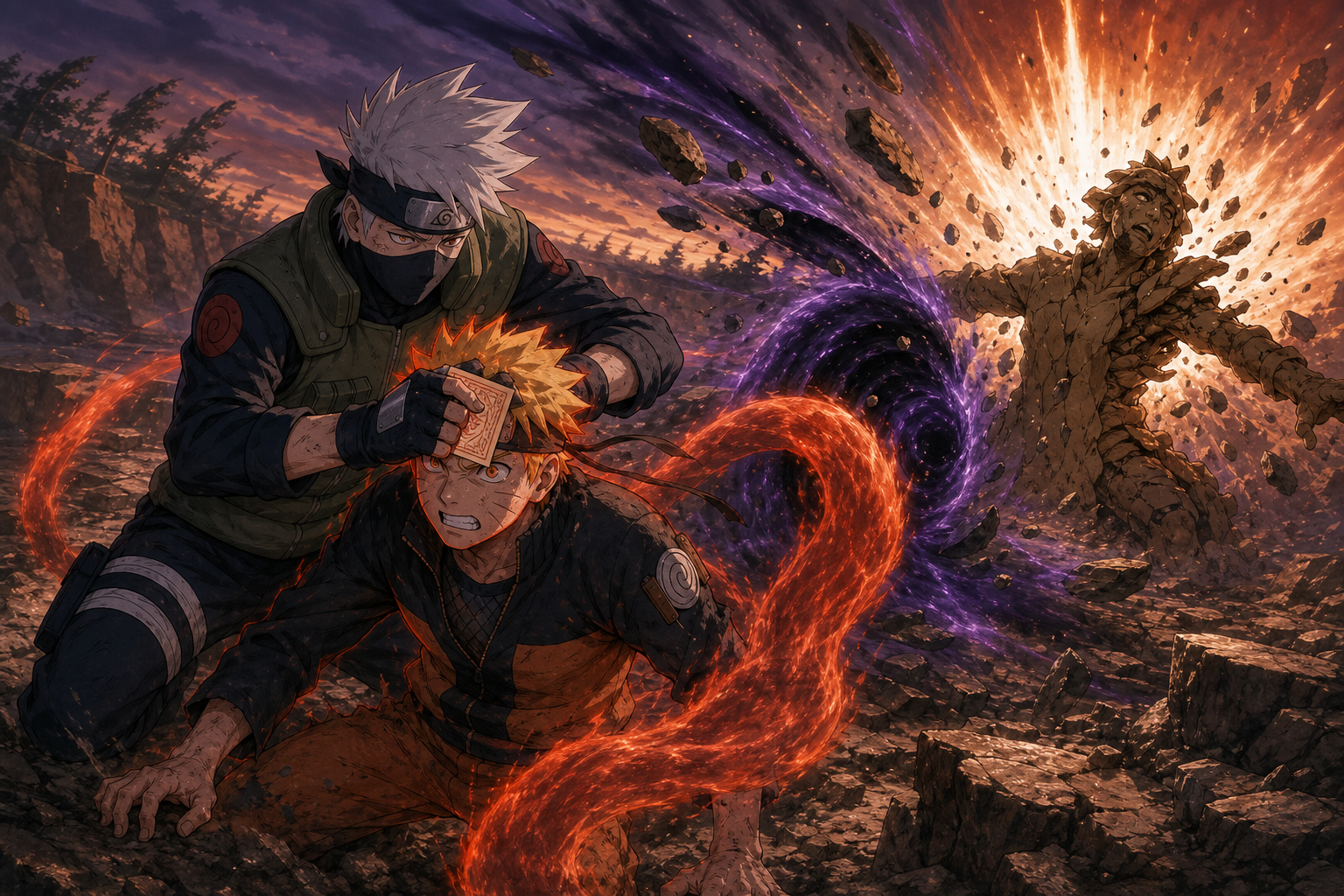
Kakashi suppresses Naruto’s Nine-Tails chakra and spends nearly everything to send Deidara’s staged explosion away.
Gorgeous power still sends an invoice
Naruto Shippuden Episode 30 places two spectacular powers on screen and refuses to pretend either is free. Naruto's body becomes the battleground for Nine-Tails chakra. Kakashi's Mangekyō Sharingan lets him remove a massive explosion from the battlefield, then leaves him nearly unable to stand.
The animation makes both forces beautiful. Red chakra coils around Naruto. Space folds into a dark spiral. Deidara's clay duplicate becomes an enormous flash. The beauty is part of the danger because spectacle can make consequence easy to ignore.
This episode keeps the invoice visible. Naruto loses reason. Kakashi loses stamina. The teams survive because someone understands when power must be stopped and someone else accepts the cost of redirecting it.
Naruto's rage stops belonging only to him
Deidara's treatment of Gaara pushes Naruto past the edge Kakashi feared. The Nine-Tails chakra surfaces more aggressively, changing Naruto's movement, perception, and ability to distinguish rescue from retaliation.
Naruto's anger began with care. Gaara was reduced to cargo after living through the same isolation Naruto knew. That origin does not make every action produced by the anger safe.
Once the chakra takes over, Naruto's body can endanger the people trying to help him. The emotion stops being a private experience and becomes a team condition. Kakashi must respond before Naruto's grief turns into another source of destruction around Gaara.
This is not a punishment for caring too much. It is a reminder that care without regulation can lose contact with the person it claims to serve.
Jiraiya planned for the emergency
Kakashi carries a suppression tag Jiraiya entrusted to him. That detail tells us the danger was known before the mission began. Jiraiya did not assume Naruto's determination would always be enough to contain the fox.
Planning for failure is an act of care. It respects Naruto's effort while acknowledging that willpower is not an emergency protocol.
The tag also distributes responsibility. Naruto is not left alone to manage a sealed creature that adults placed inside him. Kakashi has information and a tool. Jiraiya prepared another adult to intervene.
That does not remove the violation at the center of the situation. Naruto did not choose to become a jinchuriki. The least his mentors can do is build systems that protect him and others when the burden overwhelms him.
Suppression is not betrayal
Kakashi has to physically interrupt Naruto at the moment Naruto feels most justified. From Naruto's perspective, Deidara is escaping with Gaara and any delay feels intolerable. Kakashi suppressing the chakra could look like siding with the enemy's timetable.
It is actually loyalty to the rescue. A transformed Naruto might reach Deidara faster while becoming less capable of recovering Gaara safely. Kakashi protects Naruto's purpose from the power trying to replace it.
Good leadership sometimes means stopping a teammate rather than amplifying them. The intervention works because Kakashi does not treat Naruto as a monster. He treats the chakra state as dangerous and Naruto as someone worth bringing back.
The distinction matters. Villages often responded to jinchuriki danger by rejecting the child. Kakashi responds by staying close enough to place the tag.
Deidara turns his own image into ammunition
The clay duplicate is a perfect expression of Deidara's art. It imitates his body only long enough to become an explosion. Identity is staging for the instant.
Sasori wanted bodies to remain. Deidara wants the crafted object to disappear at the moment of greatest effect. Both philosophies convert form into control. Deidara's duplicate lets him weaponize the team's belief that they finally caught him.
The trick also exposes his relationship to risk. A copy can detonate while the real artist preserves himself elsewhere. Deidara celebrates the instant but does not always volunteer his own body for it.
The duplicate is spectacle with an escape route. Kakashi has to solve the consequences after Deidara has already arranged the audience.
Kamui becomes protection
In Episode 29, Kamui appeared as a difficult offensive technique aimed at a distant moving target. Episode 30 reveals a broader function. Kakashi can use spatial distortion to remove a catastrophic event from the battlefield.
The application is extraordinary because an explosion is not a stable object. It expands in every direction and changes by the instant. Kakashi has to create a distortion large enough, fast enough, and accurately enough to prevent the blast from consuming both teams.
The success reframes the Mangekyō. Its value is not limited to striking an enemy. Space-warping becomes a shield by relocation.
That use fits Kakashi better than pure spectacle. He spends the technique to preserve other people's lives, knowing the strain will leave him vulnerable afterward.
The eye extracts a cost from the body
Kakashi's Sharingan has always consumed more chakra because he is not an Uchiha. The Mangekyō raises that cost dramatically. Using Kamui repeatedly drains him toward collapse.
The limitation prevents the eye from becoming detached from Kakashi's body. A borrowed gift remains part of a living system with finite reserves. Technique, intent, and physiology cannot be separated.
This parallels Sakura's antidote window. Exceptional skill creates an opening rather than abolishing limits. Kakashi can remove the explosion, but he cannot pretend the effort leaves him ready for another identical threat.
The team must account for his exhaustion after benefiting from his power. Rescue work includes carrying the people who made survival possible.
Two interventions save Naruto
Kakashi's actions in the episode operate on different scales. He uses a small paper tag against the chakra overwhelming one person. He uses Kamui against an explosion threatening everyone.
The quieter intervention comes first. Without suppressing Naruto, the team might face the blast while also managing a transformation. Precision at the personal level makes large-scale protection possible.
This structure challenges the idea that the biggest technique is automatically the most important. Kamui saves the teams from immediate destruction. The tag saves Naruto from losing more of himself.
Both are rescue actions. One simply looks better in a trailer.
Deidara's aesthetic depends on collateral damage
Deidara calls the explosion art because the instant of destruction matters to him. The people inside the blast radius become part of the material whether they consent or not.
That is the ethical failure inside his aesthetic. He treats consequence as proof of impact. A larger death toll would make the event more memorable, not more wrong.
Kakashi's Kamui denies him the audience and the result. The explosion still occurs, but it is removed from the people Deidara intended to consume. Art without victims is not the outcome he designed.
The clash is therefore not merely technique against technique. It is one person's claim that beauty justifies destruction against another person's decision that lives matter more than the spectacle.
Naruto needs more than a seal
The suppression tag stops the immediate chakra escalation, but it does not resolve the grief underneath it. Naruto still believes Gaara is dead. He still heard Deidara reduce his friend to an emptied container.
Emergency control is necessary and incomplete. Naruto will need language, support, and training that help him recognize the trigger before the fox's chakra replaces his choices.
This is where adult responsibility continues after the crisis. It would be easy to call the intervention successful because the visible tails disappear. The emotional wound remains.
Kakashi's exhaustion may delay that conversation, but the story should not mistake silence for resolution.
Power is not free because the result is good
Kakashi saves everyone from the explosion. The outcome is good. The cost still matters. He is depleted, injured by strain, and less able to protect the team afterward.
Naruto's chakra may offer the force needed to catch Deidara. The motive may be love for Gaara. The loss of control still matters.
The episode refuses a common shortcut in action stories: if power produces a heroic result, its harm to the user becomes decorative. Here the consequences shape what can happen next.
Sakura and Chiyo's battle made the same point through poison and antidotes. Every advantage had duration, dosage, and bodily cost. The arc consistently treats power as something bodies must survive.
The instant passes and the work remains
Deidara's explosion dominates one moment. Kamui removes it. Then the teams still have to locate Gaara, assess injuries, manage Naruto, and understand what happened.
This is the limit of an aesthetic built around the instant. The flash can command attention without completing the story. Survivors continue after the artist's chosen climax.
Sasori's permanent puppets also failed to control what came afterward. Sakura lived. Chiyo changed. Intelligence moved toward another mission. Neither permanence nor explosion can stop people from creating consequences beyond an artist's frame.
The rescue arc belongs to those consequences. Gaara's body still requires care. Naruto's grief still requires support. Kakashi's depleted body still requires teammates.
Final reaction
Aesthetics of an Instant delivers a spectacular explosion and makes the responsible actions around it more important. Kakashi uses Jiraiya's tag to bring Naruto back before the Nine-Tails chakra consumes his judgment. Then he uses Kamui to send Deidara's clay-duplicate blast away from both teams.
Both interventions cost him. Naruto's power costs Naruto too. The episode refuses to separate beautiful technique from the body paying for it.
Deidara believes the instant of destruction completes the art. Kakashi proves that what survives the instant matters more. The explosion disappears into warped space. The people remain, exhausted and unfinished, with a rescue still demanding their care.
Official episode reference: Naruto Official episode guide
Licensed episode route: Crunchyroll licensed episode page
Kakashi stops Naruto without treating him like the enemy
Naruto’s first tail has formed, his attention has narrowed to Deidara, and the chakra around him is becoming a danger to everybody nearby. Kakashi responds quickly, but the purpose of the suppression tag matters as much as the technique. He does not punish Naruto for losing control. He interrupts the transformation so Naruto can return to himself.
That distinction should be basic, yet the shinobi world regularly confuses containment with condemnation. Kakashi knows Naruto is grieving. He also knows grief does not make the Nine-Tails safe. Care means holding both truths at once.
The tag carries Jiraiya’s preparation into Kakashi’s hand
Jiraiya prepared the seal because he understood that training Naruto’s power also created risk. Kakashi uses it because responsibility can travel between adults without turning Naruto into shared property.
The handoff is quiet evidence of trust. Jiraiya does not need to be present for his knowledge to protect Naruto, and Kakashi does not need to pretend he invented the answer. Good guardianship builds continuity before the emergency arrives.
Naruto wakes from rage and still has to meet the loss
Suppressing the chakra does not fix what triggered it. Gaara remains dead. Deidara remains responsible. Naruto returns to consciousness with less destructive power around him and the same unbearable fact in front of him.
This is why restraint cannot be the end of care. Stopping harm creates the space where grief can be felt without consuming the person who carries it. Somebody still has to stand beside Naruto after the seal works.
Deidara’s clay duplicate turns escape into performance
Deidara leaves a copy behind because flight alone would not satisfy his idea of art. He wants the pursuers to witness an instant of destruction, and he wants their final memory of him to be an explosion arranged on his terms.
The duplicate is tactical deception wrapped in ego. It buys distance, threatens everyone at once, and makes the battlefield into an audience. Deidara keeps insisting that annihilation becomes meaningful when he controls the timing.
“Art is an explosion” is also a theory of ownership
Deidara’s slogan sounds like a celebration of impermanence, especially beside Sasori’s obsession with preservation. The episode reveals the controlling impulse they share. Sasori wanted objects that could never change. Deidara wants one instant nobody else can revise.
Both men claim authority over how bodies become art. Both remove consent. Their disagreement concerns duration, not whether another person gets to refuse becoming material.
Kamui answers spectacle with removal
Kakashi sees the clay duplicate expand and uses Kamui to warp the explosion away. He does not outshine Deidara with a bigger blast. He denies the blast its audience, victims, and intended consequence.
That makes the technique morally different in this moment. The same power that tore away an arm now functions as protection. A jutsu does not carry one fixed meaning. Purpose, target, cost, and consequence decide what the act becomes.
The second Kamui use nearly empties Kakashi
Warping the explosion saves the team, but Kakashi cannot treat that success as free. His vision fails, his balance goes, and the others have to account for a leader who spent almost everything.
The episode refuses the fantasy that elite competence means endless capacity. Kakashi can be the person with the necessary answer and still need somebody else to catch the aftermath. Dependence does not cancel mastery. It makes survival possible after mastery has taken its price.
Team Guy arrives as backup, not an applause section
Guy, Lee, Neji, and Tenten finish their mirror battles and reach the larger conflict in time to face the clay explosion. Their presence changes the stakes because Kakashi is no longer protecting only himself and Naruto.
They also embody the reason the rescue coalition matters. Separate teams handled separate barriers, gathered different information, and returned with uneven reserves. Nobody arrives pristine. The mission continues because exhausted people combine what they still have.
Neji’s Byakugan cannot see through every deception
Visual power repeatedly promises certainty in this arc, then meets a limit. Neji can locate people across distance. Kakashi can read movement and bend space. Deidara still uses substitution, clay, and timing to manipulate what observers think they see.
The lesson is not that special eyes are useless. It is that perception requires interpretation. Seeing a body, a chakra shape, or an apparent escape does not automatically reveal the plan controlling it.
Deidara survives because he planned beyond the visible fight
The missing arms make him look cornered, and Naruto’s assault makes capture feel inevitable. Deidara escapes because the battlefield contains prepared clay, hidden substitutions, and choices the rescuers discover late.
That survival keeps him dangerous without pretending he dominated the exchange. He lost limbs, lost Gaara’s body, and nearly disappeared into Kamui. Retreat is still a tactical result, not proof that the loser was secretly winning all along.
The rescue team protects Gaara’s body before hope returns
At this point, nobody has earned certainty that Gaara can come back. Protecting his body matters anyway. Naruto’s relationship with Gaara, Chiyo’s unfinished purpose, and Sunagakure’s claim on its Kazekage all refuse Akatsuki’s treatment of him as discarded packaging.
Respect cannot depend on knowing a miracle is coming. The team preserves Gaara because his personhood did not expire when the extraction ended.
The episode lets two kinds of interruption save lives
Kakashi interrupts Naruto’s transformation with the tag, then interrupts Deidara’s explosion with Kamui. One act protects Naruto from power emerging inside him. The other protects the group from power imposed from outside.
Neither intervention solves the whole arc. That is exactly why both feel responsible. Emergency care often means stopping the next irreversible thing before anyone can address the larger wound.
Instant art leaves everybody else holding the consequences
Deidara wants the beauty of one perfect detonation. He does not care who spends the next hour treating injuries, carrying bodies, explaining deaths, or rebuilding what the blast erased.
That is the cheapness hiding inside his grand claim. He treats consequence as somebody else’s boring problem. The rescue teams, medics, villages, and grieving friends live in the time after his instant. Their labor exposes how little his aesthetics can account for.
Kakashi’s power works because other people remain near him
Kamui removes the explosion, but Kakashi’s collapse proves the act is not solitary heroism. Naruto, Team Guy, Sakura, and Chiyo form the human structure around the technique. They carry the mission when he cannot.
The story often frames rare eyes as isolated inheritance. Episode 30 places the eye inside a network of responsibility. Kakashi saves the group because the group is worth exhausting himself for, then survives the exhaustion because the group is there.
The aftermath decides whether the spectacle meant anything
Once the explosion disappears, the episode does not get to pretend the danger vanished without residue. Kakashi is spent, Naruto is returning from a transformation he did not fully choose, Gaara remains motionless, and Chiyo is approaching while poison works through her body. Saving everyone from one blast preserves a field full of unfinished needs.
That is the moral difference between Deidara’s instant and the team’s response. He wants meaning to end at detonation. They accept responsibility for what comes next. Somebody has to carry Kakashi. Somebody has to stay near Naruto. Somebody has to protect Gaara’s body. Somebody has to notice what Chiyo is preparing to do. The quiet work after the impossible technique is not less heroic than the technique. It is the reason survival becomes more than a lucky interruption.
RaeRae’s full take
Deidara keeps announcing that art is an explosion because he wants destruction to sound profound before anybody asks who has to clean it up. His “instant” depends on everyone else losing their future at the exact moment he chooses. That is not freedom. It is control with better branding.
Kakashi gives us the opposite use of impossible power. Kamui is ugly, difficult, and expensive. He uses it to remove the blast, not to make himself the center of the scene. Then his body collects the bill.
The best choice comes before that spectacle. Kakashi stops Naruto’s transformation without confusing Naruto with the Nine-Tails. He protects the team from the chakra and protects Naruto from becoming Deidara’s proof. That is what care looks like under pressure: stop the harm, preserve the person, and stay for the grief that remains.
RaeRae checkpoint: Deidara wants one unforgettable instant. Kakashi chooses everybody’s next minute. The episode knows which form of power matters more.
Receipts and official routes
- Episode placement, Naruto’s transformation, the clay duplicate, and Kakashi’s use of Kamui: Naruto Official Site episode guide.
- Licensed episode route: Crunchyroll.