
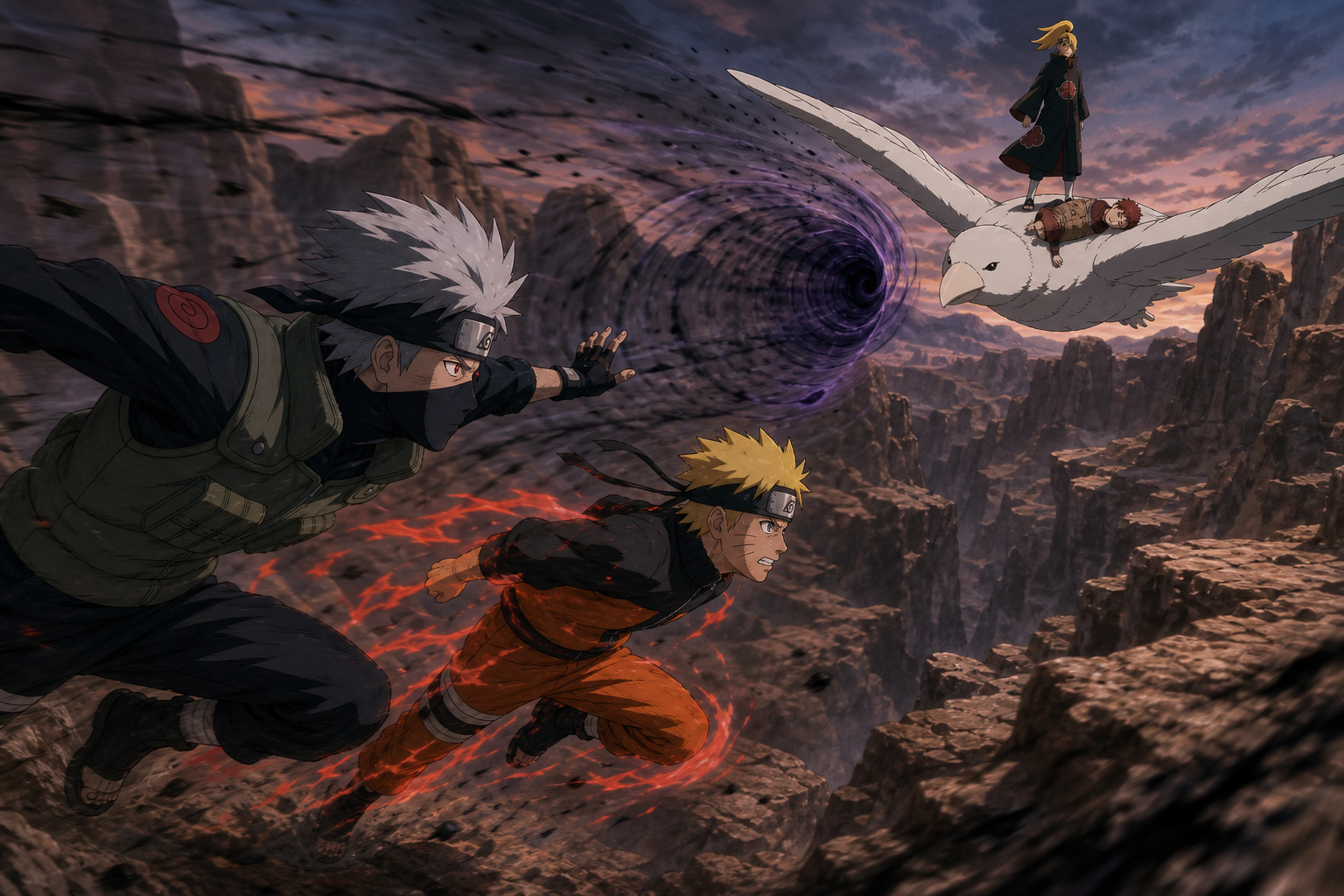
Kakashi Enlightened!
Kakashi struggles to focus Kamui while Naruto’s anger turns Deidara’s contempt for Gaara into a dangerous trigger.
Kakashi bends space while Naruto loses distance
Naruto Shippuden Episode 29 gives Kakashi a technique that can warp space and gives Naruto an emotional problem far more ordinary. Deidara keeps referring to Gaara as cargo, bait, and a dead jinchuriki because he understands exactly what that language will do. Naruto hears every village that reduced both boys to the creatures sealed inside them.
Kakashi needs focus. Naruto is losing it. The pursuit places those two conditions beside each other until the contrast becomes the episode's real tension.
Kamui is astonishing, but it is not instantly reliable. Kakashi has to select a distant moving target, calculate the distortion, and maintain control while running through unfamiliar terrain. Naruto needs a similar kind of precision with his anger. Deidara is trying to make precision impossible.
Gaara is not cargo
Deidara's treatment of Gaara's body is strategic cruelty. He knows Naruto will continue chasing. He also knows that dismissing Gaara as an object will make Naruto chase badly.
The insult reaches beyond friendship. Naruto and Gaara both grew up under labels that placed a tailed beast before the child carrying it. Villagers treated fear as knowledge and isolation as protection. When Deidara handles Gaara like a container that has already been emptied, Naruto hears that old verdict again: without the beast, the person does not matter.
Naruto's rage is therefore understandable. It is also dangerous. A rescue requires attention to Gaara's body, Deidara's movement, Kakashi's plan, and the risk of another explosion. Rage narrows all of that into a single need to strike.
Deidara is not merely provoking a temper. He is weaponizing a social wound.
Kamui begins as difficult work
Kakashi's Mangekyō Sharingan reveal does not arrive as effortless mastery. He struggles to focus the technique. The target shifts. The distortion forms imperfectly. The chakra cost is visible.
That limitation is important because Kamui can sound like an answer to every distance problem. If Kakashi could erase any target immediately, the pursuit would collapse into a demonstration. Instead, the technique behaves like a new tool whose consequences are enormous and whose control remains uncertain.
Kakashi has likely carried private questions about the eye for years. Using the Mangekyō in front of Naruto turns private development into team responsibility. A poorly aimed distortion could miss Deidara, harm Gaara, or exhaust Kakashi before the mission is finished.
The episode treats power as a burden of accuracy. Bending space matters less than deciding exactly what should be bent.
A moving target changes the calculation
Deidara's clay bird gives him altitude, speed, and the ability to alter direction without sharing the ground route Naruto and Kakashi must navigate. Gaara's body makes the target morally complicated. Kakashi cannot simply engulf the entire bird in a spatial distortion.
He has to isolate a part of Deidara's movement while preserving the person they came to recover. The precision required is severe, especially because the technique itself is new.
This is where Kakashi's combat intelligence matters more than the eye. The Sharingan provides perception and access. Kakashi still has to read trajectory, predict response, and choose a useful target.
Kamui is not enlightenment because a new symbol appears in his eye. It is enlightenment only if Kakashi can integrate the ability into judgment.
Naruto is reliving more than one loss
Naruto's reaction to Gaara contains the fear of losing a friend, but it also carries identification. Gaara achieved something Naruto still wants: his village recognized him as its leader. That achievement proved that a jinchuriki could become more than a warning whispered by adults.
Seeing Gaara dead threatens that proof. If Akatsuki can extract the beast and discard the person, the future Naruto imagined looks fragile again.
His anger is partly grief and partly terror. Deidara's contempt gives both feelings a target. The first Nine-Tails chakra begins to surface because Naruto has not found enough distance between emotion and action.
That does not make his bond with Gaara false. It shows why love requires regulation in a crisis. Naruto wants to honor Gaara as a person. Losing control risks making Gaara's body the center of another destructive display.
Kakashi has to manage two threats
Kakashi is pursuing Deidara while monitoring Naruto's chakra. The external enemy and internal escalation demand different responses. One requires attack. The other requires trust, warning, and readiness to intervene.
This is the difficult part of leadership. Kakashi cannot devote every resource to Kamui if Naruto is moving toward a transformation. He also cannot abandon the only technique likely to end the aerial pursuit.
The teacher-student relationship gives Kakashi information that a stranger would not have. He knows Naruto's anger often protects something real. He also knows the Nine-Tails can turn that protection into indiscriminate force.
Kakashi must treat Naruto as responsible without pretending the danger is imaginary. That balance is more delicate than targeting Deidara's arm.
Deidara understands spectacle
Deidara's art depends on explosion, surprise, and the instant when a carefully made object disappears into force. He knows how to direct attention. During the pursuit, Gaara becomes part of the composition he is arranging for Naruto.
The bait is emotional spectacle. Deidara wants Naruto to see a dead friend, hear degrading language, and respond in a way that proves control belongs to the provocateur.
This connects to his argument with Sasori. Deidara values the instant. Sasori valued permanence. Both artists turned people into materials for a private theory. Gaara's body is carried through the sky as evidence that Akatsuki's aesthetic debates still depend on victims.
Naruto can reject that framing only by remembering the rescue is about Gaara, not about giving Deidara the reaction he designed.
Rage can imitate focus
Anger feels clarifying because it removes competing concerns. Naruto sees Deidara and wants to close the distance. The simplicity is seductive.
Real focus does something different. Kakashi must hold several facts at once: Deidara is moving, Gaara must not be harmed, Kamui is unstable, Naruto's chakra is changing, and his own reserves are limited. Precision keeps complexity visible.
Naruto's rage begins erasing complexity. The Nine-Tails chakra offers speed and force while making careful distinctions harder. The power might help him reach Deidara. It might also make him less capable of completing the rescue that justified the pursuit.
This is why emotional regulation is not the opposite of caring. It is how care remains connected to the person rather than becoming permission for destruction.
The Mangekyō carries history
Kakashi's eye is not an isolated upgrade. The Sharingan came from Obito, and every development of that eye carries the history of loss, responsibility, and borrowed possibility. Kakashi using Kamui means using power rooted in another person's final choice.
That history may explain some of his caution. The eye is not simply equipment. Its use costs his body and recalls a bond he rarely discusses.
Naruto is also moving under inherited power, but the relationship differs. The Nine-Tails was sealed inside him without consent and has often emerged through emotional rupture. Kakashi's eye was given through a friend's choice and is activated through deliberate concentration.
Both powers carry someone else inside a person's combat identity. The episode contrasts what control looks like in each case.
Enlightenment is an unfinished process
The title can make Kakashi's new technique sound like a completed revelation. The episode presents a beginning. Kakashi knows what he wants the eye to do, but intention and execution have not aligned.
That is a more useful version of growth. Discovering an ability does not create mastery. Kakashi has to train accuracy, endurance, and judgment while the mission gives him no safe practice space.
His struggle also protects the larger story from treating teachers as finished products. Kakashi is experienced, but experience does not mean there is nothing left to learn. He can guide Naruto while confronting his own unstable edge.
The title's exclamation mark belongs to possibility, not completion.
The rescue must remain larger than revenge
Gaara is already dead, and that fact makes the mission emotionally unstable. Recovering his body still matters. Bringing him home matters. Denying Akatsuki the right to discard him matters.
Naruto's desire to punish Deidara is understandable, but revenge cannot become the only goal. If it does, Gaara remains an object around which other people act.
Kakashi's plan tries to preserve the rescue structure. Disable Deidara. Recover Gaara. Keep Naruto from losing himself. The order matters.
This is one of the arc's clearest lessons about respecting the dead. Gaara's personhood does not end because his life did. His body is not cargo, bait, or a prop for Naruto's anger. The rescue team owes him care even when hope appears gone.
Deidara's provocation repeats the villages' language
The cruelty works because it is familiar. Jinchuriki are repeatedly described by what they contain and what villages can extract from them. Akatsuki radicalizes that logic, but it did not invent it.
Deidara can treat Gaara as an emptied vessel because institutions already treated jinchuriki as vessels while they lived. Naruto's rage recognizes the continuity even if he does not articulate it.
That is why defeating Akatsuki alone cannot solve the entire problem. The villages must change the conditions that made jinchuriki isolation seem normal.
Naruto's bond with Gaara is part of that change. He sees a person where systems saw a weapon. To protect that vision, he has to refuse the loss of control Deidara is trying to trigger.
Final reaction
Kakashi Enlightened! gives its most spectacular power to the character exercising the most restraint. Kamui can bend space, yet Kakashi's challenge is accuracy, timing, and responsibility. The technique matters because Gaara cannot be collateral damage.
Naruto faces the opposite pressure. His bond with Gaara is real, and Deidara targets it with language designed to reopen the wound both jinchuriki share. Nine-Tails chakra begins to surface as anger collapses the distance between feeling and action.
The pursuit becomes a test of whether power can remain accountable to the rescue. Kakashi has to focus a new eye. Naruto has to keep seeing Gaara as a person rather than a reason to explode. Deidara understands spectacle. The team has to remember purpose.
Official episode reference: Naruto Official episode guide
Licensed episode route: Crunchyroll licensed episode page
Kamui arrives as power with a bill attached
Kakashi’s Mangekyo Sharingan does not enter the story as a clean upgrade screen. He has trouble fixing the target, the distortion forms slowly, and every attempt drains him. The technique is frightening because space itself bends around Deidara. It is also frightening because Kakashi’s body looks like it may refuse the next command.
That cost matters. Naruto has spent years treating spectacular jutsu as proof that somebody finally reached the next level. Episode 29 makes mastery look less glamorous. Kakashi possesses the technique before he can use it comfortably. Knowledge and control arrive on different schedules.
Kakashi calls it enlightenment, but the body calls it strain
The title celebrates a new eye opening, yet the episode keeps showing the labor hidden inside that revelation. Kakashi measures distance, concentrates, misses the result he wanted, and forces himself to try again while Deidara keeps moving.
“Enlightened” usually suggests clarity. Kamui gives him a power that temporarily narrows the world to one impossible task. The irony works because advancement does not simplify his responsibility. It gives him a more dangerous choice about how much of himself to spend.
Taking Deidara’s arm changes the pursuit without ending it
Kakashi’s first successful warp does not remove Deidara from the sky. It tears away an arm and leaves the Akatsuki artist adapting mid-flight. The result is brutal, useful, and incomplete.
That incompleteness keeps tactics alive. A lesser episode would treat the new eye as an automatic victory. Here Deidara still reads the danger, shifts position, and exploits the recovery time. Power changes the board. It does not excuse anybody from continuing to think.
Deidara keeps using Gaara as bait after Gaara is already dead
Carrying Gaara’s body is not only escape logistics. Deidara knows exactly what the sight does to Naruto. He turns a dead person into a moving trigger and keeps the rescuer looking upward instead of inward.
The cruelty fits Akatsuki’s larger treatment of jinchuriki. Gaara was reduced to a container during the extraction, then reduced again to leverage during the chase. Even after death, the organization tries to decide what his body means and how other people must respond to it.
Naruto’s rescue becomes grief before he can prepare
Naruto finally pulls Gaara free and asks him to wake up. There is no ceremony, no village elder, and no protected space for the truth. He has the person he came to save in his arms and learns that reaching him was not the same as arriving in time.
That gap breaks the fantasy that effort guarantees rescue. Naruto ran, fought, shouted, and refused to stop. None of it makes Gaara breathe. The episode lets helplessness enter before rage covers it.
The first tail turns grief into visible danger
Naruto’s red chakra answers a feeling too large for his current control. The transformation can punish Deidara, but it cannot distinguish vengeance from rescue or protect Naruto from being used by the enemy who provoked him.
This is why the Nine-Tails cannot be discussed as a convenient reserve tank. Its power arrives through a wound. Every increase raises the question of who still directs the body and whether Naruto’s love for Gaara is being converted into another person’s violence.
Deidara wants Naruto to become proof of Akatsuki’s story
Akatsuki treats jinchuriki as unstable weapons separated from ordinary human value. If Naruto loses control over Gaara’s body, Deidara gets to point at the destruction and pretend the organization’s reduction was accurate.
Naruto’s anger is justified. The trap lies in letting the person who caused the harm choose its direction. Deidara cannot make the grief illegitimate, so he tries to make it useful to him.
Kakashi has to manage two threats at once
The obvious threat flies above them with stolen clay and Gaara’s body. The second threat runs beside Kakashi and begins disappearing inside red chakra. A leader who watches only the enemy will lose Naruto.
Kakashi’s exhaustion sharpens the problem. He spent his reserves creating the opening Naruto needed, and now he may have to contain the teammate that opening devastated. Leadership means remaining responsible after the impressive move is finished.
Sakura sees Chiyo’s body refusing its own limits
Elsewhere, Chiyo continues while poison should have put her down. Sakura recognizes the medical reality and tries to turn her back toward treatment. Chiyo refuses because she still carries unfinished responsibility.
The scene does not make medical knowledge irrelevant. Sakura is right about the danger. Chiyo is also making a moral decision about what she is willing to risk before returning home. Their disagreement gives the cost a name instead of pretending determination heals poison.
Team Guy’s victory arrives too late to prevent the worst news
Neji’s Byakugan lets the team find Naruto and Kakashi, but vision delivers the truth before they can help. Gaara has been recovered and is dead. Both statements occupy the same moment.
That is the cruel rhythm of the rescue arc. Team Guy surpassed the mirror copies through growth, yet success in one battlefield could not freeze events in another. Coordination matters, but distance and delay still have consequences.
The episode separates vengeance from responsibility
Naruto wants Deidara to answer for Gaara. That demand is not childish. The danger begins when punishment becomes the only remaining purpose and Naruto’s own body becomes collateral.
Responsibility asks more difficult questions: protect Gaara’s body, keep the living team intact, stop Deidara from hurting somebody else, and preserve Naruto’s ability to choose what happens next. Vengeance narrows the field until only the target remains.
Gaara’s silence becomes the loudest fact in the chase
Until Naruto opens the clay bird, Deidara controls the pace with movement, taunts, and spectacle. Gaara’s body changes the rhythm. Naruto speaks to him, demands an answer, and receives nothing. The absence cuts through every trick Deidara used to keep the pursuit feeling like a contest.
That silence also protects Gaara from the villain’s interpretation. Deidara can carry him and weaponize the sight of him, but he cannot make Gaara endorse the story Akatsuki tells about jinchuriki. Naruto remembers a person, a rival, and a Kazekage who chose his village after the village failed him. Grief hurts because that full person remains present in memory even when the body cannot respond.
The next danger is whether Naruto can hold that memory without letting Deidara reduce it to a command: attack, lose control, become the monster everybody expected. Kakashi has seen enough loss to recognize the pattern. His hardest act of perception may be noticing the exact moment Naruto needs restraint rather than another order to fight.
RaeRae’s full take
Kamui is a spectacular debut because the episode refuses to pretend spectacular means finished. Kakashi bends space and still misses. He takes Deidara’s arm and still has to chase him. He unlocks a frightening advantage and nearly empties himself using it.
The real center is Naruto holding Gaara and discovering that rescue did not arrive in time. Deidara keeps poking that wound because he wants Naruto’s grief to prove the jinchuriki can be reduced to a monster. I am not blaming Naruto for breaking. I am blaming every adult system that watched children become containers and then acted surprised when pain found teeth.
Kakashi’s next responsibility is not another flashy warp. It is keeping Naruto present inside his own body while the team protects what remains of the mission. Power opened the eye. Care has to decide what it sees.
RaeRae checkpoint: Deidara thinks Gaara’s body can control Naruto from the outside and the Nine-Tails can control him from within. The rescue now depends on somebody defending Naruto’s right to remain himself.
Receipts and official routes
- Episode placement, Kakashi’s new technique, the pursuit, and Naruto recovering Gaara: Naruto Official Site episode guide.
- Licensed episode route: Crunchyroll.