
Father and Mother
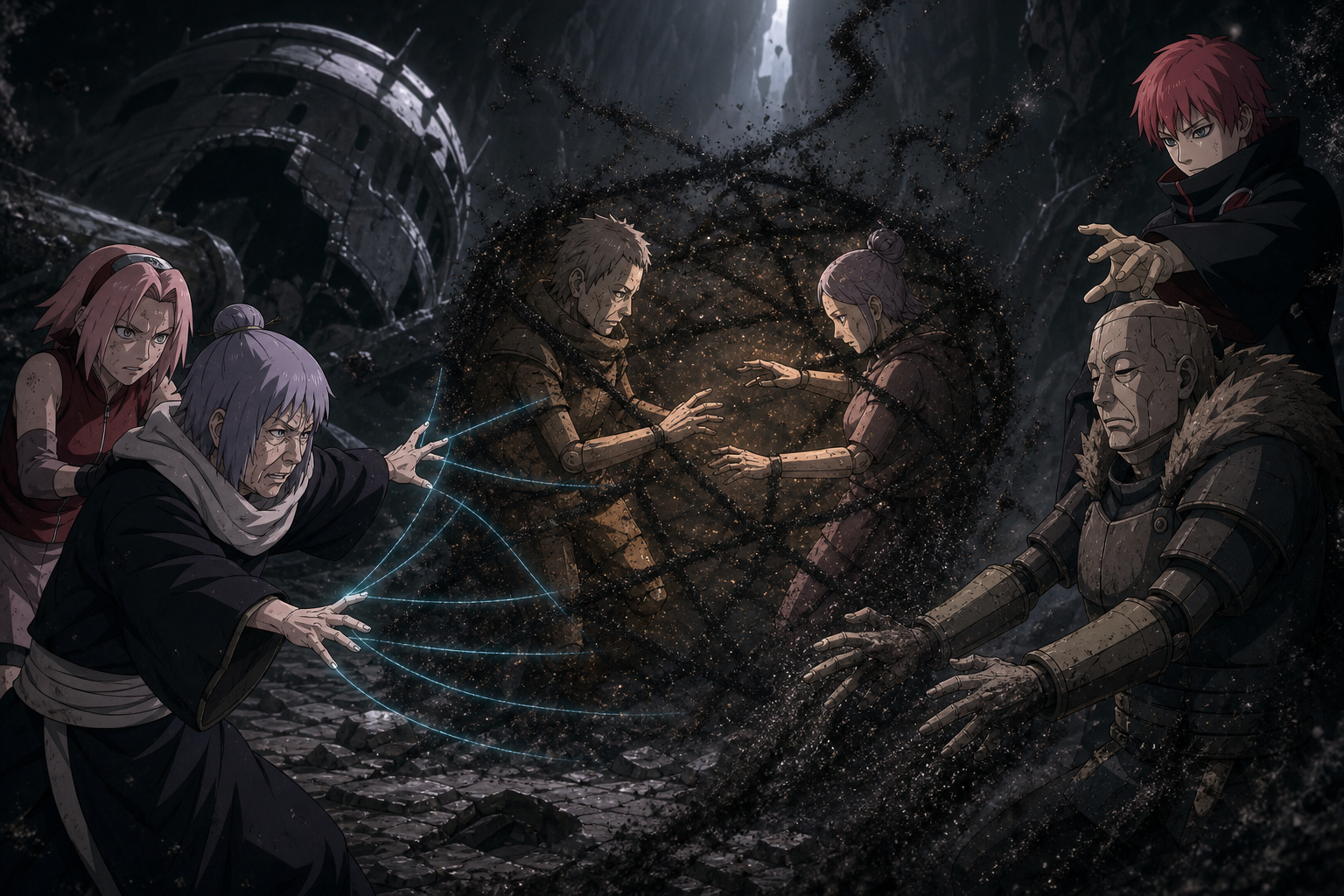
The Third Kazekage’s Iron Sand traps Chiyo’s family puppets, forcing Sakura to turn protection into a decision of her own.
The moment memory stops being shelter
Chiyo's Father and Mother puppets enter this fight carrying an impossible tenderness. They were built by a lonely child who wanted two absent people to come home. Their embrace once gave Sasori a shape for the comfort he could not receive. Now the same figures stand between him and Chiyo, and there is no warmth left in the room. Naruto Shippuden Episode 23 makes that contrast hurt before it lets the battle move forward.
The episode does not use Sasori's childhood to pardon what he became. It shows us where one coping mechanism began, then places that beginning beside the choices he has made since. Sasori did not merely preserve his parents as puppets. He turned other human beings into tools, erased the Third Kazekage's personhood, poisoned Kankuro, and helped tear Gaara away from his village. Grief explains why the first pair mattered. It does not excuse the collection that followed.
That distinction matters because the title, Father and Mother, sounds gentle. The episode itself is anything but gentle. Chiyo animates the pair with care, Sasori answers through the Third Kazekage, and Iron Sand closes around the family figures until they cannot move. The image of a mother and father reaching toward their child becomes a picture of memory trapped in place.
Iron Sand changes the rules
The Third Kazekage puppet is not simply another body with hidden blades. His magnetic chakra lets Sasori control Iron Sand, and that ability changes the scale of the chamber. A conventional puppet attacks along readable lines. Its joints, weapons, and strings suggest paths that a master might anticipate. Iron Sand spreads, gathers, and reshapes. It can strike from several directions while denying space at the same time.
Chiyo recognizes the danger immediately. Her warning to retreat is not cowardice. It is the judgment of someone who understands how completely the Third Kazekage's technique can overwhelm ordinary puppet tactics. She has spent decades reading mechanisms and hands. Magnetized sand gives Sasori a weapon that behaves more like the room itself has turned against them.
That is why the sealing of Father and Mother lands so sharply. Sasori does not need to destroy the puppets to defeat their immediate purpose. He immobilizes them. Their arms remain extended, but the embrace cannot close. The battle takes the private language of Sasori's childhood and freezes it under the power of a person he later murdered and converted.
There is a bleak progression inside that single exchange. The child Sasori created substitutes for the family he lost. The adult Sasori answers those substitutes with another stolen human body. One act tried to fill an absence. The other created an absence for an entire village. The episode trusts us to see the distance between them.
Chiyo protects more than a fighter
Chiyo's movements around Sakura say as much as her words. She places herself between Sakura and the attack because she knows the battlefield better, but the protection is not patronizing. Chiyo has already learned that Sakura is not baggage. Sakura broke free of Sasori's poison, read his timing, and committed herself to a fight that could kill her with one scratch. Chiyo protects a partner whose strength she respects.
That choice also reveals the change happening inside Chiyo. She entered this mission carrying old resentment, old certainty, and a willingness to reduce younger shinobi to the villages they represented. Sakura has made that distance harder to maintain. She is Tsunade's student, a Leaf ninja, a medic, and also simply a young woman refusing to abandon Gaara. Chiyo cannot keep those truths separated into convenient boxes.
Protection becomes the episode's quiet counterpoint to possession. Sasori controls bodies. Chiyo guides puppets. Both use chakra threads, but Chiyo's instinct in the critical moment is to preserve Sakura's ability to choose. Sasori's art removes choice from its materials. The visual similarity of their craft makes the moral difference clearer.
There is also guilt in Chiyo's defense. She knows that the young Sasori once needed care that the adults around him could not provide. She knows her own part in the silence surrounding his parents. Shielding Sakura cannot repair that history, yet it shows what Chiyo does with regret now. She can stand in front of someone. She can share what she knows. She can try to keep another young life from being swallowed by the consequences of the older generation.
Sakura's decision is the real turn
Sakura spends much of this phase physically connected to Chiyo's chakra threads, but Episode 23 refuses to let that arrangement define her as a puppet. The tension is building toward a choice. Chiyo can help her evade Sasori's attacks, but Sakura understands that endless evasion will not rescue Gaara or defeat the Third Kazekage puppet. Protection has to become an opening for action.
This is one of the strongest uses of Sakura's medical training in the arc. A medic reads danger through consequences. She knows how little room poison leaves for error, how quickly a wound can become irreversible, and how valuable each remaining antidote is. That knowledge could justify withdrawal. Instead, it helps her calculate what must be risked.
Her courage is not ignorance of the threat. She has seen exactly what Sasori's weapons can do. She chooses while afraid and informed. That makes the choice more meaningful than a sudden burst of confidence. Sakura is not waiting for Chiyo to solve the battlefield for her. She is studying the rhythm of the Iron Sand and deciding how her own strength can change it.
The partnership therefore begins to evolve. At first, Chiyo supplies movement while Sakura supplies power. Now Sakura is starting to claim the timing too. The strings remain visible, but dependence is giving way to coordination. Chiyo can protect her without owning her next move.
What the parent puppets mean now
Father and Mother are not neutral relics. Chiyo preserved them, and bringing them into this battle is an emotional gamble. She is asking objects shaped by Sasori's longing to reach the person who rejected that longing. Perhaps some part of her hopes recognition can cross the distance that words cannot.
Sasori's response offers no obvious reconciliation. He treats the pair as enemy weapons and uses Iron Sand to stop them. Yet the absence of an open reaction does not make the moment empty. Sasori has built his identity around stillness. He claims permanence through puppetry, keeps his face unchanged, and speaks as though ordinary attachment belongs to weaker people. A visible wound in that performance would threaten the entire structure.
The episode leaves the question in his silence. Does he feel nothing, or has feeling become something he can only answer through force? We do not need to diagnose him to understand the tragedy. The parent puppets cannot give back the family he lost. Destroying or immobilizing them cannot erase the child who built them.
Chiyo faces a related limit. She can wield the puppets with mastery, but she cannot make their symbolism do the work of an apology. Love expressed too late does not automatically become healing. Her present actions matter because they are present actions, not because they rewrite the past.
Sasori and the Third Kazekage
The Third Kazekage puppet is the most damning object in Sasori's collection. It represents talent stolen from a living person and converted into permanent property. The Kazekage's magnetic gift survives, but his will does not. Sasori calls that art. The episode shows the cost hidden inside the word.
This also connects the battle to Gaara even while he remains offscreen. Sunagakure has now lost Kazekage figures to the ambitions of others more than once. The Third was taken and transformed by Sasori. Gaara was taken by the Akatsuki and stripped of Shukaku. Chiyo and Sakura are fighting in a chamber filled with the history of that violation.
Sasori's control of the Third Kazekage also mocks the office itself. A leader who once protected the Sand is now made to attack one of its elders and a medic trying to save its current leader. The village's strength has been folded back against it. Chiyo is not only facing her grandson. She is facing the accumulated failures and losses of her home.
The battle's emotional geometry
The staging places three generations of choice in the same space. Chiyo carries the decisions of the past. Sasori has made absence into an ideology of control. Sakura belongs to a younger generation that inherited the damage without consenting to it. None of them can leave the history outside the chamber.
Father and Mother occupy the center because family is the first battlefield here. Chiyo looks at Sasori and remembers the boy. Sasori looks back through a body he built. Sakura sees both the intimate wound and the present threat. Her compassion does not require her to pretend they are the same thing.
That is where Episode 23 avoids an easy mistake. Understanding a villain's pain can deepen the story without shrinking the victims of his actions. Sasori's grief deserves recognition because it was real. So do the lives he took. The episode gains power by holding both truths at once.
Final reaction
Father and Mother is a painful title for an episode about failed protection. Sasori once made two puppets because he wanted an embrace. Chiyo brings those puppets back because she wants to reach him. Iron Sand locks them in place before they can complete the gesture. The family image remains, but the comfort is gone.
Sakura prevents the episode from ending inside that old grief. She is the person still capable of choosing what happens next. Chiyo's shield gives her time, not a command. Her medical knowledge gives her caution, not paralysis. Her strength gives the partnership a way to challenge a technique that has rewritten the battlefield.
The episode's best idea is that memory can explain a person without absolving them. The young Sasori's loneliness is heartbreaking. The adult Sasori's crimes are still his. Chiyo's regret is sincere. It cannot undo what she failed to see. What remains is action: protect someone now, trust someone now, and refuse to let the past dictate every movement still available.
Official episode reference: Naruto Official episode guide
Licensed episode route: Crunchyroll licensed episode page
The embrace fails because an object cannot complete grief
Mother and Father reproduce the shape Sasori wanted as a child. Their arms can close around him, but no mechanism can answer his anger, grow beside him, or repair the adults’ silence around his loss.
The failed embrace does not mock the child’s need. It exposes how desperately he needed living care and how little a crafted substitute could provide.
Iron Sand immobilizes memory without disproving it
Sasori traps the family puppets before they can function as Chiyo intends. Their inability to move does not make the love behind their creation false.
It shows that memory has no automatic battlefield authority. Chiyo must connect remembrance to present action rather than hope symbolism alone will reach the person attacking them.
Sasori answers tenderness with a stolen body
The contrast could not be uglier. Chiyo brings representations of parents created after death; Sasori responds through the preserved corpse of a man he murdered.
Both sides involve puppetry and absence, but one acknowledges loss while the other manufactures it and claims the remains as property.
The Third Kazekage attacks his own village’s future
Sasori forces a former Sand leader’s technique against Chiyo and Sakura while Gaara, the current Kazekage, lies dead nearby. The village’s stolen past is weaponized against people trying to recover its stolen present.
This is political desecration, not merely an impressive matchup. The office survives in reputation while the body that held it has been stripped of all authority.
Chiyo’s retreat warning is expertise, not surrender
She understands that Iron Sand changes the scale of the chamber and can neutralize ordinary puppet responses. Telling Sakura to withdraw acknowledges a danger she cannot responsibly minimize.
Courage without accurate threat assessment would only make Sakura easier to spend. Chiyo protects her by naming the point where inherited skill no longer guarantees control.
Sakura refuses the false choice between caution and action
Medical knowledge makes her aware of poison, limited antidotes, and the consequences of one mistake. That awareness does not force retreat.
It lets her decide which risk belongs to a viable plan. Informed courage is not fearlessness; it is action shaped by a truthful account of what the body can lose.
The chakra threads are becoming a conversation
Chiyo once supplied most of the evasive timing. Sakura has watched, learned, and begun anticipating patterns herself.
Direct control gives way to shared reading. The partnership improves because the younger fighter becomes less dependent, not because Chiyo secures permanent authority over her movement.
Protection should produce a decision window
Chiyo shielding Sakura does not settle the battle. It creates enough time and space for Sakura to study the attack and choose the next commitment.
Care is effective when it returns agency. A shield that never allows the protected person to act would become another enclosure, even if built from love.
Sakura’s next move belongs to her accumulated evidence
She has observed Hiruko, poison delivery, Iron Sand formation, Sasori’s preference for distance, and Chiyo’s responses. Her choice emerges from analysis across the fight.
The story is not handing her a sudden burst of instinct. It is showing battlefield literacy becoming strong enough to alter the partnership.
Chiyo cannot use the parent puppets as an apology
The figures carry regret, but Sasori is not required to interpret them as repair. An object built years ago cannot replace the conversation, protection, or accountability that failed to arrive when he was a child.
Chiyo’s responsibility exists in what she does now: protect Sakura, oppose Sasori’s crimes, and refuse to keep family history sealed away from consequence.
Understanding pain must preserve the victims around it
Sasori’s loneliness deserves recognition because children deserve care before they become dangerous. The Third Kazekage’s murder, Kankuro’s poisoning, and Gaara’s death remain equally real.
An explanation that makes those victims disappear would repeat Sasori’s own logic of turning other people into background material for his art.
The chamber holds three different relationships to inheritance
Chiyo carries Sand craft and regret. Sasori turns inherited knowledge into possession. Sakura learns from the tradition without accepting its moral failures as her destiny.
Inheritance becomes a choice about use. Receiving technique does not require repeating the relationship to bodies that earlier practitioners normalized.
The parent puppets remain meaningful after tactical failure
They do not defeat the Third Kazekage puppet in this exchange. Their value is not exhausted by whether they win.
They reveal the origin of Sasori’s attachment to controllable bodies, the limit of Chiyo’s earlier response, and the family wound both characters have tried to organize through craft.
Sasori’s silence cannot be read as absence of feeling
He has built an identity around stillness and control. A visible emotional response would threaten the posture through which he claims superiority over change.
The episode does not need to diagnose what remains beneath that posture. It only needs to show that silence does not absolve him or prove the family image had no effect.
Failed protection can still teach a different practice
Chiyo could not protect Sasori from loss, isolation, or the path he later chose. She cannot repair that failure by treating Sakura as another child whose choices must be overridden.
She learns to offer knowledge, shielding, and trust while leaving Sakura’s future open. The correction is incomplete, but it is real.
The title names relationships the battle cannot restore
“Father and Mother” centers two absences rather than the people physically speaking. The names remind us that family shaped this violence long before the cave.
They also refuse a sentimental ending. Naming parents does not make their return possible or turn their puppet forms into consent from the dead.
RaeRae’s full take
This episode hurts because the parent puppets were never enough, and Chiyo has to know that now. She built the shape of an embrace for a child who needed living people, truthful grief, and adults willing to stay present after the craftsmanship was finished.
Sasori takes that same terror of loss and builds a world where nobody can leave because nobody inside his collection can choose. The Third Kazekage’s Iron Sand is spectacular, but the spectacle belongs to a murdered man whose ability is being forced against his own village.
Sakura keeps the battle from becoming a closed family tragedy. Chiyo protects her so she can keep choosing, studying, and acting. That difference matters. The elder cannot rewrite Sasori’s childhood, but she can refuse to turn another young person into an object while trying to survive its consequences.
RaeRae checkpoint: Father and Mother can reproduce an embrace, but they cannot become the relationship Sasori lost. Repair begins when Chiyo stops asking objects to fix the past and protects a living partner’s choices now.
A memorial must remain different from a weapon
Mother and Father began as objects carrying grief, but combat asks Chiyo to use them offensively. The shift does not automatically make their creation equivalent to Sasori’s human puppets. Their material was never a murdered person whose abilities were confiscated.
Still, the episode lets the discomfort remain. When family memory enters battle, its meaning changes for everyone watching. Chiyo has to remember that the puppets cannot consent on behalf of Sasori’s parents or deliver forgiveness from them.
Their healthiest purpose is limited: protect the living, expose the history, and refuse the fantasy that controlled forms can finish a relationship the dead no longer inhabit.
Receipts and official routes
- Episode number, titles, the Father and Mother puppets, the Third Kazekage’s Iron Sand, and the battle’s changing conditions: Naruto Official Site episode guide.
- Licensed episode route: Crunchyroll.