
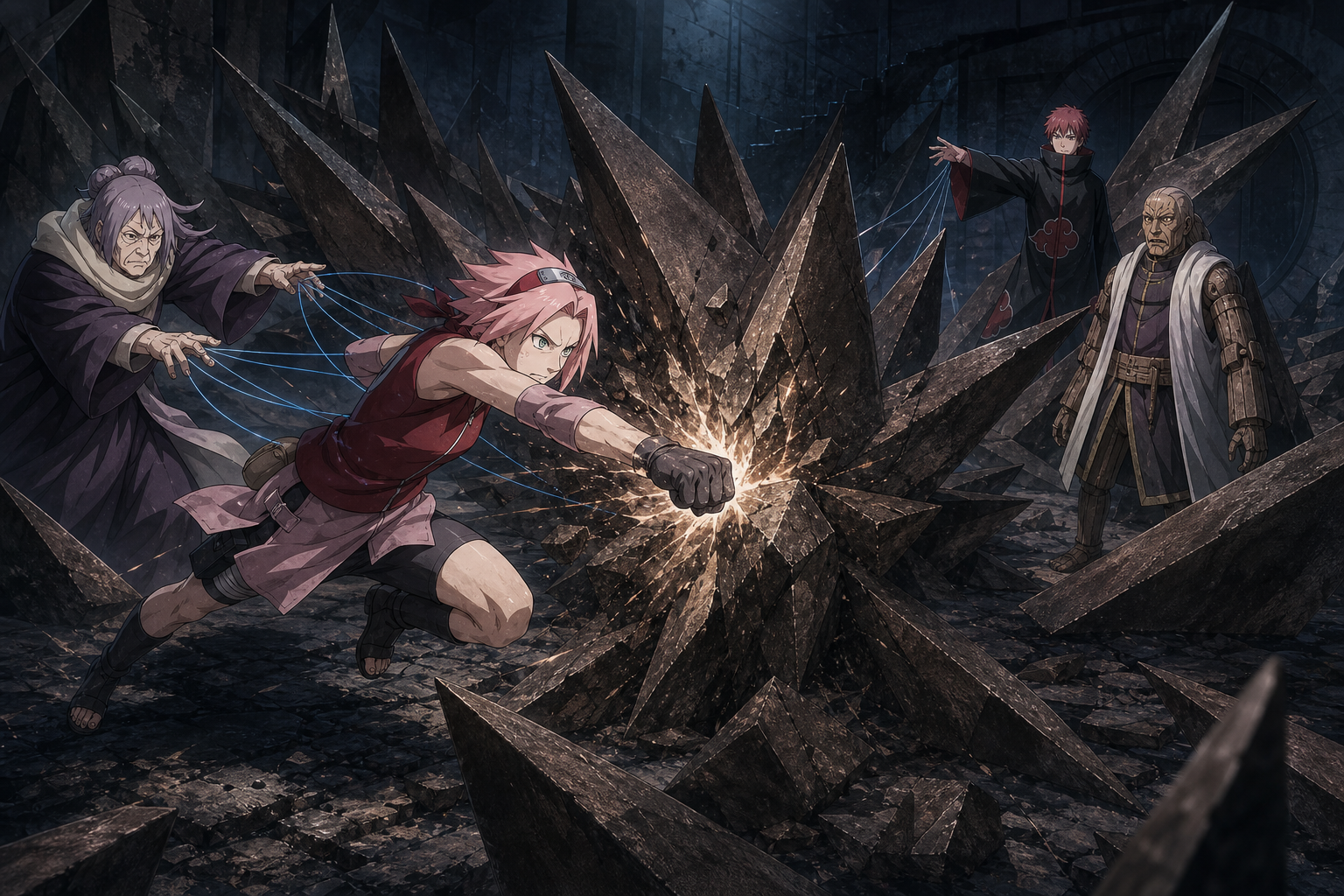
The Third Kazekage
Sakura reads the Iron Sand pattern, protects Chiyo, and proves that her strength begins with disciplined judgment.
Sakura's strength starts before the punch
Naruto Shippuden Episode 24 gives Sakura one of the cleanest demonstrations of what Tsunade actually taught her. The visible payoff is a devastating strike. The real skill begins several decisions earlier. Sakura studies how the Iron Sand occupies space, notices how Sasori shapes its attacks, respects the poison carried by every fragment, and commits only when she can turn one opening into a meaningful result.
That distinction matters. Reducing Sakura's growth to powerful punches misses the discipline that makes those punches possible. Tsunade did not train a blunt instrument. She trained a medical ninja who has to survive long enough to keep everyone else alive. Evasion, diagnosis, chakra control, and judgment are all part of the same system. The impact is the receipt, not the whole purchase.
The Third Kazekage puppet forces all of those lessons into the open. Its Iron Sand can become a cloud, a wall, a forest of spikes, or a compressed weapon. Sasori does not have to meet Sakura at close range. He can alter the battlefield until there is nowhere safe to stand. Sakura has to solve the technique before strength can matter.
A stolen leader controls the room
The horror of the Third Kazekage puppet is easy to lose beneath the spectacle. This was once a person whose rare magnetic chakra helped define his reputation as the strongest Kazekage of his era. Sasori killed him, preserved his body, and converted that gift into a tool. The Iron Sand remains. The man who chose how to use it does not.
Every attack therefore carries two kinds of violence. The immediate threat is poisoned metal moving under Sasori's command. The older violence is the theft of a human life and a village leader's agency. Sunagakure's strength has been turned back against one of its elders while Gaara, another Kazekage, lies dead because Akatsuki treated his body as a container to be emptied.
Sasori calls this preservation. Episode 24 makes it look like possession. He admires the Third Kazekage's power, but admiration without respect becomes acquisition. The puppet can reproduce a bloodline ability because Sasori maintained the body. It cannot consent, refuse, protect its village, or decide what that ability is for.
That makes the chamber feel crowded by absence. The Third Kazekage is physically present and personally gone. Gaara is elsewhere, his body recovered but his life missing. Sasori stands in front of Chiyo with the face of her grandson and speaks as though the child she knew no longer matters. The arc keeps asking what remains when a body is separated from the will that made it a person.
Iron Sand is a problem of space
Sasori's earlier weapons rewarded quick reactions. A blade arrived, and Chiyo pulled Sakura out of its line. The Iron Sand is harder because it changes the available geometry. It spreads across the chamber, gathers overhead, and condenses into shapes that cover multiple escape routes. Dodging one point can place a fighter inside the next attack.
Poison makes that control more severe. Sakura does not need to suffer a dramatic wound. A small contact can decide the battle. Sasori can force caution simply by filling the air with material that must not touch skin. The technique pressures attention before it pressures the body.
Sakura responds like a medic. She treats the attack as a system with causes, patterns, and consequences. She watches the movement rather than staring only at the weapon's final shape. She understands that Sasori still has to direct the Iron Sand through the Third Kazekage puppet. Large coverage does not mean infinite speed or perfect control.
This is the kind of intelligence action scenes often hide. Sakura's analysis happens while she is moving, protecting Chiyo, and trusting chakra threads she cannot pause to inspect. Her eventual strike looks spontaneous only if we ignore everything she has measured to make it possible.
Chiyo and Sakura reverse their roles
Chiyo has protected Sakura throughout the fight, using experience and chakra threads to compensate for the younger ninja's unfamiliarity with puppetry. Episode 24 begins to reverse that relationship. Sakura sees danger moving toward Chiyo and acts for her. The person who entered the chamber as the protected partner becomes a shield.
This is not a declaration that Chiyo is suddenly helpless. It is proof that the partnership has become reciprocal. Chiyo brings technical knowledge, timing, and decades of experience. Sakura brings medical judgment, controlled strength, and a willingness to accept responsibility for the next move. Neither contribution cancels the other.
The chakra strings underline that trust. In another context, strings could mean control. Here they transmit cooperation. Chiyo can guide Sakura because Sakura consents to the arrangement and continues making decisions inside it. Sasori's puppets have no comparable agency. The visual language is similar while the relationship is opposite.
That difference becomes especially sharp beside the Third Kazekage. Sasori kept the former leader's ability by removing his choice. Chiyo helps Sakura use her own abilities more effectively without claiming them. One puppeteer builds obedience. The other builds coordination.
Tsunade's first rule of survival
The episode directly connects Sakura's performance to Tsunade's insistence that a medical ninja must evade attacks. This rule is sometimes mistaken for an order to remain passive. It is actually a demand for disciplined presence. A medic who falls cannot treat anyone, and a medic who panics can become another casualty the team must protect.
Sakura's evasion is not retreat from the fight. It keeps her alive until she can alter it. Every avoided Iron Sand strike preserves the possibility of saving Chiyo, producing more antidote knowledge, reaching Gaara, and confronting the next threat. Survival is part of the mission, not an embarrassing delay before the impressive moment.
Her chakra control connects healing and strength. The same precision that lets a medic work on fragile tissue lets Sakura concentrate power and release it at the chosen instant. The punch is not proof that she abandoned medical training for combat. It is proof that Tsunade taught her a unified discipline.
This framing also protects Sakura from an unfair comparison with Naruto and Sasuke. Her growth does not need to imitate their techniques. She has developed a method built around her own control, intelligence, and vocation. Episode 24 lets that method solve a problem neither determination nor spectacle alone could solve.
The strike is a decision
When Sakura commits to the attack, she is accepting risk with open eyes. The Iron Sand can poison her. Sasori can change its shape. Chiyo cannot guarantee a safe route. Yet waiting only gives Sasori more control over the chamber. Sakura chooses the moment when action offers a better chance than continued evasion.
Her strike works because it is aimed at the structure of the problem. She does not punch whatever happens to be nearest. She attacks through the formation and disrupts the Third Kazekage puppet's advantage. Controlled strength turns analysis into consequence.
That is why the scene feels earned. The story has shown Sakura preparing antidotes, reading mechanisms, escaping poison, accepting Chiyo's guidance, and learning Sasori's rhythm. The punch gathers those earlier choices into one visible answer. It is satisfying because it has a history.
Sasori's surprise matters too. He has treated Sakura as material to be manipulated, first through poison and then through the space controlled by Iron Sand. Her breakthrough denies that assumption. She cannot be reduced to the route his weapons leave open. She can read the design and break it.
Power without responsibility
The title belongs to the Third Kazekage, but the episode denies him a voice. That absence is the point. His strength survives only as evidence of what Sasori stole. A title associated with responsibility has been emptied until only power remains.
Gaara's story provides the contrast. He struggled to become Kazekage because he wanted a relationship with his village. His power mattered, but the office changed when he chose to use it for other people. The Third Kazekage puppet has tremendous ability and no relationship at all. Sasori preserved the weapon while destroying the bond.
Sakura's power moves in the other direction. Her strength is inseparable from responsibility. She fights because Gaara might still be recovered, because Chiyo is beside her, because Naruto is chasing Deidara, and because the poison Sasori created has already harmed others. Her ability becomes meaningful through the people it can protect.
The episode therefore places three definitions of strength in conflict. Sasori values ownership and permanence. The puppet displays stolen capacity without choice. Sakura joins capacity to judgment and care. The loudest collision in the chamber is also an argument about what power is for.
Chiyo sees a future she did not expect
Chiyo's reaction to Sakura carries more than tactical approval. Sakura represents a generation Chiyo initially distrusted. She is a Leaf ninja trained by Tsunade, yet she risked herself for the Sand's Kazekage and prepared the antidote that saved Kankuro. Each decision weakens Chiyo's belief that old village divisions should determine present loyalty.
Watching Sakura confront the Third Kazekage puppet makes the lesson impossible to dismiss. The Sand's stolen history is being defended by someone from the Leaf. Chiyo can respond by clinging to resentment, or she can recognize the alliance taking shape in front of her.
That recognition does not erase the wars, losses, or mistakes that formed Chiyo. It gives her another choice now. Like Sakura, she must decide what inherited knowledge will serve. She can use it to maintain old walls or to help a younger ninja survive a battle neither village can win alone.
Final reaction
The Third Kazekage succeeds because it understands that Sakura's punch is the end of a thought process. She studies the field, accounts for poison, trusts Chiyo, protects her partner, and chooses a point where concentrated force can matter. Calling that brute strength would ignore nearly everything the episode shows us.
The Third Kazekage puppet remains a brutal symbol of stolen agency. Sasori preserved a rare technique while discarding the person and responsibilities that gave it meaning. Sakura answers with power rooted in the opposite values. Her training matters because she decides how to use it and whom it should protect.
This is Sakura's growth in full: not simply stronger, but more disciplined, more observant, and more willing to carry the consequences of a choice. The impact is spectacular. The judgment behind it is the real achievement.
Official episode reference: Naruto Official episode guide
Licensed episode route: Crunchyroll licensed episode page
Iron Sand makes scale look like inevitability
The technique fills the chamber so completely that resistance can seem childish. Spikes, clouds, and compressed shapes deny the eye a simple route toward Sasori.
Sakura’s analysis matters because scale is not the same as inevitability. Every formation still has timing, direction, and a controller whose decisions create openings.
Sakura reads the attack before she challenges it
Her strength does not rescue her from observation. She watches how the Iron Sand gathers, where Sasori directs it, and which movement leaves enough structure for one committed answer.
That patience is active. Each avoided strike builds a record, and the record becomes the difference between impact and waste.
Medical discipline prevents courage from becoming disposal
Sakura knows poisoned material can end the fight through contact too small for spectacle. She cannot treat her body as an unlimited payment method.
Tsunade’s survival rule asks the medic to preserve future capacity: treatment, antidote knowledge, protection for Chiyo, and whatever comes after the cave.
The Third Kazekage’s title remains while his authority is gone
Sasori can deploy the leader’s magnetic gift and benefit from the fear attached to his reputation. The dead man cannot decide whether his technique attacks the Sand’s allies.
This is power stripped from responsibility. A political title becomes branding for a weapon whose operator murdered the person who once carried its obligations.
Sakura fights the puppet without fighting the victim
Destroying or disabling the Third Kazekage’s body is necessary because Sasori keeps using it to harm people. That necessity does not transfer blame onto the dead leader.
The moral target remains the person who created the impossible choice. Sakura resists continued exploitation even when resistance damages what was stolen.
Sasori’s admiration never becomes respect
He preserved the Kazekage because the man’s ability was rare and powerful. Admiration focused only on usefulness becomes acquisition.
Respect would have recognized bodily autonomy, political responsibility, and the right to remain more than a technique. Sasori keeps everything except the person.
Gaara and the Third Kazekage occupy the same accusation
One leader lies dead after Akatsuki removed Shukaku. Another attacks as a puppet after Sasori removed his agency. Both bodies were targeted because of exceptional power.
The cave exposes a system that praises strong Kazekage while making their bodies vulnerable to anyone who believes power creates ownership.
Chiyo’s guidance succeeds when Sakura can exceed it
The elder supplied a foundation for reading puppet combat, but Sakura is beginning to choose timing and protection independently.
Mentorship becomes visible when the student can act beyond the exact instruction given. Chiyo’s authority grows through Sakura’s agency instead of shrinking when direct control becomes less necessary.
Sakura protecting Chiyo makes reciprocity physical
The younger fighter was initially the body Chiyo pulled away from hidden weapons. Now Sakura recognizes danger and places her strength between the elder and the attack.
The reversal does not cancel age or expertise. It proves both women understand care as a responsibility that can change direction during the same fight.
The chakra threads remain useful without owning the decision
Chiyo can adjust Sakura’s line, but she cannot guarantee safety or select every risk on Sakura’s behalf. The next commitment belongs to the person whose body will enter it.
Their coordination remains ethical because influence does not erase authorship. Sakura receives information through movement and still decides what her strength will do.
The strike attacks a structure, not a mood
Sakura does not punch because frustration finally overflows. She chooses a formation whose destruction can reduce Sasori’s control of space.
Anger may energize her, but analysis determines the target. Emotional force becomes useful only after judgment gives it an address.
Sasori’s surprise reveals his own reduction of Sakura
He expects a younger medic to remain manageable inside poison, distance, and Chiyo’s threads. Her ability to read and break the formation contradicts the category he assigned her.
Control specialists often mistake the routes they leave available for the full range of another person’s choices. Sakura creates an answer outside his prediction.
Strength is most impressive when it refuses unnecessary repetition
One controlled strike can matter more than many desperate attempts. Sakura conserves movement until the battlefield offers a point where force will alter the conditions.
This is precision at scale. The punch looks enormous because the decision behind it is narrow.
The episode returns stolen power to historical context
Iron Sand is not simply Sasori’s cool technique. The title insists we remember the Third Kazekage, the missing leader whose body made the display possible.
Naming him interrupts Sasori’s claim of ownership. Every attack becomes evidence of a person and village history concealed inside the collection.
Chiyo’s changing view of the Leaf has a witness
Sakura risks herself for Sunagakure’s dead leader, current Kazekage, elder, and poisoned shinobi. Those choices challenge Chiyo’s inherited expectation that village identity determines loyalty.
The alliance is no longer an agreement between offices. It is visible in a Leaf medic defending Sand lives while confronting the weaponized remains of Sand history.
Sakura’s path does not need to imitate Naruto or Sasuke
Her control, medical reasoning, and concentrated force form a coherent discipline. Episode 24 tests that discipline against a battlefield neither inherited bloodline nor emotional determination solves automatically.
Growth becomes specific instead of comparative. Sakura is formidable because her training fits the problem and because she knows how to make it serve somebody else.
The punch carries earlier work into one visible receipt
Kankuro’s antidote, Chiyo’s explanations, the Hiruko exchange, poison-cloud escape, and Iron Sand observations all arrive inside the final commitment.
The moment feels sudden only if the preparation is ignored. The spectacle works because the story has already shown the labor making it possible.
RaeRae’s full take
Sakura does not win this moment by discovering she can hit hard. She already knows that. She wins it by refusing to spend that strength before she understands what Sasori’s Iron Sand is doing to the room, Chiyo, and every safe route.
The Third Kazekage puppet makes the achievement uglier and more important. Sasori stole a leader’s body, kept the rare technique, and removed every obligation that once told the power whom to protect. Sakura has to damage the stolen remains to stop the theft from continuing.
Her answer joins force to care. She protects Chiyo, preserves her medical future, reads the formation, and commits at the point where one strike changes the battlefield. The impact is loud. The discipline underneath it is the real flex.
RaeRae checkpoint: Sakura’s punch is not the beginning of her strength. It is the visible receipt for observation, medical judgment, reciprocal trust, and one decision precise enough to break Sasori’s control of the room.
Tactical destruction and historical recovery are separate obligations
Sakura may need to break formations produced through the Third Kazekage’s body. That necessity cannot become permission to forget whose remains Sasori is operating.
After survival, Sunagakure still needs the truth: how its leader disappeared, who killed him, and how his body was used. A battlefield victory can stop the immediate attack without completing the work of returning the victim to public history.
Holding both duties prevents urgency from becoming erasure. The women can destroy the weaponized function while refusing Sasori’s claim that the person inside it was ever only useful material.
Receipts and official routes
- Episode number, titles, the Third Kazekage puppet’s Iron Sand, Chiyo’s guidance, and Sakura’s counterattack: Naruto Official Site episode guide.
- Licensed episode route: Crunchyroll.