
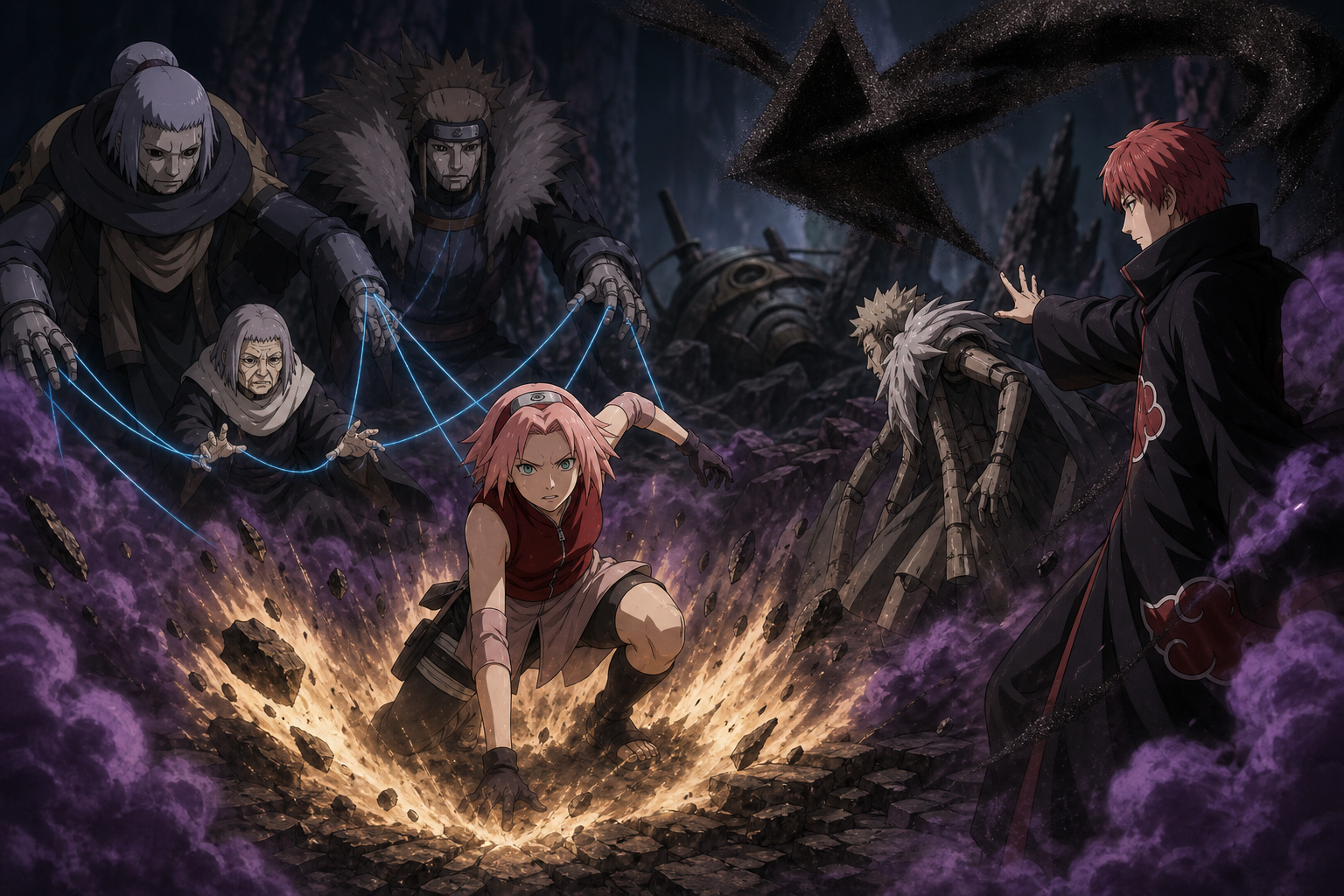
Chiyo’s Secret Skills
Sakura blasts free of Sasori’s poison, and her resolve moves Chiyo to summon the two family puppets reserved for this battle.
Sakura rescues herself before Chiyo answers
Naruto Shippuden Episode 22 places Sakura inside Sasori's poison cloud and lets her solve the immediate problem herself. She uses a paper bomb to blast clear of the fumes rather than waiting for Chiyo to pull her out.
That choice matters because the previous fight used chakra threads to coordinate Sakura's movement. Episode 22 makes clear that partnership did not replace her judgment. She has been studying Sasori's attack pattern, measuring the poison, and keeping options available.
Chiyo's secret skill arrives after Sakura demonstrates resolve. The elder answers a capable partner, not a helpless body.
Poison tries to make time belong to Sasori
Sasori's poison changes every injury into a countdown. The cloud expands that control from individual weapons to the surrounding air.
Sakura cannot simply endure inside it. Breathing becomes exposure, and remaining still lets the poison decide the timetable.
The paper bomb creates violent movement on Sakura's terms. She accepts the force of her own detonation to escape a field where every additional second benefits Sasori.
This is calculated self-risk rather than recklessness. She chooses a known blast over invisible contamination because her medical knowledge tells her which danger she can survive.
Sakura's declaration changes Chiyo's decision
Sakura declares that she will risk injury to capture Sasori and force information about Orochimaru from him. The statement reaches beyond this fight.
Orochimaru is connected to Sasuke, so Sakura's determination carries Team 7's unresolved mission into the cave. She is not fighting only because Naruto ran after Deidara or because Chiyo needs assistance.
Her purpose is her own. She wants information that might create a route toward Sasuke, and she is willing to place her trained body behind that goal.
Chiyo hears commitment rather than youthful posturing. It moves her to reveal the puppets she reserved specifically for Sasori.
Chiyo brings out Mother and Father
The two puppets are modeled after Sasori's parents. Chiyo once built them in response to a child's grief, hoping crafted bodies could provide some version of the embrace he had lost.
Bringing them into battle turns a private family artifact into a countermeasure against the adult Sasori became.
The choice is emotionally dangerous. Chiyo exposes the form of an old attempt at comfort to someone who transformed puppetry into a philosophy of permanent control.
She also accepts that the puppets cannot repair the original loss. Their value now lies in protecting Sakura and opposing the person who rejected living attachment.
The secret skill is not only technique
Chiyo's ability to control multiple puppets is technically impressive, but the real secret is what she is willing to bring into the open.
The Mother and Father puppets contain family history, regret, and an elder's failed effort to answer a child's loneliness. Using them means refusing to keep that history sealed away from the consequences it helped shape.
Chiyo does not summon neutral weapons from storage. She summons evidence of love that could not substitute for living parents.
The skill therefore joins technique with accountability. Her hands can move the puppets because she is finally willing to let their meaning enter the fight.
Sasori and Chiyo use family differently
Sasori turns the Third Kazekage into a human puppet by killing and preserving him. Chiyo created Mother and Father as representations rather than stolen bodies.
Both use puppetry to hold something absent, but the ethics differ. Chiyo's figures acknowledge loss through craft. Sasori's human puppet produces permanence by violating a person.
Neither approach can make the dead return as willing participants. The question is whether the puppet admits that absence or hides it behind simulated control.
Mother and Father are memorial forms. The Third Kazekage is confiscated agency.
The Third Kazekage's Iron Sand is inherited theft
The Third Kazekage puppet retains Iron Sand, an ability tied to his body and reputation as the strongest Kazekage.
Sasori did not invent that power. He acquired it by murdering the person who carried it and preserving the body as equipment.
This is extraction on a smaller scale. Akatsuki removes Shukaku from Gaara; Sasori removes choice from the Kazekage while keeping the useful technique.
The Iron Sand cloud looks like Sasori's mastery, but it is also evidence of what he stole.
Iron Sand turns the whole cave into a weapon
Unlike a single puppet blade, Iron Sand can fill space, change shape, and attack from many angles. The battlefield itself becomes unstable.
Sakura's strength is less useful when the target is a shifting mass. Chiyo's puppets can block and redirect, but every defensive movement must account for particles that can reform.
The technique rewards Sasori's distance. He controls danger through the Third Kazekage while keeping his own body outside Sakura's immediate range.
The women need to read pattern inside apparent chaos, just as Sakura read the poison cloud closely enough to choose an exit.
Sakura keeps studying while fighting
Sakura's most important strength in this stage is observation. She tracks the sequence of Sasori's attacks instead of treating each one as unrelated spectacle.
Pattern recognition creates the possibility of independent evasion. The more she understands, the less Chiyo must control every joint.
That growth matters to the partnership. Good support should increase another person's agency over time, not make dependence permanent.
Chiyo's guidance gave Sakura a model of Sasori's timing. Sakura now converts that borrowed knowledge into her own battlefield literacy.
Chiyo's protection respects Sakura's purpose
Sakura's willingness to risk injury could be dismissed as reckless youth. Chiyo does not answer by removing her from the fight.
She brings out the tools that can make Sakura's commitment survivable.
This is protection without cancellation. Chiyo respects Sakura enough to strengthen the chosen mission rather than substitute her own judgment for every decision.
The two puppets create coverage while Sakura continues gathering information and preparing force.
The episode refuses passive mentorship
Chiyo is not a mentor who delivers a lecture while the younger fighter performs. Her past and body are directly involved.
Sakura is not a student waiting to be rescued by older expertise. Her resolve causes Chiyo to reassess what she is willing to use.
Influence moves in both directions. Chiyo teaches Sakura how to survive Sasori. Sakura teaches Chiyo that the next generation may use inherited knowledge differently.
Their partnership becomes a feedback loop rather than a hierarchy.
Mother and Father cannot repair childhood
The puppets were once meant to answer Sasori's longing for parents he could no longer hold. Their embrace could imitate shape and movement, but it could not restore relationship.
That failure does not make Chiyo's care false. It shows the limit of replacing people with controllable objects.
Sasori appears to have taken the lesson in the worst direction. If puppets cannot bring the dead back, he can at least make bodies permanent and obedient.
Chiyo now uses the same family forms to oppose that conclusion.
Sakura's risk must remain hers
Sakura's declaration that she will accept injury is powerful because she understands the cost. It would become dangerous if others treated it as permission to spend her body carelessly.
Chiyo's response avoids that trap. She does not praise sacrifice and step aside. She increases protection.
The distinction matters in a shinobi system that often celebrates young people for offering themselves to missions. Respecting courage requires reducing unnecessary harm, not demanding proof through suffering.
Sakura owns the decision to enter risk. Chiyo owns the responsibility to help her survive it.
Sasori's permanence depends on other people's endings
Sasori's art appears durable because its materials no longer change on their own. The Third Kazekage puppet can remain in inventory for years.
That permanence depends on a person's death. Sasori freezes time by ending the lives whose bodies he preserves.
Chiyo's puppets are also durable objects, but they do not contain stolen human techniques. Their meaning changes as Chiyo changes how she uses them.
This contrast suggests a healthier form of continuity. An object can carry memory without claiming to replace the person or own the body that memory belongs to.
The battle becomes an argument about inheritance
Chiyo and Sasori share a puppetry lineage. The Third Kazekage represents Sand power converted into private property. Mother and Father represent family memory converted into protection.
Sakura enters that argument from outside the lineage. She brings medical knowledge, chakra-enhanced strength, and a mission connected to Orochimaru.
Inheritance is no longer only what elders pass to descendants. It is what the recipient chooses to make from the knowledge received.
Sasori turns craft into possession. Chiyo turns it toward repair. Sakura learns from both while refusing to become either woman's object.
Survival knowledge should make independence possible
Chiyo's guidance began by moving Sakura directly through chakra threads. That intervention was necessary while Sasori's hidden mechanisms exceeded Sakura's experience.
Episode 22 shows the next stage of useful teaching. Sakura recognizes the poison trap, chooses the paper bomb, and creates her own escape. The earlier support has become information she can apply without waiting for another hand.
This is a better measure of mentorship than permanent dependence. Chiyo's value does not shrink when Sakura needs less direct control. It becomes visible in the younger fighter's expanding options.
Sasori's model of mastery moves in the opposite direction. His puppets become more valuable to him as their independent agency approaches zero. The perfect instrument cannot surprise its operator.
Chiyo accepts surprise. Sakura's resolve changes her plan and draws out techniques she had not intended to reveal so soon. Their cooperation grows because each woman remains capable of affecting the other.
The distinction separates education from possession. Teaching prepares another person to act. Control prepares another body to obey.
The paper bomb is a medical decision
The explosion may look like raw battlefield improvisation, but Sakura's choice depends on clinical judgment. She evaluates the poison cloud as a greater threat than the blast radius she can manage.
Medical expertise often appears cautious because it values preservation. Here, preservation requires decisive violence against the environment around her.
Sakura does not choose the safe option because no safe option exists. She chooses the harm whose mechanism, timing, and treatment she understands.
That reasoning is part of what earns Chiyo's trust. The elder sees that Sakura's willingness to risk injury is not ignorance of consequences. It is a calculated refusal to let Sasori determine which consequence occurs.
Her escape also protects Chiyo from having to spend attention on an impossible rescue inside the cloud. One act of self-preservation returns both women to a coordinated fight.
Fandom arguments worth sorting out
One argument says Chiyo saves Sakura from the poison cloud. Sakura uses her own paper bomb to escape, then Chiyo escalates protection in response to her resolve.
Another argument treats Mother and Father as simple power upgrades. They carry the history of Chiyo trying to answer Sasori's childhood grief through controllable substitutes.
A third argument says Sakura's willingness to be injured is automatically heroic. Its value comes from informed purpose and Chiyo's refusal to spend her carelessly.
The final argument treats Iron Sand as solely Sasori's achievement. He controls it through the murdered Third Kazekage's preserved body.
RaeRae's verdict
“Chiyo's Secret Skills” makes self-rescue the condition for deeper cooperation. Sakura blasts herself out of poison, states what she is fighting for, and keeps studying Sasori's patterns. Chiyo answers by exposing the two family puppets she brought only for this confrontation.
Across the cave, Sasori uses the Third Kazekage as equipment. The contrast is brutal. Chiyo's puppets acknowledge absent parents. Sasori's human puppet deletes a murdered leader's consent while keeping his power.
The secret skill is not merely controlling two puppets. It is Chiyo's decision to turn private regret into protection for someone still alive.
Sakura does not become the object of that protection. She remains the partner whose resolve changed what Chiyo was willing to do.
Sakura turns an explosion into controlled escape
The paper bomb is not a panic button. Sakura chooses a violent force whose range and consequences she can judge over a poison cloud whose continued exposure belongs entirely to Sasori.
Medical reasoning lets her compare harms instead of searching for an imaginary safe option. She accepts the danger she can manage to escape the danger designed to remain invisible until it is too late.
Self-rescue proves the earlier threads expanded her choices
Chiyo’s direct guidance in the Hiruko fight did not train Sakura into dependence. It gave her a model of Sasori’s timing, weapon logic, and use of space.
Episode 22 shows that borrowed knowledge becoming independent action. Good support leaves the supported person with more agency after the connection loosens.
Sakura’s resolve is specific, not decorative courage
She wants Sasori alive long enough to produce information about Orochimaru and the route toward Sasuke. Her willingness to risk injury belongs to a concrete investigative objective.
That purpose does not make every sacrifice wise. It gives Chiyo enough information to strengthen the plan around what Sakura has consciously chosen.
Chiyo answers courage by increasing protection
The elder does not praise Sakura’s willingness to be hurt and then let her absorb whatever follows. She summons tools capable of reducing that harm.
This is the obligation adults often avoid in shinobi stories. Respecting a young person’s bravery means making survival more likely, not treating bravery as permission to spend their body.
Mother and Father record an attempt that could not become repair
Chiyo built the puppets to answer Sasori’s longing after his parents died. Their arms could reproduce an embrace, but controllable forms could not restore the relationship or let grief change through another living person.
The failure does not make her care false. It reveals the limit of substituting craft for presence while leaving the child’s loneliness structurally untouched.
Sasori converts that limit into a philosophy
Where Chiyo’s puppets admit absence, Sasori’s human puppets pretend loss can be defeated through ownership. He keeps bodies, techniques, and appearances while eliminating refusal.
Permanence becomes attractive because living relationships can leave. His solution is to make departure impossible by ending the person first.
The family puppets enter as witnesses, not restored parents
Summoning Mother and Father does not recreate a family reunion. The forms carry evidence of what Sasori needed, what Chiyo tried, and what neither object could provide.
Using them against him brings that history into the present without asking the audience to confuse representation with resurrection.
Iron Sand extends a dead man’s power without his authority
The Third Kazekage’s technique remains effective because Sasori preserved the body capable of producing it. The leader’s judgment, obligations, and consent are absent.
Sasori displays the power as personal achievement, yet every particle also records theft. He owns access to ability he did not originate and cannot morally inherit.
The cave becomes hostile air, not merely hostile ground
Poison cloud and Iron Sand deny the women the comfort of a stable safe zone. Breathing, distance, and visibility become contested resources.
Sakura and Chiyo must build temporary safety through motion and mutual observation. The environment cannot be treated as neutral space surrounding a duel.
Pattern recognition returns control piece by piece
Sakura studies the sequence behind Sasori’s attacks rather than reacting to each weapon as unrelated surprise. Every observed pattern removes a small portion of his monopoly over timing.
She does not become immune to danger. She becomes harder to direct because she can anticipate what the attack is trying to make her do.
Teaching and control point toward opposite futures
Chiyo’s support succeeds when Sakura can act without a thread on every joint. Sasori’s control succeeds when a puppet has no independent future at all.
The techniques may share visual language, but their measures of mastery conflict. One increases another person’s options; the other perfects obedience by erasing them.
Sakura changes Chiyo’s plan because partnership allows surprise
Chiyo did not begin the exchange intending to expose every family artifact immediately. Sakura’s escape and declaration force the elder to revise her judgment.
A partner can introduce new information and alter strategy. An object can only perform the function its operator already assigned.
Privacy cannot protect regret from consequence forever
Mother and Father were Chiyo’s intimate response to family loss. Keeping them hidden may have protected grief, but Sasori’s violence has made that history operational.
She brings the private artifact into public danger because repair sometimes requires exposing the evidence a family would rather contain.
The secret skill is a willingness to be changed
Technical mastery lets Chiyo control multiple puppets. Moral movement appears when Sakura’s resolve changes what Chiyo is prepared to risk and reveal.
Sasori seeks permanence so complete that nothing can surprise the operator. Chiyo’s alliance grows because another person remains capable of changing her.
RaeRae’s full take
Sakura blasting herself out of that poison is not the story abandoning teamwork. It is proof that teamwork worked. Chiyo’s earlier guidance became something Sakura could use when nobody else could enter the cloud and choose for her.
Then Sakura tells Chiyo exactly why she is staying in the fight. She needs Sasori as a route toward Orochimaru and Sasuke. Chiyo does not romanticize the risk. She brings out Mother and Father to make that chosen purpose more survivable.
Those puppets hurt because they were built from love and could never become living parents. Sasori took the same grief and decided bodies would be better if they could never leave, age, or refuse him. Chiyo’s secret skill is finally using memory to protect a person whose future remains open.
RaeRae checkpoint: Useful mentorship does not keep a hand on every joint forever. It gives somebody enough knowledge to escape the next trap under their own power, then answers their courage with protection.
Receipts and official routes
- Episode number, titles, Sakura’s paper-bomb escape and resolve, and Chiyo summoning the two family puppets reserved for Sasori: Naruto Official Site episode guide.
- Licensed episode route: Crunchyroll.