
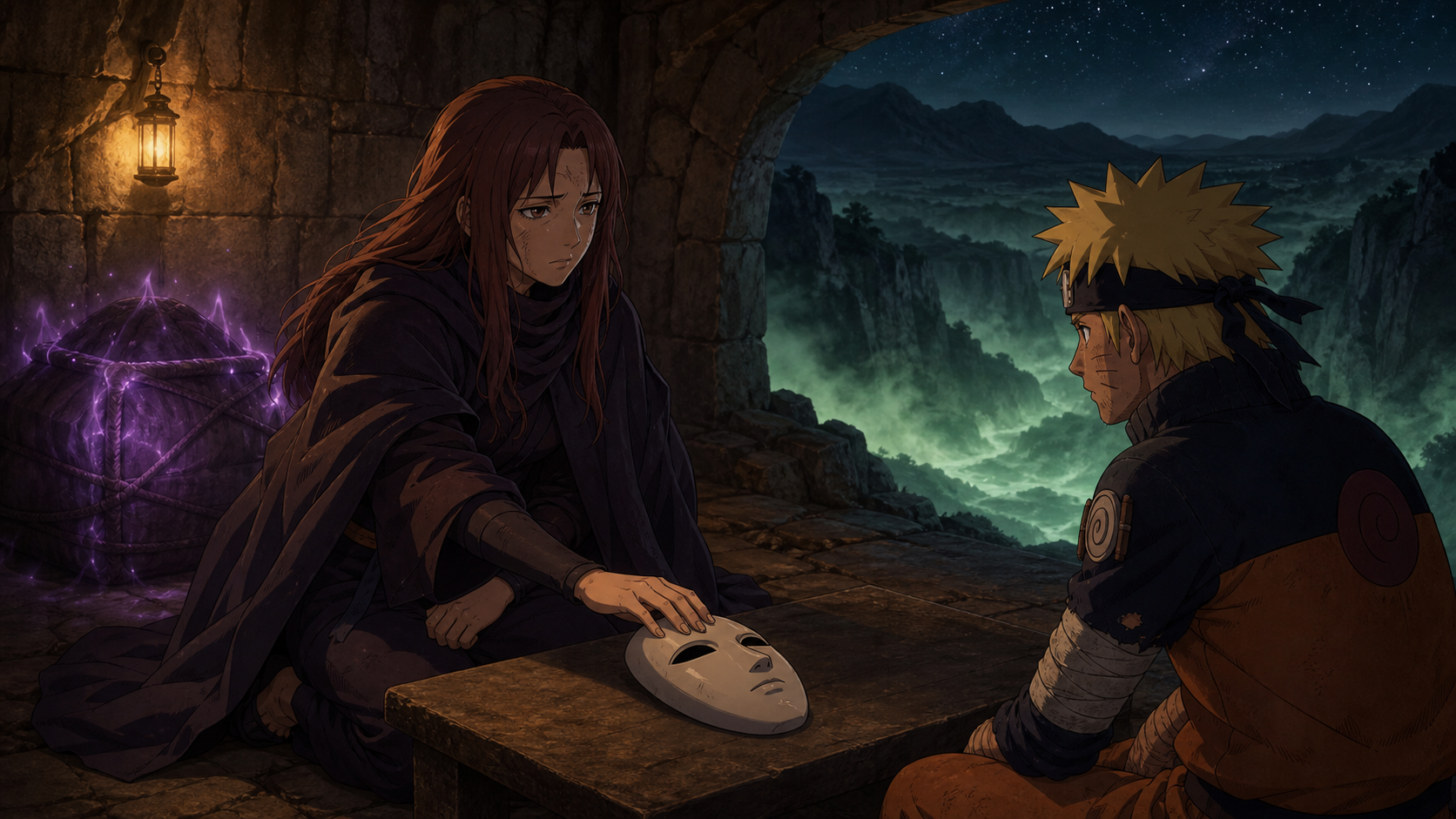
Hoshikage: The Buried Truth
Natsuhi reveals Sumaru’s parentage, the Third Hoshikage’s safeguard and the murder Akahoshi used to restart lethal star training.
Akahoshi did not inherit a village crisis.
He murdered the leader who tried to stop it.
Episode 181 digs up the history Hidden Star buried beneath hero stories and classified records. Natsuhi is Sumaru's mother. She and her husband Hotarubi survived the star training, watched others die, and tried to remove the meteorite. The Third Hoshikage listened and ended the program.
Akahoshi killed him so the children could be used again.
The star did not corrupt a good leader by accident.
It gave an ambitious man a reason to call murder and sacrifice public service.
Episode 181 Facts
- English title: Hoshikage: The Buried Truth
- Japanese title: 星影 葬り去られた真実
- Original Japanese broadcast: April 19, 2006
- Story position: Fourth episode of the six-part Star Guard Mission
- Direct identity reveal: Natsuhi is Sumaru's mother
- Historical safeguard: Natsuhi and Hotarubi were ordered to monitor Hidden Star from exile
- Buried crime: Akahoshi, Yotaka, and Shisō murdered the Third Hoshikage
- Cliffhanger: Akahoshi absorbs his accomplices' chakra as both teams reach the fight
The buried truth is larger than a secret parent or one murder confession. Hidden Star had already created a lawful answer to the star's danger. Survivors reported the cost, the recognized leader stopped training, and an external safeguard remained in place. Akahoshi did not inherit uncertainty. He dismantled a decision he disliked.
Akahoshi Tries to Dismiss the Witnesses
Neji confronts Akahoshi after seeing him knock Naruto into the Valley of Death with Natsuhi.
Akahoshi calls Naruto's fall an accident. He claims he had to deliver a finishing blow because Mysterious Peacock Method had never been defeated and the threat could have turned on them.
Then he declares the Leaf mission over.
Neji refuses.
The assignment was to protect and recover the star. Akahoshi does not get to terminate outside oversight immediately after an allied genin disappears and before the objective is complete.
That refusal is one of Neji's strongest leadership choices in the arc. He does not yet possess every fact, but he recognizes the client's attempt to control the investigation. Akahoshi wants the Leaf team gone before it can connect Sumaru's kidnapping, Naruto's fall, and the hidden training room.
Neji keeps the mission alive long enough for evidence to reach the people Akahoshi governs.
He also refuses Akahoshi's attempt to define completion. A client can clarify an objective, but cannot erase an unreturned protected asset or make a missing allied shinobi administratively disappear. Neji grounds his resistance in the existing assignment, which denies Akahoshi an easy claim that the Leaf has invaded local affairs.
The Woman Naruto Attacked Saves Him
Naruto wakes in a shelter beyond the poison valley.
The masked woman he punched saved his life and treated his injuries.
She introduces herself as Natsuhi. Naruto remembers Sumaru speaking about Natsuhiboshi, the red star that watches over him. When he asks whether she knows Sumaru, Natsuhi gives the answer the village erased.
Sumaru is her child.
She does not punish Naruto for joining Akahoshi's attack. Naruto acted on false information and tried to protect an apparent ally. Natsuhi can distinguish his intention from the harm he caused.
Akahoshi cannot make that distinction because people only matter to him according to usefulness. Naruto was useful as a weapon against Natsuhi, then disposable once he stood inside the attack line.
Natsuhi sees a manipulated child.
She saves him even while her own chakra network is failing.
Natsuhi's response models the distinction Akahoshi has spent the arc destroying. Naruto caused harm, but he did so while deceived and stopped once the deception surfaced. She treats him as a person capable of understanding new evidence, not an enemy tool permanently defined by one attack.
Sumaru Learns Akahoshi Was Behind the Mask
Lee and Tenten rescue Sumaru from Akahoshi's medical room and return him to the trainees.
Neji tells them the masked kidnapper was their village leader, not the person who stole the meteorite. The two chakra signatures were different. Akahoshi knocked the students unconscious, carried Sumaru into the gas, and hid him inside his own residence.
The children resist the truth.
They have built their training, loyalty, and future around Akahoshi's authority. Accepting that he used Sumaru means asking whether every sacrifice he requested was part of the same manipulation.
That is not a belief anyone can discard in one conversation, even when the evidence is standing in front of them.
Neji points toward Mizura. Continued training will make others collapse too.
The evidence is no longer foreign rumor. Their friend can barely move.
Sumaru still does not know why Akahoshi chose him as bait. That answer belongs to Natsuhi's history, which is unfolding outside the village while the children begin questioning the man who controlled access to it.
The trainees' disbelief is not stupidity. Akahoshi controls the records, rank, training program, and story of the Third Hoshikage's death. Lee and Tenten bring direct physical evidence, but accepting it means admitting the institution that formed their identities has been using them. Evidence can be immediate while emotional reorientation takes longer.
Natsuhi and Hotarubi Tried to Remove the Weapon
Ten years earlier, Natsuhi and her husband Hotarubi survived star training.
Many others did not.
They stole the meteorite because they wanted to seal it somewhere the village could no longer use it. A tracking unit caught them before they escaped.
The Third Hoshikage arrived and did something Akahoshi never does.
He listened.
He admitted Natsuhi and Hotarubi were right about the suffering. He had struggled to make the decision while carrying the office, but he promised to terminate training completely.
The hesitation deserves criticism. People died while the leader wavered. Yet his eventual response recognized that village ambition did not outrank the bodies being destroyed.
He also understood that a ban written by one leader might not survive the next hardline faction.
So he created a safeguard outside official power.
That safeguard reveals both wisdom and institutional weakness. The Third Hoshikage recognized that a future leader could reverse his ban, yet he could not build a transparent process strong enough to survive succession. Natsuhi and Hotarubi became a hidden emergency brake because official governance could not be trusted to remember its own casualties.
Exile Became an Agreement, Not a Punishment
The Third Hoshikage ordered Natsuhi and Hotarubi to leave Hidden Star.
The order looks like punishment until he explains its purpose. They were to watch the village from outside and intervene if anyone restarted training. Their strength and survivor knowledge made them the check his successors could not easily control.
Natsuhi and Hotarubi accepted.
They asked him to tell Sumaru they had died and to care for him.
That choice protected the mission and wounded their child. Sumaru grew up believing foreign thieves killed his parents while they defended the star. The lie turned him against outsiders and pushed him toward the same training they sacrificed family life to stop.
The parents could not safely bring a young child into exile while guarding a secret target. Their reasoning makes sense.
The cost remains Sumaru's.
The parents made the decision for a child too young to understand the threat. Their exile may have protected him from immediate pursuit, but the false death story handed Akahoshi exactly the grief he later weaponized. Protective secrecy solved one danger and created another.
Hotarubi later died from the meteorite's effects. Natsuhi expects the same fate may reach her at any time.
They escaped the training room.
The training never left their bodies.
Hotarubi's death confirms that survival at the training site was never the same as safety. The meteorite's damage continues after the political decision, after exile, and after active use ends. Natsuhi returns knowing that the safeguard itself may not live long enough to stop another cycle.
Akahoshi Murdered the Man Who Said No
The Third Hoshikage kept his promise.
He refused Akahoshi's demand to resume star training. As long as he lived, he said, the program would remain forbidden.
Akahoshi murdered him with help from Yotaka and Shisō.
The killers immediately justified the act as necessary for the village. With the opposition removed, they could train as they pleased and raise Hidden Star to rival the Five Great Villages.
This confession changes every earlier detail. The Third Hoshikage did not die conveniently before Akahoshi reversed policy. His death was the policy change.
Akahoshi could not win the argument while casualties remained visible and the legitimate leader retained authority. He removed the person, buried the cause, restarted the program, and taught children that dying under it would be honorable.
He did not merely ignore institutional memory.
He killed its keeper.
Murdering the Third Hoshikage also let Akahoshi counterfeit continuity. The public saw a leader die and a deputy resume a traditional program. They did not see the refusal, conspiracy, or killing that made the reversal possible. His authority depends on presenting a violent rupture as ordinary succession.
Naruto Rejects the Tool Argument
Naruto confronts Akahoshi at the hidden star location.
He demands to know what Akahoshi thinks of the trainees who work themselves toward death while trusting him. Mizura is already near the edge.
Akahoshi answers without shame. Sacrifice is unavoidable for village prosperity. A shinobi is merely a tool for that purpose.
Naruto has heard versions of this philosophy before. Zabuza called Haku a tool. Orochimaru treats bodies as containers. Villages assign children to deadly work and sometimes praise obedience more easily than survival.
Naruto's entire life pushes against that reduction. A shinobi has bonds, promises, fear, anger, and value beyond what a leader can extract.
Akahoshi talks about village prosperity while deceiving the village itself. The trainees did not choose with full knowledge. They were denied casualty history, fed a heroic story about Sumaru's parents, and trained under the authority of the man who murdered the leader protecting them.
Tools do not need truth.
People do.
Naruto's objection is therefore political, not merely sentimental. A village cannot claim prosperity through choices its people were prevented from understanding. If shinobi exist only as tools, leadership never needs consent, medical disclosure, or accountability. Akahoshi's philosophy conveniently erases every standard that could judge him.
Natsuhi Claims Hidden Star's Right to Settle It
Natsuhi offers Akahoshi one final exit.
Stop the training and release the children, and she will leave the village alone.
He refuses.
Naruto wants to fight beside her, but Natsuhi tells him to step back. This is a Hidden Star issue, and she intends to settle it.
Her position mirrors Neji's earlier concern about outsiders dictating village policy. The difference is that Natsuhi is a surviving Hidden Star shinobi enforcing an agreement made with its murdered leader.
Akahoshi answers by letting his chakra beast consume power from Yotaka and Shisō. The same men who helped him kill the Third Hoshikage become fuel for his next display.
Even his closest collaborators are tools once their chakra is more useful than their autonomy.
Yotaka and Shisō helped build the regime, but complicity never earns safety inside a system organized around extraction. Akahoshi's beast consumes their power because the logic they applied to trainees eventually reaches them too. Nobody remains a partner once the leader needs fuel.
The Leaf team and Hidden Star trainees arrive as the battle begins again.
Episode 181 stops before the reunion can heal anything. Sumaru now stands near the mother he was taught to mourn, while Natsuhi faces a technique that may finish the damage the star already placed inside her.
The truth is no longer buried.
The village still has to choose what to do with it.
That choice cannot be reduced to whether Natsuhi wins the next exchange. Hidden Star must decide whether leadership exists to manufacture military power or to keep its people alive. Exposing Akahoshi removes the lie. Rebuilding trust will require the villagers to reject the values that made his lie useful.
Neji refuses a client’s attempt to close the case
Akahoshi declares Naruto’s fall accidental and tells the Leaf team its assignment is over. Neji recognizes that the protected object remains missing, an allied shinobi has disappeared, and the client’s account conflicts with observed conduct. Ending outside oversight at that moment would convert contractual authority into evidence control. Neji stays because mission duty now includes his teammate and the truth.
A suspicious explanation does not require Neji to know the whole conspiracy
He lacks Natsuhi’s history and has not yet heard the murder confession. He still possesses enough to reject premature closure: different masked chakra, Sumaru found in Akahoshi’s residence, Naruto struck near the valley, and concealed medical harm. Good leadership acts on verified contradictions without filling every gap through accusation.
Natsuhi saves Naruto before asking him to believe her
She brings him out of the poison valley, treats his injuries, and then explains why she stole the star. The order matters. Her care does not prove every claim automatically, but it contradicts Akahoshi’s presentation of a thief willing to discard anyone for the meteorite. Naruto receives conduct and testimony together.
Revealing herself as Sumaru’s mother changes the emotional case
Natsuhi is not an outsider coveting village power. She is a former trainee, survivor, parent, and person bound to a promise made with the Third Hoshikage. Her secrecy protected Sumaru from political retaliation while costing both of them years of relationship. The reveal deserves compassion without pretending exile was harmless.
Natsuhi and Hotarubi survived what killed others
Their survival gave them direct evidence of the program’s bodily cost. It did not make the training safe. Survivors may carry delayed injury, guilt, and pressure to prove the deaths produced something valuable. Their testimony should have triggered permanent medical records and independent review rather than a story celebrating exceptional endurance.
Trying to remove the meteorite was a protective act with public consequences
Natsuhi and Hotarubi understood that leaving the object accessible made renewed training possible. Removing it threatened Hidden Star’s military identity and could provoke leaders who treated possession as sovereignty. The Third Hoshikage listened instead of dismissing them as traitors. That response separates legitimate governance from Akahoshi’s rule: evidence changed policy.
The Third Hoshikage built an external safeguard
Ordering the couple into protective exile let them monitor whether the prohibition held after his death or removal. The arrangement acknowledges that an internal order can fail when ambitious successors control the village. It also placed an enormous burden on two injured survivors. A stronger safeguard would have included written records, multiple custodians, and allies capable of acting without forcing a family into disappearance.
Protective exile still deprived Sumaru of informed family history
He grew up believing his parents died defending the star. That story shaped grief, loyalty, and his desire to become Hoshikage. Natsuhi had reasons to remain hidden, but the cost belongs in the analysis. Safety plans for children should preserve age-appropriate truth and trusted contact whenever possible instead of making total absence the only protection.
Hotarubi’s later death proves the star’s damage outlived training
Leaving the chamber did not restore his body. The long-term consequence strengthens Neji’s finding that amplified chakra continues causing harm at rest. Every former trainee may need monitoring even after the program stops. Hidden Star cannot define the affected population only as children currently practicing beside the meteorite.
Akahoshi murdered the leader who followed evidence
The Third Hoshikage’s refusal to resume training blocked Akahoshi’s plan, so Akahoshi, Yotaka, and Shisō removed him. This was not desperate action under uncertainty. It was an organized seizure of authority to reverse a safety decision. The murder and the restarted program belong to the same chain of intent.
Calling shinobi tools prepares the public for disposable children
Akahoshi’s doctrine sounds familiar because the larger shinobi system often treats mission utility as worth. He uses that tradition to erase any boundary between accepting occupational risk and being unknowingly exposed to lethal training. A shinobi can consent to danger within understood duties. A child cannot consent to hidden medical harm packaged as patriotism.
Naruto’s answer must reject both disposability and false heroism
He knows villages celebrate sacrifice while ignoring who had choices. His objection should not claim shinobi never risk death. It should insist leaders owe truthful information, proportionate necessity, alternatives, and accountability. Sacrifice means little when authority selects other people’s bodies and protects itself from the same price.
Natsuhi’s theft enforces an agreement the current regime broke
She removes the meteorite because the lawful prohibition has been overturned through murder. That context does not make every tactic beyond review, but it distinguishes protective custody from personal acquisition. Her stated goal is preventing further training deaths, consistent with the Third Hoshikage’s order and her own family’s injury.
Lee and Tenten’s discovery should transform the Leaf response
Finding Sumaru inside Akahoshi’s residence verifies client involvement in the abduction. The team must protect the child, preserve the room and restraints, control who approaches him, and send the finding to Neji and Naruto. Evidence handling matters because Akahoshi has already shown he will rewrite events and attempt to dismiss witnesses.
Akahoshi absorbing his accomplices’ chakra repeats the village pattern
Even partners who helped him murder and deceive become fuel when power requires it. Their prior guilt does not justify his extraction. The technique makes his leadership philosophy visible: every relationship ends as a resource flow toward himself. Hidden Star’s children were never being prepared to share national strength. They were being filtered and harvested for his ambition.
The star must not return to normal custody
Natsuhi’s testimony, Hotarubi’s death, Mizura’s condition, the old prohibition, and the leadership murder create overwhelming reason for containment outside Akahoshi’s control. The object is evidence and a health hazard. Recovery should involve medical specialists, surviving trainees, legitimate village representatives, and the Leaf alliance. Quietly placing it back in the training chamber would assist the conspiracy.
Sumaru deserves truth without becoming responsible for fixing the village
He needs to learn who his parents were and why they left, but adults should not turn that revelation into another duty. He can grieve, reject parts of the story, and choose how much public role he wants. Being the child at the center of a political crime does not make him the institution’s repair plan.
RaeRae’s full take
Episode 181 buries Akahoshi’s favorite excuse. He did not inherit a confused policy after a leader died. He helped kill the leader because that man listened to survivors and stopped the training. The village already had an answer. Akahoshi murdered it.
Natsuhi’s story is not tidy. Protective exile saved the safeguard and stole years from her family. Hotarubi still died. Sumaru grew up inside a heroic lie. Those costs do not discredit her warning. They show how much ordinary people paid because one faction treated the meteorite as more valuable than every body beside it.
Neji is right to refuse dismissal. The Leaf team was hired to guard a star and found a murdered leader, an abducted child, poisoned trainees, and a client consuming his own allies. This is not a completed protection mission. This is the evidence file finally opening.
RaeRae checkpoint: Hidden Star already chose safety once. Survivors testified, the Third Hoshikage banned training, and Natsuhi guarded the agreement from exile. Akahoshi murdered the decision because the truth blocked his ambition.
Receipts and official routes
- Episode number, licensed title, Natsuhi identity reveal, and official synopsis: Naruto Official Site.
- Japanese title, Natsuhi safeguard account, and April 19, 2006 broadcast record: TV Tokyo.