
Encounter! The Boy with a Star’s Name
Hidden Star asks the Leaf to guard a chakra-altering meteorite while secrecy, sick trainees and an internal thief expose the cost of its ambition.
The Village Hidden in the Stars hires Leaf shinobi to guard its greatest treasure.
Then it refuses to let them near it.
Episode 178 opens the Star Guard Mission with a meteorite that changes chakra, a village desperate to be taken seriously, and a boy who shares Naruto's dream of becoming Kage. Hidden Star believes the star can lift it into the company of the great nations.
Its first thief already knows the village's secret technique.
The danger does not arrive because an outsider finally discovers the power.
It arrives through the walls built around it.
Episode 178 Facts
- English title: Encounter! The Boy with a Star's Name
- Japanese title: 出会い「星」の名を持つ少年
- Original Japanese broadcast: March 29, 2006
- Story position: First episode of the six-part Star Guard Mission
- Leaf team leader: Neji Hyuga
- Hidden Star guide: Sumaru
- Protected object: A chakra-affecting meteorite that fell two hundred years earlier
- Village technique: Mysterious Peacock Method
The opener presents every important contradiction before it explains any of them. Hidden Star wants protection but limits access. It wants recognition but uses a title the great villages do not recognize. It calls the meteorite its future while a student collapses beside it. The theft does not create those problems. It forces them into view.
Hidden Star Wants Help Without Looking Weak
Hidden Star requests protection from the Leaf.
Shizune wonders why a shinobi village cannot guard its own property. Tsunade explains that smaller allied villages sometimes request support, especially when they lack enough ninja for a serious threat.
This particular request carries extra weight.
Two hundred years earlier, a meteorite fell in the Land of Bears. The village calls it a star and trains near it because its mysterious radiation affects chakra. Foreign shinobi have tried to steal it several times.
Tsunade describes Hidden Star as small, proud, and sometimes troublesome. The village needs outside protection but cannot comfortably admit dependence. It wants Leaf strength at the border without accepting Leaf eyes near the object being guarded.
That pride is not silly by itself. Great villages control money, military contracts, diplomatic language, and the right to define which leaders count as Kage. Hidden Star has reasons to resent a hierarchy that treats small villages as secondary. The problem begins when proving equality matters more than protecting the people expected to produce it.
Neji receives command of a three-person team with Tenten and Rock Lee. It is a sensible choice. Neji brings the Byakugan, careful judgment, and experience leading the same group during the Katabami Gold Mine mission.
Then Naruto hears “mysterious chakra power” and assumes Orochimaru may want it.
He decides he is joining.
Naruto Bribes His Way Onto Neji's Team
The team is already selected.
Naruto has an ace up his sleeve: rare roasted chestnut bean jelly covered with gold-leaf candy from Amaguriama.
Tsunade adds him to the mission.
When Shizune questions the change, Tsunade says the four proved themselves together at the Katabami Gold Mine and that sending Naruto will quiet things down in the village.
Those are plausible reasons.
The expensive candy sitting beside her is also a reason.
It is a funny abuse of authority because everybody knows exactly what happened. Naruto does not win a formal argument about team composition. He identifies Tsunade's weakness and pays the entry fee in dessert.
His concern is not entirely selfish. If Orochimaru is connected to the star, the mission may produce information about Sasuke.
Still, he enters a team led by Neji and immediately races ahead of Neji's instructions.
Naruto gets himself assigned to the mission.
He has not yet accepted the part where somebody else commands it.
That matters because Neji's warning is immediately correct. Naruto's instinct to investigate unusual power is useful, but instinct without command discipline turns him into another hazard the team must manage. The candy gets him a seat. It does not transfer leadership away from Neji.
Sumaru Saves Naruto by Attacking Him
Neji warns that danger begins before the village.
Naruto runs ahead anyway.
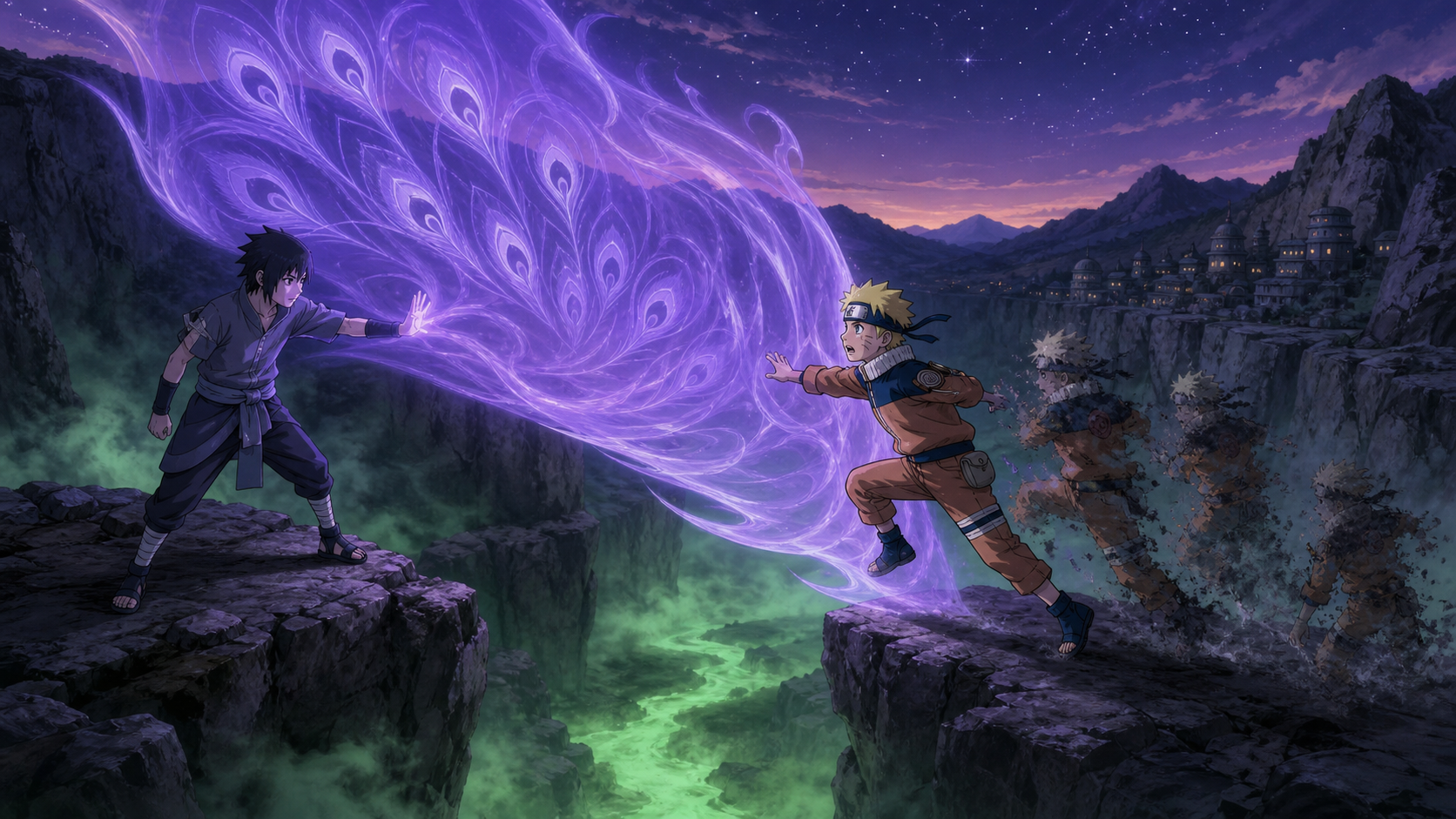
A boy attacks him with purple chakra shaped into a defensive form. The energy blocks kunai and cuts through Naruto's Shadow Clones. Naruto assumes he has found an enemy until the boy points toward the ravine Naruto was about to enter.
Poison gas fills the border of the Land of Bears.
The gas acts as a natural fortress, and Sumaru's apparent attack stopped Naruto from walking into it.
This introduction tells us nearly everything important about Sumaru before he explains himself. He is suspicious, powerful, direct, and willing to protect somebody he does not trust. He could have shouted a warning. Naruto probably would have charged through it while arguing. Sumaru uses the method Naruto cannot ignore.
Lee calls it the beginning of a beautiful friendship between villages.
Sumaru wonders whether he should have let Naruto learn the hard way.
Both reactions fit the team perfectly.
The rescue also establishes Mysterious Peacock Method. The star's power lets trained users externalize chakra into visible shapes with defensive and offensive force.
Sumaru's decision also complicates Hidden Star's suspicion of outsiders. He does not trust Naruto with village information, yet he risks revealing the technique to keep Naruto alive. His loyalty is defensive rather than cruel. He protects the border and the reckless stranger crossing it because both responsibilities belong to him.
Mizura's Body Gives the First Warning
Before Sumaru meets the Leaf team, Mizura collapses during training.
Hokuto worries. Mizura insists he does not want to fall behind. The adults send him to medical treatment while Sumaru receives the escort assignment.
The episode does not explain the illness yet.
It does place the warning exactly where we can see it.
Hidden Star speaks about the meteorite as a source of advancement, prestige, and military strength. A child training beside it is already in enough pain to fall over, and his first concern is losing progress.
That reaction shows how thoroughly ambition has entered the students. Mizura does not ask whether the training is safe. He worries that stopping will leave him weaker than his peers.
Power always has a price, but the person paying should know the cost. Here young shinobi compete inside a system whose danger is not openly discussed.
The collapse is brief.
It should make every later boast about the star sound less clean.
Mizura's fear of falling behind shows how institutional danger becomes self-enforcing. Nobody needs to drag him back into training in this scene. Status, competition, and the village's political dream have already taught him to interpret collapse as personal weakness. A program becomes difficult to question when children believe stopping will betray both teammates and country.
Akahoshi Wants a Sixth Kage Title
Akahoshi introduces himself as deputy Hoshikage.
The Third Hoshikage died suddenly one year earlier, and nobody officially holds the position now. Neji points out that only the leaders of the Five Great Shinobi Villages receive the title of Kage.
Sumaru objects immediately.
Hidden Star is not inferior, he says. The village may be small now, but it will someday rival the great villages, and he will become its true Hoshikage.
Akahoshi gives the diplomatic version of the same ambition. He admits the current title lacks outside recognition, then says the meteorite's power will help Hidden Star become strong enough to claim a sixth Kage title.
The difference between him and Sumaru matters.
Sumaru connects leadership to effort. The greater the power, he tells Naruto, the harder somebody must work to control it. He plans to train until he becomes worthy.
Akahoshi connects legitimacy to possession. The village owns something the established Kage envy, so that resource will force the world to respect them.
One dream asks what kind of shinobi Sumaru must become.
The other asks how much power the village can accumulate.
Formal recognition cannot be forced by naming a deputy Hoshikage or displaying one extraordinary technique. A Kage title implies institutions capable of protecting citizens, managing missions, and surviving leadership change. Akahoshi treats military output as a shortcut to legitimacy while the episode quietly shows a vacant office, sick trainees, and a security system that fails during the welcome briefing.
Naruto Finds Another Boy Chasing a Kage Dream
Naruto follows Sumaru and repeatedly gets his name wrong before finally listening.
Sumaru explains that his name refers to the Pleiades, also called the Spring Star, and that people throughout the village carry names connected to stars.
He also sees through Naruto's questions.
Outsiders have always wanted the meteorite. Sumaru assumes Naruto is trying to learn what its power can provide. Naruto asks whether anyone who possessed it could produce chakra like Sumaru's.
Sumaru rejects the idea of effortless power. The meteorite may enhance chakra, but control requires relentless work. He plans to work until he becomes Hoshikage.
Naruto answers with his own Hokage dream.
That moment creates real connection because Naruto does not laugh at the title or remind Sumaru that the great nations refuse to recognize it. Naruto understands what it means to announce an ambition other people consider impossible.
He looks forward to meeting Sumaru as a fellow Kage someday.
Sumaru calls him strange.
For Naruto, taking another person's impossible dream seriously is basic courtesy.
You Cannot Guard What You Are Forbidden to See
The meteorite rests inside the training area.
Sumaru refuses to let Naruto enter because people from other lands are not trusted. Naruto points out the obvious problem. The Leaf team cannot protect the star if it cannot approach it.
Both boys have a case.
Foreign shinobi have targeted the meteorite before, so Sumaru's suspicion did not appear from nowhere. Allowing every hired guard unrestricted access would create its own security risk.
Yet Hidden Star requested outside help. If it withholds the location, access rules, training routines, and internal threat information, the Leaf team becomes decoration instead of protection.
Security requires least-necessary access, not zero access. Neji's team does not need every village secret, but it needs a defensible perimeter, a response plan, and enough knowledge to distinguish authorized chakra from an intruder. Hidden Star provides none of that before the alarm.
The contradiction is still unresolved when an alarm sounds.
Somebody steals the star in broad daylight.
Naruto pursues the thief while Sumaru checks the trainees. The security arrangement fails before the visiting team even finishes its briefing.
Secrecy protected the meteorite from the people invited to defend it.
It did not protect the meteorite from the person who knew the way inside.
The Thief Knows Hidden Star's Jutsu
Naruto catches the intruder and floods the battlefield with Shadow Clones.
The thief answers with Mysterious Peacock Method. Purple chakra becomes a beast, combines into stronger forms, and eventually creates wings. Naruto notices that the user's body remains still while controlling the chakra creature and attacks the apparent weak point.
The technique is more flexible than he expects. The thief changes its form, overpowers him, and escapes through the air with the meteorite.
Sumaru blames Naruto for letting the target go. Naruto accepts that responsibility, but he also asks the question Hidden Star cannot dismiss.
Why did the thief use the village's exclusive technique?
Akahoshi confirms that only somebody who completed star training should be capable of Mysterious Peacock Method. The mission stops being a simple defense against greedy foreigners.
The threat has a connection to the village.
That fact changes the risk model. Foreign thieves can be watched at borders and judged by unfamiliar techniques. An insider knows routines, blind spots, access paths, and the assumptions defenders make about friendly chakra. Hidden Star prepared for envy from outside while treating internal knowledge as automatic loyalty.
Episode 178 ends without naming the thief or explaining the motive. That uncertainty is the correct stopping point. What we know is already damaging enough: Hidden Star built its future around a power guarded by secrecy, and somebody inside that circle carried it away.
Naruto promises to recover the star.
First, the village will have to decide how much truth it is willing to give the people helping him.
Hidden Star asks for protection while restricting the protectors
The village wants Leaf manpower at the perimeter but refuses to give the team direct access to the object, training site, or full threat picture. That arrangement creates responsibility without visibility. Neji cannot build a serious defense around a meteorite he cannot inspect, routes he cannot map, or local personnel whose access the client will not disclose.
Small-village pride has a political history without becoming a safety excuse
The Five Great Villages dominate recognition, contracts, and the language of legitimate leadership. Hidden Star’s desire to resist that hierarchy makes sense. Endangering its own children to prove equality does not. A community can reject condescension while still accepting outside medical review, transparent security planning, and evidence that a treasured practice causes harm.
The poison ravine is a border and a recurring public hazard
Natural toxic gas limits ordinary access and provides defensive value, but the village depends on people who know safe routes or possess specialized techniques. Any failure of guides, weather assumptions, or communication can turn isolation into entrapment. A protection plan needs marked crossings, exposure limits, rescue equipment, and a way to evacuate residents without relying on one child’s chakra mantle.
Sumaru stops Naruto because competence outranks enthusiasm
Naruto charges toward the ravine as if commitment can substitute for environmental knowledge. Sumaru’s Mysterious Peacock Method blocks him before toxic gas turns the mission into a medical emergency. The moment establishes Sumaru as a trained local guide rather than a child waiting for Leaf heroes to explain his own country. Naruto’s respect begins when he listens.
The Mysterious Peacock Method is beautiful because the risk is hidden
The translucent chakra wings, reach, and flight-like movement make the technique look like evidence that Hidden Star found a path other villages ignored. That visual success can conceal the bodily cost of producing it. A technique should not be evaluated only by what an observer sees during performance. Recovery time, organ damage, pain, failed trainees, and long-term function belong in the record.
Naruto and Sumaru recognize each other through ambition
Both boys want a leadership title their communities treat as difficult or unofficial. The connection is genuine, yet their paths differ. Naruto’s dream challenges a village that once rejected him. Sumaru’s dream has been tied to a training system controlled by leaders who may define sacrifice as proof of loyalty. Friendship should help them compare conditions without collapsing those differences.
“Hoshikage” carries aspiration and institutional ambiguity
Hidden Star uses a Kage title without recognition from the five major villages. The title may strengthen identity inside the community, but it does not automatically supply the resources, oversight, alliances, or military stability associated with formal status. Akahoshi treats symbolic equality as if the meteorite can manufacture every missing institution through stronger chakra.
Mizura’s collapse is evidence, not an unfortunate side effect
A young trainee becoming visibly ill near star practice should stop the session and trigger independent medical evaluation. Leaders need exposure histories, symptoms, recovery patterns, and comparisons between trained and untrained residents. Calling the damage a price of advancement protects the program from evidence by converting injury into a test of commitment.
Children cannot consent freely inside a village-wide prestige project
Sumaru and the other trainees grow up hearing that the star represents national recognition and that mastering its technique proves devotion. Refusal can feel like betraying family, teachers, and the village’s future. Meaningful consent requires truthful risk information, alternatives that preserve social belonging, and the ability to stop training without losing dignity or opportunity.
Akahoshi’s secrecy weakens the security he requested
He withholds internal details to protect prestige and control, then expects outside shinobi to prevent theft. Secrecy can limit unnecessary exposure, but every defense needs a trusted circle with accurate information. When nobody outside leadership can challenge assumptions, an insider with the village’s own technique gains the perfect blind spot.
The thief using local chakra changes the threat model immediately
An outsider attempting to steal the meteorite would need to cross the poison ravine, enter a guarded village, locate the chamber, and escape. A user of the Mysterious Peacock Method may already know schedules, routes, seals, and weaknesses. Neji should shift from perimeter defense to access review, personnel accountability, and protection of witnesses before accusing anyone based only on technique.
Possessing a local technique is evidence, not a complete identity
The thief may be a current trainee, former resident, stolen-technique user, or someone trained by an insider. Investigators need chakra characteristics, timing, entry method, motive, and knowledge displayed during the theft. Treating every practitioner as suspect would punish the same young people already absorbing the training risk while the leadership record stays unexamined.
Neji’s Byakugan should be used with a defined purpose
His vision can inspect routes, chakra movement, injuries, and concealed spaces, but access to bodies and private village areas still needs justification. The mission should specify what he may examine and how findings are handled. Powerful surveillance is useful precisely because disciplined limits keep it from becoming another reason smaller allies distrust the Leaf.
Tenten and Lee bring different protection capacities
Tenten can secure approaches and supply equipment, while Lee provides rapid movement and close defense without relying on the same chakra assumptions as star-trained fighters. The team’s diversity matters against an unknown thief. A defense built only around matching the local technique would repeat Hidden Star’s mistake of treating one extraordinary power as the answer to every problem.
Naruto’s presence is useful when curiosity becomes relationship
He was not part of the original Neji team, but his connection with Sumaru may open information formal interviews would not. That access carries responsibility. Naruto should not promise outcomes, expose private disclosures, or turn friendship into surveillance. He can listen, report immediate safety concerns, and ensure the boy knows Leaf help is not conditional on praising the village leadership.
The meteorite should be treated as a hazardous object before a treasure
Two hundred years of cultural meaning do not eliminate the need for containment, exposure measurements, controlled access, and medical monitoring. Protecting the object from theft while allowing uncontrolled proximity mistakes possession for safety. The village may own the star. It does not own the right to hide preventable harm from the people ordered to train beside it.
The opening theft exposes a governance failure, not just a guard failure
Hidden Star concentrated ambition, military development, national identity, and youth training around one object, then limited scrutiny to preserve authority. The thief exploits that structure. Replacing a guard or recovering the meteorite will not repair the system unless the village also confronts who controls information and whose illness is considered acceptable.
RaeRae’s full take
Episode 178 gives us a gorgeous chakra technique wrapped around an ugly institutional question. Hidden Star wants recognition from a world that dismisses smaller villages. I understand the hunger. I do not accept sick children as the entrance fee.
Sumaru is not naive because he wants to become Hoshikage. He is ambitious, skilled, and proud of home. The adults around him owe him a future sturdy enough to survive questions about the star. If the dream collapses when somebody asks what happened to Mizura, the problem is not the question.
The thief arrives from inside the village’s own technique because secrecy did not protect Hidden Star. Secrecy protected the people defining every injury as necessary. Recover the meteorite, yes. Then open the medical records and count who paid for its power.
RaeRae checkpoint: Hidden Star’s ambition deserves respect. Its sick trainees deserve evidence, independent care, and the right to refuse more. A meteorite cannot make a village great by teaching leaders to hide the bodies carrying its cost.
Receipts and official routes
- Episode number, licensed title, meteorite premise, and official synopsis: Naruto Official Site.
- Japanese title, synopsis, and March 29, 2006 broadcast record: TV Tokyo.