
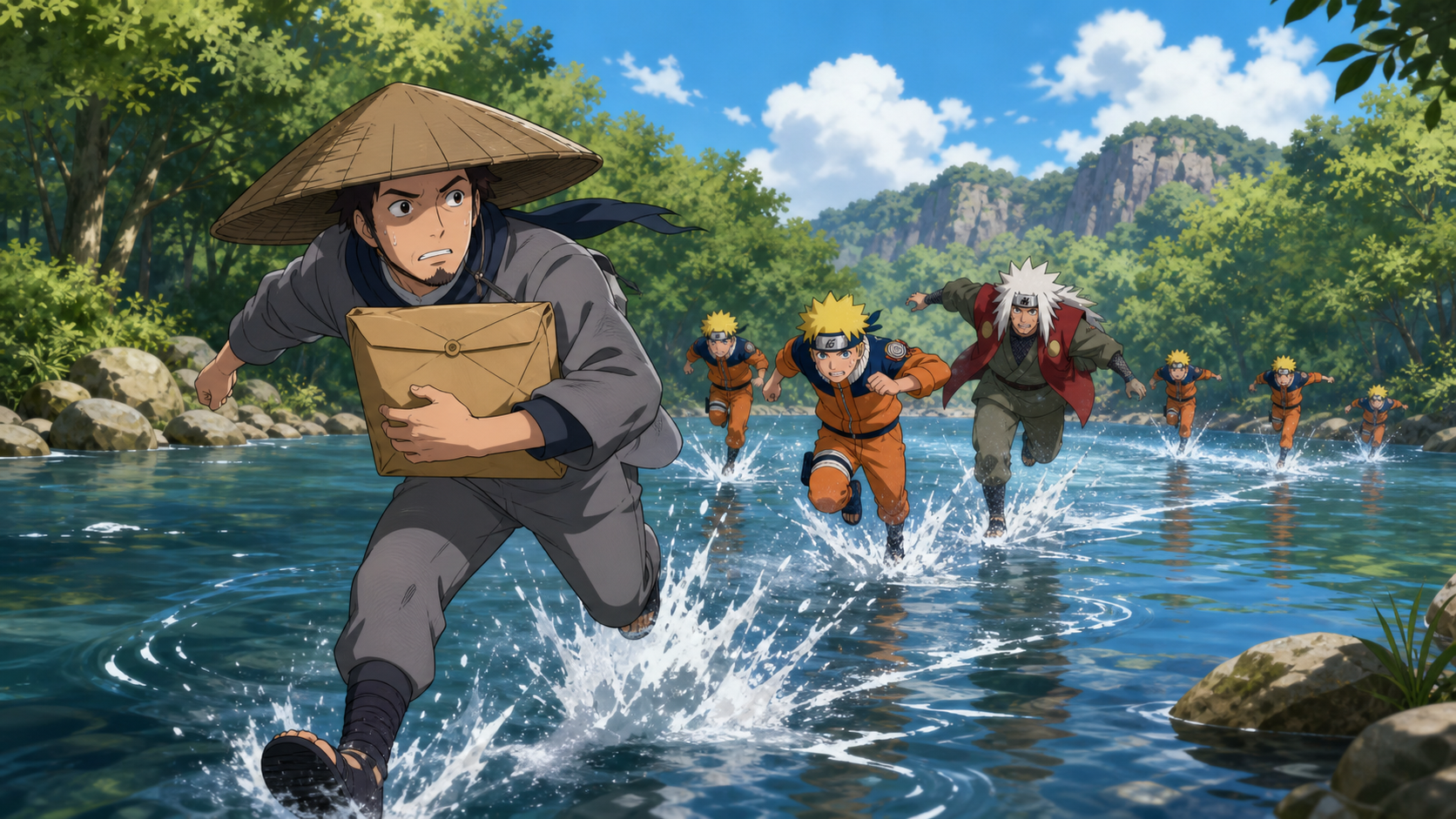
Please, Mr. Postman!
Naruto’s fake Jiraiya manuscript and a peace document switch parcels, sending duty, authorship and two countries into one reckless postal chase.
Naruto writes one terrible book.
Two countries nearly go to war.
Then the book saves the peace because a feudal lord has questionable taste and excellent enthusiasm.
Episode 177 gives Naruto a postal chase where everybody is committed to doing a job, and nearly everybody misunderstands what doing that job responsibly means. Jiraiya dodges training to finish a manuscript. Naruto decides authorship can be completed by any available pair of hands. The delivery ninjas protect customer trust so absolutely that correcting a known mistake becomes unthinkable.
The wrong document reaches the right reader.
Luck does the work judgment refused to do.
Episode 177 Facts
- English title: Please, Mr. Postman!
- Japanese title: OH!? ぷりーず みすたーぽすとまん
- Original Japanese broadcast: March 22, 2006
- Story position: A standalone anime-original episode
- Delivery ninja: 596-03
- Misrouted parcels: Naruto's fake Jiraiya manuscript and a Land of Claws peace document
- Political result: The Land of Fangs daimyo treats the manuscript as a personal peace gesture
This episode is a chain of people protecting one narrow definition of their job. Jiraiya protects his freedom to switch roles whenever responsibility arrives. Naruto protects the training time he thinks he earned. The couriers protect delivery neutrality. Each choice makes sense from inside its own little box, and the combined system nearly starts a war.
Naruto Meets the Most Serious Postman Alive
Naruto returns from an “important solo mission” that turned out to be extra labor for a castle restoration project.
He is exhausted, annoyed, and desperate for a hot spring.
On the way, he sees parcels scatter from a stranger's load and uses Shadow Clones to recover all twenty-six. The man thanks him, announces that he is a Delivery Ninja, and introduces himself as 596-03.
Naruto calls him a postman.
596-03 insists there is a difference. Delivery ninjas are professionals who risk their lives to bring every entrusted parcel to its destination. They identify themselves with numbers that sound like zip codes and treat a delivery promise with the seriousness of a military oath.
The joke is easy, but the episode gives the corps real dignity. Naruto watches 596-03 move with speed, discipline, and pride. These are not random couriers wearing headbands for decoration. Their work depends on customers believing a parcel will arrive regardless of danger, politics, or interference.
The numbered identity reinforces that institutional promise. 596-03 presents himself as a function of the corps before he presents himself as an individual. Customers do not need to know his biography. They need to know that whoever carries the number will honor the same chain of custody.
That trust becomes the entire problem once the wrong parcel enters the system.
Jiraiya Has Three Jobs and Avoids All of Them
Naruto finds Jiraiya at the hot spring doing exactly what Jiraiya always calls research.
Naruto is furious. Jiraiya claimed to be away on an important mission while Naruto waited for training. Jiraiya explains that an Akatsuki member may arrive in town the day after tomorrow, so the surveillance assignment is real.
He is using the waiting period to finish the final volume of Make-Out Violence.
The publisher expects the manuscript immediately. Jiraiya suggests that if he finishes early, he might have time to train Naruto. That turns Naruto into an assistant, servant, and source of increasingly ridiculous visual inspiration.
Naruto massages his shoulders, brings a drink, and performs a steam-bath variation of Sexy Jutsu. Jiraiya praises the “research” and writes almost nothing.
There is a real tension underneath the routine. Jiraiya is a spy gathering information about the group hunting Naruto. He is also Naruto's teacher and a professional author with a deadline. All three roles matter.
He uses whichever role is convenient to avoid the demands of the other two.
When Naruto asks for training, Jiraiya is an author on deadline. When the manuscript disaster requires a chase, Jiraiya becomes a teacher who planned endurance work all along. When questions about Akatsuki become urgent, he is a spy who must leave Naruto behind. The roles are all real. His timing is still suspiciously excellent.
Naruto sees only another promise sliding away.
Naruto Cannot Ghostwrite Experience
Jiraiya falls asleep without completing the manuscript.
Naruto solves the problem himself.
He writes an ending in Jiraiya's name, packages it, and gives it to 596-03 for delivery to the publisher. In Naruto's mind, the obstacle has disappeared. Jiraiya no longer needs to write, which means he is free to train.
Jiraiya wakes and reacts as if Naruto mailed a bomb.
His anger is funny because Make-Out Violence is hardly sacred literature. Still, he is right. Naruto did not help finish Jiraiya's work. He impersonated an author and sent unapproved writing under that author's name.
Writing is not the physical act of filling blank pages. Jiraiya's voice, experience, reputation, and relationship with readers are part of the product. Naruto cannot replace those by scribbling faster.
The episode does not let Jiraiya enjoy the moral high ground for long. He spent the day manipulating Naruto into supplying bathhouse fantasies while refusing to teach him. Naruto's choice is wrong, but it grows from a teacher who made his responsibility feel permanently negotiable.
They chase 596-03 together.
Jiraiya calls the run physical training as soon as Naruto complains about the pace.
Apparently every inconvenience becomes a lesson after Jiraiya needs help fixing it.
The Peace Document Goes to the Publisher
At the inn, officials from the Land of Claws also entrusted a parcel to the delivery corps.
Their package contains a secret document offering peace to the Land of Fangs. The two countries are close to war, so the message must arrive safely and privately.
During a handoff between delivery zones, the packages were switched.
Naruto and Jiraiya catch one courier and recover what they think is the manuscript. Instead, they open the peace document.
That means Naruto's version of Make-Out Violence is headed to the Land of Fangs as official communication from the Land of Claws.
The political danger comes from interpretation. The manuscript does not need to contain a declaration of war. It only needs to look like a deliberate insult, threat, or obscene joke sent through a diplomatic channel.
Naruto understands that war is bad.
Jiraiya understands that Naruto's writing may start one.
Neither initially spends much time admitting that they took a parcel from a courier doing honest work and opened a classified document addressed to somebody else.
The correction creates another violation before it solves the first.
That matters because urgency does not automatically authorize Naruto and Jiraiya to seize and inspect other people's mail. They know a switch occurred, but they do not know which courier holds which parcel until after opening one. Their rescue attempt reproduces the same assumption Naruto made while ghostwriting: the desired outcome excuses taking control of work entrusted to somebody else.
The Delivery Rules Protect Trust Until They Protect the Mistake
The delivery corps identifies Naruto and Jiraiya as postal thieves.
Members across the area mobilize to protect 596-03 and the parcel. Naruto and Jiraiya try to explain the switch, but the organization is built around rules stronger than any individual request.
Once a package is accepted, it must reach the named recipient.
Couriers must not open customer mail.
No nation or institution can pressure them into abandoning a delivery.
Those principles are valuable. Political independence lets rival countries use the same trusted network. Confidentiality prevents couriers from deciding whether a message deserves protection based on its contents. Reliability gives the service meaning.
Yet 596-03 has direct notice that an accidental switch occurred. He refuses even to inspect the evidence because inspection itself violates the rule.
The system can guarantee delivery.
It cannot guarantee that the package being delivered is the one the customer handed over.
Professional integrity becomes professional paralysis when a rule offers no process for correcting a verified error.
The missing piece is an exception protocol. Confidentiality and neutrality need not disappear because one sender reports a documented handoff mistake. A secure recall, destination verification, or supervisor review could preserve trust while correcting the chain. Instead, the corps treats consistency as proof of integrity even when consistent action guarantees the wrong result.
596-03 is not corrupt or careless. That makes him harder to stop. His mistake is believing duty requires him to ignore consequences he now understands.
The Postal Chase Becomes Accidental Training
Naruto and Jiraiya pursue the couriers along the river toward the Land of Fangs.
Delivery ninjas arrive from every direction. Naruto and Jiraiya switch positions, run across water, use Shadow Clones, and throw around so many Rasengans that Naruto complains the technique is starting to look cheap.
The chase is training, though not the training Naruto requested.
That distinction protects Naruto's complaint from being dismissed. Useful exertion does not erase Jiraiya's broken promise. A teacher can recognize learning in an accident and still owe the student honest instruction. Jiraiya prefers the version where any crisis he causes becomes evidence of his educational genius.
He has to maintain speed, coordinate with Jiraiya, identify 596-03 among near-identical couriers, and fight without destroying the parcel they need. Jiraiya keeps dressing necessity as intentional instruction, but Naruto still practices useful skills.
Naruto finally uses Harem Jutsu: Riverside Mad Dance against 596-03.
The distraction works on the man and fails against the mission. Even while surrounded by temptation, he keeps lurching toward the destination and repeating that he will deliver.
His commitment is absurd and impressive.
Naruto and Jiraiya cannot defeat it before the parcel reaches the feudal lord.
Naruto's Bad Book Saves the Peace
The Land of Fangs daimyo opens the package.
He recognizes what appears to be the newest Make-Out manuscript and is delighted. He assumes the Land of Claws daimyo knew he was a devoted fan and sent the book as a personal gesture.
He immediately orders the fighting stopped and sends a messenger of peace.
Naruto's writing succeeds because the receiver supplies the meaning the document lacks. The daimyo sees evidence that his rival understands him. A piece of entertainment reaches him more personally than a formal peace proposal might have.
That does not make Naruto's decision smart.
It makes everyone lucky.
Another reader could have treated the manuscript as mockery. A less devoted fan could have ordered troops forward. Peace rests on information Naruto never had when he mailed the pages.
The daimyo supplies authorship, intent, and emotional meaning on behalf of both sender and writer. He believes the Land of Claws chose a gift tailored to him and that Jiraiya produced the words. Neither belief is true. The peace is emotionally genuine on the receiving end and procedurally false everywhere else.
Jiraiya is relieved that war has been avoided and offended that Naruto's scribbling passed as his prose.
For once, wounded artistic pride may be the fairest consequence available.
Jiraiya Leaves Naruto the Training He Did Not Promise
Naruto expects the Akatsuki contact to arrive the next day.
He wakes to find Jiraiya gone. The lead developed while Naruto slept, so Jiraiya left to continue the pursuit alone.
Naruto feels tricked again.
He was promised possible training after the manuscript was finished. Instead, he spent the day chasing an international postal disaster created by his own shortcut.
Jiraiya leaves him with the claim that the experience was good training.
He is not entirely wrong. Naruto ran beyond exhaustion, coordinated advanced techniques, protected a fragile target, and faced an opponent whose strength was commitment rather than violence.
He also learned why another person's work cannot be completed by stealing the name attached to it.
Jiraiya remains a maddening teacher because he rarely gives Naruto the lesson in the form requested. Sometimes that flexibility is wisdom.
Sometimes it is an excuse delivered with excellent timing.
Episode 177 lets both be true and sends the correct peace message nowhere at all.
The authentic document fails at delivery while the fraudulent manuscript succeeds at diplomacy. That irony does not prove formal communication is useless. It proves that messages work through both content and relationship, and this receiver happened to find a relationship inside the wrong package.
Naruto helps the courier before knowing the job matters
He uses Shadow Clones to recover twenty-six scattered parcels because somebody is struggling in front of him. No mission order or reward creates the choice. That opening gives Naruto a practical reason to respect delivery work before the chase turns it into an obstacle. Reliability begins with countless small acts that never become legendary.
596-03 treats custody as a professional identity
His number, uniform, movement, and strict language communicate a corps built around predictable handling. Customers trust the system because a courier cannot casually open, abandon, or redirect a parcel whenever a stranger tells a persuasive story. That discipline has real public value. The episode’s problem is not reliability. It is reliability without a safe exception process.
Jiraiya creates the first deadline crisis
He tells Naruto training must wait because the manuscript is due, while spending time in the hot spring town and shifting attention whenever convenient. Professional writing includes deadlines, but mentorship is also a commitment. Jiraiya could set a clear schedule, explain what he must finish, and give Naruto independent work. Vague delay turns Naruto’s frustration into a problem everyone else inherits.
Naruto confuses replacing labor with solving the responsibility
He sees unfinished pages and assumes any manuscript delivered under Jiraiya’s name will free the promised training time. The shortcut ignores authorship, quality, reader expectations, and the publisher’s agreement with the actual writer. Finishing an object is not the same as fulfilling the obligation attached to it. Naruto produces pages while creating a much larger breach.
Submitting work under Jiraiya’s name crosses a clean ethical line
The manuscript is not fan fiction privately shared with a friend. Naruto represents it as Jiraiya’s professional work and sends it into an established publishing relationship. Even if the text were brilliant, the deception would remain. Authorship tells an editor and reader who made the choices, who owns the words, and who answers for the result.
The parcel switch exposes a handoff-control failure
Two packages change routes during a delivery-zone transfer, and the system lacks a simple reconciliation step capable of catching the mismatch. Chain of custody requires more than refusing later interference. Each handoff should verify sender, destination, seal, count, and unique identifier. Reliability measured only by speed can deliver the wrong item perfectly.
A peace document deserves classification and redundant control
An international offer capable of preventing war should not travel as an ordinary lookalike parcel with one point of failure. Diplomatic custody needs authenticated seals, duplicate notice through another channel, named recipients, confirmation deadlines, and escalation if the expected document does not arrive. Secrecy may limit who reads it, but secrecy cannot mean nobody can verify its route.
596-03 is right not to surrender a parcel to chasing strangers
Naruto and Jiraiya know the mix-up, but the courier sees people attempting to intercept entrusted material. Handing it over based on urgency would destroy the very security his customers depend on. He needs a verified command path from dispatch, not a personal judgment about whether two frantic shinobi sound sincere while attacking the route.
The corps is wrong to lack a correction protocol
Once credible evidence suggests misrouting, continuing delivery without investigation turns discipline into negligence. A secure system should quarantine the parcel, contact both sending stations, verify identifiers, and document any reroute. “Never stop” is a slogan, not governance. Professional duty includes correcting known errors while preserving a record of who authorized the change.
The chase converts safety infrastructure into an opponent
River routes, relay teams, decoys, and defensive maneuvers demonstrate why the delivery corps deserves respect. Those same protections now prevent correction because the system classifies every interception as attack. Security that cannot distinguish a threat from authenticated incident response becomes brittle. The answer is not weaker couriers. It is better communication between field personnel and dispatch.
Naruto’s Shadow Clones increase reach and confusion
Clones help cover multiple paths, but a crowded chase around confidential parcels also raises the chance of mistaken identity and accidental damage. Naruto needs assigned sectors, a shared stop condition, and a rule against grabbing unknown packages. More bodies create capacity only when coordination keeps them from multiplying the original mistake.
Jiraiya understands the political risk after avoiding the personal duty
He becomes urgent once the manuscript switch could trigger conflict between the Lands of Claws and Fangs. That urgency is justified, but the chain began with a deadline he failed to manage and a student he left without honest expectations. Large consequences often grow from ordinary neglect long before anyone recognizes an emergency.
The Fangs daimyo interprets the wrong book as a personal gesture
Because he admires Jiraiya, receiving an unpublished manuscript feels more intimate than a formal peace offer. The misunderstanding happens to create goodwill. It could just as easily look insulting, obscene, or manipulative. Diplomatic success produced by a recipient’s fandom is luck, not a communications strategy any government should repeat.
The peaceful result does not excuse Naruto’s deception
Outcome bias makes the temptation obvious: nobody goes to war, the daimyo is delighted, and the fake manuscript becomes a gift. Naruto still impersonated an author and caused the document swap that created the risk. Accountability should examine the decision using what he knew when he made it, not only the fortunate ending he could not predict.
The delivery corps should preserve the incident as a systems lesson
The review needs exact handoff times, parcel identifiers, relay assignments, interception reports, and the reason dispatch could not issue a verified correction. Punishing 596-03 for refusing unauthorized interference would teach the wrong lesson. Leaders should repair the protocol that left him choosing between chain-of-custody rules and obvious evidence of a dangerous error.
Jiraiya still owes Naruto actual training
The manuscript reaches a reader and peace survives, but the original promise remains. Jiraiya should finish his professional work honestly, address the unauthorized submission with his publisher, and give Naruto the training time he used as leverage. A comedic escape from consequences cannot become another excuse to leave the student waiting.
RaeRae’s full take
Episode 177 is funny because everyone protects one narrow duty until the duties collide. Naruto wants training. Jiraiya wants a finished book without organizing his time. The delivery ninjas want unbreakable custody. Two countries want a peace document. Every goal sounds reasonable alone, and the combined result is a sprint toward diplomatic disaster.
596-03 is not the villain. A courier should not hand sealed material to anybody who yells “mistake” while chasing him over a river. The failure is a system with excellent forward motion and no authenticated brake. Secure delivery requires both tamper resistance and a documented way to stop the wrong parcel.
The daimyo’s Jiraiya fandom saves everyone, which is delightful and absolutely not a plan. Luck prevents war. Judgment should prevent the next switch.
RaeRae checkpoint: Reliability is more than delivering whatever lands in your hands. Naruto violates authorship, Jiraiya mishandles responsibility, and the courier system lacks an authenticated correction path. The peaceful ending is luck with a fan club.
Receipts and official routes
- Episode number, licensed title, and official synopsis: Naruto Official Site.
- Japanese title, synopsis, and March 22, 2006 broadcast record: TV Tokyo.