
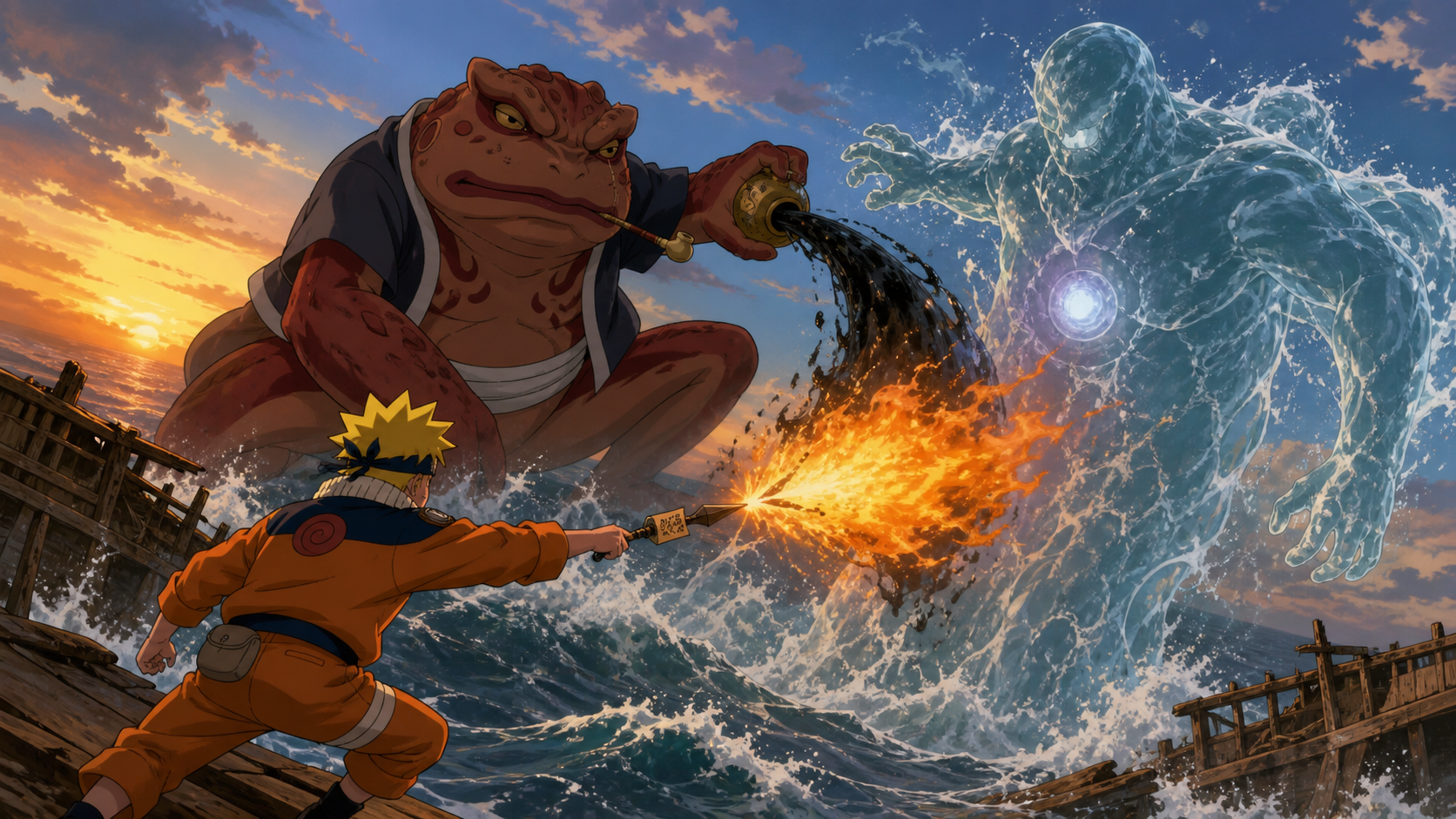
Battle at Sea: The Power Unleashed!
Naruto and Gamabunta target Umibozu’s spiritual core while Isaribi rejects Amachi and Anko recovers the choice Orochimaru tried to rewrite.
Anko was not discarded.
She refused to follow Orochimaru.
That recovered memory closes the Kaima Capture Mission more powerfully than the giant fireball swallowing Umibozu. Amachi spent the previous episode telling Anko that Orochimaru replaced her with a better student. The lie worked because her erased memory left room for his version.
Episode 173 gives the choice back.
It does the same for Isaribi. Amachi threatens that she will remain altered forever if she disobeys. She refuses him anyway.
Naruto unleashes power to end the battle.
Anko and Isaribi reclaim power over the stories keeping them trapped.
That is what the title gets right. “Power unleashed” sounds like a promise of bigger chakra, and the episode certainly delivers a fox-powered hit plus a toad-oil inferno. The lasting release is quieter. Two women stop measuring themselves by what Orochimaru and Amachi wanted from their bodies. Force wins the morning. Choice ends the nightmare.
Episode 173 Facts
- English title: Battle at Sea: The Power Unleashed!
- Japanese title: 海戦 解き放たれた力
- Original Japanese broadcast: February 22, 2006
- Story position: The conclusion of the Kaima Capture Mission
- Primary opponents: Amachi, Yoroi, and Umibozu
- Key summon: Gamabunta
- Final destination: The Leaf Village, where Tsunade can examine Isaribi
This is not an episode that hides its machinery. Naruto handles Amachi. Ino and Shino handle Yoroi. Gamabunta helps solve Umibozu. Anko handles the missing truth that has been eating at her since the mission began. Each thread receives a distinct finish, which keeps the finale from pretending one oversized attack can resolve every kind of damage.
The fights require force. The people require something harder: a choice nobody makes for them.
Isaribi Chooses Naruto
Nine-Tails chakra tears Naruto free from Amachi's water prison and turns the fight around immediately.
Amachi sees the fox's power and calls Naruto another monster. The accusation no longer has any authority. Naruto uses the feared chakra to stop a man who transformed people into weapons. The source of power does not decide what the person does with it.
Naruto overwhelms Amachi.
Isaribi helps Naruto after the clash, repeating the choice she made when she pulled him from the sea. This time she knows his secret and understands that his claim of shared experience was true. She does not join him because his body now looks frightening enough to qualify. She joins him because he kept treating her as a person while Amachi treated her as material.
That distinction matters. Recognition can begin with similarity, but solidarity has to survive difference.
Naruto carries a sealed beast. Isaribi's own body was altered. Their experiences are not identical. Both know what it means when a community lets fear speak louder than the person standing in front of it.
The episode also refuses Amachi's cheap attempt to make appearance equal morality. Naruto's chakra cloak looks dangerous because it is dangerous. Isaribi's scales and fins came from a violent experiment. Neither fact gives Amachi the right to define the person inside the altered body.
Amachi calls them monsters because the label saves him from answering for what he did. If Isaribi is only a failed specimen, he owes her nothing. If Naruto is only a beast, attacking him becomes self-defense. Naruto breaks that logic by using the power Amachi fears to protect the person Amachi harmed.
Ino and Shino Finish Yoroi Together
Yoroi tries to drain the rest of Shino's chakra.
Ino reaches them in time and uses Mind Destruction Jutsu. The interruption breaks Yoroi's control and gives Shino the opening he needs.
Yoroi turns his back to the enemy.
Shino ends the fight.
The sequence completes the teamwork Episode 171 established. Shino chose the matchup because ranged insects denied Yoroi easy physical contact. Ino provides control when Yoroi finally gets a grip. Neither contribution replaces the other.
That makes the finish better than a surprise rescue from the strongest available fighter. Ino does not need to overpower Yoroi. She needs to disrupt him at the exact second his advantage becomes decisive. Shino does not need to pretend he escaped alone. He uses the opening his teammate creates.
Yoroi's chakra absorption turns contact into control. The team's answer is coordination. He can drain one person, but he cannot manage two shinobi attacking his concentration from different directions. The tactical result fits the larger story: the villains isolate people, while the Leaf team survives by refusing isolation.
Amachi attempts to escape after Naruto beats him, but the Leaf team catches the “huge fish.” Injured sailors move to safety, and Anko tells Amachi that his return to the Leaf will end with justice for the collection-ship attacks.
That custody matters because this arc has contained a lot of convenient disappearing evidence. Orochimaru erased memories. Amachi collapsed the laboratory. Victims vanished at sea under cover of legend. Taking the principal offender back alive creates the possibility of testimony, records, and accountability that does not depend entirely on Anko remembering every hidden room.
For about ten seconds, the mission looks finished.
Then Umibozu rises again.
Gamabunta Hates Saltwater for a Reason
Umibozu cannot be beaten through ordinary impact.
Its visible body consists of seawater gathered around a spiritual core. A blade can split the water, but the surrounding ocean fills the gap. On open sea, the creature has an effectively limitless supply of replacement mass.
Naruto summons Gamabunta.
This pays off the warning from Episode 169. The Mount Myoboku toads are freshwater creatures. Gamabunta develops a vicious itch and rash almost immediately, and he is not impressed that Naruto called him into an ocean after receiving that information.
Naruto asks him to ignore it and fight.
Gamabunta reasonably considers killing Naruto first.
Amachi mocks the summon, and pride accomplishes what Naruto's pleading cannot. Gamabunta decides nobody insults amphibians on his watch.
The first attacks prove brute force useless. Umibozu absorbs the impact, pulls in more water, and rebuilds around the core.
Gamabunta analyzes the mechanism. If the body is water, heat can evaporate it long enough to expose and damage the spirit holding it together.
That diagnosis is the real turning point. Naruto's first instinct is more force. Gamabunta recognizes that strength aimed at the wrong part of the problem only gives Umibozu another dramatic splash before the ocean rebuilds it. The spirit core, not the borrowed water, is the actual target.
He sprays toad oil and tells Naruto to ignite it with Fire Style.
Naruto cannot use Fire Style.
Tiny problem.
He attaches an explosive tag to a kunai and uses the blast as the ignition source. The improvised flame catches Gamabunta's oil, burns across Umibozu, and evaporates the water body until the core can no longer sustain it.
The solution works because Naruto does not suddenly acquire a convenient element. He understands the required function and finds a tool already available.
It is classic Naruto problem-solving at its best: incomplete technique, terrible planning, total commitment, and one useful object in his pouch. Gamabunta supplies the scale and the tactical read. Naruto supplies the ignition neither of them initially has. The victory belongs to the combination because neither contribution works alone.
The saltwater joke earns its place too. Episode 169 warned that Gamabunta would hate this environment, and Episode 173 pays the warning off as both a limitation and a punchline. Summoning him solves the crisis without making the setting irrelevant. He can fight at sea, but Naruto will hear about it.
Gamabunta and Naruto celebrate as the strongest combination.
Then Gamabunta throws him into the air for the saltwater rash.
Fair.
He eventually forgives Naruto, partly because his own sons have caused the kid enough inconvenience to balance the account.
Amachi Never Had a Cure
With Umibozu gone, Amachi makes one last attempt to control Isaribi.
He orders her to kill the Leaf shinobi and repeats the promise that only he can make her human again.
Isaribi says no.
If she continues hurting people for his approval, she will become a monster in her heart. The phrasing is imperfect because cruelty does not transform somebody into another species. Isaribi means that she will not let Amachi decide her conduct through shame about her body.
He retaliates by revealing the truth.
There is no cure.
Amachi never developed a way to restore her former body. He intended to dissect her and use the remains for further experiments.
The promise was always a leash.
Isaribi's refusal comes before that confirmation. She chooses without knowing that obedience has become medically pointless. Even if Amachi could restore her, the price would still be participation in attacks on innocent people.
That order is crucial. If Amachi confessed first, Isaribi's departure could look like a practical response to a broken deal. Instead, she rejects the deal while she still believes he may possess the one thing she desperately wants. She decides that becoming human cannot mean surrendering her conscience to the man who altered her.
Amachi's answer exposes the entire abuse pattern. He creates the injury, withholds information, promises exclusive relief, and demands obedience as payment. Then he treats Isaribi's body as property once she stops complying. His planned dissection is not a sudden escalation. It is the logical end of a system that never recognized her consent.
Naruto gave her a future not because he guaranteed a body change, but because he proved life could continue beyond the monster label.
Anko Remembers Her Own No
After the battle, Anko visits Jiro Island alone.
The location holds the last fragments of her nightmare. Her memory finally connects.
Orochimaru prepared to leave after a brutal experiment in which only one of ten subjects survived. He treated that survival as a small useful result and handed the facility to Amachi because the work no longer interested him.
Young Anko confronted the teacher she respected.
Orochimaru told her she lacked desire for power, tenacity, hatred, and everything he valued. Then he offered to take her with him because her survival might indicate some use.
Anko refused.
He said he would find a better-gifted child.
For years, Anko lived with the feeling that Orochimaru cast her aside. Amachi exploited it by pointing to Sasuke. The recovered memory changes the sentence.
She was not rejected for being insufficient.
She rejected the path that required power, hatred, and obedience to him.
Anko chose the Leaf before she had language for the full abuse. Remembering does not erase the cursed seal or restore the lost years. It returns ownership of the decision.
Her memory also changes how we read the mission. Anko did not come to the Land of the Sea simply because an old laboratory happened to sit there. She returned to a place where someone else had written the ending of her own story. Amachi told her Orochimaru discarded her, and the missing years made that version feel plausible.
The truth is not that Orochimaru secretly respected her. He still reduced children to traits he could exploit. The truth is that Anko saw enough to refuse him. That does not make the abuse harmless, but it restores the moral clarity Amachi tried to steal.
Orochimaru found another child later.
That makes her refusal more urgent, not less valuable.
Hope Without a Fake Promise
Isaribi asks whether she can travel to the Leaf with the team.
Naruto tells her about Tsunade, a frightening but extraordinary medical ninja. Anko confirms that the Fifth Hokage is a specialist who may be able to help.
The difference from Amachi is honesty.
Nobody guarantees a cure. The episode does not show Isaribi restored. The Leaf offers evaluation, care, and a place to go without demanding that she attack anyone to earn it.
That distinction keeps Tsunade from becoming a cleaner version of Amachi's false promise. Her medical skill creates a possibility, not a debt Isaribi must repay. The Leaf can investigate what was done, explain what treatment may involve, and accept that the answer might not be a complete reversal.
Tsunade may discover a treatment, or she may only help Isaribi live more safely in the body she has. Either outcome begins with consent. Isaribi can ask questions, refuse procedures, and remain a person if medicine cannot deliver the result she wants. Amachi never allowed any of those conditions.
That is a smaller promise and a real one.
Anko rejoins the team after leaving one of her famously unhelpful notes. They board the boat for home with Isaribi beside them.
The Kaima Capture Mission began with a village hunting a monster.
It ends with the supposed monster becoming a patient, a survivor, and a person allowed to choose her next shore.
Naruto did not cure Isaribi. Anko did not recover every missing detail. Capturing Amachi did not erase the people lost to the experiments or the collection-ship attacks.
The finale does something more honest. It removes the men who kept declaring what these women were allowed to become, then leaves the future open in their own hands.
Naruto’s fox chakra ends Amachi’s control, not the argument
The burst frees Naruto from the water prison and gives him enough force to strike back. Amachi points at the chakra and calls him a monster, hoping visible power will settle the moral question. It does not. Naruto uses feared power to interrupt domination. Amachi used medical knowledge to create dependency. Conduct remains the difference.
Isaribi sees proof that hidden difference can coexist with care
Naruto’s seal is not identical to her forced alteration, and the episode should not flatten those histories. What she can recognize is that an unusual body or dangerous power does not erase prior choices. The boy carrying the Nine-Tails still returned for her, defended the fleet, and rejected the man who reduced both of them to useful monsters.
Ino creates the opening Shino needs
Yoroi’s chakra absorption has trapped Shino at close range, where the matchup finally favors Yoroi. Ino uses Mind Destruction to interrupt his control long enough for Shino to act. Her intervention does not steal Shino’s finish. It proves the team understood rescue as coordination. Specialists still need one another when a good plan changes under pressure.
Shino’s victory closes a tactical conversation
Episode 171 established why insects were the correct counter to chakra absorption. Episode 173 lets Yoroi adapt and briefly threaten that answer before teamwork restores it. That is stronger than treating a favorable matchup as automatic. Shino reads the technique, preserves his resources, and finishes the opponent once Ino breaks the immediate hold.
Umibozu cannot be beaten by hitting the water harder
The creature rebuilds its body from the surrounding sea. Every successful strike appears useless because the environment supplies replacement mass. Gamabunta identifies the spiritual core as the real target. The distinction turns the battle from a contest of volume into an analysis problem: separate the regenerating material from the component that makes regeneration purposeful.
Gamabunta brings scale and a limit
He can confront a summoned creature larger than the ships, but saltwater irritates him and prevents the setting from becoming decorative. The earlier warning pays off as both constraint and comedy. Naruto has summoned help suited to the crisis, yet the help still arrives with preferences, discomfort, and a very justified complaint about being dropped into the ocean.
The oil attack needs Naruto’s improvised ignition
Gamabunta can coat Umibozu with oil, but Naruto cannot produce Fire Style. He uses an explosive tag to supply the missing function. The solution respects what both fighters actually know. Gamabunta provides volume and tactical diagnosis. Naruto recognizes the requirement and uses equipment already available. Cooperation fills a capability gap without inventing a convenient new power.
Burning away the water exposes the true target
The attack works because it changes the conditions sustaining Umibozu rather than merely striking its surface again. Once the water body evaporates, the spiritual core can no longer hide inside endless replacement material. The sequence rewards observation established before the spectacle. Fire is useful because the team understands what it must accomplish, not because bigger flames automatically win.
The strongest-combination celebration earns the joke after it
Naruto and Gamabunta deserve the victory pose. They also deserve the immediate reminder that partnership includes consequences. Gamabunta tossing Naruto for the saltwater rash keeps their relationship recognizable: mutual respect never turns the chief toad into obedient equipment. Naruto can ask for help, but he cannot summon somebody into misery and expect gratitude without complaint.
Isaribi refuses before Amachi admits the cure is false
This ordering protects her agency. She rejects him while she still believes obedience might restore her former body. Her decision is not merely a practical exit from a deal that stopped offering value. She decides the promised outcome cannot justify attacking innocent people. The later confession confirms the abuse without creating the conscience that resisted it.
Amachi’s dissection threat reveals the planned ending
Once Isaribi stops functioning as a compliant weapon, he describes her body as material for further study. That was always the logic beneath the cure promise. A person mattered only while useful. The threat shows why medical rescue must include physical protection, independent consent, and control of records. Treatment cannot remain in the abuser’s hands.
Anko returns to Jiro Island as an investigator of herself
She does not revisit the site to prove the trauma was unreal. She returns because the missing ending allowed Amachi and Orochimaru to define her for years. Recovered memory can be incomplete and still correct a central falsehood. She remembers the offer, the values attached to it, and the answer she gave before someone altered what she could recall.
Anko’s refusal was never a failure of ambition
Orochimaru framed compassion, restraint, and insufficient hatred as defects. Young Anko declined a path that required her to become useful according to those terms. Remembering her no does not turn him into a respectful teacher or erase the cursed seal. It restores the fact that she exercised judgment under pressure and chose not to follow.
Sasuke makes the recovered memory hurt differently
Orochimaru later found another child who appeared to fit the qualities he wanted. That does not prove Anko was inferior. It proves the recruitment system continued. Her memory should sharpen concern for Sasuke without turning either child into a comparison. Both were targeted through distinct needs, and neither owes value to the man who exploited them.
Tsunade represents evaluation, not another guarantee
The Leaf offers Isaribi access to a skilled medical specialist without promising complete reversal. That uncertainty is more ethical than Amachi’s certainty because honest care explains limits and allows refusal. Tsunade may find a treatment, manage symptoms, or learn that some changes cannot be undone. Isaribi remains entitled to safety and belonging under every outcome.
Leaving the island is part of recovery, not proof recovery is complete
Isaribi still carries physical changes, public rejection, grief, and the knowledge that her promised cure was a lie. Traveling with the team gives her distance from Amachi and a chance to choose care. It does not settle how the Land of the Sea addresses survivors, missing residents, damaged ships, or the community that punished her visibility.
RaeRae’s full take
Episode 173 gives us a satisfying giant battle because the mechanics make sense. Umibozu regenerates from seawater, Gamabunta finds the core, oil removes the protective body, and Naruto supplies ignition. Nobody wins by shouting the title louder than the problem.
The better victory belongs to Anko and Isaribi. Isaribi refuses Amachi before learning his promise was empty. Anko remembers that Orochimaru did not discard her for lacking worth. She rejected the cruelty he called ambition. Both women recover a choice abusive men tried to narrate out of existence.
The episode refuses a fake perfect ending. Isaribi receives a medical possibility, not a magical guarantee. Anko receives a truthful memory, not untouched childhood. That honesty is the point. Freedom begins when the abuser stops owning the story, even when healing still has work to do.
RaeRae checkpoint: Naruto and Gamabunta solve Umibozu by finding its core. Isaribi and Anko solve the deeper trap by reclaiming their own choices. Neither woman needs an abuser’s definition of humanity, usefulness, or worth.
Receipts and official routes
- Episode number, official English display title, and synopsis: Naruto Official Site.
- Japanese title, synopsis, and February 22, 2006 broadcast record: TV Tokyo.
- Licensed viewing route: Crunchyroll.