
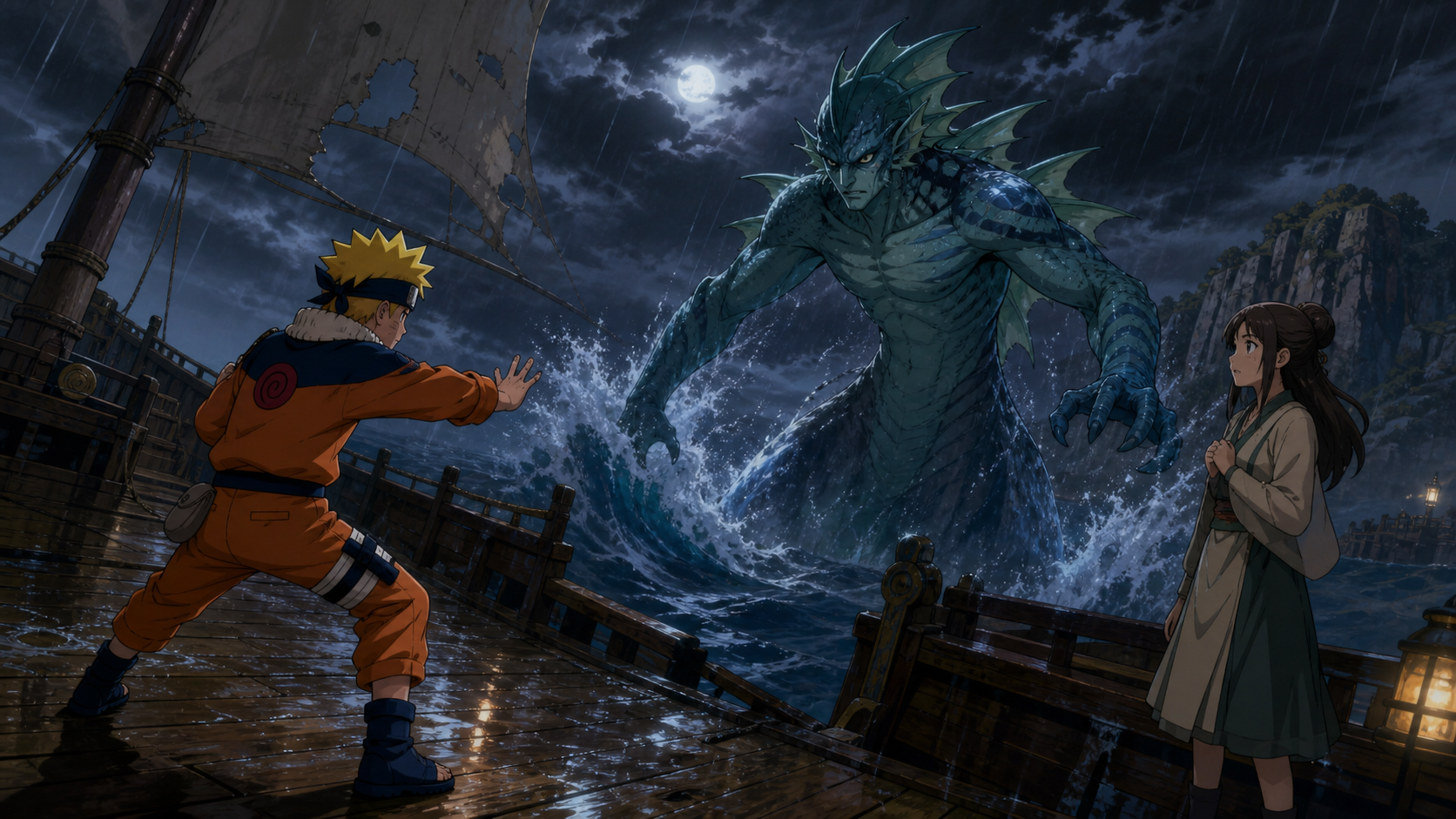
Despair: A Fractured Heart
Amachi attacks the Land of the Sea’s collection fleet and forces Isaribi to choose between his false promise of restoration and the kindness Naruto already witnessed.
Isaribi says she does not care who gets hurt or who drowns.
Naruto calls her a liar.
He has evidence.
When Naruto sank beneath the sea, Isaribi saved him. Nobody ordered her to do it. No cure waited as payment. The kind heart she now denies already made a choice when Amachi was not standing over it.
Episode 172 fractures Isaribi between that choice and the bargain controlling her life. Amachi promises a human body if she obeys. Naruto insists she is human while demanding that she stop helping Amachi harm people.
The difference between a person and a monster has nothing to do with scales.
Amachi proves it.
Episode 172 Facts
Episode: 172 of the original Naruto anime
Licensed title: Despair: A Fractured Heart
Japanese title: 絶望 引き裂かれた心 (Zetsubō Hikisakareta Hāto)
Japanese broadcast: February 15, 2006
Arc: Kaima Capture Mission, Episodes 169 to 173
Classification: Anime-original filler
The title does not mean Isaribi lacks a moral center. Her heart fractures because the actions that prove she cares conflict with the obedience she believes survival requires. She saved Naruto freely. She attacks the fleet under the promise that Amachi can return her body.
Episode 172 makes both histories visible but does not complete the choice. The final defeat, Isaribi's refusal, and the honest medical possibility belong to Episode 173.
Anko Gets Her Team Out Alive
The laboratory collapses around Anko, Naruto, Ino, Shino, and a restrained Misumi.
Naruto reaches for Rasengan. Anko stops him because punching an unstable wall without knowing the structure could drop the ceiling faster. More force is not automatically more escape.
She summons a giant snake.
The snake gathers the team into its mouth and drives through the facility wall, carrying them out before the mountain buries them. It is an appropriately Anko solution: unsettling, efficient, and much safer than letting Naruto perform structural engineering by Rasengan.
Morning has arrived.
The collection ships are already at sea.
Amachi made sure they would leave without protection. He sent word that the Leaf shinobi had defeated the Demon of the Ocean during the night. Hitode and the crews believe the mission succeeded, so the fleet proceeds through the dangerous waters with no reason to wait.
The lie weaponizes trust in the Leaf. Amachi does not need to defeat every shinobi at the port if he can make officials believe their protectors already finished the job.
That false message is an administrative attack, not merely a clever trick. The fleet leaves because officials act on the completion notice of a contracted military village. Procedures designed to coordinate protection become the route around protection once Amachi can impersonate success.
The Leaf team's delayed arrival therefore has consequences beyond losing a head start. Their institutional reputation moved civilians into danger while the actual shinobi were trapped beneath a collapsing laboratory. Amachi turns credibility into an unguarded shipping lane.
A Poor Country Sails Into the Trap
The collection ships carry more than a convenient pile of money.
The Land of the Sea is poor. Its government depends on maritime relationships and the transfer the fleet represents. Amachi targets the infrastructure holding isolated islands together, exactly as his underwater-army plan promised.
His forces attack from below.
Steering fails. Ships drift toward reefs. Crews cannot see the people controlling the water under them. Amachi adds Demonic Illusion: Descending Hell Technique, making sailors perceive fire and torture on open sea.
The attack combines physical and psychological control. The reefs can destroy the hulls, while genjutsu destroys the crew's ability to respond coherently.
The Leaf team catches up to a fleet already near collapse.
Naruto goes for Isaribi. Anko confronts Amachi. Shino and Ino support the defense while Yoroi tries to keep the team divided.
The original escort mission finally becomes visible beneath the personal rescue. Saving Isaribi and protecting the ships are not competing goals. Amachi uses one victim to create more victims. Stopping the attack is part of getting her free.
The poor-country context makes “just cargo” an ugly reading. These ships support a government spread across islands and dependent on maritime connection. Disabled steering and reef collisions threaten sailors immediately, but a lost transfer can also damage services, trade, and relationships after the battle ends.
Amachi understands that vulnerability. His ocean army is designed around places that cannot patrol every submerged approach. He calls that strategic genius. The people on deck experience it as being set on fire by an illusion while their ship drifts toward stone.
It also exposes the lie inside Amachi's grand shipping strategy. He talks about controlling the sea as if he built a new military order. His first demonstration is piracy against a country too poor to absorb the loss. He is not liberating forgotten medical knowledge or creating security. He is using experimental bodies to steal from civilians who cannot defend the water beneath their own boats.
Amachi Uses Sasuke to Cut Anko
Anko asks where Orochimaru went.
Amachi claims not to know, then mentions the talented boy who traveled beside him.
Sasuke Uchiha.
He tells Anko that something about her was not enough and suggests Orochimaru abandoned her because Sasuke made the better student.
The taunt is designed for the exact wound Anko carries. Orochimaru selected her, marked her, erased her memories, and left her in the Land of the Sea. Sasuke now occupies the position near him that once defined her childhood.
Amachi treats replacement as proof of personal failure.
That is how abusers keep former victims measuring themselves by the abuser's preference. Anko's survival, rank, loyalty to the Leaf, and command of a team become irrelevant if she still asks why Orochimaru did not keep her.
The episode does not give Amachi the authority to answer. Orochimaru discards people when their usefulness changes. That judgment describes him, not the value of the student left behind.
The Sasuke comparison also targets Naruto indirectly. Anko hears that a more talented child replaced her. Naruto hears that the teammate he failed to retrieve now stands where Orochimaru once placed another marked student. Amachi wants both of them to measure loss through Orochimaru's ranking system.
They do not have to accept the scale. Anko became a Leaf leader precisely because she did not remain whatever Orochimaru intended. Naruto's promise to retrieve Sasuke is grounded in the belief that proximity to Orochimaru is not a final identity either.
Naruto knows the other side of the comparison. He still wants to bring Sasuke home from the place that nearly destroyed Anko.
Isaribi Says the Cruel Thing She Needs to Believe
Naruto begs Isaribi to stop attacking the fleet.
She says she does not care who is injured, who drowns, or what the ships lose. Returning to a human body is all that matters.
Naruto refuses the performance.
Isaribi saved him. She fed him, treated him, and warned him away from danger. Those actions happened before she trusted him and against the interest of the people controlling her. Her kindness is not Naruto projecting goodness onto a stranger. He survived because she acted on it.
Admitting that kindness now would make her position unbearable.
If the sailors matter, obedience has a cost. If Naruto matters, attacking him is not a neutral step toward recovery. Isaribi needs to describe herself as uncaring because Amachi has made harm the price of hope.
Naruto understands the desperation and rejects the conclusion.
Pain can explain why she participates. It cannot make drowned strangers acceptable.
That line is harder than simple reassurance and more respectful. Naruto refuses to blame Isaribi for being altered, but he also refuses to say coercion makes every later act morally weightless. Accountability has to consider pressure without pretending the sailors are imaginary.
Isaribi's cruel statement functions like emotional anesthesia. If she can convince herself the crews do not matter, she can keep obeying without facing the distance between the person who rescued Naruto and the person Amachi orders her to become. Naruto calls it a lie because her earlier action is stronger evidence than the sentence she needs for survival.
The Completed Monster Has Human Skin
Amachi becomes impatient and enters the fight himself.
Naruto calls him a monster wearing human skin. Amachi laughs, then reveals the body he considers superior.
He used the research on himself.
Unlike Isaribi's unstable transformation, Amachi claims his aquatic form is fully integrated for combat. He chose alteration to gain power and treats that power as proof that the experiments succeeded.
The visual similarity does not make him and Isaribi morally equal.
Isaribi was kidnapped, altered, isolated, and promised restoration in exchange for service. Amachi pursued the procedure as an upgrade while directing the suffering of other subjects. One person survives a system. The other builds himself a throne from it.
Consent changes the moral landscape even when two altered bodies look related. Amachi chose risk for power and controlled the process. Isaribi was used, then taught that cooperation was the only route back. Similar scales do not erase who held authority, who could refuse, and who turned other people into raw material.
Naruto's “monster in human skin” language aims at conduct, not species. Amachi hurts people easily, treats subjects as inventory, and attacks civilians for control. The episode risks repeating the same monster label it criticizes, but the contrast is deliberate: appearance cannot establish monstrosity, while chosen cruelty can reveal a moral one.
Then he destroys the promise holding Isaribi beside him.
Amachi says she was a nearly dead guinea pig. The researchers intended to dissect her and use her as experimental material. They kept her alive out of supposed pity, and he now calls her ungrateful and useless.
There was never a relationship she could make safe through better obedience. Her life remained conditional, and the man promising a cure always viewed her body as inventory.
Naruto's Body Tells Isaribi the Truth
Amachi overwhelms Naruto with aquatic strength and Great Cannonball Jutsu.
Naruto keeps returning. He will not stop until Isaribi is free.
Amachi answers with Umibozu, a mass of water that functions like a moving Water Prison. It captures Naruto and begins drowning him in the same environment where Isaribi can breathe.
The weapon is a brutal extension of Amachi's philosophy. Water has no face to plead with and no stable body to strike. It surrounds the target, removes air, and turns the sea itself into the jailer. Amachi wants soldiers shaped the same way: adapted to the environment, stripped of individual claims, and useful wherever ordinary people remain vulnerable.
Amachi turns to her and repeats the command holding her in place. He is the only one who can save her. If she wants to be human, she must finish the others.
Naruto refuses to let her enter that darkness.
The Nine-Tails chakra breaks through.
For the first time, Isaribi can see the history behind Naruto's claim that they are alike. Anko explains that the Nine-Tailed Fox is sealed inside him and that the Leaf once treated him as a monster. Naruto kept working until people recognized the person they had refused to see.
Isaribi realizes he told the truth.
The reveal validates Naruto for her, but it should not become a rule that private pain only counts after public proof. He understood her before exposing the Nine-Tails because he listened to what exclusion sounded like. The chakra makes his experience visible. It does not create the empathy.
Isaribi was still reasonable to doubt the comparison. Naruto's body normally passes as ordinary in public. Her scales, bandages, and transformation force the history into every encounter. Shared stigma can create understanding without making two risks identical.
The Nine-Tails chakra closes that credibility gap for this specific conversation, but nobody should have to expose a sealed trauma before another person's compassion counts. Naruto told the truth before his body supplied the receipt.
Anko's explanation matters for another reason. Naruto cannot speak clearly while trapped and transformed by the chakra. His team leader supplies the context without using his secret to shame him. She tells Isaribi what the village did and what Naruto chose afterward, allowing his history to become a bridge at the moment he is physically unable to build it himself.
That disclosure carries responsibility. Anko reveals sensitive history because Naruto is drowning and Isaribi is being ordered to help kill him. She gives the minimum context needed to preserve his message: he knows what it means to have a feared creature attached to his identity, and the village once punished him for it.
She does not turn the Nine-Tails into spectacle or claim Naruto suffered exactly what Isaribi did. She explains why his insistence was not empty optimism.
Episode 172 ends with Naruto breaking through despair, not finishing the battle.
Isaribi's heart is still divided.
Now she knows Amachi lied about her future and Naruto told the truth about his past.
Anko chooses extraction before spectacle
The laboratory is collapsing, Misumi is restrained, and nobody has a reliable map of the structure. Naruto reaches for Rasengan because direct force is his favorite answer. Anko stops him and summons a snake capable of carrying the whole team through the wall. Leadership means choosing the method that protects injured people and preserves a route, not the technique that looks most heroic.
The destroyed laboratory leaves medical questions alive
Escaping saves the team, but Amachi has buried equipment and records that might identify compounds, procedures, doses, and other subjects. Isaribi’s future care becomes harder because the person promising a cure has also destroyed the evidence an independent clinician would need. Recovery now requires testimony, surviving samples, and a search for records outside Demon Island.
The forged report weaponizes ordinary administration
The collection fleet sails because officials receive information designed to make danger look manageable. Amachi does not need to defeat every guard before the attack. He only needs the government to place ships on the route he prepared. A secure response would compare reports against witness accounts, verify the sender, and keep mission changes visible to the escort team.
Workers aboard the collection ships carry national risk
The Land of the Sea depends on maritime transfers and cannot treat every threatened voyage as optional. That economic pressure makes sailors and guards easier for powerful people to gamble with. Protection should include evacuation plans, redundant communication, route variation, and compensation for crews sent into a danger officials knew existed. Poverty cannot become permission to spend workers cheaply.
Genjutsu turns rescue into helpless witnessing
Amachi’s illusion does more than hide an attacker. It forces Anko to watch the fleet collapse while her body cannot answer what she sees. That recreates the logic of her missing memory: she knows harm is occurring, yet someone else controls perception and action. Breaking the technique restores agency, but it does not erase the panic of being trapped inside believable failure.
Taunting Anko with Sasuke is calculated abuse
Amachi invokes Orochimaru’s newer student to tell Anko she was replaceable. The claim targets an old wound and attempts to reduce her present authority to a competition for an abuser’s approval. Anko does not need to prove she was the better student. She needs to reject the hierarchy that made children audition for value through danger, secrecy, and bodily control.
Isaribi says cruelty because obedience requires a story
If she admits the sailors matter, then helping Amachi attack them becomes unbearable. Declaring that strangers can drown protects the bargain for one more minute. Naruto calls the statement false because he has already seen her act without coercion. He does not invent goodness for her. He points to the rescue she chose when no reward was available.
Naruto’s evidence is stronger than reassurance
He could simply repeat that Isaribi is a good person. Instead, he identifies conduct: she entered dangerous water and saved him. That action belongs to her, not to Amachi’s experiment or Naruto’s opinion. When shame makes someone distrust every flattering label, a specific remembered choice can return moral authorship without pretending later harmful choices do not matter.
Amachi reveals the cure promise was never care
He treats Isaribi as an intermediate result, not a patient whose restoration guides the work. His voluntary transformation shows he values the altered body when it grants power, while promising reversal only to keep her compliant. The contradiction exposes the scheme. He did not organize treatment around her needs. He organized her hope around his commands.
Voluntary alteration and forced alteration are not equivalent
Amachi chooses his procedure, understands its purpose, and uses the result to command others. Isaribi was taken, altered, denied clear information, and returned to a community unprepared to protect her. Their bodies may share visible traits, but consent and power separate them. The monster question cannot be answered by comparing scales. It must examine choices and conditions.
Umibozu changes the battlefield into confinement
The water creature traps Naruto where breathing time, visibility, and movement work against him. A straightforward punch cannot solve a body that disperses through water. The scene also places Naruto inside the physical fear Isaribi lives with: a body and environment other people cannot safely navigate. That parallel should deepen empathy without turning her experience into a lesson designed for him.
Nine-Tails chakra exposes Naruto’s hidden difference
Isaribi sees that Naruto also carries power other people call monstrous. The revelation supports his claim that social fear and personhood are different questions. It does not make their situations identical. Naruto’s seal, village history, and access to shinobi protection differ from her medical captivity. Solidarity needs those differences named so one survivor does not disappear inside another’s story.
A feared power can protect or dominate
Naruto’s chakra erupts while he is trying to stop an attack and reach people in danger. Amachi transforms to enforce control, protect his project, and preserve his authority over Isaribi. Power alone does not supply the moral verdict. Purpose, consent, restraint, and accountability decide whether strength serves rescue or makes another person easier to own.
The episode stops before Isaribi’s choice is complete
Her doubt has cracked the bargain, but she has not yet secured safety, treatment, or a future outside Amachi’s reach. Episode 172 should not receive credit for a completed recovery it deliberately postpones. The cliffhanger holds on recognition: the promised cure is a weapon, Naruto’s hidden burden is real, and changed bodies do not dictate identical conduct.
RaeRae’s full take
The title says fractured heart, but Isaribi’s moral center is not missing. Her free choice to save Naruto remains the cleanest receipt in the arc. Amachi needs her to deny that person because a victim who trusts her own judgment becomes harder to control. Naruto’s argument works because he remembers what she did before he knew her name.
Anko also refuses the identity Amachi offers her. She is not Orochimaru’s rejected prototype competing with Sasuke for rank. She is the team leader who gets everyone out, returns to the fleet, and keeps pursuing a victim whose abuser tried to bury both evidence and witnesses.
The episode’s real divide is not human versus monster. It is care versus ownership. Naruto insists Isaribi remains a person while demanding she stop harming others. Amachi admires useful bodies while discarding the people inside them. The scales were never the verdict. Their choices are.
RaeRae checkpoint: Isaribi’s heart is fractured because Amachi made hope conditional on obedience. Naruto answers with a receipt she cannot erase: she saved him freely. Amachi’s chosen transformation proves that scales are not the moral issue. Ownership is.
Receipts and official routes
- Episode number, licensed title, and official synopsis: Naruto Official Site.
- Japanese title, synopsis, and February 15, 2006 broadcast record: TV Tokyo.
- Licensed viewing route: Crunchyroll.