
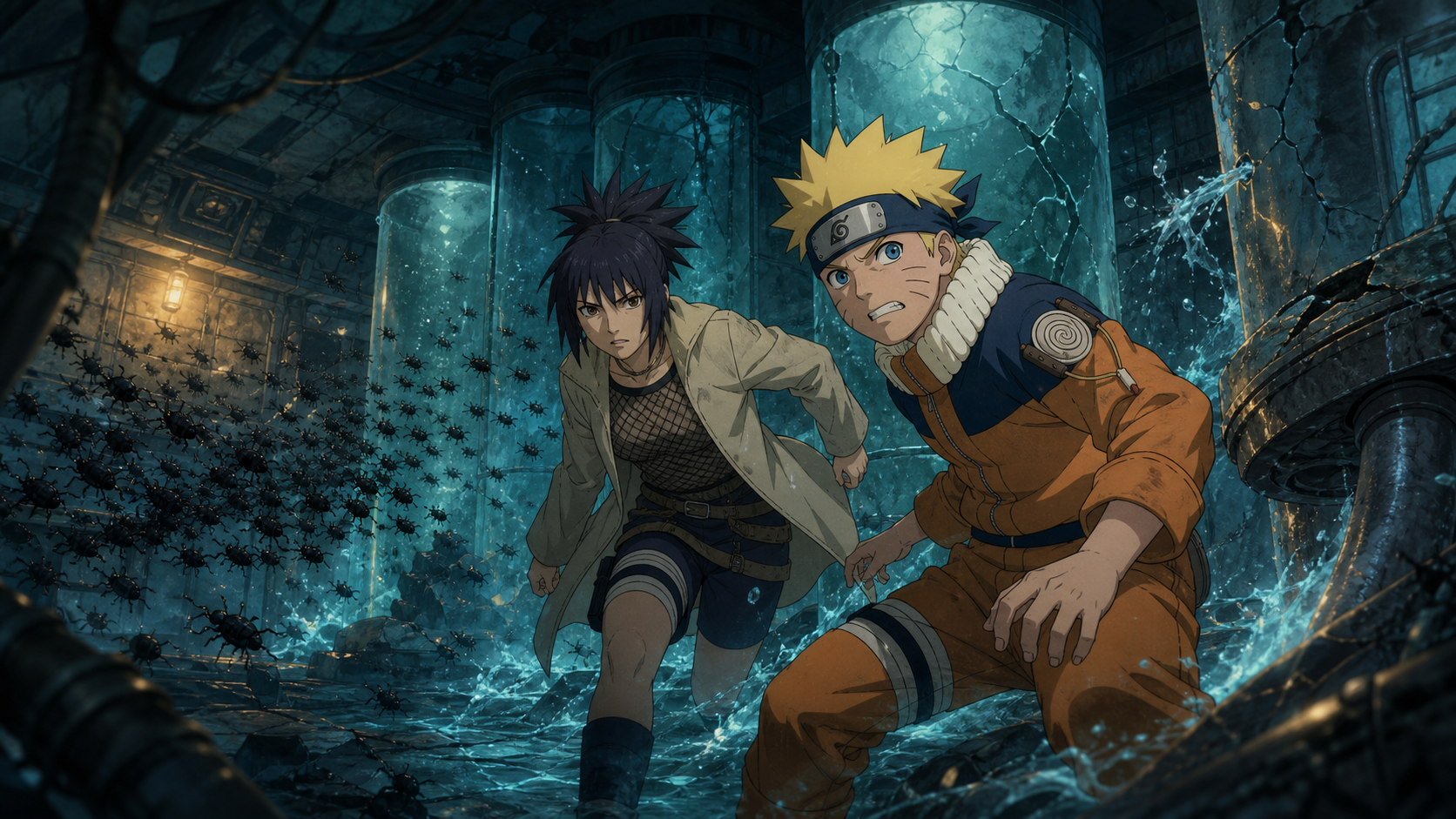
Infiltration: The Set-Up!
Anko leads Naruto and Shino into Amachi’s underwater laboratory, where Isaribi’s promised cure is exposed as another form of control.
Amachi hurts Isaribi, changes her body, and makes himself the only person promising to fix it.
Then he calls her cooperation loyalty.
Episode 171 opens Orochimaru's laboratory and finds a system built to turn victims into evidence, weapons, and accomplices. The experiments are not hiding behind a sea demon anymore. Anko remembers what the facility did. Amachi explains what he wants. Isaribi says why she protects him.
Naruto tells her she is human already.
He is right.
That does not make the cage around her imaginary.
Episode 171 Facts
Episode: 171 of the original Naruto anime
Licensed title: Infiltration: The Set-Up!
Japanese title: 潜入 仕組まれた罠 (Sen'nyū Shikumareta Torappu)
Japanese broadcast: February 8, 2006
Arc: Kaima Capture Mission, Episodes 169 to 173
Classification: Anime-original filler
This episode converts the sea-monster case into a human-experimentation case. Demon Island is not haunted. It is useful to people who need dangerous geography, local superstition, and missing witnesses to keep a laboratory invisible.
The title's set-up operates twice. Amachi plants fighters and explosives to trap the Leaf team. He also builds Isaribi's entire future around a promise only he claims he can fulfill. The second trap is harder to escape because it looks like hope.
Anko Turns Memory Into Evidence
Ino tends to Anko while the team argues about its next move. The collection ships leave in the morning. Guarding them remains the official mission. Isaribi has been taken toward Demon Island, and Naruto refuses to treat her as somebody else's problem.
Anko wakes with the missing pieces finally moving into place.
The Demon of the Ocean is not a species. It is a human body altered through experimentation.
The old disappearances were not supernatural either. Orochimaru kidnapped people near Demon Island and used them as live subjects while developing forbidden jutsu. He maintained private facilities outside the Leaf so village oversight could not reach the work.
Anko knows because Orochimaru was her jonin instructor.
The confession changes how Naruto, Ino, and Shino see their leader. Anko is not merely familiar with Orochimaru's methods from intelligence reports. She learned under him, entered this facility with him, received his cursed seal, and was abandoned in the same country where Isaribi now lives.
She does not turn the revelation into a speech about herself. She converts it into a briefing.
That is leadership. Anko cannot undo the years Orochimaru stole, but she can use returning memory to keep another subject from disappearing inside the same system.
The disclosure also gives her team information they need to judge her condition. Anko's cursed seal has already interrupted decisions and movement. Naming Orochimaru as her former instructor tells Naruto, Ino, and Shino why the island affects her and why the pain may reveal danger instead of simple illness.
She does not surrender command by admitting vulnerability. She makes command more reliable. Secrecy protected Orochimaru. Converting private memory into shared operational knowledge removes one layer of that protection.
The parallel does not make Anko and Isaribi interchangeable. Anko returned to a village that treated the cursed seal and gave her work, rank, and some protection. Isaribi returned to neighbors who drove her outside town and made every visible difference another accusation. Anko can still recognize the mechanism: damage becomes leverage when the person who caused it controls the explanation.
The team heads for Demon Island.
The Laboratory Was the Demon
The island legend did useful work for Orochimaru.
Fishermen already feared reefs and disappearances. A demon story discouraged witnesses from approaching. Anyone who vanished could be blamed on the sea, and anyone who returned altered could be blamed for surviving.
The laboratory turned geography into security.
Anko explains that Orochimaru's hunger for knowledge and power moved beyond the accepted scope of shinobi research. Once the Leaf discovered his forbidden work, he fled. His outside facilities let the experiments continue beyond the village that trained him.
Calling this “research” cannot clean it up.
The subjects did not consent. They were kidnapped, cut off from their communities, changed, and discarded when the results failed. The word demon belongs to the process long before it belongs to a body with scales.
Shinobi villages already accept dangerous training, body modification, secret techniques, and medical experimentation under some conditions. That makes the ethical line more important, not less. A dramatic result does not answer who consented, who could refuse, who benefits, who carries the risk, or what happens when the experiment fails.
Amachi and Orochimaru answer every question with power. The subjects cannot refuse. The researchers gain knowledge and military options. The altered people carry the pain and public stigma. Failure becomes a body to hide. Success becomes a body to deploy.
Anko's cursed seal hurts more as the group approaches. Orochimaru is not waiting inside. He visited more than half a month earlier, and the residual influence is enough to make his mark react.
Even his absence controls the room.
Shino Picks the Right Fight
The team enters the facility and meets Yoroi.
Naruto needs an embarrassing amount of help remembering him. Yoroi fought Sasuke during the Chunin Exam preliminaries and used chakra absorption to drain his strength. Once Naruto gets there, he is ready to charge straight into the same technique.
Shino stops him.
Close combat feeds Yoroi exactly what he wants. Shino's insects can consume chakra at range, create decoys, and attack without offering Yoroi an easy grip. He stays behind while Anko, Naruto, and Ino continue.
It is the correct tactical decision, not a convenient excuse to split the cast.
Yoroi boasts that he has improved. Shino answers with an insect clone and turns the fight into a contest between two chakra consumers. Yoroi can drain what he touches. Shino can make the apparent target dissolve into insects and take chakra without closing his own body into Yoroi's hands.
Shino rarely announces that he is clever. He simply identifies the bad matchup, replaces it with himself, and gets to work.
His choice also protects the mission from Naruto's preferred solution to every memory problem: charge until recognition arrives. Yoroi's absorption punishes direct contact. Shino can test range, disguise his true position, and make chakra consumption a contest instead of a one-sided drain.
This team split respects specialty. Shino does not stay behind because the plot forgot him. He stays because his toolkit changes the matchup and frees the others to pursue Isaribi before Amachi moves her again.
Amachi Wants an Ocean Army
Anko reaches Amachi.
She remembers him as the medical ninja who worked beside Orochimaru and ran experiments in the facility. He confirms that Orochimaru visited recently but has already left. The current operation belongs to Amachi.
He is proud of it.
Isaribi can breathe underwater and move through the sea with strength and speed ordinary humans cannot match. Amachi plans to build an entire underwater combat corps from that result. Such a force could control marine shipping routes between lands, attack vessels from below, and make him powerful enough to stand above other nations.
The strategic idea is real. The ocean creates blind spots conventional shinobi struggle to cover. Episode 169 already showed how fog, currents, and saltwater disrupt familiar techniques.
Amachi's answer is to manufacture soldiers out of stolen people.
He talks about Isaribi's body like a successful equipment test. Her pain, isolation, and fear are irrelevant unless they affect performance. He wants Orochimaru to regret abandoning the work, which means even his rebellion remains trapped inside his former master's approval.
The ocean-corps concept is militarily coherent enough to make Amachi worse. Underwater fighters could sabotage steering, attack shipping lanes, evade ordinary detection, and pressure island economies that depend on maritime trade. He is not chasing random mad-scientist spectacle. He has identified a strategic advantage and decided kidnapped bodies are an acceptable production cost.
His resentment toward Orochimaru does not free him from Orochimaru's values. Amachi wants recognition from the man who abandoned the project, so he reproduces the same hierarchy beneath himself. Somebody else becomes the disposable student. Somebody else waits for approval that will never make the abuse worthwhile.
Anko and Naruto reject the premise.
People are not tools.
Amachi calls them ordinary guinea pigs who cannot understand greatness.
The doctor has diagnosed himself by accident.
Isaribi Protects the Person Who Controls the Cure
Isaribi moves between Naruto and Amachi.
Naruto cannot understand why she protects the man who did this to her. Isaribi gives the answer Amachi built into the experiment.
He promised to return her body to normal.
People already avoid her when bandages hide the scales. If they see her aquatic form, she believes any possibility of belonging disappears. She wants to be human again and will do anything to make that happen.
Naruto tells her she is human now.
He also challenges the attacks on innocent ships. Her body does not make her monstrous, but helping Amachi sink vessels and endanger people is a choice that causes real harm.
That distinction matters. Naruto refuses both easy lies. Isaribi is not guilty because Amachi altered her. She is not free of responsibility for everything she does afterward.
He says he is the same as her.
Isaribi looks at his ordinary human appearance and calls it a lie.
Naruto carries a monster inside him and knows social rejection. Isaribi cannot see that history, just as the village cannot look through her scales. His comparison is emotionally honest but incomplete. Naruto can walk through town without his body announcing the Nine-Tails. Isaribi cannot hide what Amachi did without wrapping herself in bandages.
She needs more than reassurance. She needs freedom from the man holding restoration over her head.
That promise is coercion because Amachi controls both the injury and the alleged cure. Isaribi cannot compare providers, inspect a treatment plan, or walk away while keeping access to restoration. Her obedience becomes the price of possibly undoing what he did without her meaningful consent.
Naruto's answer protects her humanity, but Isaribi is asking about livability. Can she walk into town without bandages? Can she work, belong, and be seen without children throwing objects? “You are human” is morally necessary. It is not a medical remedy, social reintegration plan, or guarantee that the village will stop punishing her body.
Ino Makes Misumi Tie Himself Up
Amachi uses Isaribi's distress exactly as intended.
While everyone watches her, he detonates an explosive tag and brings Anko down. He escapes with Isaribi, leaving Misumi to handle Naruto and Ino.
Misumi stretches his body around Naruto and begins to strangle him. His flexibility makes ordinary holds nearly useless.
Ino answers with Mind Destruction Jutsu.
She takes control of his movement and makes that flexible body bind itself. Misumi complains that the tactic is dirty. Ino reminds him that shinobi fights do not award points for protecting an opponent's preferred advantage.
It is a clean payoff for the team's construction. Shino handles the chakra absorber. Ino turns bodily control against the man who treats his body as a weapon. Naruto keeps his focus on Isaribi. Anko supplies the history and direction.
Amachi expected disposable genin.
He gets a functioning unit.
So he collapses the laboratory around them.
The trap destroys evidence, blocks the exit, and turns the facility into a tomb while Amachi moves toward the collection ships. Episode 171 ends with the Leaf team buried inside the physical remains of Anko's lost memory.
Destroying the facility serves more than escape. The rooms, equipment, records, and remains could prove who operated there and what happened to the missing islanders. Amachi turns structural collapse into evidence management and attempts to bury the witnesses with the archive.
That repeats Orochimaru's original strategy against Anko. Remove the record. Damage the witness. Leave enough confusion that survivors must prove an event whose strongest receipts were deliberately erased.
That is the real set-up in the title. Amachi stages enemies, distractions, and explosives, but the oldest trap is hope attached to obedience. Isaribi believes she must protect him today to become herself tomorrow. As long as he owns that promise, she can run from Naruto and still believe she is running toward freedom.
They found the truth.
Now they have to survive its demolition.
Anko names the crime before the team enters
Her recovered memory changes the assignment from monster control to victim recovery and evidence preservation. That is not a cosmetic distinction. A team hunting a creature may prioritize capture or elimination. A team entering a human experimentation site must expect survivors, medical hazards, records, restraints, and people whose fear of rescuers may be entirely rational.
The mission brief was wrong because the powerful controlled the story
Villagers saw disappearances and an altered survivor, then received no trustworthy investigation. Orochimaru and Amachi benefited from the supernatural explanation because folklore required no supply trail, staff roster, or chain of command. Anko’s testimony gives Konoha a duty to revisit every missing-person report attached to Demon Island instead of treating this raid as the whole case.
Going inside requires more than courage
Naruto wants Isaribi back immediately, and the urgency is justified. The facility may also contain unstable seals, chemicals, trapped subjects, contaminated water, and deliberate demolition points. Ino should maintain communication and triage capacity outside the deepest route while Anko, Naruto, and Shino advance with marked exits. Heroism does not excuse losing the entire rescue team underground.
Yoroi’s return proves Orochimaru’s discarded people remain dangerous
Yoroi once appeared as a Chunin Exam opponent attached to Kabuto’s cover operation. Here he works inside another hidden project after Orochimaru has supposedly moved on. That continuity shows why stopping one laboratory is not enough. Operatives, techniques, records, and loyalties survive the leader’s departure and can be repurposed by whoever still wants status inside his system.
Shino wins the assignment before he wins the fight
He recognizes that Yoroi’s chakra absorption punishes skin contact and that Naruto is the wrong person to test that limit through enthusiasm. His insects can attack at range, impersonate his body, and consume the same resource Yoroi wants to steal. Choosing the matchup protects Naruto without reducing Shino to backup. It is excellent team reasoning.
Ino’s placement protects the team’s medical margin
She remains close enough to stabilize Anko and later uses Mind Destruction against Misumi. The episode does not give her the longest confrontation, but her presence keeps injury from becoming automatic mission failure. A four-person unit needs somebody tracking the leader’s condition while the others chase, scout, and fight. That labor is operational, not decorative.
Amachi understands strategy and refuses ethics
An underwater corps could threaten collection ships, ports, bridges, and coastal supply lines from angles ordinary guards cannot watch. His plan is not foolish because the military advantage is imaginary. His plan is criminal because he produces that advantage through kidnapping, involuntary alteration, dependency, and disposal. Competence makes his choices more culpable, not more respectable.
“Guinea pig” is the organization chart in two words
The label tells us who gets to ask questions and who becomes material. Amachi keeps authorship, ambition, and the imagined future glory. Isaribi keeps the altered body, pain, social exile, and risk of failure. Every time he calls her a specimen, he erases the fact that his result belongs to a person who never agreed to become his proof.
Orochimaru’s visit does not make him the episode’s only villain
Amachi cannot hide behind obedience to a former superior. He continues the work, designs the ocean force, controls the cure narrative, and destroys the laboratory on his own initiative. Orochimaru created the institutional method, but Amachi chooses to preserve it because the method gives him power. Responsibility can travel through a hierarchy without disappearing at either level.
Isaribi’s bargain is coercion dressed as treatment
She cannot meaningfully refuse the doctor who caused her condition while he claims exclusive power to reverse it. She has no independent diagnosis, no second opinion, no timetable, and no guarantee that obedience will produce care. Calling that arrangement voluntary ignores the cage. Hope becomes leverage when one abuser controls both the wound and the only advertised exit.
Naruto gives her moral recognition, not a complete recovery plan
“You are human” directly rejects Amachi’s language and the village’s cruelty. Isaribi still needs medical stabilization, housing, protection, honest information, and a community willing to stop treating visible difference as guilt. Naruto’s answer is the necessary first sentence. Konoha and the Land of the Sea owe the practical paragraphs that must follow it.
Shared pain does not mean identical access
Naruto understands being marked as dangerous, yet most strangers see an ordinary boy until they learn about the Nine-Tails. Isaribi’s scales expose private harm before she can choose whom to trust. His empathy becomes useful when he recognizes the pattern and stays beside her. It would fail if he used similarity to flatten what only she endures.
Misumi complains when Ino refuses his preferred rules
He weaponizes flexibility to wrap around Naruto, then calls Mind Destruction dirty when Ino makes that body restrain itself. The complaint is almost funny because he expects courtesy while strangling someone. Ino does not owe him a contest designed around his advantage. She identifies the control point and ends the hold with the skill her team actually brought.
The collapse is an evidence purge
Amachi is not merely blocking pursuit. He is destroying tanks, notes, equipment, and physical traces that could identify victims or explain their treatment. Survivors may need those records for medical care. Families may need them to learn what happened to missing relatives. Demolition attacks both the present rescue and everyone’s future ability to establish truth.
Escaping alive is not the same as closing the case
The collection ships remain under threat, Isaribi remains with Amachi, Yoroi and Misumi are still active, and the treatment question has no answer. Episode 171 earns its cliffhanger because the team uncovers the mechanism without ending its consequences. The next priority is extraction, followed by protecting the fleet and separating Isaribi from the person monetizing her hope.
RaeRae’s full take
This episode finally walks through the door Episode 170 kept shut and finds exactly what the arc promised: not a sea curse, but organized human choices. Orochimaru supplied the method. Amachi kept the laboratory useful. Yoroi and Misumi enforce it. The island’s fear helped everyone responsible work without scrutiny.
Anko does the bravest thing before the fighting starts. She turns damaged memory into a public record her team can act on. Shino and Ino then prove that competence is not always the loudest attack. They choose the correct matchups, protect the mission, and refuse to let specialists dictate the terms of combat.
Naruto is right about Isaribi’s humanity, and the story must demand more than a comforting sentence. Rescue means bodily safety, independent care, truthful records, and a future Amachi cannot hold hostage. Anything less leaves the laboratory’s logic standing after its walls fall.
RaeRae checkpoint: The laboratory did not create a monster. It created evidence of kidnapping, coercion, and a military plan built on stolen bodies. Isaribi needs rescue and independent care, while Anko’s returning memory gives the investigation a witness Amachi tries to bury.
Receipts and official routes
- Episode number, official English display title, and synopsis: Naruto Official Site.
- Japanese title, synopsis, and February 8, 2006 broadcast record: TV Tokyo.
- Licensed viewing route: Crunchyroll.