
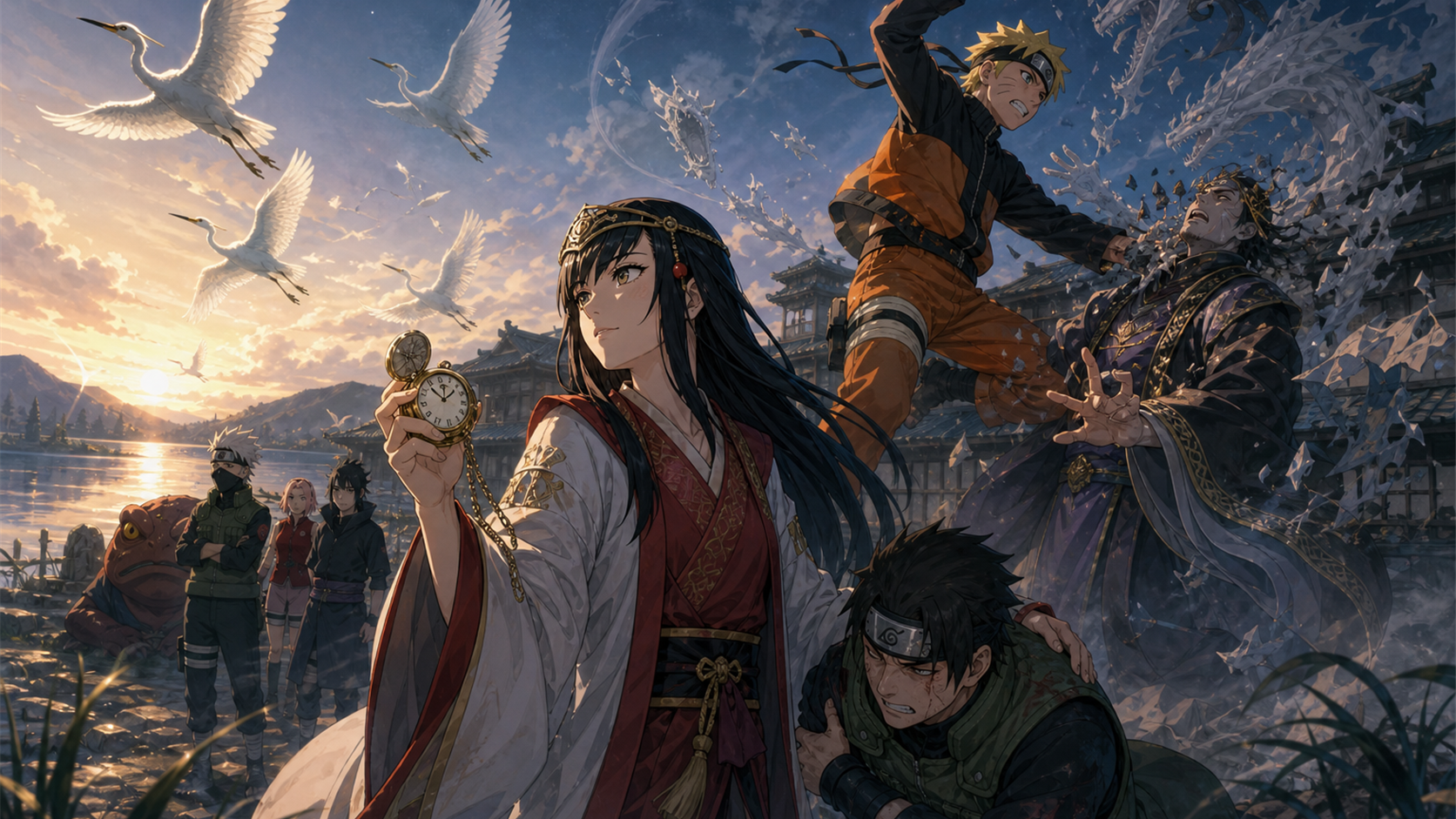
When Egrets Flap Their Wings
Sagi’s spirit gives Naruto the message Toki needs, turning a stopped watch from an order for revenge into a duty to the living.
Sagi does not ask Naruto to avenge him.
He asks Naruto to save his sister.
That distinction ends the Cursed Warrior Extermination Mission more completely than Naruto's final attack on Hoki. Toki has spent the arc treating revenge as the duty she inherited from her dead family. The brother whose name she wears finally tells her that she misunderstood what he left behind.
The watch was not a countdown to murder.
The Land of Birds was not a prize to defend by disappearing inside Sagi's identity.
Toki inherited a future, and Episode 167 makes her choose whether she will finally live in it.
Episode 167 Facts
Episode: 167 of the original Naruto anime
Licensed title: When Egrets Flap Their Wings
Japanese title: 白鷺のはばたく時間 (Sagi no Habataku Toki)
Japanese broadcast: January 4, 2006
Arc: Cursed Warrior Extermination Mission, Episodes 162–167
Classification: Anime-original filler and arc finale
This is the episode where every disguise has to answer to the people it affected. Hoki cannot hide conquest behind Moso's reputation. Toki cannot keep treating Sagi's face as private mourning when that face has governed a country. Naruto cannot save her by winning a fight and leaving the political lie untouched.
The title's egret image gives the stopped watch a second answer. Time does not restart because Hoki falls over. It restarts when Toki moves under her own name and accepts that surviving her family is not disloyalty.
Chishima Reaches Naruto First
Naruto entered Hoki's genjutsu knowing it was a trap. The false lake now holds him beneath the surface while familiar voices and images pull his mind farther from the fight.
Hoki needs Naruto to accept the illusion long enough for his body to drown. The scheme works because Naruto's greatest strength can also become an opening. If somebody is waiting beyond the danger, he will run into danger before calculating how he plans to return.
Chishima supplies the return route.
He follows Naruto, calls him back to himself, and disrupts Hoki's control. Chishima has no celebrated clan technique, special eye, or famous teacher. His importance has never come from matching the Leaf team in combat. He refuses to abandon Toki, and that loyalty keeps moving him into rooms where Hoki expects fear to clear the path.
Hoki attacks him for it.
Naruto goes under again, and Chishima appears to pay the price for reaching him. The moment resembles the story Toki already believes about her life: anyone who stays close will be taken, so connection only creates another grave.
Then somebody truly dead reaches Naruto too.
Sagi Gives Naruto the Real Mission
Underwater, Naruto meets Sagi.
Not Toki in armor. Not one of Hoki's projections. Not another stolen face inside the conspiracy.
Sagi asks him to save Toki.
He entrusted the Land of Birds and their father's watch to his younger sister. He expected her to continue the family's work. Instead, Toki made the watch a monument to the instant her life stopped. She took Sagi's public identity, buried her own name, and decided that revenge was the only motion still available to her.
Sagi wants Naruto to make her time move forward.
The request cuts through every justification Toki has used. She believes living as Sagi honors him. Sagi wants his sister back. She believes killing Hoki will complete her responsibility to the dead. Sagi asks Naruto to protect her from that responsibility as she has defined it.
Toki turned memory into a prison because grief felt more faithful than survival. Her brother refuses the tribute.
Naruto understands why he has been placed between them. At the Valley of the End, Sasuke also treated revenge as proof that his family mattered. Every bond that pulled him toward a different future felt like an insult to the dead. Naruto could not break that conviction before Sasuke left.
He has another chance now.
Sagi does not give Naruto a new enemy to punish. He gives him a living person to bring home.
That request is also a correction to revenge stories that turn the dead into silent permission slips. Toki has built years of policy and risk around what Sagi would supposedly want. When Sagi finally speaks, he does not validate the punishment carried out in his name. He protects the sister still capable of having a future.
Naruto serves as messenger because he understands how easily love becomes an argument for self-destruction. He cannot prove that grief is over. He can prove that the dead person at the center of Toki's vow did not ask her to disappear.
Hoki Cannot Claim the Future He Stole
Naruto rises from the water and hits Hoki.
He tells Toki that he saw Sagi and delivers her brother's message. Hoki dismisses the connection, then points to Toki's obsession as evidence that she cannot govern.
He is not entirely wrong about the danger.
Toki has lied to her people, pursued a private vendetta through public office, rejected advice, and repeatedly endangered the people trying to protect her. A ruler who reduces the country to an instrument of revenge is not serving it.
Hoki recognizes that failure because he has built an even larger version of it.
The wandering shinobi want a homeland where they will no longer be mocked or left outside the protection of a village. Hoki answers that pain by murdering the Land of Birds' ruler, impersonating a trusted monk, framing an innocent minister, and terrorizing citizens with manufactured ghosts. He calls the country a future for his people while denying its existing people any voice in that future.
Naruto names the contradiction.
Hoki wants the land. He does not care for the people who make it a country. His plan offers the wandering shinobi security by forcing everybody else to live under a lie.
Sagi's message and Hoki's conquest place two meanings of homeland beside each other. Hoki sees a territory that can be possessed. Sagi sees people who must be cared for after he is gone.
That is the inheritance Toki failed to understand.
Hoki's grievance about wandering shinobi still deserves a hearing after his defeat. Village shinobi receive training networks, recognized ranks, employers, intelligence, medical support, and a flag that can make clients trust them before they have earned personal trust. People outside that system can work just as hard and remain disposable.
None of that grants Hoki the Land of Birds. He responds to exclusion by recreating it with himself in charge. The citizens become obstacles, Komei becomes a problem to remove, and Toki becomes a vacancy waiting to happen. A refuge built through assassination and impersonation is not refuge for the people already living there.
The episode's politics are strongest when Naruto refuses Hoki's false choice. Toki's revenge has damaged her judgment. Hoki's takeover is still illegitimate. Criticizing the ruler does not transfer the country to the critic with the best murder plan.
Naruto Rendan Ends the Fraud
Hoki has survived by controlling appearances.
Moso looked like a holy man. Genjutsu looked like secret techniques. Empty armor looked like a curse. Toki looked like Sagi. The government looked stable while a takeover hollowed it out from inside.
Naruto's answer is wonderfully direct.
Shadow Clones surround Hoki, drive him into position, and turn the finishing sequence into Naruto Rendan. There is no borrowed clan identity in the attack and no illusion that asks Hoki to defeat himself. Naruto and his copies hit him until the performance ends.
Naruto originally shaped Naruto Rendan after watching Sasuke's Lion Combo. He adapts what he learns openly into a technique marked by his own clones, timing, and stubbornness.
Hoki copies to erase the original.
Naruto learns from other people without pretending they never existed.
Around them, Kakashi, Neji, and Tenten finish the wandering shinobi's resistance. Kakashi even denies one fighter the prestige of forcing out the Sharingan. Hoki's organization has spent years collecting techniques and reputations, but the collection never became the community it was meant to replace.
Their leader falls, and the false government loses the fear holding it together.
Toki Tells the Country Her Name
Victory does not automatically make Toki a good ruler.
The episode refuses that shortcut. She must face the people she deceived.
Toki admits that Sagi died and that she governed in her brother's place. She apologizes for the lie. Then she asks to remain long enough to rebuild the Land of Birds after Hoki's conspiracy.
That public request matters.
Hoki treated rule as something he could seize through superior manipulation. Toki previously treated it as a role she could inherit by wearing the expected man's face. Now she stands before the country as herself and lets its people answer.
They accept her.
The decision does not erase the deception. It changes the basis of her authority. Toki is no longer governing because nobody knows Sagi is dead. She governs because the truth is known and the people choose to let her repair the damage.
That consent is not a blank check. Toki asks to remain long enough to rebuild, which frames rule as accountable work rather than a prize returned after the villain loses. The people can judge what she does next because they now know who is doing it.
Her apology also has to be public because the harm was public. Komei faced a false sentence. Officials obeyed a ruler whose identity shaped succession. Citizens organized their trust around a dead heir. A private confession to Naruto and Chishima could repair friendship, but it could not repair government.
The wandering shinobi are taken into custody to face punishment. Their grievance remains part of the story, but suffering outside a village does not grant them ownership of one. A homeland created by silencing its citizens would only reproduce the rejection they hated.
Toki has to build the opposite kind of future. She must earn trust without armor, false names, or a dead brother standing between her and every decision.
Chishima Gives Toki Somewhere to Go
Chishima survives.
His return can look like a quick reversal after the episode asks Toki and Naruto to believe Hoki killed him. Its emotional purpose is stronger than the trick.
Toki organized her identity around being the only person left. Owashi was dead. Sagi was dead. Chishima belonged to a childhood she believed revenge had made inaccessible. Hoki reinforced that isolation because a ruler without trusted relationships is easier to manipulate.
Chishima's survival puts an ordinary human bond back within reach. He remembers Toki before she became a title, and he keeps choosing her when rank tells him to stand outside. He proves that moving forward is not the same as moving alone.
His sleepy comment about Naruto's ramen also releases the pressure in exactly the Naruto way. A man who seemed dead wakes up thinking about food, and tragedy yields one small piece of everyday life.
That is the future revenge kept hiding from Toki. It is not a grand reward waiting after Hoki dies. It is friendship, work, embarrassment, rebuilding, meals, and another morning in a country that still needs her.
The First Cursed Warrior Was Real
The Leaf team leaves the Land of Birds with the case apparently solved.
Hoki and his shinobi created the false hauntings. Toki wore the original armor during her investigation. Every supernatural threat has been assigned a human operator.
Neji notices one problem.
The first Cursed Warrior they encountered had no body inside the armor.
That apparition may have been Sagi.
Naruto reacts with horror, which turns the last revelation into a joke without reducing it to one. The story has spent six episodes teaching everyone to distrust appearances. Its final move is to suggest that careful skepticism can still leave room for something real.
Hoki used belief in ghosts as a weapon. That does not mean every ghost was his.
The distinction keeps the finale honest. A real apparition would not retroactively make Hoki's manufactured hauntings harmless. He staged fear, framed Komei, and exploited a culture's uncertainty for political control. The possibility that Sagi's spirit also appeared only means fraud did not exhaust the world.
Neji is the right person to leave the question open. His eyes usually settle arguments about hidden bodies and mechanisms. When his observation cannot account for the empty first suit of armor, the remaining mystery has earned its place instead of demanding belief through noise.
Sagi may have been moving through the story before Naruto met him underwater, trying to reach the sister frozen in his name. The title's egret can finally flap its wings because Toki no longer needs to keep Sagi trapped in armor, office, or memory.
Her watch can move.
So can she.
Chishima enters the genjutsu because friendship becomes action again
He has crossed borders, carried evidence, endured rejection, and returned to the person he believes can still choose life. Breaking into Hoki’s water illusion places him in direct danger, yet the act is not blind sacrifice. Chishima brings a relationship from before the conspiracy into a space designed to isolate Toki and Naruto from every trustworthy voice.
Naruto’s meeting with Sagi gives grief a message beyond revenge
Sagi’s spirit does not demand punishment for Hoki. He asks Naruto to save Toki and protect the living country entrusted to her. That request releases Toki from the belief that honoring her brother requires remaining inside his identity or killing in his name. Memory becomes a responsibility toward people still here.
The spiritual encounter should not replace the material evidence
The arc has already established tunnels, kites, copied techniques, assassins, planted weapons, and Hoki’s stolen face. Sagi’s message matters emotionally without becoming the only proof of the conspiracy. Justice still needs testimony, captured operatives, recovered armor, and records that the Land of Birds can examine publicly.
Naruto serves as messenger rather than owner of Toki’s decision
He carries Sagi’s request back because Toki cannot hear it directly. Naruto should not use the message to command her future. Its value lies in offering another interpretation of loyalty: she may live, govern as herself, and protect the country without betraying the dead.
Hoki defines homeland through possession
He claims murder, impersonation, and political capture as the means to create a place for wandering shinobi. A homeland built by removing residents’ choice reproduces the dispossession it supposedly answers. Community cannot become legitimate merely because the conqueror also experienced exclusion.
Naruto rejects the idea that suffering licenses conquest
He knows isolation and the desire to be acknowledged. That history lets him recognize Hoki’s grievance without accepting the method. Pain may explain why belonging feels urgent. It does not turn another country’s people, ruler, and institutions into available material.
Naruto Rendan ends the immediate threat while capture preserves the case
Defeating Hoki protects Toki and Chishima. The surviving wandering shinobi should be secured alive where possible so the country can learn who participated in Owashi and Sagi’s deaths, how long the network operated, and whether outside supporters remain. Victory becomes durable through information.
Chishima’s survival restores a relationship revenge had pushed away
Toki rejected him while living as Sagi because closeness threatened the identity and anger holding her together. His return does not erase that harm, but it gives them a chance to rebuild through truth. Friendship can continue only if Chishima is allowed to name what the rejection cost him.
Toki’s public disclosure returns agency to the country
She tells residents that she lived under Sagi’s name and asks them to decide whether rebuilding under her leadership is acceptable. That is different from Hoki’s rule through a stolen face. Toki reveals the deception and accepts the risk that truth may change how people see her.
An apology should name why the concealment occurred without demanding instant forgiveness
Succession danger and conspiracy shaped Toki’s decision, but residents still lived under a ruler whose identity they did not know. People may feel protected, deceived, relieved, or uncertain at the same time. Public repair requires records, questions, and a lawful process for confirming leadership beyond one emotional gathering.
Komei deserves visible restoration
He was framed, detained, and nearly executed before the same public that heard Moso’s case. Clearing him privately would leave the accusation intact in community memory. The government must present the contradictory evidence, correct the confession narrative, and restore his standing while allowing review of his actual political choices separately.
The restarted watch marks permission for time to continue
The heirloom no longer has to freeze Toki inside the deaths. Restarting it does not mean grief ends or the past becomes unimportant. It means memory can travel with her into decisions made for living people instead of functioning as an order to repeat the moment of loss.
White egrets offer movement without pretending everything is healed
The birds rise while institutions, relationships, and public trust still require repair. Hope works because it points toward motion, not perfection. The Land of Birds has an exposed conspiracy, surviving witnesses, and a ruler speaking under her own name. Morning begins before recovery is complete.
Neji preserves the first apparition as unresolved evidence
Most Cursed Warrior appearances now have physical explanations, yet his final observation leaves the original hollow encounter genuinely uncertain. Responsible closure can admit that gap. An unexplained event does not invalidate the solved conspiracy, and a solved conspiracy does not authorize the team to rewrite every earlier observation as understood.
Uncertainty is not failure when the main danger is contained
The team can secure Hoki, protect Toki, clear Komei, and document the armor mechanisms while marking one appearance unresolved. Honest limits make the report stronger. Claiming total knowledge would repeat the false certainty that nearly enabled Komei’s execution.
RaeRae’s full take
Episode 167 lets Sagi’s memory stop being an order for revenge. His request is for Toki to live and protect the country still in front of her. Naruto carries that message without becoming the person who gets to choose her name or future.
Toki’s public truth is the real political repair. Hoki stole a face to remove consent. Toki reveals the face she carried and asks people what comes next. The history is complicated, but the direction is honest.
I love that Neji leaves one apparition unexplained. The team solved the conquest without pretending every mystery surrendered. That is not weakness. It is the integrity the investigation needed from the beginning.
RaeRae checkpoint: Sagi asks for Toki’s life, not Hoki’s death. The restarted watch lets memory move forward, while Neji’s unresolved first apparition keeps the final report honest.
Watch Naruto Episode 167
- [Naruto Official episode guide](https://naruto-official.com/en/anime/naruto1/list/01_391)
- [Watch “When Egrets Flap Their Wings” on Crunchyroll](https://www.crunchyroll.com/watch/GYNQ15K3Y/when-egrets-flap-their-wings)
- [Browse official Naruto viewing options from VIZ](https://www.viz.com/anime/tv-show/naruto-video/video-unit/1)
Receipts and official routes
- Episode number, licensed title, and official synopsis: Naruto Official Site.
- Japanese title, synopsis, and January 4, 2006 broadcast record: TV Tokyo.