
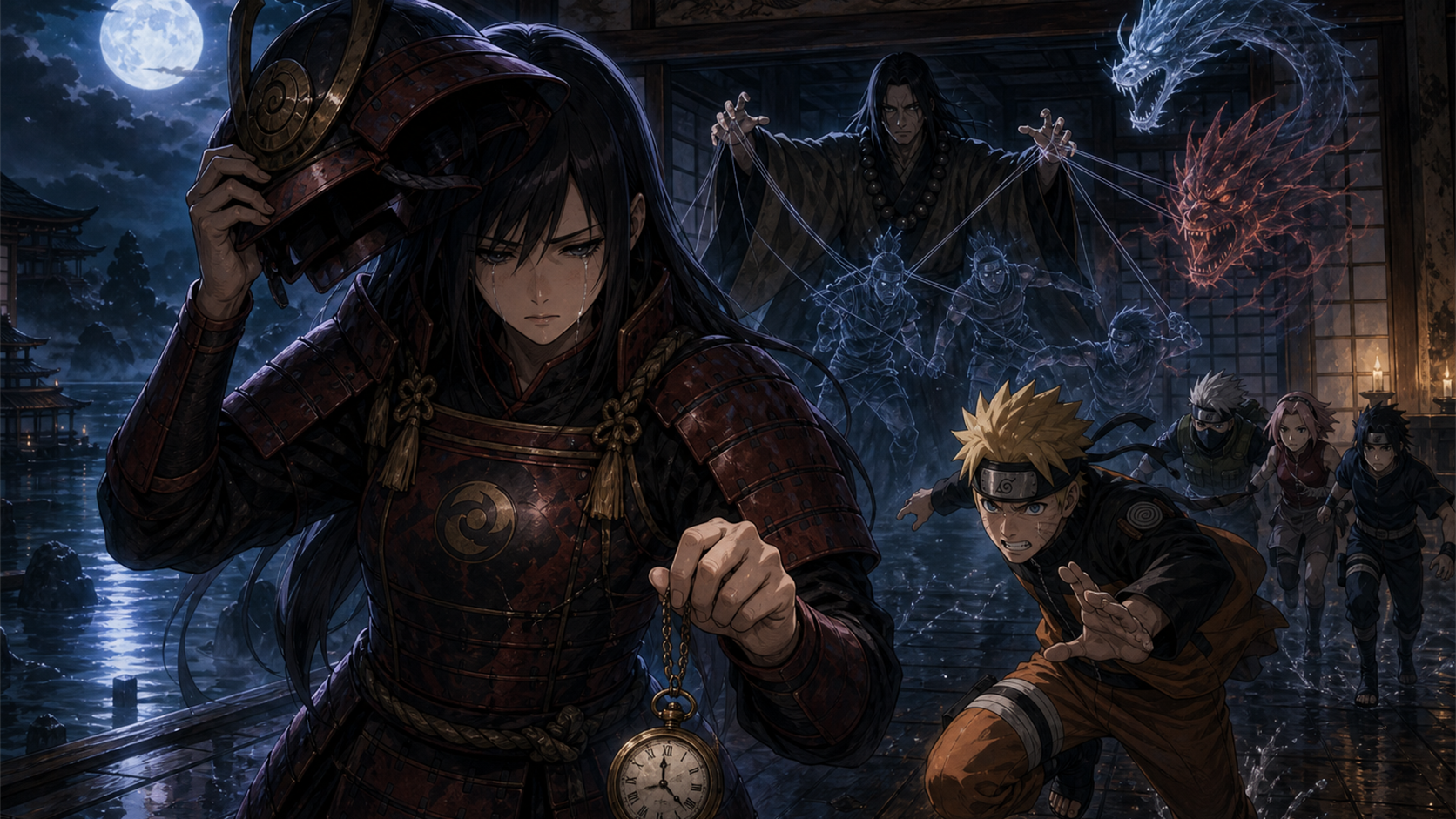
When Time Stands Still
Toki names herself beneath Sagi’s identity while Hoki reveals the stolen face, copied techniques, and conquest hidden behind Moso.
Sagi is Toki.
Moso is Hoki.
The Cursed Warrior is sometimes Toki, sometimes one of Hoki's shinobi, sometimes Naruto, and never a reliable job description.
Episode 166 finally strips the identities from the Land of Birds conspiracy. The surprise is not that everyone has been lying about a name. The surprise is what each lie costs.
Hoki steals another man's identity to conquer a country. Toki takes her dead brother's identity because she believes her own future died with him.
One disguise erases victims.
The other erases the person wearing it.
Episode 166 Facts
Episode: 166 of the original Naruto anime
Licensed title: When Time Stands Still
Japanese title: 止まったままの時間 (Tomatta Mama no Jikan)
Japanese broadcast: January 4, 2006
Arc: Cursed Warrior Extermination Mission
Classification: Anime-original filler
That label describes where the story came from, not whether viewers are forbidden to care about it. Episode 166 does not advance the manga plot, and nobody should smuggle its Land of Birds politics into manga canon. It still gives Naruto a sharp rehearsal for the argument he keeps losing with Sasuke: grief can turn revenge into an identity so complete that accepting help feels like betraying the dead.
The episode also earns its title literally and emotionally. Sagi's inherited watch has stopped. Toki has decided her life stopped with it. Hoki wants a country whose political future will stop the moment his imitation government becomes permanent. Everybody is moving, fighting, and planning, but almost nobody is living toward tomorrow.
Naruto Sees Sasuke in Sagi
The ruler Naruto knows as Sagi refuses to wait for the Leaf team. Revenge must be completed before the clock inside his heart can move again.
Komei warns that revenge will drag him into darkness. Sagi accepts the price.
Naruto hears Sasuke.
He remembers the Valley of the End, where Sasuke reduced his life to hatred, revenge, and the road to Orochimaru. Naruto could not stop that comrade from leaving. Watching Sagi make the same bargain turns the old failure into immediate panic.
He refuses to let another person walk willingly into the dark.
Sagi does not want help. A prepared mechanism traps Naruto, Neji, Tenten, Komei, and Chishima long enough for the ruler to leave alone.
The move exposes the selfishness inside revenge disguised as personal duty. Sagi claims the fight belongs to him, but everybody else must absorb the consequences. Chishima already bled to uncover the truth. Komei nearly died under a false sentence. The Leaf team risked an international incident to keep the case alive. Sagi still treats their lives as side effects of a private score.
Naruto knows that pattern too.
Sasuke called bonds interference because admitting they mattered would weaken the revenge identity he built. Sagi traps the people who care because their presence threatens the same illusion: that nothing remains worth living for after the target dies.
Kakashi Defeats the Copy of a Copy
Before the team can pursue, Kakashi finishes his fight with Nagare.
Nagare's Universal Assimilation makes stolen techniques look impressive. He appears to merge with stone, roll forward as Rock Tank, and reproduce Gaara's sand attacks.
Kakashi sees the limit.
Nagare has not become the material. His real body remains elsewhere while chakra manipulates the rocks and sand. The performance copies a technique's visible result without reproducing the power underneath.
Lightning Blade ends the trick.
Nagare recognizes Kakashi too late and admits the painful motive behind the wandering shinobi. Without a village, they are mocked as low-ranked outsiders. They travel, steal jutsu, sharpen what they can, and search for a place in the sun. Effort alone has not erased the distance between them and shinobi backed by established villages.
That grievance is real.
It does not make murder, impersonation, and conquest a homeland policy.
Kakashi's victory also previews Hoki's weakness. The wandering shinobi collect surfaces. They can imitate what an ability looks like, but not always the lineage, training, judgment, or structure that makes the real technique work.
Toki Buried Herself with Sagi
The team determines that revenge will draw Sagi to Moso's residence.
Then the episode shows the memory hidden beneath the name.
Owashi died first. Toki feared losing her elder brother after already losing their father. The siblings had each other, the lake, and the future their family expected them to share.
Sagi died too.
Toki stood alone with the inherited watch and a country that expected a male heir. Instead of grieving publicly as herself, she took Sagi's identity. She vowed to keep living as her brother until she avenged both deaths and restarted the hands of time.
The plan keeps Sagi present by removing Toki.
Every earlier scene changes. Chishima could not reach his childhood friend because the person behind the door was carrying two deaths and a false public life. The ruler's coldness was not Sagi becoming cruel after Toki died. It was Toki refusing every connection that might recognize her beneath Sagi.
The office makes that refusal easier to maintain. Courtiers address the title, guards enforce distance, and the country needs continuity after two sudden deaths. Every formal interaction rewards Toki for sounding less like herself. Chishima threatens the arrangement because he remembers the siblings before the throne divided them into ruler and subject. Letting him close would mean answering as the person who survived.
The succession pressure matters too. Toki does not simply choose her brother's clothes in a private grief ritual. She occupies a government built to recognize a male heir. The disguise keeps the country from confronting whether it would accept the surviving daughter as ruler, and that avoidance makes the lie politically useful long after the first shock passes.
That does not remove Toki's responsibility. She governs through deception, shuts out Komei, uses the Cursed Warrior identity to conduct a private investigation, and traps the people trying to stop her suicide mission. Grief explains why the arrangement felt necessary. It does not make every decision inside it wise.
What makes the situation cruel is that the same lie can protect continuity and destroy the person maintaining it. The court receives a familiar ruler. The citizens receive the appearance of stability. Toki receives daily confirmation that her own name is the expendable part of the bargain.
The heirloom watch becomes more than a grief object. It marks the exact point where she decided that the future belonged to revenge and her own name no longer belonged anywhere.
She also becomes the original Cursed Warrior, using the armor to search for the killer while governing as Sagi.
Toki is not pretending because she wants power. She is pretending because she thinks survival as herself would betray the dead.
That is why Naruto cannot dismiss her as another liar. He has to separate the grief he understands from the revenge that is destroying her.
Chishima Apologizes Without Making Himself the Solution
Chishima reaches Toki during the confrontation and apologizes for failing to understand what she carried. The apology matters because he does not demand credit for caring. He had access to the childhood friend beneath the title, yet rank, secrecy, and Toki's withdrawal kept that relationship from becoming useful when she needed it.
His failure is not equal to Hoki's crimes. Hoki manufactures isolation so he can seize power. Chishima is a loyal friend who did not recognize how completely grief had reorganized Toki's life. The episode lets both truths stand: he loves her, and love did not automatically give him the right question at the right time.
Naruto needs to hear that too. He often treats determination as a substitute for understanding. With Sasuke, he knows the bond is real but keeps struggling to describe a future that does not sound like an order to return. Chishima's apology shows the work Naruto still has to do. Reaching someone in revenge means recognizing what revenge is protecting, not merely shouting louder than it.
Toki still does not stop. An apology cannot instantly reopen a life she has spent years sealing shut. Episode 166 ends before repair because hearing a person is only the beginning. The choice to live under her own name remains hers.
Moso Was Never Moso
Hoki expects the Cursed Warrior to come.
Killing the feudal lord openly would expose the takeover. Killing a masked “ghost” can be presented as defending the country from a criminal apparition. Toki's disguise gives Hoki the legal cover he needs to erase her.
She attacks his residence in the white armor.
The man called Moso drops the humble-priest performance. His real name is Hoki, and he leads the wandering shinobi.
He did not merely advise the government. He replaced the actual monk Moso, used genjutsu that Owashi mistook for holy power, and exploited the monk's reputation to approach the ruler. Owashi trusted the identity Hoki stole.
Komei was the only official who remained suspicious.
Hoki admits the sequence. He assassinated Owashi, forced Komei out of the way, manipulated the succession crisis, and built the false Cursed Warrior case. Killing Sagi is the final step toward taking the Land of Birds as a permanent homeland for his group.
His people deserve safety. They do not deserve this country by right of having suffered elsewhere. Hoki answers exclusion by stripping the Land of Birds of its ruler, public trust, and freedom to choose its own future. He wants the protection of belonging while denying belonging to the people already there. That is not refuge. It is conquest with a sympathetic origin story.
Toki removes the helmet and names herself.
She will avenge her father and brother.
Hoki appears to catch her with Shadow Possession Jutsu. Their shadows overlap, and Toki freezes.
Naruto calls the fraud.
Shadow Possession is a Nara clan secret technique. Hoki cannot reproduce it because he saw the shape of a jutsu. Toki is trapped in genjutsu, not Shikamaru's inherited art.
Hoki's identity and techniques follow the same method. He borrows a trusted appearance, imitates the result, and relies on other people supplying belief.
The difference between secrecy and lineage also matters here. Shadow Possession is not a public trick that becomes authentic because an observer can reproduce the silhouette. It belongs to a clan practice with training, inherited knowledge, tactical limits, and people who understand its costs. Hoki copies the recognizable outline and expects fear to complete the technique for him.
That is cultural theft reduced to combat logic. He wants the authority attached to Moso without the monk's life, the protection attached to a homeland without its citizens' consent, and the prestige attached to village techniques without the relationships that preserved them. He keeps the useful surface and discards the human source.
Copies Without Conviction
Naruto attacks with the Leaf team and Chishima beside him.
Hoki uses Phoenix Flower Jutsu. Naruto dismisses it as a weak imitation of Sasuke's fire and answers with Shadow Clones. The insult is funny, but it lands on the episode's central point. Naruto knows the person behind the technique. A copied flame cannot reproduce Sasuke's precision, history, or intent.
Naruto is not a purity snob about techniques. His own fighting style grows through observation, instruction, improvisation, and a frankly unreasonable number of clones. He learned the principles behind what he uses, changed the application, and attached the result to his own limits. He does not erase Jiraiya, Kakashi, Sasuke, or the people whose work made his growth possible.
Hoki does the opposite. His copied techniques function like forged credentials. Each one says, “Trust the appearance and do not inspect the foundation.” That strategy works against frightened officials and opponents who hesitate. It weakens the moment somebody such as Kakashi or Naruto knows what the original technique actually requires.
Kakashi recognizes Hoki by reputation and confronts the grievance directly. Village shinobi do benefit from institutions the wandering shinobi lack. Hoki responds by trying to seize an existing country through deception and murder, repeating the exclusion he claims to oppose with himself at the top.
He summons dragons.
Even those are false projections.
Hoki escapes into the mansion while the team realizes the spectacle was another layer of genjutsu. Naruto follows because Toki is still in danger.
Inside, the building gives way to water and distance. Hoki's voice calls from across the illusion and promises that Toki waits on the other side. A boat offers the route.
Naruto knows it is genjutsu.
He goes anyway.
That choice is reckless, but it is not blind. Toki has spent the arc believing nobody can reach the person buried beneath Sagi. Naruto enters a false world because leaving her inside it would repeat the failure he cannot stop seeing in Sasuke.
Time remains frozen. Toki still wants revenge. Hoki still controls the illusion.
Naruto has stepped inside the clock.
Toki buried her name beneath a role built for her dead brother
Sagi’s identity gave the Land of Birds a recognized successor while requiring Toki to disappear inside it. The decision may have protected political continuity, but survival through erasure carries a private cost. Every official interaction asks her to answer as someone she mourns. Removing the helmet is therefore political evidence and a personal act of return.
The reveal should not reduce disguise to a trick
Toki has lived under grief, expectation, and danger while maintaining another person’s public identity. The question is not merely how convincingly she passed. The country must ask why succession felt safer through concealment than through recognizing her directly, and who controlled the conditions that made honesty dangerous.
The stopped watch holds a life before revenge took over
Keeping the heirloom fixed at the moment of loss preserves the family rupture as the center of every later choice. Time standing still describes more than mourning. It describes a government unable to move beyond the deaths because conspirators benefit from keeping Toki isolated inside the old moment.
Naruto recognizes Sasuke’s revenge logic and its limits
Toki restrains the people trying to help so she can confront Moso alone. Naruto has watched Sasuke make the same bargain: connection becomes interference, and revenge becomes the only relationship allowed to remain. Recognizing the pattern gives him reason to intervene without pretending Toki and Sasuke are interchangeable people.
Preventing revenge must include another route to justice
Telling Toki not to kill Hoki is incomplete if the murderer remains powerful, evidence disappears, and the country stays occupied from within. Naruto and Komei need to offer capture, testimony, public truth, and protection. Moral restraint becomes credible when it does not ask the harmed person to accept impunity.
Kakashi defeats imitation by testing substance
Nagare’s Universal Assimilation reproduces the appearance of techniques and materials. Kakashi watches timing, durability, and response rather than accepting the copied surface as identical mastery. The fight repeats the arc’s investigative lesson: resemblance can guide attention, but behavior under pressure reveals where the imitation ends.
Hoki stole Moso’s trusted face to occupy the court
The conspiracy succeeds through access, not only combat. A familiar identity allows Hoki to guide a grieving ruler, shape the case against Komei, control mission authority, and bring wandering shinobi near power. Identity theft becomes a governing weapon because institutions verify the face less carefully than the decisions emerging behind it.
The deaths of Owashi and Sagi created the opening for conquest
Removing the ruler and heir destabilized succession while Toki’s concealed survival gave Hoki a dependent figure to manage. The Cursed Warrior spectacle then directed public fear toward supernatural punishment and political rivals. Each layer protects the next: murder creates grief, grief creates isolation, and isolation creates control.
Toki naming herself interrupts the conspiracy’s deepest premise
Hoki’s plan depends on the ruler remaining an identity he can interpret for everyone else. Declaring “Toki” restores the person beneath the office and rejects the idea that only Sagi can legitimize leadership. The statement does not solve succession. It makes an honest solution possible for the first time.
Naruto distinguishes copied Shadow Possession from the real technique
An imitation can reproduce the visual threat while lacking Shikamaru’s exact mechanics and tactical habits. Naruto draws on lived familiarity rather than appearance alone. His recognition shows how relationships produce verification knowledge that an outsider copying a technique may not anticipate.
The dragon projections depend on belief and sensory control
Hoki uses genjutsu to create attacks that feel physically authoritative before contact is tested. Naruto identifying illusion does not eliminate danger automatically. Fear, disorientation, and injury caused while reacting can remain real. The team needs signals and mutual grounding so one person’s perception does not become the only battlefield.
Naruto knowingly enters the illusion to reach Toki
The decision is dangerous, but it has a defined relational purpose. Toki is isolated inside revenge and manipulated perception. Naruto accepts temporary vulnerability to create contact where shouting from outside has failed. He still needs an exit cue and teammates ready to break the technique if Hoki uses empathy as another trap.
Chishima’s evidence gives Toki a reason to trust beyond Naruto’s speech
Friendship, observed meetings, and the exposed identity behind Moso provide facts that support a different account of her family’s deaths. Naruto can connect emotionally, but Chishima helps anchor the choice in the country’s own relationships. Recovery should not depend entirely on an outsider being persuasive.
Toki needs permission to grieve as herself after the battle
Public leadership may demand immediate decisions once Hoki is exposed. She also has two family deaths, a hidden identity, attempted assassination, and prolonged isolation to process. Advisers should create space where governance does not require continuing the same self-erasure the disguise imposed.
The country must verify identity through continuity, not appearance
Hoki’s stolen face and Toki’s assumed role expose a court that authenticates people visually while relationships and records remain controlled. Future safeguards should include shared memories, sealed credentials, multiple witnesses, and limits on any adviser’s exclusive access to the ruler.
RaeRae’s full take
Episode 166 turns the whole arc into a story about copied surfaces. Nagare copies techniques. Hoki copies Moso’s face. Toki carries Sagi’s name. The difference is purpose and consent. Toki hides to keep a country standing while losing herself inside the role. Hoki steals trust so he can conquer through it.
Removing the Cursed Warrior helmet matters because Toki finally names the person who survived. Naruto sees the revenge pattern and tries to reach her before killing Hoki becomes the only future she can imagine.
I want justice to be concrete enough that refusing revenge does not mean swallowing the crime. Capture Hoki. Record Chishima’s evidence. Restore Komei publicly. Then let Toki grieve without needing her brother’s identity to prove she belongs on the throne.
RaeRae checkpoint: Toki removing the helmet is not another disguise reveal. She names the self buried beneath succession, grief, and revenge while Hoki’s stolen face exposes how political trust was weaponized.
Watch Naruto Episode 166
- [Naruto Official episode guide](https://naruto-official.com/en/anime/naruto1/list/01_390)
- [Watch “When Time Stands Still” on Crunchyroll](https://www.crunchyroll.com/naruto/episode-166-when-time-stands-still-523732)
- [Browse official Naruto viewing options from VIZ](https://www.viz.com/anime/tv-show/naruto-video/video-unit/1)
Receipts and official routes
- Episode number, licensed title, and official synopsis: Naruto Official Site.
- Japanese title, synopsis, and January 4, 2006 broadcast record: TV Tokyo.