
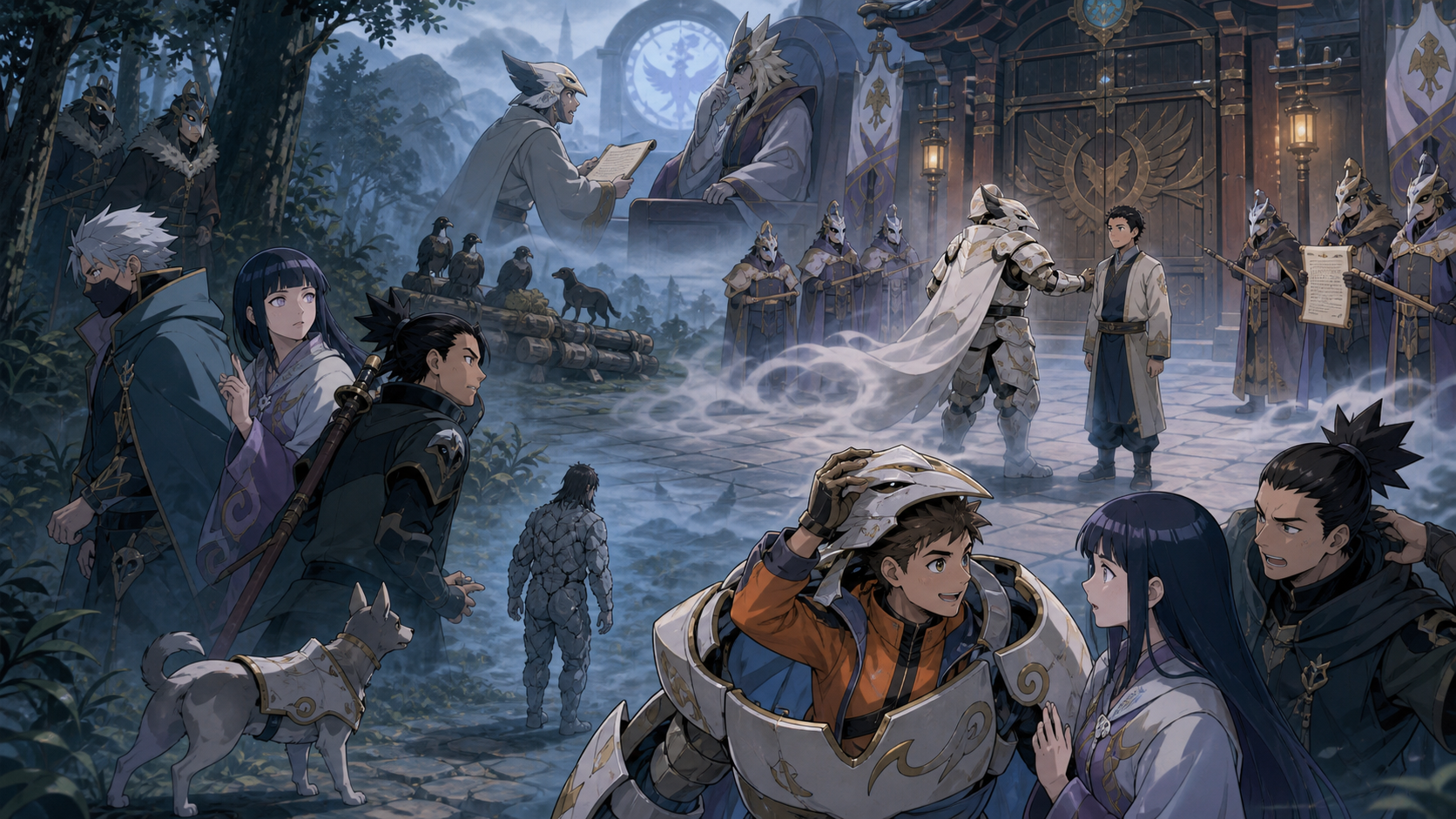
The Death of Naruto
Kakashi stages Naruto’s death to fool surveillance while Naruto turns the Cursed Warrior disguise into a rescue that keeps Komei alive.
Naruto is dead.
Kakashi says so with the tired authority of a jonin who has buried too many teammates. Neji and Tenten follow him toward Konoha. Enemy watchers hear that the mission ended with an unavoidable sacrifice.
Naruto is not dead.
He is about to put on haunted armor, interrupt a public execution, and make the country's worst political symbol useful for once.
Episode 165 uses its aggressively dramatic title as part of the operation. Kakashi stages loss to move under surveillance. Moso stages justice to kill Komei. Sagi accepts the possibility of an innocent man dying because revenge matters more.
Naruto rejects the last two performances by crashing the execution dressed as the ghost that started this mess.
Kakashi Makes Naruto a Casualty
Kakashi arrives after Naruto's arrest and appears to close the mission.
He tells Neji and Tenten that the Land of Birds assignment is over. When they ask about Naruto, Kakashi accepts responsibility as team leader and says sacrifice is unavoidable in shinobi work.
The words are cold enough to sell a death.
Nagare and Hokushin are watching. The wandering shinobi have monitored the Leaf team since Moso's operation began to crack. Kakashi knows an ordinary retreat would invite pursuit, so he gives them a story they want to believe: the troublesome genin died, the remaining team accepted the loss, and Konoha is leaving another country's business alone.
Kakashi, Neji, and Tenten cross toward the border. A pursuer studies them during an absurdly long rest and finally attacks. The three figures become animals and logs. Substitution Jutsu broke the trail.
The trick works on one watcher.
Kakashi senses another.
That layered surveillance explains why he cannot simply announce a rescue plan. Every visible choice must convince Moso's people that the Leaf has withdrawn. Naruto's fake death buys the real team room to act.
It also creates a sharp contrast with the execution about to begin. Kakashi uses the appearance of sacrifice while protecting his subordinate. Moso uses the language of justice to make a real sacrifice politically acceptable.
Komei Is Ordered to Kill Himself
Komei stands before a public list of crimes.
He is accused of murdering Owashi and Toki, creating the Cursed Warrior, terrifying the public, undermining the government, attempting to assassinate Sagi, and trying to seize the feudal lordship.
The authorities order him to perform seppuku.
Komei finally understands the shape of the frame and accuses Moso directly. Nobody pauses the execution to ask why the alleged mastermind's confession required coercion or why a tactician who supposedly planned the entire conspiracy left matching armor and weapons in his own storeroom.
The state has a complete story. Komei's death will keep it complete because dead defendants stop producing inconvenient testimony.
His forced confession is especially useful because it lets everyone pretend the investigation produced consent. The armor, guard weapons, political rivalry, and confession all point in one direction, so questioning the sentence can be presented as refusing obvious truth. Moso does not need every citizen to understand the case. He needs the official record to look settled long enough for the only competing witness to die.
Mist covers the grounds. An executioner prepares to finish the sentence anyway.
The Cursed Warrior appears, knocks aside the guards, takes Komei, and escapes.
Several guards transform into Kakashi, Neji, and Tenten. They planted themselves inside the ceremony while the staged retreat drew attention toward the border.
The ghost story has switched sides.
Moso used the white armor to frighten the public and condemn Komei. The Leaf team now uses the same image because every guard will chase the supernatural spectacle instead of looking for a shinobi rescue plan.
Kakashi Handles the Watcher
Neji and Tenten follow the fleeing warrior. Kakashi separates to confront the shinobi monitoring them.
Pakkun finds Nagare hiding near the temple. Nagare argues that hired ninja should return home when a mission ends. Kakashi gives the answer Neji prepared in Episode 164: that rule depends on the commission's premise remaining valid. Here, the evidence shows that the client ended the mission through a false case.
Nagare attacks with Universal Assimilation Jutsu, drawing properties from the surrounding stone into his own body. He becomes a rock-armored tank, then launches Rock Shower and other copied techniques.
The wandering shinobi survive without a village by stealing jutsu and recombining what they learn. Nagare even imitates Gaara's Sand Coffin and Sand Funeral.
Copying the visible technique does not give him Kakashi's judgment.
Kakashi uses clones, explosive traps, and timing to control the fight. Nagare treats collected abilities like proof that he can answer any opponent. Kakashi reads when and why each technique is being used. One man owns a shelf of stolen tools. The other knows how to build a plan.
Pakkun also deserves his tiny amount of respect. Nagare mocks Kakashi for sniffing around like a dog, and Pakkun objects on professional grounds before finishing his tracking job.
The Warrior Is Naruto
The Cursed Warrior carries Komei through the hidden route and reaches safety.
Then the armor comes off.
Naruto is inside.
Tenten is furious because she believed the title of the episode for several minutes. Neji recognized Naruto much earlier from the way the warrior stood. He simply did not explain, because apparently making Tenten experience avoidable emotional distress counts as operational discipline.
Naruto used Sagi's armor and the ghost's reputation to rescue Komei without forcing Sagi's guards into a direct battle. The plan avoids the rebellion Sagi claimed would be impossible and proves that “nothing can be done” often means “I refuse to risk my preferred plan.”
That restraint matters. The guards are enforcing a corrupt sentence, but most do not know the case was manufactured. Fighting through them would make Leaf shinobi look like foreign attackers and give Moso a fresh excuse to isolate Sagi. Naruto turns their attention toward the symbol they already fear, extracts Komei, and leaves the political lie intact only long enough to gather the witnesses needed to break it properly.
Komei explains that Moso forced the confession from him. He had been investigating the Cursed Warrior too. When an armored figure entered his room, he suspected Sagi and went to the abandoned temple. The warrior he met there was not Sagi. It was a separate fake designed to connect Komei to the apparition.
The frame used his suspicion against him. Komei followed the staged warrior, was seen at the meeting, and then found himself surrounded by planted evidence that made his private investigation look like command of the conspiracy.
Chishima Reaches Sagi in Time
The rescue began because Chishima survived long enough to reach Sagi.
Bleeding from shuriken wounds, he identifies Moso as the betrayer. Moso's shinobi killed Owashi and Toki, then used the distinctive guard weapons to frame Komei. Chishima begs Sagi to stop the execution.
Sagi refuses.
Saving Komei would reveal that Sagi knows Moso's role. That would destroy the surprise needed for revenge. One innocent man becomes an acceptable cost for the chance to kill the real target.
Naruto calls the bargain what it is.
Sagi has turned the same grief that made Chishima desperate to save him into permission to sacrifice somebody else. Revenge is no longer only consuming Sagi's future. It is demanding Komei's life as fuel.
Naruto offers another option: he will rescue Komei himself.
Sagi allows it, and Naruto takes the Cursed Warrior disguise.
That choice exposes the weakness inside Sagi's fatalism. He says the rescue cannot succeed without a rebellion, but Naruto finds a route that protects Komei, preserves the investigation, and avoids slaughtering the guards. Sagi did not lack options. He had stopped looking for any that did not serve revenge.
The Ghost Was Always Political
By the end of Episode 165, the team can finally separate the overlapping performances.
Sagi used the Cursed Warrior identity to search for the person behind the family deaths. Moso created another warrior to manipulate sightings, frame Komei, and direct the investigation away from himself. Naruto used the same armor to stop an execution.
One symbol carried three different intentions.
That is why Neji's living-presence contradiction mattered. The armor never had one stable identity. Treating every sighting as the work of one ghost made the conspiracy easier to control.
Komei is alive. Naruto is alive. The official solution is dead.
Sagi still intends to confront Moso and complete the revenge that has kept time frozen.
The Leaf team has moved from solving a haunting to stopping a ruler from becoming the final sacrifice in his own plan.
Kakashi recognizes surveillance before the withdrawal becomes real
The team cannot simply turn around and reenter the case while hostile observers report every movement. Kakashi uses the appearance of compliance to create operational space. His plan works because the watchers see what they expect: a mission ending after loss and official dismissal. Controlled deception protects the investigation when open action would alert Moso’s network.
Staging Naruto’s death carries emotional and institutional cost
A false death can mislead enemies, but it can also traumatize teammates, trigger grief among allies, and produce records that spread beyond the intended audience. Kakashi needs to limit who sees the performance, confirm Naruto consents to the risk, and establish when the truth will be restored. Secrecy must remain proportional to the threat.
Substitution lets the team create evidence without sacrificing a person
The watchers believe the visible scene because logs, timing, and movement fit an expected fatal outcome. Naruto remains alive while the enemy adjusts around false certainty. The technique becomes intelligence work rather than only an escape trick. Its value lies in making opponents reveal what they do once they believe resistance has weakened.
Neji and Tenten must know enough to protect the cover
If only Kakashi and Naruto understand the deception, genuine reactions may help sell the scene while placing teammates under unnecessary distress. If everyone knows every detail, a captured member could expose it. Good compartmentalization gives Neji and Tenten the actions, signals, and safety limits they need without distributing information irrelevant to their roles.
Komei’s public sentence turns an unresolved investigation into irreversible punishment
The evidence remains contradictory, the confession conditions are unknown, and outside operatives have been linked to Moso. Execution eliminates the accused before the case can be tested. A government choosing death under those conditions is not restoring order. It is making uncertainty impossible by removing the person most capable of challenging the official story.
The ceremony uses visibility to manufacture legitimacy
Residents are gathered to watch authority punish the named conspirator. Public ritual can make a weak case feel complete because the state performs confidence in front of witnesses. Interrupting the sentence protects Komei’s life, but the longer repair must explain why the evidence was insufficient. Otherwise the crowd may experience rescue as another mysterious attack.
Naruto wears the feared armor to reverse its political meaning
The Cursed Warrior once justified fear and suspicion. Naruto uses the same symbol to remove Komei from an unjust sentence. The disguise exploits what guards expect to see while converting propaganda into protection. That reversal is clever, but the armor should still be preserved afterward because construction and residue may identify the wider operation.
Rescuing Komei before proving innocence is appropriate
Stopping an irreversible punishment does not require the team to establish every fact first. The standard is narrower: the case is unresolved enough that execution cannot safely proceed. Komei can remain in secure protective custody while investigators examine the armor, confession, weapons, tunnel, and wandering shinobi.
Neji identifies Naruto through movement and context
The armor hides appearance, but Naruto’s patterns, timing, and purpose remain recognizable to someone who has worked beside him. This mirrors Episode 161 from the other direction. Identity is more than costume. Shared experience allows teammates to recognize behavior even when the visible form is deliberately false.
Tenten’s frustrated relief deserves room
Learning Naruto is alive resolves one fear while revealing that he participated in a plan others may not have fully understood. Relief does not cancel anger. Teams need a debrief where people can say that the deception hurt or endangered them without being accused of undermining the successful tactic.
The rescue needs an extraction route beyond the dramatic reveal
Opening the armor and announcing survival can draw every guard toward Naruto and Komei. Neji should map exits, Tenten should create distance, and Kakashi should control pursuing operatives. A rescue is incomplete until the protected person reaches a location where evidence can be heard and medical needs addressed.
Kakashi tracks Nagare instead of assuming the plot ends at Moso
A wandering shinobi offers the technical capacity behind armor, assassinations, and planted evidence. Following the operative can reveal suppliers and command structure. Kakashi’s tracking dog adds an independent sensory route after the arc repeatedly demonstrates that visual appearances can be manufactured.
Copied stone techniques make imitation the arc’s recurring weapon
Nagare reproduces forms that may look durable and overwhelming without possessing the exact timing or judgment behind the original. Kakashi answers with observation, decoys, and controlled counters. The fight echoes the impostor episode: copying a visible technique does not reproduce the relationships, discipline, and adaptive knowledge that make mastery reliable.
Kakashi should prioritize capture because testimony can expose the network
Defeating Nagare protects the immediate team. Taking him alive could identify Moso’s orders, other wandering shinobi, equipment sources, and the truth behind Owashi and Toki’s deaths. A captured operative may also corroborate Chishima’s observation. Intelligence value should shape force when safe capture remains possible.
Chishima reaches Sagi with evidence despite personal rejection
Sagi told him to leave and expressed a wish to die, yet Chishima continues because friendship is not measured only by gratitude. His persistence does not mean he should ignore every boundary forever. Here, new evidence of Moso’s conspiracy and immediate danger justifies another attempt to reach the isolated ruler.
The message forces Sagi to choose truth over a revenge script
If Moso framed Komei and used wandering shinobi, the person Sagi was prepared to punish may not be responsible for the family deaths. Revenge has provided a reason to live, so contradicting its target can feel like removing the structure holding Sagi together. The team must pair truth with protection and another path forward.
Evidence against Moso should not become another instant conviction
The secret meeting, tunnel, false case, and wandering operatives create a strong direction. Investigators still need to document orders, finances, access, and the deaths that began the succession crisis. The arc’s lesson would collapse if the team replaced one convenient certainty with another merely because the new suspect feels narratively satisfying.
Naruto’s staged death weaponizes enemy assumptions about sacrifice
Opponents believe he would throw himself into danger and that his team would retreat after losing him. The deception uses a reputation built from real behavior. Naruto should notice the warning inside that success: if enemies can predict self-sacrifice, future plans need ways to protect him from becoming the obvious bait.
The title creates stakes without making death entertainment
“The Death of Naruto” promises catastrophe while the episode reveals a tactical performance. The emotional impact should remain tied to why false death is believable and whom it affects, not only the surprise that the protagonist survives. Deception is safest when it prevents real loss and is repaired with allies afterward.
The team’s unauthorized return still needs formal review
Kakashi’s arrival and Chishima’s evidence may justify intervention, but Konoha should document why withdrawal became unsafe and what imminent harm required action. That record protects the Land of Birds from future interference disguised as intuition. Exceptional action becomes accountable when the decision can be examined after the emergency.
RaeRae’s full take
Episode 165 turns the white armor from a weapon of fear into a rescue vehicle. Naruto does not destroy the symbol from outside. He climbs inside the lie, carries Komei away from execution, and opens the shell while still alive. That is the arc’s cleanest reversal.
Kakashi’s deception works because the enemy expects Naruto to die protecting people and expects the team to retreat in grief. I want the success acknowledged alongside the emotional cost. Neji and Tenten deserve the truth, and Naruto needs to understand why becoming predictable through self-sacrifice is dangerous.
Saving Komei before the execution does not require proving him innocent on the spot. It requires admitting the case is too compromised to make death irreversible. The evidence can continue. The person must remain alive long enough to answer it.
Chishima becomes a protected witness the moment he reaches Sagi
His account of Moso meeting wandering shinobi may dismantle the official case, which makes him dangerous to anyone preserving it. The Leaf team should record the statement, separate Chishima from suspected guards, and establish more than one route for the evidence to leave the residence. Friendship gave him access; protection must keep that access from becoming a death sentence.
The public execution narrative needs a public correction
Residents saw Komei presented as a convicted conspirator and then carried away by the feared armor. Without explanation, many may believe the ghost rescued its accomplice or that Konoha attacked lawful authority. Once evidence is secured, the correction should name the compromised confession, planted or disputed items, and reason the sentence was stopped. Saving Komei’s body is urgent. Restoring the truth around his name prevents the frame from surviving him.
RaeRae checkpoint: Naruto’s staged death defeats surveillance, and the Cursed Warrior armor changes from a tool of condemnation into the disguise that keeps Komei alive long enough for truth to matter.
Watch Naruto Episode 165
- [Naruto Official episode guide](https://naruto-official.com/en/anime/naruto1/list/01_389)
- [Watch “The Death of Naruto” on Crunchyroll](https://www.crunchyroll.com/naruto/episode-165-the-death-of-naruto-523730)
- [Browse official Naruto viewing options from VIZ](https://www.viz.com/anime/tv-show/naruto-video/video-unit/1)
Receipts and official routes
- Episode number, licensed title, and official synopsis: Naruto Official Site.
- Japanese title, synopsis, and December 21, 2005 broadcast record: TV Tokyo.