
Too Late for Help
Naruto rejects an absurd official solution, and two wandering toads expose the kite and tunnel mechanics hidden beneath the ghost story.
Komei confessed. The ghost was a soldier. The soldier escaped by pouring acid on himself until his body melted.
Case closed.
Excuse me, what?
Episode 164 opens with an official explanation so grotesquely convenient that accepting it should count as a second crime. Moso says the mystery is solved and the Leaf mission is over. Naruto refuses to leave. Neji knows foreign-country protocol says they should.
Both positions make sense.
Then two snack-obsessed toads find more evidence in ten minutes than the country's investigators found during the entire case.
The Confession Solves Too Much
Moso congratulates Naruto, Neji, and Tenten. Komei has confessed to creating the Cursed Warrior, misleading the public, and pursuing the feudal lordship.
The disappearing warrior has an explanation too. A soldier wore the armor and used a powerful corrosive acid to melt his own flesh, leaving the shell empty.
That is not an explanation. It is a horror story with chemistry words.
It does not explain why the first armor held no living presence when Neji examined it. It does not explain how a soldier who dissolved his body controlled the escape. It does not explain why the evidence at Komei's residence appeared so quickly or why one alleged conspirator would accept that fate to preserve a theatrical rumor.
Moso calls the affair a trifle and ends the mission.
Naruto objects. Neji admits the story is suspicious, but Konoha was hired by the Land of Birds. Once the employer declares the work complete, Leaf shinobi cannot simply keep searching government property because they dislike the answer. Foreign intervention wrapped in good intentions is still intervention.
That boundary matters. So does the possibility that the person invoking it is part of the problem.
Neji is not surrendering his judgment. He is separating what the team suspects from what Konoha has legal authority to do. A ninja village cannot accept one narrow assignment, dislike the client's conclusion, and appoint itself permanent investigator of another country's government. That would turn every mission into a license to interfere.
Naruto approaches the same boundary from the person trapped behind it. Chishima did not spend his savings because he wanted a tidy report about public rumors. He believes Sagi may die. If the mission ends while the danger remains, following the letter of the commission means failing the reason it existed.
Neji and Tenten decide to reinvestigate from another angle without charging into a political confrontation. Naruto hears “reinvestigate” and leaves at once.
Subtlety will arrive on a later train.
Gamakichi and Gamatatsu Solve the Flight
Chishima brings a thank-you gift to the team: chicken-wing buns filled with bean paste, a Land of Birds specialty. The contribution is sweet, odd, and exactly suited to the man who spent his travel money buying help for a friend.
Naruto is already back at the old temple where the Cursed Warrior appeared.
Searching alone takes too long, so he uses Summoning Jutsu. He wants useful assistance and gets Gamakichi and Gamatatsu because Gamabunta is busy.
Naruto asks whether toads have strong noses. Gamakichi takes offense at being treated like a tracking dog. Gamatatsu wanders away and pounces on a large black object.
It is a kite.
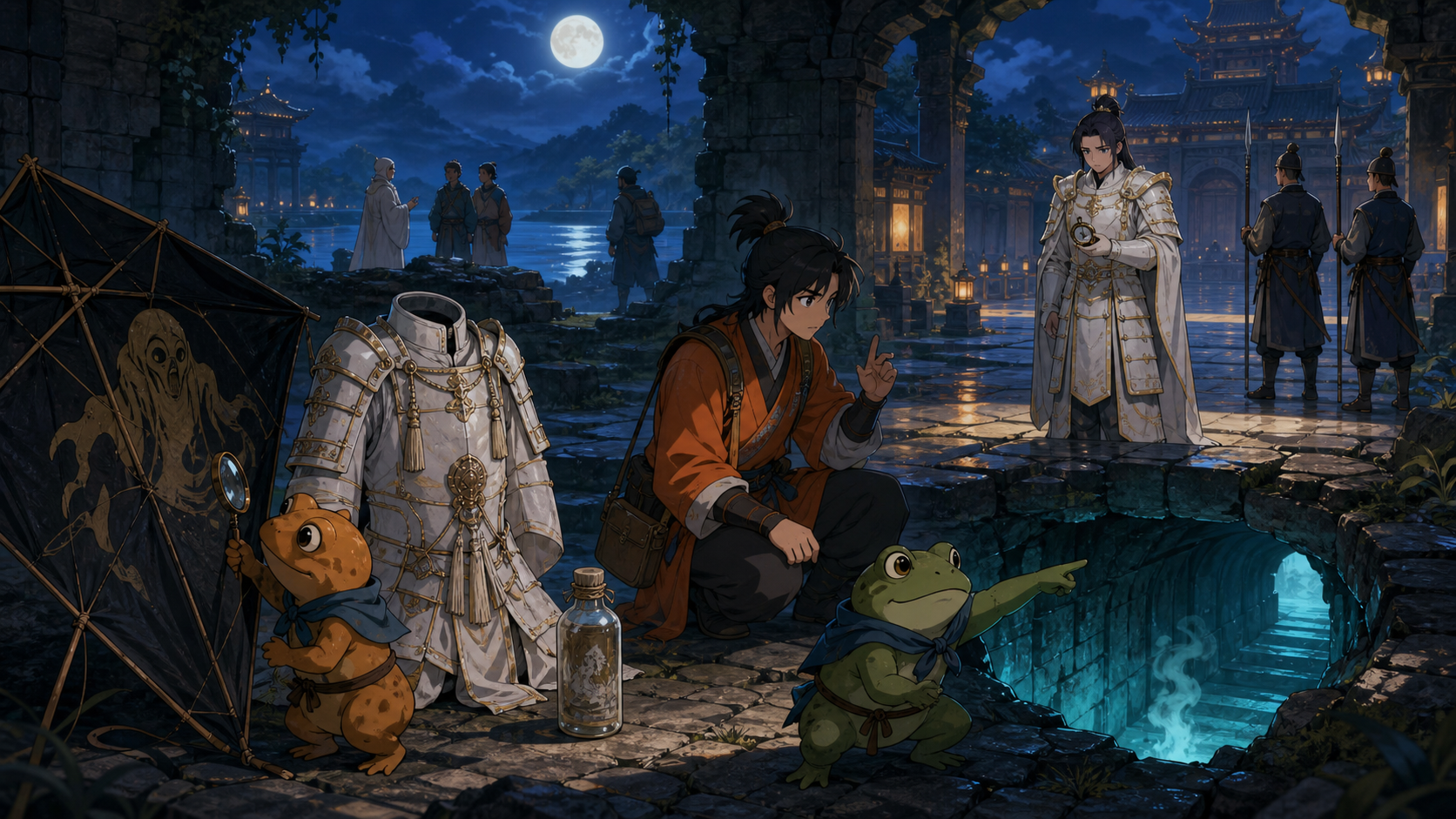
At night, a white-armored figure hanging beneath a huge black kite would appear to fly against the dark sky. One of the ghost's impossible powers becomes stagecraft sitting in the grass.
The discovery works because Gamatatsu does not investigate like a shinobi. He notices whatever feels interesting, comfortable, or possibly edible. That lack of discipline is maddening until it pulls the case away from the story everyone has been told.
At the temple, Gamatatsu comments on a cool damp breeze. The building is hot and humid, so the airflow must come from below.
Naruto uncovers a hidden passage.
The ghost did not vanish through death or acid. Somebody built a route beneath the scene.
Solving the kite and tunnel does not identify every Cursed Warrior, but it changes what the team can prove. Flight no longer requires a spirit. Disappearance no longer requires a body to dissolve. The supernatural story survives by treating each visual effect as one impossible event. Naruto and the toads break it into ordinary mechanisms that can be built, hidden, and traced.
The Tunnel Leads to Sagi
Naruto and the toads follow the passage until it opens inside the feudal lord's residence.
That destination changes the mystery. The temple was not merely a performance space for Komei's conspiracy. It connects directly to Sagi's protected home.
Before Naruto can examine the route properly, Gamatatsu wanders into sight and admires the view. Guards seize Naruto as an intruder.
He could resist. He does not.
These soldiers serve the country that hired Konoha, and Naruto cannot treat them as enemies without turning his investigation into an attack on the government. He tries to explain that Moso commissioned him to investigate the Cursed Warrior.
The guards bring him before Sagi.
Naruto expects recognition from their lakeside meeting. Sagi says he knows no such person and orders him locked in the dungeon rather than sent to the magistrate.
The decision is harsh, but it keeps Naruto inside the residence and away from any public legal process. His hands are bound, which blocks most of his jutsu. Gamakichi and Gamatatsu remain nearby, arguing while trying to free him.
The Cursed Warrior enters the cell.
Naruto must evade the polearm without hand signs while the toads work on the restraints. The figure is no rumor now. It is close, deliberate, and prepared to kill the one investigator who found the tunnel.
Then Naruto sees the person inside.
Sagi is wearing the armor.
Sagi Is Living for Revenge
The reveal explains one warrior without resolving the larger operation.
Sagi shows Naruto the heirloom watch passed through the feudal family from father to son. It stopped with the death that shattered his life. He has preserved that frozen time as proof that nothing after the loss deserves to move forward.
He admits that revenge is the only reason he remains alive.
Once he completes it, he does not care whether he goes to hell.
Naruto rejects that logic immediately. He has already watched Sasuke build an identity around avenging the Uchiha clan. He knows revenge can keep a person moving while stripping away every relationship that might give survival meaning.
Sagi believes Naruto cannot understand what it means to have everything taken. That assumption misses Naruto by a mile. Naruto grew up without parents, family history, or a village willing to tell him why people hated him. He understands isolation. What he refuses to accept is the claim that pain grants revenge ownership of the future.
That does not mean Naruto has a polished answer for grief. He does not tell Sagi to stop feeling angry or forgive an unknown killer. He rejects the endpoint: living only long enough to hurt someone and treating death afterward as acceptable. Revenge can explain why Sagi put on the armor. It cannot make his life disposable.
Sagi does not want rescue from a boy he has sentenced as a trespasser. Naruto now knows too much about the armor, the tunnel, and the motive behind at least one apparition.
The punishment is death.
Chishima Finds the Other Half of the Case
While Naruto follows the physical evidence, Chishima follows protocol. He learns Naruto is still investigating and goes to inform Moso.
That responsible choice places him outside a hidden meeting.
Moso is speaking with wandering shinobi about trouble and a newly secured refuge. The quiet priest who presented himself as a stabilizing public servant has private armed associates the Leaf team was never told about.
Chishima overhears enough to understand that the official solution concealed a second operation. The shinobi spot him. He runs to warn the others and is wounded during the pursuit.
The episode separates its two investigators in a useful way. Naruto discovers how the illusion works and where the passage leads. Chishima discovers who benefits from stopping the investigation. Neither has the complete answer, and both are now in immediate danger.
“Too Late for Help” is not about help arriving after everything ends. It is about institutions declaring the danger over while the people asking inconvenient questions are isolated one by one.
Komei's confession gave the government closure. Moso's order gave Konoha a reason to leave. Sagi's title gives him control over Naruto's fate. Every official mechanism points toward silence.
Naruto's refusal to accept a rotten explanation breaks that arrangement.
He is trapped, bound, and sentenced to die.
He is also the first person in the country to find the tunnel beneath the ghost story.
Moso presents a confession that answers every question too quickly
Komei supposedly admits the plot, the armor appears at his residence, and a soldier conveniently explains the empty shell by claiming acid dissolved his body. Each statement supports the same conclusion without leaving a living operator to examine. A complete story can be evidence of truth. It can also be the shape a coordinated frame chooses because officials are tired of uncertainty.
The corrosive-acid explanation creates physical questions
An acid capable of dissolving a body should affect cloth, armor lining, fasteners, nearby surfaces, and anyone handling the suit. It should leave residue, odor, heat damage, fluid, or chemical injury. Neji’s observation of an empty shell cannot be explained by a sentence alone. Tenten should inspect the material while medical or technical specialists test whether the proposed reaction is physically consistent.
A confession requires conditions, not only content
Investigators need to know when Komei confessed, who questioned him, whether counsel or witnesses were present, and whether threats shaped the statement. Political detention can produce the answer authorities demand. A confession gains reliability when independently verifiable details match evidence that interrogators did not supply.
Moso ends the mission because the client withdraws authority
Neji correctly recognizes that Konoha cannot openly police another country after its government says the contracted work is finished. Sovereignty and mission limits matter. Ignoring them can turn assistance into occupation. Those limits do not require the team to pretend the evidence is sound or abandon concern for an immediate threat to life.
Neji separates private doubt from unauthorized intervention
He and Tenten can document contradictions, report them to Tsunade, and prepare to respond if new danger crosses the mission boundary. That restraint is professional. It prevents personal certainty from becoming permission to control another country. Naruto hears the same limit as an order to leave vulnerable people inside a lie.
Naruto’s refusal begins from evidence, not mere stubbornness
The acid story does not fit the armor, the case against Komei arrived with suspicious speed, and Sagi remains isolated. Naruto cannot articulate jurisdiction cleanly, but he recognizes that official closure has not produced safety. His decision becomes defensible only if he investigates narrowly, avoids harming local guards, and brings findings back rather than declaring himself the new authority.
Gamakichi and Gamatatsu provide ordinary observation
The toads are not court insiders and do not arrive committed to Komei or Moso. Their curiosity helps Naruto inspect the temple as a physical site. Comedy lowers the emotional temperature while simple questions reveal what the grand political explanation ignored. Outsiders can notice mechanisms experts miss when everyone else is debating motive.
The black kite explains apparent flight without explaining the whole conspiracy
A large kite can carry or suspend the hollow armor, producing movement that witnesses interpret as supernatural. That finding addresses one mechanism from the first encounter. It does not identify the operator, prove Komei’s involvement, or explain the living warrior Neji saw later. Solving one effect should narrow the case rather than inflate into total certainty.
Recovering the kite creates traceable evidence
Fabric, knots, frame material, wear, storage residue, and construction skill may connect it to a workshop or route. Tenten could compare fibers with the armor or items seized from Komei’s home. The team should preserve the object instead of treating it as a disposable reveal. A mechanism becomes politically useful only when its origin can be supported.
The cool damp draft reveals architecture beneath the story
Air movement indicates an opening, and moisture suggests a passage connected to canals or underground space. Naruto follows a physical clue rather than supernatural expectation. The hidden stair matters because infrastructure requires labor, access, and maintenance. Someone built or reused a route between the old temple and the seat of power.
A tunnel into the feudal residence changes the security question
The passage could support secret movement by Sagi, advisers, guards, or conspirators. Its existence does not automatically assign guilt. Investigators should map entrances, footprints, recent repairs, locks, and who knew the route. A direct connection to political power explains opportunity while leaving intent unresolved.
Naruto refuses to attack the client country’s guards
That choice respects a boundary even while he violates the order to leave. The soldiers may be protecting their ruler based on information they believe. Fighting them would injure people who are not necessarily part of the conspiracy and transform Naruto’s investigation into an armed intrusion. Surrender preserves a chance to speak with Sagi.
Capture places Naruto inside the institution he distrusts
Once detained, he cannot control evidence or movement. The decision is risky but morally distinct from forcing access through violence. He accepts personal consequence for continuing the inquiry. That does not make every unauthorized action wise; it shows he is not asking local soldiers to pay physically for his disagreement with Moso.
Sagi wearing the Cursed Warrior armor complicates victim and suspect labels
The grieving ruler has participated in at least one part of the spectacle. That fact can coexist with being manipulated, targeted, and suicidal. Wearing the armor does not prove Sagi designed the broader conspiracy or killed Owashi and Toki. The question becomes what Sagi intended, who supplied the equipment, and who benefited from each appearance.
The stopped family watch gives grief a physical anchor
Sagi holds time at the moment the family was lost, preserving pain as the only stable relationship left. The object can carry memory without determining what justice requires. Naruto should listen before trying to replace it with a speech about moving on. Grief does not follow a mission clock.
Revenge has become Sagi’s reason to remain alive
That admission requires immediate care. Removing the revenge target without building another reason could increase danger rather than resolve it. Naruto can reject killing while acknowledging that Sagi’s life has narrowed around loss. Trusted companionship, protection, and a truthful account of the deaths must develop together.
Naruto recognizes the survival bargain from his own fixation
Finding Sasuke has sometimes become the purpose that organizes every mission and emotion. He can understand why Sagi fears emptiness after revenge. The parallel should make him careful. He cannot demand that Sagi surrender the only current reason for living without helping create conditions where more reasons can return.
Chishima overhears Moso meeting wandering shinobi
The observation connects the respected counselor to armed outsiders and supplies a new investigative direction. Chishima must survive long enough to report it. He should note location, participants, words heard, and escape route rather than confronting them alone. Witness protection becomes part of the case immediately.
Wandering shinobi provide capacity for multiple armor mechanisms
Outside operatives could control a kite, wear a second suit, stage attacks, and plant weapons. The meeting does not prove Moso ordered every event, but it explains how a court figure might access skills beyond local guards. Neji’s contradiction begins to fit a coordinated operation without requiring supernatural assumptions.
The team needs a lawful route back into action
Chishima’s evidence, Naruto’s tunnel discovery, and Sagi’s immediate danger can be communicated to Tsunade or a legitimate local authority not controlled by the suspected faction. Emergency protection may justify limited steps while formal permission catches up. The goal should remain saving lives and preserving evidence, not proving Naruto was right to disobey.
RaeRae’s full take
Episode 164 dismantles the ghost story with a kite and a draft, which is exactly why I like it. The official explanation asks everyone to accept a body-dissolving acid with no physical questions. Naruto follows air through a hidden passage and reaches the power structure underneath the legend.
Neji is right about jurisdiction. Naruto is right that leaving an implausible closure untouched could abandon Sagi and Chishima. The responsible answer lives between them: document the contradiction, protect the witnesses, avoid fighting local guards, and find a lawful route back into the case.
Sagi’s revenge is not only a motive. It is the ruler’s stated reason to stay alive. Solving the conspiracy must include care for what happens when that reason is removed.
Naruto needs a secure way to send findings beyond the compromised court
The tunnel, kite, Sagi’s disclosure, and Chishima’s observation may become dangerous if reported only through Moso. A summon, coded message, or trusted courier could carry the evidence to Tsunade while limiting who inside the residence learns what Naruto knows. Communication protects the investigation from disappearing with one detained shinobi.
Neji and Tenten should receive the same record so the team can compare independent observations after separation. If Naruto cannot return safely, they need enough detail to request renewed authority and protect Chishima. Evidence becomes useful when it survives the person who discovered it.
RaeRae checkpoint: A black kite explains the flight, a cool draft reveals the tunnel, and the tunnel leads into political power. Ordinary evidence defeats the ghost story without making Sagi’s grief ordinary or safe.
Watch Naruto Episode 164
- [Naruto Official episode guide](https://naruto-official.com/en/anime/naruto1/list/01_388)
- [Watch “Too Late for Help” on Crunchyroll](https://www.crunchyroll.com/naruto/episode-164-too-late-for-help-523728)
- [Browse official Naruto viewing options from VIZ](https://www.viz.com/anime/tv-show/naruto-video/video-unit/1)
Receipts and official routes
- Episode number, licensed title, and official synopsis: Naruto Official Site.
- Japanese title, synopsis, and December 14, 2005 broadcast record: TV Tokyo.