
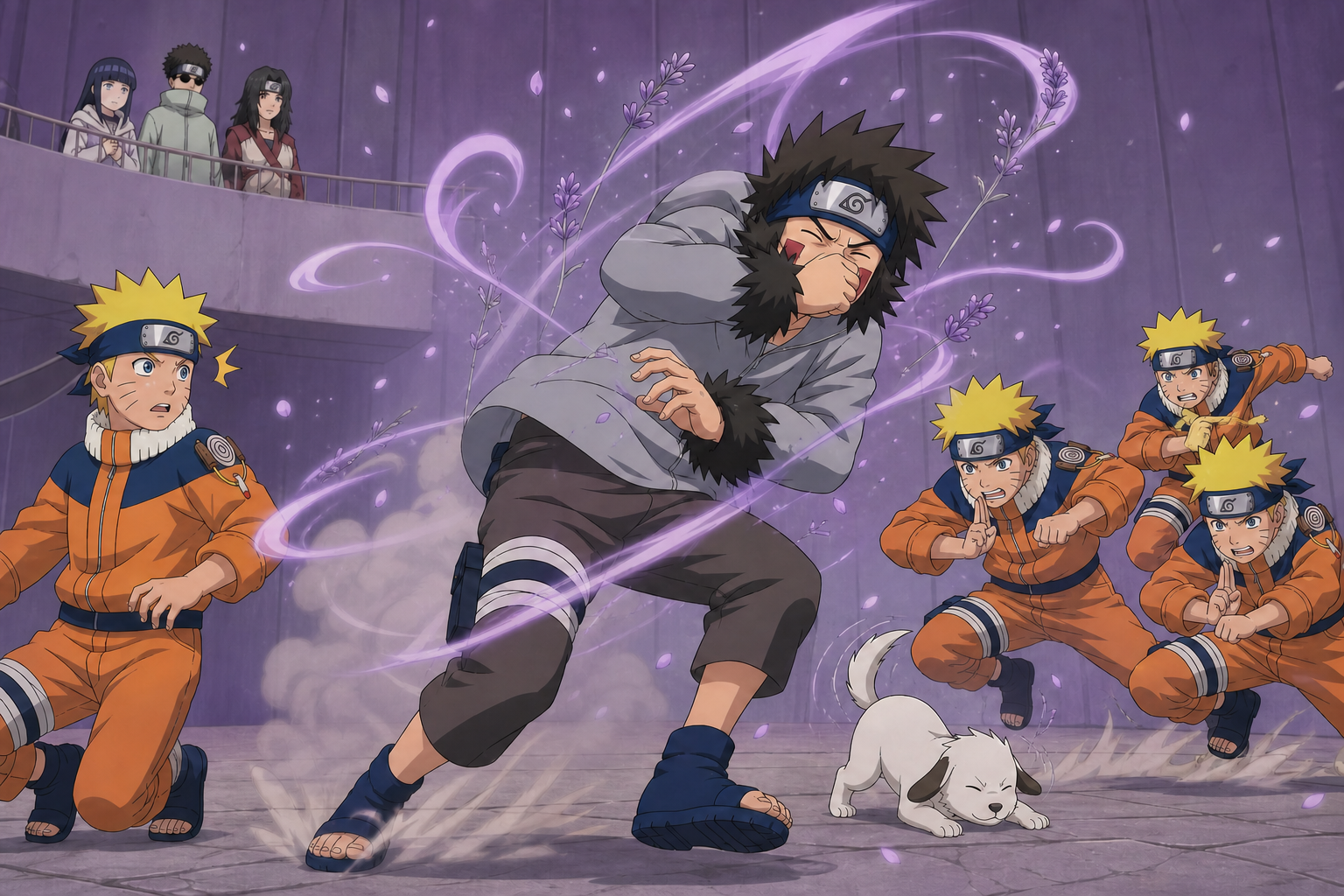
Surprise Attack! Naruto’s Secret Weapon!
Naruto does not defeat Kiba with a majestic hidden technique. He survives Fang Over Fang, gets an accidental opening from the least dignified body function available, and turns Sasuke’s borrowed taijutsu into his own clone-powered answer. It is ridiculous, tactical and completely on brand.
Episode 45 lets Naruto win because he notices what Kiba refuses to respect. Kiba has better tracking, a trained ninken partner and a clan-built combat system. Naruto has stubbornness, shadow clones and a brain that becomes most useful after respectable plans have already failed. The fart is an accident. Using Kiba’s disrupted senses before the opening closes is not.
The finishing move matters even more. Naruto watches Sasuke’s Lion’s Barrage, remembers that Sasuke adapted Rock Lee’s movement, and rebuilds the sequence around clones because he cannot copy Lee’s speed. That is not imitation without thought. It is knowledge moving through rivals, bodies and limitations until Naruto makes it function in the only toolkit he owns.
Fang Over Fang makes the arena feel smaller
Kiba Inuzuka and Akamaru begin this episode with the advantage earned at the end of Episode 44. Soldier pills have increased their fighting capacity, Akamaru has transformed into Kiba’s likeness, and both bodies can launch Fang Over Fang. Naruto is not facing one stronger classmate. He is facing repeated rotational force from two directions.
The technique attacks more than durability. Speed reduces Naruto’s time to identify which body is Kiba, which is Akamaru and where the second strike will arrive. Rotation turns their trained partnership into a moving wall. Naruto can absorb an unreasonable amount of punishment, but endurance alone does not tell him where to counter.
This is why Kiba’s confidence is not empty boasting. His clan system has given him a coherent answer for pursuit, identification and joint assault. Naruto’s win will mean more if we admit the opponent is good at his actual job.
The soldier pill spends tomorrow’s body today
Military ration pills are not magical candy. They concentrate nutrition and support continued combat when ordinary fatigue would force a body to stop. Kiba and Akamaru use them to push the match into a more intense phase after Naruto’s transformation trick embarrassed Kiba.
The shinobi world praises any tool that keeps a fighter useful. Episode 45 quietly shows the cost underneath that praise. Akamaru is small, alive and expected to metabolize a battlefield supplement so the team can hit harder. Kiba takes the same risk, but he also directs the partnership. Power and responsibility arrive together whether the exam scoreboard acknowledges that or not.
The pills create capacity. They do not create judgment. Kiba still has to interpret sensory information correctly, and that is where his strongest advantage starts turning against him.
Transformation attacks Kiba’s confidence in his own nose
Naruto keeps using Transformation Jutsu because visual disguise is only the first layer of the trick. Kiba trusts scent more than sight. Once Naruto makes appearance unreliable, Kiba leans even harder on smell, the sense he believes Naruto cannot manipulate.
That confidence helps Kiba distinguish bodies, but it also narrows his attention. A sensory specialist can receive accurate information and still reach the wrong conclusion. Smell tells Kiba what is present. It does not automatically explain why Naruto placed it there or what action will follow.
Naruto’s academy techniques become dangerous through arrangement. He is not unveiling a rare bloodline ability. He is combining basic transformation, clones and opponent psychology until a familiar tool produces unfamiliar pressure.
The secret weapon is not the fart
Yes, Naruto farts in Kiba’s face. Yes, the entire room has to live with that information. No, this does not mean the episode suddenly abandons combat mechanics for a playground joke.
Kiba’s heightened smell is already established as part of his technique. A sudden overwhelming odor disrupts the sensory channel he has sharpened and relied upon. The cause is accidental, but the effect follows the rules the fight built. Kiba’s advantage becomes a vulnerability because stronger perception also means stronger exposure.
Naruto did not schedule this bodily event as a master plan. Pretending he did would make the scene less interesting. His real strength is immediate recognition. He sees Kiba stagger, understands that the opening exists and acts before dignity can hold a committee meeting.
Low comedy can still carry real causality
Anime comedy often asks the body to embarrass the person who wants to look impressive. Here the joke works because the body interrupts shinobi performance. Kiba has the clan techniques, the dramatic spinning attack and the superior academy record. Naruto’s digestive system does not care about that hierarchy.
The scene brings elite aspiration back down to flesh. These children can manipulate chakra and imitate animals, but they still sweat, hurt, panic and produce smells. The exam tries to turn them into ranked assets. The joke reminds us that the assets remain bodies.
That does not make every gross-out gag profound. This one earns its place because it changes the match through a previously established sense mechanic and exposes the fragility inside Kiba’s confidence.
Kiba’s greatest sense becomes his immediate limit
Specialization always creates tradeoffs. Kiba’s nose gives him tracking ability that Naruto cannot match. When he intensifies that sense for combat, he also increases how violently an overwhelming odor can affect him.
The lesson is not that expertise is bad. It is that expertise cannot replace adaptation. Kiba keeps treating his nose as unquestionable authority even after Naruto has already manipulated his interpretation through transformation. When the physical channel is disrupted, Kiba has no second plan ready.
Naruto, meanwhile, has spent his life operating without a stable first plan. That history is unfair and inefficient, but it has trained a specific survival habit: use whatever remains.
Naruto’s appetite for recognition keeps him standing
Kiba’s attacks hurt. The episode does not turn Naruto’s endurance into invulnerability. He is thrown, struck and pressured while spectators measure whether the academy failure will finally stay down.
Naruto keeps rising because the match is attached to an older wound. He wants advancement, but he also wants the room to revise its idea of him. Every recovery says the public label is not the whole body.
That desire can become unhealthy when recognition is the only proof of worth. In this match, it also keeps him engaged long enough for adaptation to become possible. The same attachment can wound and fuel a person at once.
Sasuke’s Lion’s Barrage is already borrowed knowledge
Sasuke created Lion’s Barrage after watching Rock Lee move during their earlier confrontation. The Sharingan let Sasuke read Lee’s physical sequence, but Sasuke still had to adapt what he saw around his own body and available techniques.
Naruto then watches Sasuke’s version. He does not possess the Sharingan and cannot reproduce Lee’s speed by observation. What he can copy is the visible logic: launch the opponent, control the fall and chain attacks before recovery.
The move therefore reaches Naruto through a small lineage of rivalry. Lee’s labor becomes Sasuke’s adaptation. Sasuke’s adaptation becomes Naruto’s problem to solve. Nobody invents from an empty room.
Naruto Uzumaki Barrage respects Naruto’s limitation
Naruto cannot make one body strike with Lee’s precision and speed, so he creates more bodies. Shadow clones divide the sequence across a coordinated group. One Naruto launches, others reposition and the formation keeps Kiba suspended long enough for the finishing blow.
This is the difference between copying an image and translating a method. Naruto keeps the function of the borrowed combination while changing its labor structure. Sasuke’s body performs a chain. Naruto’s clone collective distributes the chain.
The name is loud because Naruto is Naruto. The mechanics underneath the announcement are disciplined. He has identified what must happen and reassigned each step to a body capable of completing it.
Shadow clones become a temporary workforce
Naruto’s clones are often discussed as multiplication, but Episode 45 uses them as organization. Each clone has position, timing and a task. The technique converts chakra into cooperating labor.
That matters because Naruto grew up without the clan instruction Kiba received. He cannot summon inherited partnership knowledge on demand. He constructs a team from himself, then uses that team to perform a sequence one isolated body could not manage.
The image is triumphant and a little sad. Naruto solves the lack of support by becoming his own support network. The series will keep asking whether other people can eventually share that burden without disappearing into his need to prove himself.
Kiba loses because contempt delays revision
Kiba sees evidence of Naruto’s growth throughout the match. Naruto survives his speed, manipulates transformation and keeps returning after heavy attacks. Kiba still speaks and fights as though academy reputation should settle the outcome.
Contempt is cognitively expensive. It forces Kiba to explain every new fact as luck or annoyance instead of updating his strategy. By the time the accidental scent disruption creates a genuine opening, he has spent too much of the match protecting his old conclusion.
Naruto does receive luck. Winning still requires a response. Kiba’s mistake is believing luck cancels all the work performed after it arrives.
Akamaru shares the loss without choosing every risk
Akamaru is not a decorative extension of Kiba’s ego. He tracks, transforms, attacks and takes bodily risk. The defeat belongs to the partnership because the strategy depended on both participants.
At the same time, the human partner has more authority over pills, commands and match escalation. That imbalance matters. Mutual affection does not erase differences in decision power.
A responsible reading can honor the bond while still asking who chooses the danger. Naruto wins against a team, but Akamaru should not be reduced to the equipment Kiba failed to use correctly.
Hinata watches proof that rankings can be wrong
Hinata Hyūga reacts to Naruto’s embarrassment, pain and refusal to quit with an intensity the title itself notices. The original Japanese title leads with her blush before describing the stunned spectators and Naruto’s hidden move.
Her attention is not only romantic. Hinata has been judged inadequate inside the Hyūga clan, where ability is tied to inheritance, family hierarchy and public comparison. Naruto’s victory gives her evidence that an assigned identity can be challenged in front of the people who assigned it.
That evidence matters as the bracket moves toward her own confrontation. Naruto does not deliver a speech to Hinata here. He changes what she thinks may be possible by surviving visibly.
The spectators finally have to update the record
The room’s surprise is part of Naruto’s reward. Teachers, peers and rival teams have watched him carry the academy failure label into the exam. Kiba speaks that judgment out loud, which makes the reversal public.
Public recognition does not repair Naruto’s childhood. It does change the immediate social record. He is no longer only the loud boy who slipped through graduation through an unusual crisis. He has defeated a competent clan heir inside a formal evaluation.
The exam still measures children through violence, so I am not calling this healthy validation. It is the institution Naruto has, and he forces it to record evidence it preferred to dismiss.
Japanese performance keeps the joke attached to hunger
Junko Takeuchi performs Naruto in the original Japanese anime. Her Naruto can move from panic to shameless recovery without losing the deeper insistence underneath the comedy. The fart embarrasses him, but embarrassment does not get final authority over the next action.
Kōsuke Toriumi performs Kiba with swagger that becomes disbelief and anger as the match escapes his expected hierarchy. Kiba sounds personally offended because Naruto is not just another opponent. He is the classmate Kiba had already filed below himself.
Nana Mizuki performs Hinata’s quiet reactions. Those smaller sounds provide an emotional counterweight to the arena’s loud judgment, while Junko Takeuchi also gives Akamaru his original-anime vocal presence. The scene depends on a crowd of different relationships to the same result.
A cultural reading sees mastery through adaptation
The finishing move does not treat originality as creating something with no ancestors. Naruto observes, remembers and changes a technique until it fits his own resources. That model values transmission and disciplined adaptation.
Modern fandom sometimes polices borrowed moves as though influence makes achievement fake. Episode 45 shows the opposite. Lee’s work remains visible inside Sasuke’s version, and Sasuke’s version remains visible inside Naruto’s. The changes reveal each fighter more clearly.
Naruto’s authorship comes from the solution to his limitation. He cannot perform the source movement alone, so he makes cooperation out of clones. The receipt is in the modification.
A Confucian lens asks what students owe their sources
Learning exists inside relationships even when those relationships are competitive. Sasuke learned by watching Lee. Naruto learned by watching Sasuke. Neither student formally asks permission during a life-or-death exam culture that rewards rapid acquisition.
The ethical question is not whether influence occurred. It is whether the learner recognizes a source, develops the lesson and uses it responsibly. Naruto announces his own name, but the scene lets viewers remember the chain. The work does not erase its teachers.
Kiba’s clan education offers a parallel. He carries generations of Inuzuka knowledge through Akamaru, scent and joint attack. Naruto’s improvised lineage is messier, but both fighters stand on learning they did not create alone.
A Buddhist lens sees humiliation lose its authority
Naruto experiences pain, ridicule and bodily embarrassment without treating any one moment as a permanent self. He reacts, adapts and keeps moving. The fart does not become his identity because he does not cling to the shame long enough to surrender the opening.
Kiba clings to a fixed idea of Naruto. That attachment makes new evidence feel like an insult instead of information. His suffering in the match grows partly from defending a judgment that reality has already outgrown.
Impermanence is not a motivational poster here. It is a tactical fact. The weaker student changed. The stronger student’s certainty did not.
The exam rewards creativity while exposing its own failure
The Chūnin Exams claim to identify leadership and judgment. Naruto demonstrates observation, resource management, resilience and the ability to reorganize a technique under pressure. Those are real field competencies.
The same institution failed to recognize or cultivate those competencies at the academy. Naruto had to survive theft, combat and repeated humiliation before adults treated his unusual learning pattern as intelligence.
His victory proves personal growth. It also indicts an education system that noticed the growth only after a child made it entertaining through violence.
Fandom misreadings I am rejecting
“Naruto only wins because he farted.” The accident disrupts Kiba’s nose. Naruto still has to recognize the opening, execute a clone formation and complete the barrage.
“Kiba is weak.” His tracking, All-Fours Jutsu, Beast Human Transformation and Fang Over Fang control most of the match. His failure is adaptation, not an empty technique shelf.
“Naruto stole Sasuke’s move.” Sasuke’s move already adapts Lee. Naruto changes the labor and mechanics to fit shadow clones.
“Akamaru is a weapon.” He is a living combat partner who acts and pays bodily costs, even within an unequal human-directed relationship.
“Hinata is only blushing at her crush.” She is watching someone reject a public identity of weakness immediately before the bracket turns toward her own inherited shame.
“The comedy ruins the fight.” The joke follows the established smell mechanic and creates a causal opening. Low comedy and coherent combat can occupy the same scene.
What Episode 45 changes
Naruto defeats Kiba and advances from the preliminary round. The result forces classmates and adults to revise an academy-era judgment that Kiba kept treating as permanent.
Kiba’s heightened smell proves both powerful and vulnerable. Naruto’s accidental scent disruption opens the moment, while Naruto Uzumaki Barrage finishes the work through a clone-based adaptation of Sasuke and Lee’s taijutsu lineage.
Hinata receives public evidence that a person labeled weak can overturn the room’s expectation. The next stage of the preliminaries will test what that evidence can and cannot do inside her own family conflict.
RaeRae’s verdict
Kiba brought clan training, a brilliant nose and a two-body assault. Naruto brought shadow clones, stolen homework and one digestive emergency. Somehow the boy still made the final answer academically defensible.
The win is not pretty, and that is why it belongs to him. Naruto cannot become Lee or Sasuke on command. He turns their lesson into a tiny orange workforce and makes Kiba update the class ranking the hard way.
Receipts and official routes
Episode number, licensed English title and official synopsis: Naruto Official Site. Japanese title and original August 13 broadcast record: TV Tokyo. Streaming availability varies by region; use the official options linked from the episode directory.