
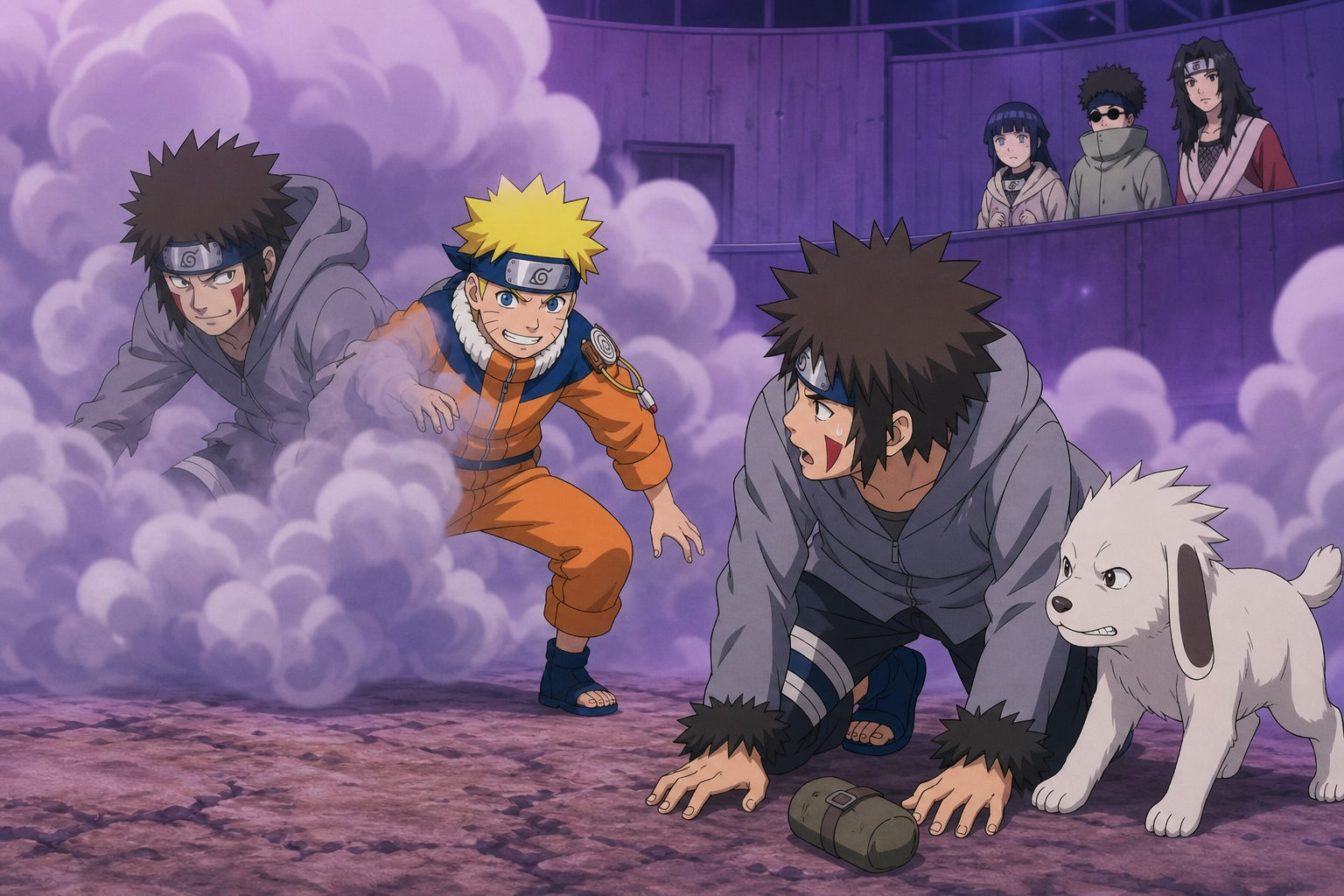
Akamaru Unleashed! Who’s Top Dog Now?
Kiba treats Naruto like the class clown he already understands. Naruto uses that contempt as camouflage, reverses the smoke trick and makes Kiba punch the wrong face. Then Akamaru eats a soldier pill and the joke becomes a two-body assault.
Episode 44 works because Kiba knows the old Naruto and keeps fighting that boy after Naruto has changed. He remembers the loud academy failure, assumes the match will be easy and never updates the model fast enough. Naruto still looks chaotic, but the chaos now contains clones, transformation timing and deliberate misdirection.
Kiba and Akamaru answer with something Naruto cannot fake: a trained multispecies partnership built around scent, speed and synchronized bodies. The soldier pills push that partnership into dangerous intensity. Naruto proves he belongs in the match. He has not solved it yet. That boundary matters because Episode 44 is the escalation, not the finish.
Kiba enters fighting an academy memory
Kiba Inuzuka remembers Naruto as the class failure who disrupted lessons and failed basic graduation requirements. That history gives Kiba confidence before the first exchange.
The confidence is not invented. Academy Naruto had poor formal control and a reputation for compensating with noise. Kiba observed a real pattern.
His mistake is freezing the pattern in time. The Naruto who survived the Land of Waves and Forest of Death has receipts Kiba did not watch closely enough.
Underestimation becomes Naruto’s first usable resource
Naruto does not enter with a respected clan combat system. He has Shadow Clones, transformation, extreme reserves and a talent for making opponents misread what counts as serious.
Kiba expects obvious attacks. Naruto can use that expectation to hide deliberate choices inside behavior that looks impulsive.
Being underestimated is harmful across a childhood. In one match, it also creates blind spots Naruto can exploit.
All-Fours Jutsu turns Kiba’s body toward animal movement
Kiba uses All-Fours Jutsu to sharpen his senses and adopt a low, clawed attack posture. The technique increases speed and aggression while aligning his movement with the Inuzuka clan’s canine partnership style.
This is not Kiba pretending to be a dog for comedy. It is trained bodily adaptation. His hands, balance, attack angles and sensory priorities change.
Naruto faces an opponent whose movement does not follow the upright academy patterns he knows best.
Akamaru is a combat partner, not equipment
Akamaru enters the match as Kiba’s ninken partner. He reads scent, receives signals and participates in techniques that depend on mutual timing.
The partnership has hierarchy because Kiba is the human handler, but Akamaru is not a kunai with fur. He acts, reacts and carries risk.
That distinction matters when soldier pills enter the fight. Akamaru’s body pays part of the cost for a team strategy.
Scent makes ordinary disguise harder
Transformation Jutsu changes visible form. Kiba and Akamaru can use smell to identify bodies underneath appearance.
That sensory advantage gives the pair a counter to one of Naruto’s favorite deception tools. A clone that looks correct may still smell wrong or carry a detectable relationship to the original.
Naruto therefore cannot rely on the audience seeing what he wants. He has to manipulate what Kiba thinks the scent information means.
Smoke removes sight and increases Kiba’s confidence
A smoke bomb makes the arena visually uncertain. Kiba expects his nose to give him an advantage while Naruto loses ordinary sight.
That is sound tactical logic. Sensory specialists should choose conditions that privilege their strongest channel.
The problem is that information still needs interpretation. Smell can identify a presence without explaining the trick being performed around it.
Naruto uses clone and transformation together
Naruto combines Shadow Clone Jutsu with Transformation Jutsu to create confusion around which figure is himself, Kiba or Akamaru. The tactic layers two familiar academy skills into a more complicated information attack.
This is the same creative pattern we saw when he transformed into a giant shuriken in the Land of Waves. Naruto’s strength is not clean textbook execution by itself. It is recombination under pressure.
The prankster’s mind becomes combat intelligence once the goal changes from embarrassing adults to surviving opponents.
Kiba punches the identity Naruto wrote for him
Naruto anticipates Kiba’s reaction and lets the opponent commit to an apparent target. The reversal makes Kiba strike the wrong body or hesitate around the right one.
The trick works because Kiba believes Naruto’s strategy cannot be more sophisticated than his reputation. Naruto authors the mistake inside that contempt.
There is emotional justice in the scene, but the mechanics deserve credit too. Recognition is not handed to Naruto. He engineers evidence.
The class clown has become a field improviser
Naruto still lacks polished planning in advance. He excels at rapid adaptation once conflict gives him concrete material.
That distinction explains why written and classroom assessments failed to capture his full ability. The academy rewarded controlled reproduction. Naruto’s intelligence appears most clearly through live recombination.
A better education system would develop both instead of treating one as proof the other does not exist.
Hinata watches someone refuse the identity assigned to him
Hinata Hyūga watches from the balcony as Naruto pushes back against ridicule and disadvantage. Her admiration is not only a crush on loud confidence.
Hinata lives inside a clan hierarchy that has already labeled her weak and disappointing. Naruto’s refusal to accept a fixed public identity gives her another model for endurance.
The emotional connection does not require Naruto to know she is watching. Witness can shape the witness before it reaches the person being observed.
Shino knows Kiba’s strengths without romanticizing them
Shino understands the Inuzuka partnership as a teammate. He can recognize the danger of scent, speed and coordinated attack more accurately than spectators meeting it for the first time.
Team 8’s specialties complement one another: tracking through smell, visual perception through the Byakugan and insect-based sensing or control.
Kiba is not simply a loud boy with a dog. He belongs to a team designed around finding what other people try to hide.
Soldier pills turn nutrition into emergency force
Kiba and Akamaru take soldier pills to increase stamina and fighting capacity. The pills function as concentrated battlefield support, pushing bodies beyond ordinary available energy.
That boost has strategic value when a fight must end quickly. It also reveals shinobi culture’s willingness to treat the body as a reserve account that can be overdrawn for mission performance.
The episode uses the visual and behavioral change to mark escalation. Naruto’s clever trick forced Kiba to spend a more expensive resource.
Akamaru’s transformation makes the partnership symmetrical
After the pill, Akamaru can participate in Beast Human Transformation, taking Kiba’s appearance so the pair can attack as matching bodies.
Naruto used transformation to make identity uncertain. Kiba and Akamaru answer by institutionalizing uncertainty through trained synchronization.
The same technique category serves different relationships. Naruto multiplies himself. Kiba and Akamaru coordinate across two distinct beings.
Fang Over Fang turns two bodies into rotational force
Kiba and transformed Akamaru launch a high-speed spinning assault. The rotation increases impact and makes approach difficult to read.
The attack’s power comes from synchronization. If timing, angle or identification breaks, the pair can interfere with one another. When alignment holds, Naruto faces repeated force from more than one direction.
Episode 44 ends with that pressure still active. The tactic has escalated beyond the smoke reversal, and Naruto needs a new answer.
The episode refuses to let one clever trick settle rank
Naruto humiliates Kiba’s assumption and proves tactical growth. The match does not stop to reward the emotional beat.
Kiba adjusts by deploying stronger partnership techniques. That response preserves his competence and keeps Naruto’s underdog status honest.
A meaningful rivalry requires the opponent to keep making decisions after the protagonist’s cool moment.
The bracket is measuring adaptation as much as technique inventory. Naruto changes first, Kiba answers, and the unanswered question becomes whether Naruto can revise again while Fang Over Fang keeps removing the time needed to think.
Direction balances comedy with escalating danger
The smoke-and-transformation sequence uses timing, reaction shots and visual uncertainty for comedy. Kiba’s confidence makes the reversal land.
The soldier pills change the rhythm. Akamaru’s involvement and the spinning assault increase speed, sound and threat.
The tonal shift works because the comedy was tactical. Naruto’s joke solved one problem and triggered a more serious phase.
Japanese performance lets rivalry sound personal
Junko Takeuchi performs Naruto in the original Japanese anime with defiance that keeps comedy attached to competitive hunger. His jokes are not breaks from wanting recognition. They are one way he fights for it.
Kōsuke Toriumi gives Kiba swagger rooted in a shared academy past. He does not treat Naruto as an abstract weakling; he treats him as the boy he remembers outranking.
Junko Takeuchi also performs Akamaru’s vocalizations in the original anime. The partner’s reactions help the coordinated techniques feel relational rather than mechanical.
An Inuzuka partnership carries cultural knowledge
Kiba and Akamaru’s training belongs to a clan tradition that organizes kinship, sensory practice and combat around ninken partners.
The bond is not a generic pet-owner relationship pasted onto ninja skills. Clan knowledge determines how scent, food pills, transformation and joint attack become a coherent system.
That inherited system gives Kiba advantages Naruto did not receive. Naruto answers with a different resource: the ability to make incomplete instruction behave unexpectedly.
A Confucian reading asks how partnership earns trust
Reciprocal duty matters in a human-animal combat pair. Kiba directs, and Akamaru risks his body. Authority creates responsibility for the partner’s welfare.
The pair’s synchronization suggests long training and mutual familiarity. Their effectiveness depends on trust that cannot be improvised in one match.
Using a soldier pill may be tactically justified, but it also places the burden of victory inside Akamaru’s body. The relationship should be evaluated through care as well as performance.
A Buddhist lens sees fixed identity becoming a trap
Kiba is attached to the image of Naruto as the academy failure. That fixed judgment prevents him from seeing change until change hits him.
Naruto has his own attachment to recognition and victory, but he treats identity more flexibly in combat. Clone, transformation and improvisation let him move between appearances without losing his goal.
The episode suggests that certainty about another person can become ignorance when we refuse impermanence.
What Episode 44 changes
Naruto proves that Kiba’s academy-era assessment is outdated. He combines Shadow Clones and transformation to reverse a smoke-based sensory advantage.
Kiba and Akamaru escalate with soldier pills, Beast Human Transformation and Fang Over Fang. Their multispecies partnership becomes the central threat.
The match remains unresolved. Naruto has earned respect without yet earning the win, and the episode ends with him under sustained coordinated pressure.
RaeRae’s verdict
Kiba walked in fighting the boy from the attendance sheet. Naruto showed up with field experience, shadow clones and the soul of a scammer. Update your records, sir.
Then Akamaru took the soldier pill and reminded everybody that Kiba’s real advantage is not swagger. It is a trained partner who can smell through lies and spin the whole arena into a problem.
Fandom misreadings I am rejecting
“Kiba is arrogant for no reason.” He has academy history and a strong clan system; he fails to update his evidence.
“Naruto wins the episode with a prank.” He solves one phase through layered clone and transformation mechanics. The match continues.
“Akamaru is just Kiba’s weapon.” He is a trained partner with agency, sensory work and bodily risk.
“Transformation is only disguise.” Naruto uses it to manipulate target identification and decision timing.
“Hinata supports Naruto because of a shallow crush.” She recognizes a struggle against an identity imposed by others.
“Soldier pills are free power.” They spend bodily reserves for short-term performance.
Receipts and official routes
Episode number, English title and official synopsis: Naruto Official Site. Japanese title and original broadcast record: TV Tokyo. Streaming availability varies by region; use the official options linked from the episode directory.