
STORY WORLD 101 · NOVEL WORLD 101
Jianghu vs Wuxia: The World Is Not the Genre
Wuxia and Jianghu belong in the same conversation, but they are not synonyms. One names a tradition of storytelling about martial heroes. The other names a cultural and imagined social world that can hold heroes, criminals, wanderers, exiles, merchants, performers, and people who would rather not explain themselves to the county magistrate.
The useful short version
If a detective novel happens in Los Angeles, Los Angeles does not become a synonym for detective fiction. Same problem. Better robes.
Jianghu: rivers, lakes, exile, margins, and alternate rules
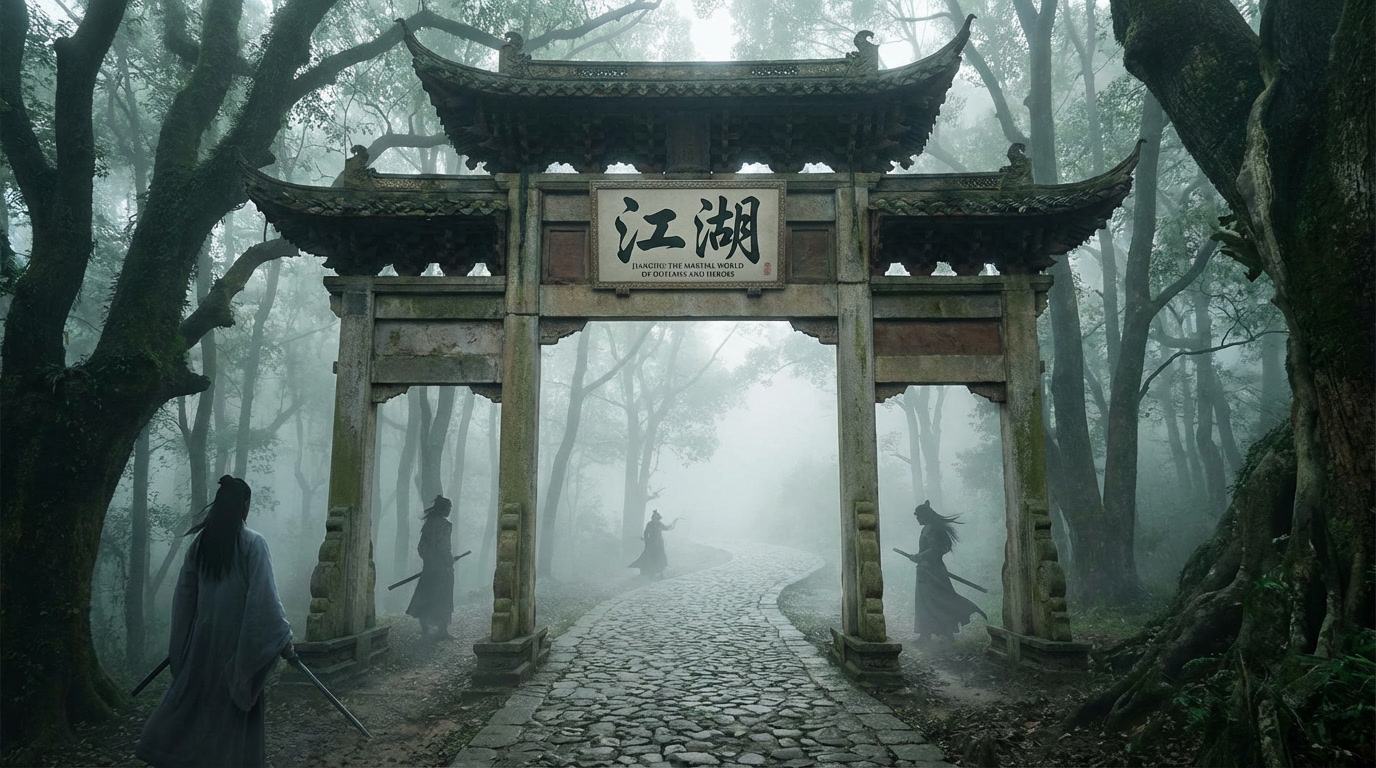
The literal characters mean “rivers and lakes,” but Jianghu has carried many lives. Classical poetry could use it for geographic and emotional distance from court, exile, wandering, seclusion, or withdrawal from politics. Later fiction developed the Jianghu that modern Wuxia audiences recognize: an alternative social order populated by sects, wanderers, healers, escorts, beggars, outlaws, assassins, monks, performers, merchants, and martial artists.
That society has hierarchies and rules, but they are not identical to imperial bureaucracy or respectable family life. Reputation travels. Debts travel faster. A person may be judged by whom they trained under, which oath they broke, whose life they saved, or whether they honored an obligation when official law offered no justice.
Jianghu is not a fantasy power category
Jianghu does not mean “ordinary humans with no magic.” It can appear in relatively realistic stories, in heightened martial fantasy, or as a metaphor in modern crime cinema. Its defining feature is social position, not the maximum number of roof tiles a fighter may disrespect during one leap.
Jianghu is also wider than wulin
Wulin (武林), the “martial forest,” often points more specifically toward the martial-arts community. Jianghu can include that community while stretching beyond it. Collapsing both terms into “the martial world” hides the non-martial people, older literary meanings, and modern metaphorical uses that make Jianghu so slippery and useful.
Wuxia: martial skill plus the burden of being a xia
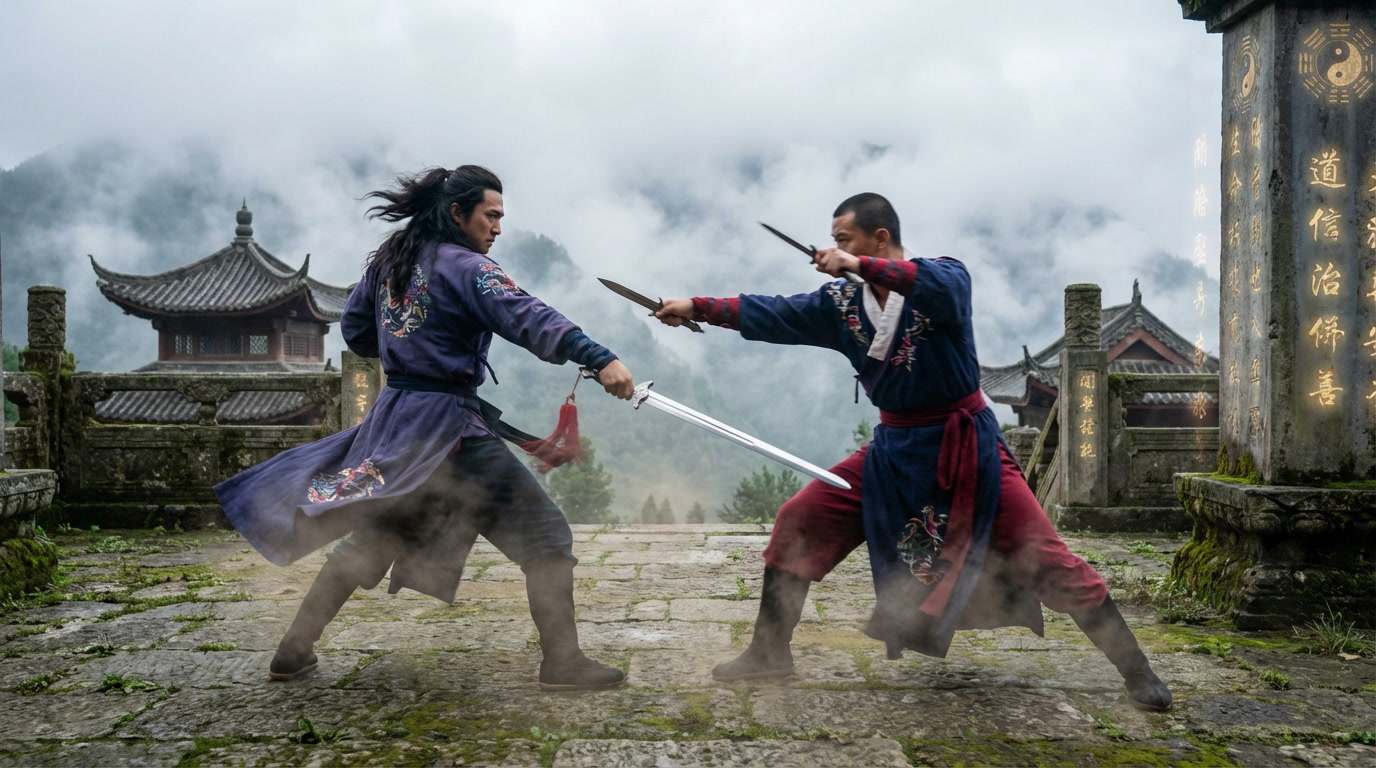
Wu (武) points toward martial force or martial practice. Xia (侠) is harder to compress. “Hero,” “knight-errant,” and “chivalrous person” each catch part of it. The xia acts according to a moral claim that may conflict with law, class, court authority, clan interest, or personal safety. A Wuxia protagonist may defend the weak, avenge an injustice, keep an oath, challenge corruption, or discover that their favorite code of honor becomes much less convenient when applied consistently.
The genre grew through long literary traditions and later exploded across novels, newspapers, film, television, comics, and games. Modern Wuxia is not one fixed historical simulation. It can be romantic, political, comic, tragic, pulpy, philosophical, or spectacular.
Wuxia can be physically impossible without becoming Xianxia
Qinggong, internal force, pressure-point attacks, improbable endurance, and airborne choreography are part of Wuxia’s familiar vocabulary. A fighter bounding across bamboo does not automatically summon a cultivation realm chart. Xianxia is organized by a different fantasy cosmology: immortals, cultivation, tribulations, divine and demonic beings, reincarnation, heavenly law, or layered realms. Movement alone is a terrible genre detector.
What changes when you stop treating them as twins
| Question | Jianghu | Wuxia |
|---|---|---|
| What is it? | A social and literary space, plus a cultural metaphor | A storytelling genre and tradition |
| Central concern | Life beyond or beside official order | Martial heroes, action, justice, loyalty, and the ethics of xia |
| Who belongs? | Martial artists, wanderers, criminals, healers, merchants, performers, monks, exiles, and more | Characters inside a Wuxia narrative, especially martial figures and people affected by their choices |
| Does it require martial arts? | No. Martial fiction made the term famous internationally, but Jianghu is broader | Yes. Martial action or martial identity is foundational |
| Does it require realism? | No fixed power scale | No. Heightened abilities and impossible movement are common |
| Can it exist in modern stories? | Yes, including gangster and marginal-community narratives | Yes, though historical and pseudo-historical settings remain iconic |
Three shortcuts that cause most of the mess
“Jianghu is where Wuxia happens”
Useful as a first sentence. Incomplete as a final definition. It explains their relationship, then accidentally gives Wuxia ownership of a much older and broader concept.
“Wuxia is realistic martial arts”
Only if gravity signed a waiver. The genre may feel human-scale compared with cultivation fantasy, but human-scale does not mean physically ordinary.
“Flying means Xianxia”
No. Ask why the character can fly, what cosmology governs the story, and whether cultivation or immortal transformation structures the plot.
“Jianghu means criminals”
Criminal networks can be Jianghu, but so can honorable wanderers, displaced officials, performers, hermits, and communities built in society’s margins.
How the two work together
A Wuxia story uses Jianghu beautifully because the setting forces moral decisions into public view. Courts can be corrupt. Sects can protect their prestige instead of people. Families can demand obedience while calling it virtue. The hero cannot simply point at the rulebook, because several rulebooks are fighting in the same teahouse.
Jianghu gives Wuxia its web of consequences. Wuxia gives Jianghu some of its most famous heroes. Their relationship is intimate without being identical.
Receipts and further reading
- Mario Wenning, “Jianghu: Los niños de los ríos y lagos, y la modernidad china”, on Jianghu as a marginal countercommunity with its own norms.
- Zhu Gang, “A World Derived from Taoyuan: Jianghu in the Su Brothers’ Writings”, on earlier literary meanings.
- Helena Yuen Wai Wu, “A Journey Across Rivers and Lakes”, on the difficulty of translating Jianghu.
- Kenneth Chan, “Reading Ambiguity and Ambivalence”, discussing Jianghu and Wuxia in film and culture.
- Language and Semiotic Studies discussion of Wang Dulu and Wuxia, describing Jianghu as the imagined society of martial heroes.
Continue the trail: Read CVM Sekai’s full Jianghu guide, Wuxia guide, and Jianghu vs Xianxia.