
NOVEL WORLD 101 · ANIME 101 · STORY WORLD 101
Wuxia (武侠): Swords, Justice, Jianghu, and Extremely Personal Grudges
Chinese martial-hero fiction where skill can look impossible, loyalty can ruin an entire generation, and the government is rarely the only authority that matters.
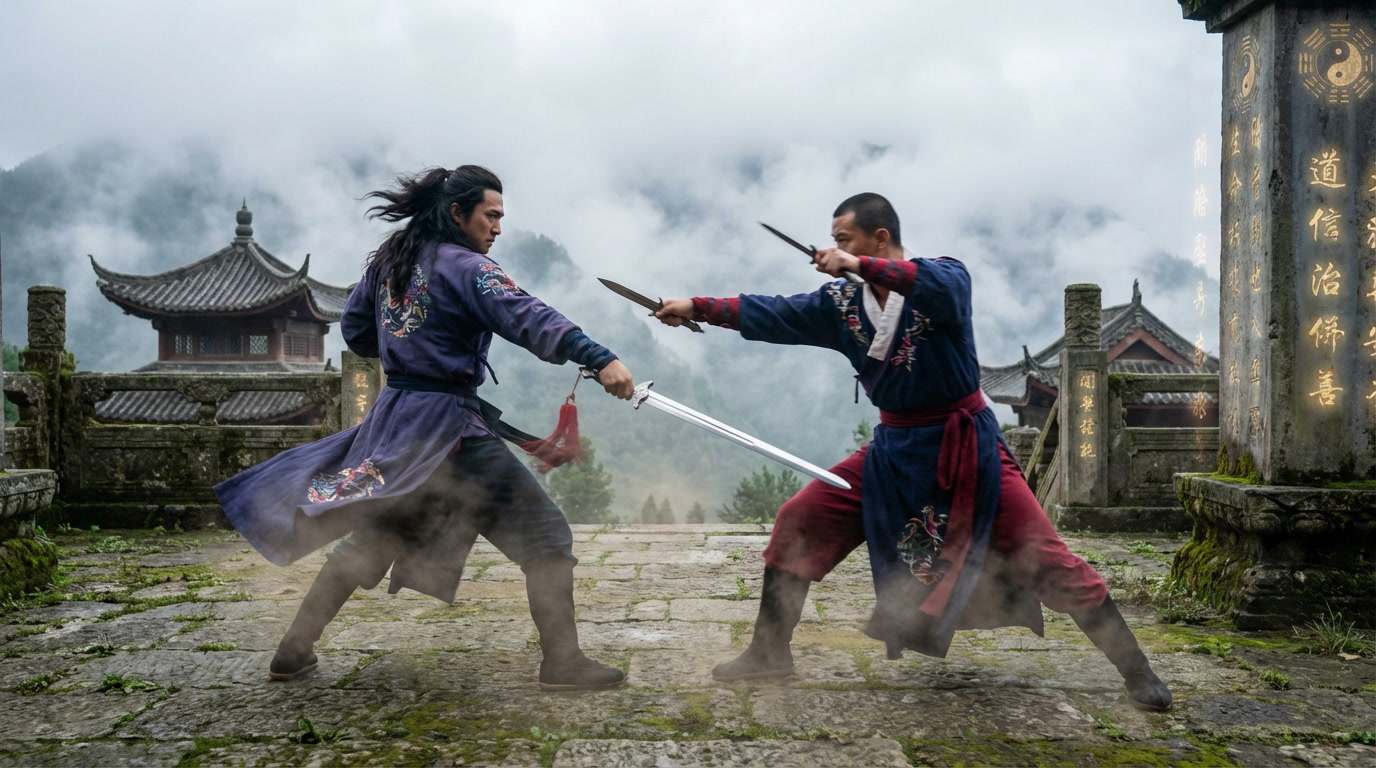
What wuxia actually means
Wǔxiá is written 武侠. Wǔ points toward the martial or military. Xiá is harder to squeeze into one English word. “Knight-errant,” “chivalrous hero,” and “martial hero” all catch part of it, but none carries the whole cultural history. The important piece is not simply that a character can fight. A xia acts according to a moral commitment that may place justice, loyalty, repayment, or protection above law, rank, and personal safety.
That tension is the engine. Wuxia heroes often live near official society without fully belonging to it. Some defend ordinary people when institutions fail. Some become outlaws because their private code collides with the state. Some are righteous. Some are terrifying people who remain technically loyal to one principle. A sword does not make the hero. The choice made while holding it does.
Jianghu is more than a martial underworld
Jiānghú (江湖) literally means “rivers and lakes,” but a literal translation immediately loses the furniture. In wuxia, jianghu is the shifting social world of fighters, sects, schools, clans, healers, assassins, escorts, wanderers, criminals, innkeepers, information brokers, and retired masters who are never as retired as they claim.
Scholar Helena Yuen Wai describes jianghu and wuxia as concepts that define one another. Jianghu gives the genre its imagined space, while wuxia stories keep remaking what that space means. It can be a community outside official control, a shadow society with its own rules, a refuge, a marketplace, a battlefield, or all five before lunch. It is not one secret club with one constitution.
This is why sect politics matter. Reputation travels. Debts survive. A favor may become an obligation years later. A disciple’s conduct can stain a master. A family feud can become public infrastructure. The jianghu remembers what the court forgot, and sometimes remembers things everybody would be healthier forgetting.
The xia ideal: justice without a tidy chain of command
The heroic code changes across periods and authors, but recurring virtues include justice, courage, loyalty, truthfulness, generosity, independence, and disregard for wealth or glory. These values do not always cooperate. Loyalty to a sworn sibling may conflict with justice. Repaying a debt may protect a villain. Obeying a master may betray one’s conscience. Wuxia becomes interesting when the code stops being a decorative speech and starts charging interest.
The hero is therefore not simply a Chinese version of a European knight. The political structure, literary ancestry, family obligations, martial lineages, and ideas of righteous action are different. Comparisons can help a new reader enter the room. They should not redecorate the room into medieval Europe once they arrive.
A very compressed history of a very large tradition
Stories about wandering retainers, assassins, swordspeople, and extraordinary heroes have deep roots in Chinese writing. Tang-dynasty chuanqi tales are often discussed as important ancestors. Later vernacular fiction, court-case stories, outlaw narratives, performance traditions, and martial tales continued feeding the form.
Modern wuxia exploded through newspapers, serialized novels, cinema, radio, television, comics, and games. Early twentieth-century writers helped establish the commercial field. The Burning of the Red Lotus Temple, adapted from a popular novel and released in 1928, became a foundational wuxia film event. The genre faced long suppression on the mainland after 1949, while Hong Kong and Taiwan became crucial publishing and screen centers.
The mid-twentieth-century “new school” transformed the genre again. Liang Yusheng, Jin Yong, and Gu Long became towering names, but not interchangeable ones. Jin Yong built immense historical and social tapestries. Liang often worked history and classical culture into carefully structured martial worlds. Gu Long stripped scenes down, sharpened suspense, and gave his loners a different modern pulse. Their work kept moving through adaptations, games, fandom, and the wider Chinese-speaking world.
The wuxia story toolkit
Schools and sects carry techniques, identity, hierarchy, grudges, and very questionable succession plans.
A text can promise mastery, destabilize the jianghu, or prove that nobody in the story understands copyright.
“Lightness skill” supports impossible-looking movement. Screen wuxia turns it into rooftop runs, bamboo balance, and elegant arguments with gravity.
Breath, qi, conditioning, focus, and fictional internal power can strengthen strikes, movement, endurance, and healing.
Debts of gratitude and resentment create relationship accounting with no reasonable closing date.
Dynastic conflict, invasion, rebellion, ethnic politics, and court power often press against the supposedly separate jianghu.
None of these features is mandatory in exactly the same form. Wuxia is a tradition, not a starter kit with six required accessories. Some works lean toward mystery, romance, political allegory, comedy, revenge, or historical epic. Film emphasizes movement and visual space. Novels can spend far longer on lineage, rumor, moral consequence, and the terrifying power of a sentence that begins, “Twenty years ago.”
Wuxia, kung fu film, xianxia, and history are not synonyms
| Label | Usual center | Scale | Do not flatten it into |
|---|---|---|---|
| Wuxia | Martial heroes, jianghu, xia ethics | Heightened human ability, sometimes edging into fantasy | A documentary about real martial arts |
| Kung fu film | Fighting craft, bodies, training, performance | Often more physical and grounded | Every Chinese-language action movie |
| Xianxia | Cultivation, transcendence, immortals, spirits | Cosmic, spiritual, openly supernatural | Wuxia with brighter visual effects |
| Historical drama | A represented historical period or figures | Varies | Proof that wuxia feats or jianghu institutions existed as shown |
Genre borders move. A wuxia story may include poison arts, uncanny medicine, near-superhuman techniques, or a weapon that feels one bad mood away from sentience. Classification depends on the work’s center of gravity, not one rooftop jump.
How to read wuxia without missing half the story
- Track obligations, not only fights. Who owes whom, and why, may matter more than who won the duel.
- Learn the hierarchy. Master, disciple, seniority, sworn kinship, sect leadership, and family position shape what a character can say safely.
- Notice the state. Jianghu may sit outside official power, resist it, cooperate with it, or reproduce its worst habits.
- Separate choreography from history. Wirework, editing, and stylized movement express feeling and skill. They are not historical footage.
- Watch adaptation choices. A novel’s internal monologue and slow reputation network may become a glance, a costume, or three seconds of flute music onscreen.
Research trail
- Oxford Academic, Stephen Teo, Chinese Martial Arts Cinema: The Wuxia Tradition
- Helena Yuen Wai, “A Journey across Rivers and Lakes”
- Smithsonian Center for Folklife and Cultural Heritage, “So You Think You Know Kung Fu”
- Duke University, “The Mysterious World of Jianghu”
- China.org.cn, “Renaissance of the Wuxia Style”
- UCLA Library, Shiao Yi Wuxia Collection