
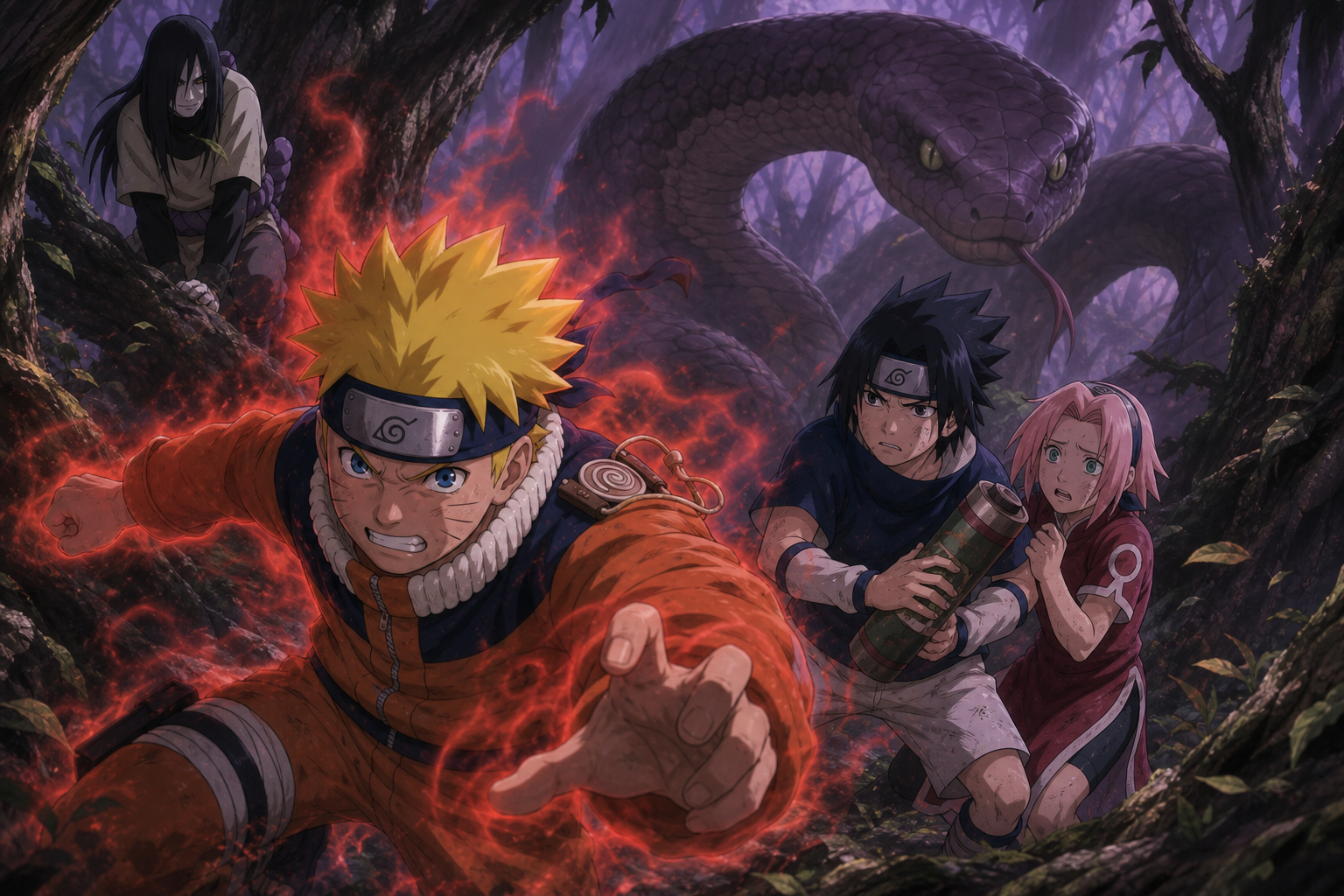
Naruto’s Counterattack: Never Give In!
Sasuke considers buying safety with the team’s scroll. Naruto refuses the deal, survives a giant snake, and forces his rival to remember who taught whom not to run.
Episode 29 is the moment Naruto’s recklessness becomes moral clarity. He does not know who the Grass ninja really is. He does not understand the scale of the power in front of him. He does understand one ugly fact that fear has made Sasuke forget: surrendering the scroll does not make a predator merciful.
Naruto punches Sasuke because Sasuke is about to confuse compliance with safety. Then Naruto fights an opponent he cannot beat, draws on the Nine-Tails’ chakra, and gives Sasuke back the courage Sasuke once lent him. That exchange is the real counterattack. Team 7 survives by passing bravery between people when one person cannot carry it alone.
The episode, with the fear put back in
The disguised Grass ninja has already shown Sasuke and Sakura what their deaths could look like. Sasuke is not mildly nervous. His body has accepted the opponent’s killing intent as a forecast. He cannot see a winning move, so he reaches for the one bargaining chip Team 7 has: the scroll.
The logic is understandable. The exam tells every team that another team wants its scroll. Give up the object, remove the motive, live to regroup. That would work if the Grass ninja were behaving like an ordinary examinee. The problem is that the opponent stopped acting like one several threats ago. Sasuke is applying the exam’s rules to someone who does not respect the exam.
Then Naruto returns. He has escaped the giant snake, reentered the fight, and immediately recognizes that something is wrong with Sasuke. Naruto, of all people, notices the behavioral impostor. The boy holding the scroll looks like Sasuke, but surrender does not sound like Sasuke. Naruto punches him and asks whether this frightened version is the real one.
That reversal is delicious because Sasuke used the same test one episode earlier. He identified a fake Naruto through behavior. Now Naruto identifies fear as something alien inside Sasuke’s usual choices. He is not claiming Sasuke never feels fear. Naruto has seen Sasuke under pressure. He is saying fear has taken control of the decision-making process.
Giving up the scroll would not buy safety
Naruto’s argument is simple enough for a frightened child to understand: the enemy can take the scroll and kill them anyway. There is no contract. There is no examiner standing nearby to enforce a clean exchange. There is only a powerful stranger who has already demonstrated an interest in terror beyond what the objective requires.
This is where Naruto’s social history becomes useful. He grew up without reliable institutional protection. Adults ignored him, feared him or reduced him to the Nine-Tails sealed inside him. Naruto learned early that appeasing hostility does not guarantee belonging. Sometimes the person demanding that you shrink has already decided what you are. His refusal is not strategic genius, but it is evidence-based.
Sasuke’s instinct comes from a different wound. He survived a massacre by being powerless in front of someone overwhelmingly stronger. When the Grass ninja floods him with murderous intent, his body remembers helplessness before the episode names the connection. Surrendering the scroll is not cowardice pulled from nowhere. It is a survival response shaped by prior terror.
The episode refuses to let that explanation become an excuse. Trauma can explain a choice without making the choice safe. Naruto interrupts Sasuke because the team cannot afford to let an old wound negotiate with a present predator.
Naruto gives Sasuke his own lesson back
During the Land of Waves mission, Sasuke protected Naruto and mocked his panic with a question about whether he was hurt, scaredy-cat. In Episode 29, Naruto returns the language. It is not a random insult. It is a receipt. Sasuke once challenged Naruto to act like the shinobi he claimed he wanted to become. Now Naruto challenges Sasuke to act like the rival Naruto knows.
This is how their bond works when it is healthy. They do not merely compete for status. Each boy holds a version of the other that fear, shame or obsession temporarily loses. Naruto’s faith in Sasuke is rude, loud and physically delivered, because this is still Naruto. It is also intimate. You cannot accuse somebody of being unlike himself unless you have been paying attention to who he is.
The scene also changes the power balance without pretending Naruto has surpassed Sasuke in every skill. Sasuke remains the more polished fighter. Naruto is the person with clearer moral judgment in this moment. Competence is not a single ladder. The team needs Sasuke’s perception and Naruto’s refusal. Neither can replace the other.
The Nine-Tails’ chakra is rescue and danger at once
Naruto attacks. Anger rises. Red chakra begins to surface. The power helps him move with a speed, force and durability that surprise the disguised Grass ninja. Naruto can confront the giant snake and hold the fight together long enough to change Sasuke’s state of mind.
The chakra is not a clean superhero upgrade. It comes from the creature whose attack defined Naruto’s childhood and Konoha’s fear of him. Every time that reserve appears, the story places survival beside loss of control. Naruto gains access to power he did not train in the ordinary way and cannot fully regulate. The resource keeping him alive is also a sealed relationship built through violence.
That contradiction matters because the village benefits from Naruto’s endurance while withholding the truth needed to understand it. He is expected to enter lethal exams, but not trusted with a complete explanation of his own body. Konoha calls secrecy protection. Naruto experiences it as power arriving without instructions.
The Grass ninja responds by disrupting that access. The encounter makes clear that a knowledgeable adult can read Naruto’s seal and interfere with it. Once again, the exam has put a child’s body in reach of an enemy who understands Konoha’s secrets better than the child carrying them.
Orochimaru is not fighting for the scroll
The opponent is Orochimaru, though Team 7 has not yet received the full biography. He is studying. The scroll is camouflage for the real objective. Sasuke’s fear, Naruto’s hidden chakra and the team’s reactions are all data.
That makes the fight feel worse than a tournament mismatch. Orochimaru is not a peer trying to advance. He is an adult missing-nin entering a youth exam under a stolen identity to evaluate children for private use. Team 7 thinks it is protecting an Earth or Heaven scroll. Orochimaru is deciding which body interests him.
The theft of a Grass participant’s face matters too. Disguise in this series is often playful or tactical. Here, it becomes bodily violation. Orochimaru does not borrow a uniform. He removes a person from the story and wears the result. That is an early statement of his central value system: bodies are containers, identities are tools, and consent is an inconvenience.
Anko finally sees the exam inside the exam
While Team 7 fights, examiner Anko Mitarashi receives evidence that something is wrong with the participant roster. The dead Grass ninja and the stolen identity turn suspicion into an institutional emergency. Her response is important because Anko understands that this is not ordinary exam violence.
The timing is also an indictment. The proctors recognize the infiltration after children have already encountered it. The Forest of Death was designed to reduce supervision so contestants could be tested under pressure. That same design delays rescue and gives Orochimaru room to operate.
Anko’s alarm carries personal weight because Orochimaru is not simply a famous criminal to her. He is tied to her own history, training and curse mark. The episode begins turning an administrative breach into the return of an abuser. That context does not excuse the exam’s failures. It explains why Anko reacts with a level of recognition other officials lack.
Sakura is watching two boys trade the right to be brave
Sakura spends much of this sequence physically outmatched, but she is not emotionally absent. She watches Sasuke break under killing intent. She watches Naruto interrupt him. She watches the Nine-Tails’ chakra change Naruto’s capacity. Team 7’s familiar hierarchy is collapsing in front of her.
This matters for what the forest will demand from Sakura next. She cannot keep treating Sasuke as the flawless center and Naruto as background noise. Sasuke can freeze. Naruto can save him. Naruto can also collapse. Sakura’s growth begins when she stops organizing the team around a crush and starts seeing two vulnerable teammates whose bodies may become her responsibility.
Her fear is appropriate. Anyone selling fearlessness as the only useful response has confused courage with poor risk assessment. Sakura’s task is to remain present, retain information and act when the opening arrives. The story is preparing her for care work under attack, and care work is about to become the only thing keeping the team intact.
What the episode says about masculinity
Sasuke’s panic threatens the identity he performs: talented, controlled, self-contained. Naruto could humiliate him for it. Instead, Naruto provokes him back toward agency. The method is rough, but the goal is not to prove that fear makes Sasuke less of a boy. The goal is to stop fear from making the team surrender to an unreliable predator.
Naruto’s version of masculinity is also under review. Charging a superior enemy looks brave, and it is. It is not automatically healthy. Naruto risks his body because he values his teammates and because he has learned to treat pain as the admission fee for recognition. The scene can be heroic and still expose that wound.
The better lesson is not “real men never run.” The better lesson is that courage is relational. Sasuke lent courage to Naruto in Wave. Naruto returns it in the forest. Neither boy owns bravery as a permanent trait. They pass it back and forth when the other cannot reach it.
Reciprocity, attachment and the scroll
A Confucian lens makes the exchange between Naruto and Sasuke clearer. Their relationship is not gentle, but it is reciprocal. Each has received protection, challenge and recognition from the other. Naruto’s return of Sasuke’s earlier words is a form of repayment. The debt is not money. It is the duty to call a teammate back to himself.
A Buddhist reading complicates the scroll. Sasuke becomes attached to survival through surrender. Naruto is attached to refusal and to the identity of someone who never runs. Neither attachment guarantees wisdom. Naruto happens to read the predator correctly here, but the series will keep asking whether refusal serves the present situation or merely protects his self-image.
The scroll is a symbol the exam makes valuable, yet Orochimaru does not care about its official meaning. That gap exposes institutional value as constructed. Teams are prepared to injure one another for an object because the village declared it necessary. The most dangerous person in the forest sees through the game and pursues the human asset instead.
Japanese performance and the sound of reversal
Junko Takeuchi gives Naruto’s return the force of somebody who has already decided before he finishes speaking. The comedy in his entrance does not erase the anger underneath it. Noriaki Sugiyama lets Sasuke’s control narrow under fear, which makes Naruto’s challenge land as recognition rather than a generic rivalry beat. Chie Nakamura keeps Sakura’s alarm active across a scene where the boys dominate the physical movement.
Kujira’s original Japanese performance as Orochimaru gives the disguised enemy an adult calm that does not belong among the examinees. I am not inventing a pitch chart from memory. The useful observation is structural: the performance does not race Naruto’s energy. Orochimaru watches, measures and allows the children to expose themselves.
What changes after Episode 29
Naruto is no longer only the teammate Sasuke has to protect. He becomes the teammate who can restore Sasuke’s will. Sasuke is no longer only Naruto’s unreachable standard. He becomes a frightened child whose strength can fail. Sakura sees both truths.
The exam is also no longer credible as a contained contest. Anko’s discovery confirms that the participant system has been breached. Orochimaru’s interest confirms that Team 7 has entered a conflict whose stakes exceed promotion. The forest is still full of rival genin, but the real danger now has history, adult power and a private plan.
RaeRae’s verdict
Naruto is right for the least polished reason possible: he knows a bully’s bargain is not a contract. Handing over the scroll would make Team 7 poorer, not safer. His punch does more than stop Sasuke’s hand. It breaks the fantasy that obedience can control somebody who entered the forest to violate the rules.
The episode also gives their rivalry a real emotional function. Sasuke taught Naruto not to freeze. Naruto returns the lesson when Sasuke needs it. That is not romance, destiny or a clean friendship speech. It is two damaged boys refusing to let the other disappear inside fear.
Fandom misreadings I am rejecting
“Sasuke is a coward.” Sasuke experiences overwhelming killing intent through a trauma-shaped nervous system. His proposed surrender is unsafe, but fear does not erase his established courage.
“Naruto wins the fight.” Naruto changes the team’s moral and emotional position. He does not defeat Orochimaru.
“The Nine-Tails is a free power-up.” The chakra helps Naruto survive, but he lacks informed control and an enemy can manipulate the seal governing access.
“Sakura contributes nothing.” Sakura witnesses, remembers and remains with two incapacitated teammates. The forest is about to convert that presence into direct protection.
“The scroll is the point.” It is the exam’s point. Orochimaru’s point is Sasuke.
Receipts and official routes
Episode number, title and official synopsis: Naruto Official Site. Original Japanese broadcast archive and synopsis: TV Tokyo. Streaming availability varies by region; use the official options linked from the episode directory.