
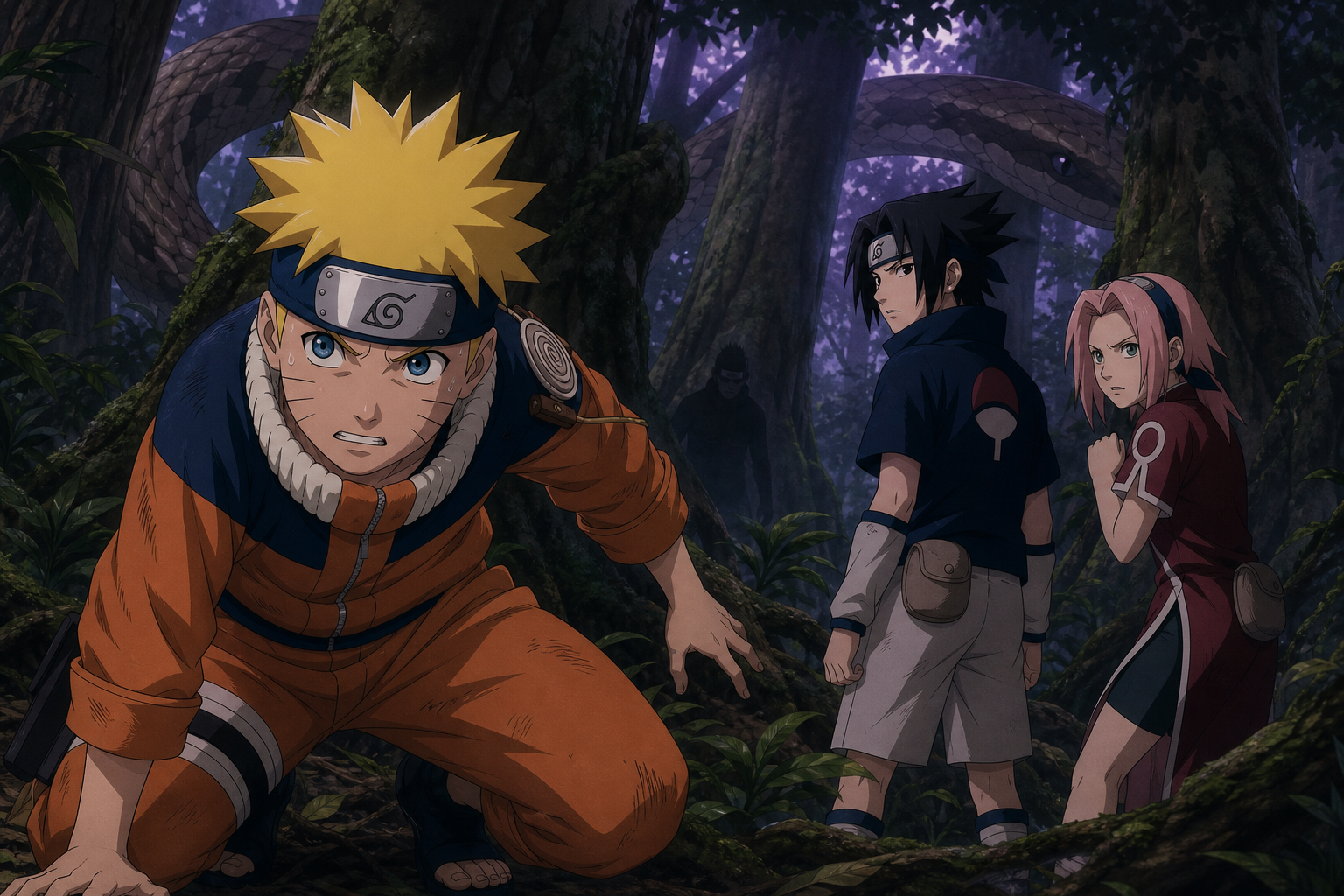
Eat or Be Eaten: Panic in the Forest
Team 7 enters a test built on theft, impersonation and fear. Sasuke reads the room. Naruto gets swallowed by it. Sakura discovers that the password meant to protect them can also expose them.
This episode turns Team 7’s weakest habit into a survival problem: they still do not know how to trust one another without making trust stupid. Naruto treats the Forest of Death like a louder version of training. Sasuke understands that every familiar face may be stolen. Sakura understands the password system, then watches that system become evidence against the person using it. The episode is funny about Naruto needing to pee, but the joke opens the door to an identity crisis with teeth.
The forest is not simply dangerous because it contains giant animals and hostile genin. It is dangerous because it destroys ordinary proof. A face is not proof. A voice is not proof. Shared information is not proof once an enemy can overhear it. Team 7 has to recognize one another through behavior, judgment and relationship. That is a much harder exam than collecting two scrolls.
The episode, rebuilt with the panic left in
The second exam begins and Naruto immediately does the least tactical thing available: he leaves his teammates because he has to use the bathroom. I laughed, because of course he does. I also winced, because Anko just explained that teams can be robbed, injured or killed inside this forest. Naruto hears the rules as a challenge to his courage. Sasuke hears them as a warning about information and exposure. Sakura hears both boys and has to keep the team from becoming three separate emergencies.
When “Naruto” returns, Sasuke attacks him. The response looks cold until the disguise breaks. An enemy Rain ninja copied Naruto’s appearance and hoped familiarity would carry him into striking distance. Sasuke does not fall for it because he notices a behavioral detail that does not fit. This matters. Sasuke’s intelligence is not a magic-eye shortcut here. It is attention. He has spent enough time irritated by Naruto to know exactly how Naruto behaves when embarrassed, defensive or confused. Petty familiarity becomes operational knowledge.
The real Naruto has been tied up. That visual lands harder than the comedy around it. He did not lose a grand duel. He separated from his team, got taken quietly and became raw material for an enemy disguise. The Forest of Death punishes small mistakes before anyone has time to announce a technique name. Naruto is powerful enough to flood a clearing with shadow clones, but power cannot fix a threat he failed to notice.
Team 7 creates a password so they can verify identity if they are separated again. It sounds sensible. It is also too long, too detailed and too easy to weaponize. Sasuke knows Naruto will not remember it. That is the point. When the next “Naruto” returns and recites the whole password perfectly, Sasuke attacks again. The impostor proves false by performing competence Naruto does not have. That is funny. It is also one of the episode’s best ideas: perfect imitation can fail because real people are inconsistent.
The second intruder is not another ordinary competitor. The Grass ninja radiates killing intent so intense that Sasuke and Sakura mentally experience their own deaths. Their bodies lock. Their confidence disappears. The exam has just jumped from peer competition to predation, and nobody from the institution arrives to acknowledge that the scale has changed. Anko told them to survive. The forest now treats that as the entire support system.
Sasuke is not being mean. He is doing identity work
Sasuke’s suspicion is the episode’s functional center. He does not trust the face in front of him merely because he wants Naruto back. He checks behavior against memory. That is a deeply relational act hiding inside his usual cool-boy packaging. Sasuke knows Naruto’s habits, limitations and emotional tells. He would never call that knowledge affection, especially not this early. The story does not need him to call it anything. He uses it to protect the team.
That does not make Sasuke an ideal leader. His communication remains harsh, and his plan depends on Naruto being predictable. Still, the result exposes why Team 7 needs difference. Naruto pushes action. Sakura retains information and watches social cues. Sasuke identifies threats and revises plans. Kakashi’s earlier teamwork lesson was not inspirational classroom wallpaper. This is what the lesson costs when the teacher is no longer standing nearby to rescue them.
Sasuke also understands that the password is disposable once compromised. A weaker story would treat the code itself as safety. This episode treats safety as judgment. Rules help until conditions change. Shinobi competence means knowing when a correct procedure has become a trap. That is not glamorous, but it is the kind of intelligence hidden villages claim they are testing.
Naruto’s courage is real, and it is not enough
Naruto hates appearing afraid because fear feels too close to the child everyone dismissed. He has built an identity around charging forward, being loud and refusing humiliation. That identity saved him in earlier episodes. Here, it makes him easy to isolate. The Forest of Death does not care whether his confidence is sincere. It cares whether he notices the person behind him.
His encounter with the giant snake turns the episode’s title literal. Eat or be eaten is not a metaphor when a predator can swallow a contestant whole. Naruto survives because the Nine-Tails’ chakra and his own refusal to stay down give him a level of endurance the average genin does not have. But the sequence should not be read as proof that Naruto’s instincts were secretly correct. He survives an error. Survival does not retroactively make the error wise.
This is one of Naruto’s recurring moral complications. The series loves his resilience, and so do I. Resilience can also become an excuse for adults to keep placing him in situations that should have broken him. The village sees a child who keeps getting up and calls the system effective. I see a system spending his body like it has an unlimited replacement policy.
Sakura is carrying the team’s continuity
Sakura does not get the flashiest movement in this episode, but she carries information. She remembers the password. She tracks the boys’ reactions. She registers danger before she has the power to neutralize it. This is early Sakura, so the gap between what she understands and what she can physically stop is painful. Fandom often turns that gap into “useless,” as if observation, memory and fear management are not work unless somebody gets punched through a tree.
The episode also places Sakura next to Sasuke when the Grass ninja’s killing intent arrives. Both are terrified. Sasuke has more combat capacity, but terror does not respect the audience’s power ranking. Sakura’s fear is not a moral failure, and Sasuke’s fear does not erase his talent. Their bodies recognize a predator whose experience sits far beyond the exam’s advertised peer level. The honest response is panic.
What matters next is not whether Sakura looks fearless. It is whether she keeps reading the situation while afraid. Courage in Naruto is too often reduced to forward motion. Sakura’s version begins as staying mentally present when her body wants to disappear. That quieter form will matter when the forest demands care, triage and protection instead of swagger.
Orochimaru turns the exam into unauthorized research
The disguised Grass ninja is Orochimaru, although the episode lets the terror arrive before the full explanation. That order matters. Team 7 does not encounter him as a famous biography. They encounter the effect of his attention. He studies Sasuke, tests his responses and treats three children as movable parts inside a private project.
Orochimaru’s intrusion exposes the exam’s institutional weakness. Konoha gathers young fighters from multiple villages, places them in a sealed forest, authorizes theft and expects proctors to distinguish ordinary violence from a major infiltrator’s agenda. That is an intelligence nightmare dressed as a promotion event. The village creates a space where suspicious behavior is normal, then acts surprised when a predator uses that normality as camouflage.
He also changes the meaning of the scroll. For ordinary teams, the Heaven and Earth scrolls are objectives. For Orochimaru, the real objective is Sasuke. He enters the exam economy without caring about its official prize. That is what makes him scarier than the Rain ninja. One enemy wants Team 7’s property. Orochimaru wants access to a person.
The Forest of Death is a school with liability waived
Anko’s exam tests survival, intelligence, teamwork and willingness to take another team’s resource. The structure is not neutral. It teaches children that advancement requires controlled predation. Some teams begin with Heaven, others with Earth, and everyone must obtain what somebody else holds. Cooperation across teams is possible in theory, but the rules reward suspicion and scarcity.
This is where the hidden-village system shows its values without giving a speech. The villages need shinobi who can infiltrate, deceive, steal and continue under lethal pressure. The exam reproduces those conditions. It also turns them into spectacle and career sorting. Children enter a forest; institutions wait at the tower; bodies become the cost of producing a rank.
A Confucian reading makes the failure of adult duty impossible to ignore. Authority is not legitimate merely because it can issue rules. Rank carries reciprocal obligation. Teachers, examiners and village leaders owe protection and moral cultivation to the young people they command. “Do not die” is not enough care to balance the obedience being demanded.
A Buddhist lens lands differently. Attachment to a fixed identity becomes dangerous because identity can be copied. Naruto’s face appears without Naruto. The password appears without loyalty. Sasuke survives by refusing attachment to appearances and checking present evidence. The lesson is not that bonds are false. It is that a bond cannot be reduced to a symbol, a face or a memorized phrase.
The bathroom joke earns its place
Naruto needing to pee is not sophisticated comedy, and it does not need to be. The joke lowers the team’s guard, makes Naruto act like an ordinary twelve-year-old, and creates the opening for the impersonation plot. That ordinary body is important. These children can leap through trees, but they still get hungry, tired, embarrassed and desperate for privacy. The exam exploits every one of those needs.
The humor also sharpens Sasuke’s recognition. He knows the returning Naruto is wrong because the fake handles embarrassment incorrectly. Their constant bickering has produced a behavioral archive. Apparently annoyance is a valid intelligence-gathering method. Team 7 accidentally studied one another while insisting they could barely stand one another. Cute. Ridiculous. Useful.
Japanese performance and the sound of shrinking confidence
Junko Takeuchi performs Naruto’s bravado with the quick, reactive energy that lets the bathroom embarrassment remain funny before the danger closes in. Noriaki Sugiyama gives Sasuke the clipped control needed for the impostor reveal. Chie Nakamura keeps Sakura alert even when fear reduces her physical options. Their contrast makes Team 7 sound like three different coping systems forced into one unit.
The production’s strongest choice is the shift in atmosphere when Orochimaru’s killing intent arrives. The episode lets silence, fixed attention and imagined bodily consequence interrupt the lighter rhythm. The fear is not explained away. Sasuke and Sakura understand, at a nervous-system level, that this opponent can kill them. The scene respects panic as information.
What this episode changes
Episode 28 proves that Team 7 has begun learning one another. Sasuke can identify Naruto through behavior. Sakura can follow the verification plan. Naruto’s absence matters enough to trigger suspicion rather than indifference. The bond is still rude, unfinished and full of ego, but it now has operational weight.
It also introduces the exam’s real threat. The Chūnin Exams are no longer simply a tournament road filled with colorful rivals. Orochimaru has entered Konoha’s system and selected Sasuke as a target. From this point forward, advancement, invasion and private experimentation occupy the same space. The village thinks it is grading children. A missing-nin is grading the village.
RaeRae’s verdict
This episode works because the impersonation plot is not filler between fights. It asks what makes a teammate recognizable after the face becomes unreliable. Sasuke’s answer is behavior. Sakura’s answer is memory. Naruto’s answer, for the moment, is surviving long enough to rejoin the conversation.
The Forest of Death is doing exactly what its name promised, but the ugliest danger is not the snake. It is the adult predator who can enter a child military exam because the institution already normalized secrecy, fear and violence. Orochimaru did not invent the conditions. He simply knew how to rent them.
Fandom misreadings I am rejecting
“Sasuke attacks Naruto because he is a jerk.” He attacks an impostor and protects the team through observation. His delivery is abrasive. His judgment is correct.
“Naruto surviving proves he was ready.” No. It proves Naruto is unusually durable. Readiness includes avoiding the trap.
“Sakura does nothing.” Sakura tracks information and remains present under overwhelming killing intent. Her limited combat response is real. Erasing her cognitive work is lazy.
“The password makes them safe.” The password becomes compromised almost immediately. Sasuke’s willingness to distrust perfect recitation makes them safer.
“The exam is fair because everyone accepted the rules.” Children signing a waiver inside a military institution does not make adult responsibility vanish. Consent under hierarchy deserves more scrutiny than that.
Receipts and official routes
Episode identification and official synopsis: Naruto Official Site. Japanese broadcast archive: TV Tokyo. Streaming availability varies by region; use the official options linked from the episode directory.