
RaeRae Reacts · ENHYPEN
Bloody Paradise
ENHYPEN turned a prison lineup into a two-minute Brazilian-funk sprint, then made the hook argue with itself until “do not touch me” sounded suspiciously like an invitation.
Bottom line: ENHYPEN found the right sound for a six-member reset. “Bloody Paradise” is hot, physical, fast and a little rude. The beat does most of the flirting, the chorus makes refusal and desire share one sentence, and the video turns confinement into a dance floor. My complaint is simple: 2 minutes and 11 seconds is robbery. The song leaves exactly when it has earned one more ugly, sweaty chorus.
What changed every time I replayed it
First play: the body answered first
The percussion got me before the story did. This is Brazilian funk used as movement, not wallpaper. The low end pushes forward, the rhythm keeps snapping at the ankles, and the hook lands in short pieces that a crowd can yell back. I was not sitting there with a notebook thinking about vampire lore. I was thinking, “Oh, they made a club track for people who pretend they do not dance.”
The smartest choice is restraint. The production does not stack ten extra ideas on top of the groove. It lets the beat, the clipped vocal phrases and the members’ different textures fight for the same small space.
Second play: the hook started an argument
The central push and pull became clearer. The lyric keeps moving between “do not touch me” and “come touch me.” That contradiction is the song. Desire feels dangerous, but danger does not cancel desire. The two impulses live together, which fits ENHYPEN better than another clean declaration of eternal love.
That tension also makes the repetition useful. Each return to the body-centered hook sounds less like a command and more like somebody losing an argument with himself.
Third play: the room became the point
The video keeps the group inside spaces built to control bodies: a lineup wall, an observation window, hard corridors and institutional rooms. Then the six members take over those spaces through choreography. They do not escape by finding a magical door. They make the place answer to their rhythm.
That is my reading, not a director quote. The official description only credits HATTRICK as director. The control-versus-motion idea comes from what the camera repeatedly shows.
Later plays: I got mad at the runtime
Apple lists the track at about 2:11, and the official video runs 2:14. That short runtime keeps the song sharp, but it also cuts off the payoff. I wanted a bridge that changed the temperature, a final chorus with rougher ad-libs, or one last formation that broke the lineup completely.
Instead, the song exits while the groove still has fresh evidence. Efficient? Yes. Generous? Absolutely not.
The beat is the getaway car
BELIFT described “Bloody Paradise” as a Brazilian funk-based dance song, and that label matters because the rhythm carries the narrative. The song is about lovers turning danger into paradise while they run. The music does not sound safe enough to call paradise in any normal sense. It sounds urgent, crowded and a little reckless. That contradiction gives the title teeth.
JULiA LEWiS produced the track, while the reported writing team includes Ryan Curtis, Pardyalone, JULiA LEWiS and Dynamic Duo’s Gaeko. The groove does not politely wait beneath the vocals. It elbows into them. Short phrases hit like footwork cues. Repeated body words make the lyric physical. The result feels less like somebody describing escape and more like the escape happening in real time.
I also like that the song does not sand off its global influence until it becomes generic K-pop seasoning. ENHYPEN performs inside the rhythm. The members change their weight, timing and attack to meet it. That is the difference between borrowing a genre label and actually letting a genre rearrange the song.
The lyric knows paradise can be a bad address
The official album story frames two lovers who keep running after breaking a taboo. “Bloody Paradise” treats each other as the only safe place left. That sounds romantic until you remember what it costs. When one person becomes your entire shelter, love and survival start sharing the same oxygen. It can feel intense, loyal and beautiful. It can also become a tiny world with no exit.
The touch language makes that problem visible. “Do not” and “come” keep colliding. Consent is not a decorative mood board, so I am not going to romanticize mixed signals in real life. Inside this fictional song, though, the contradiction captures panic, attraction and self-protection. The speaker wants closeness and fears what closeness will unleash.
From a Buddhist lens, the song is soaked in attachment. The lovers try to build permanent refuge inside a situation that keeps changing. From an MRT and power lens, the institution controls the room, the rules and the official story, while the group controls attention, rhythm and collective movement. Nobody hands them freedom. They make a temporary zone where the authorities no longer decide what their bodies mean.
The six-member sound finally has a face
Jungwon and Jay
Jungwon’s tight, recognizable tone cuts through a track that could swallow softer voices. Jay brings bite without trying to outshout the bass. Together, they keep the song from becoming one long low-register mood.
Jake and Sunghoon
Jake slides comfortably into the English-heavy phrasing, which helps the hook feel conversational instead of assembled. Sunghoon gives the performance a colder edge. His face stays controlled even when the choreography gets loose, and that contrast fits a song where desire keeps slipping past restraint.
Sunoo and Ni-ki
Sunoo brightens the vocal color at exactly the right moments. Ni-ki sounds built for the lower, clipped phrases, and the dance framing naturally gives him room to make the rhythm look heavier than it sounds. The video does not need a separate “look, Ni-ki can dance” announcement. His timing handles the paperwork.
What the formation says
This comeback arrives after Heeseung’s departure, so every formation carries extra scrutiny. The video does not hide the six. It repeatedly places them in lineups and group frames where the new shape is impossible to miss. That feels deliberate even if the director never says it out loud. The reset becomes part of the image.
The video deep dive: paradise behind glass
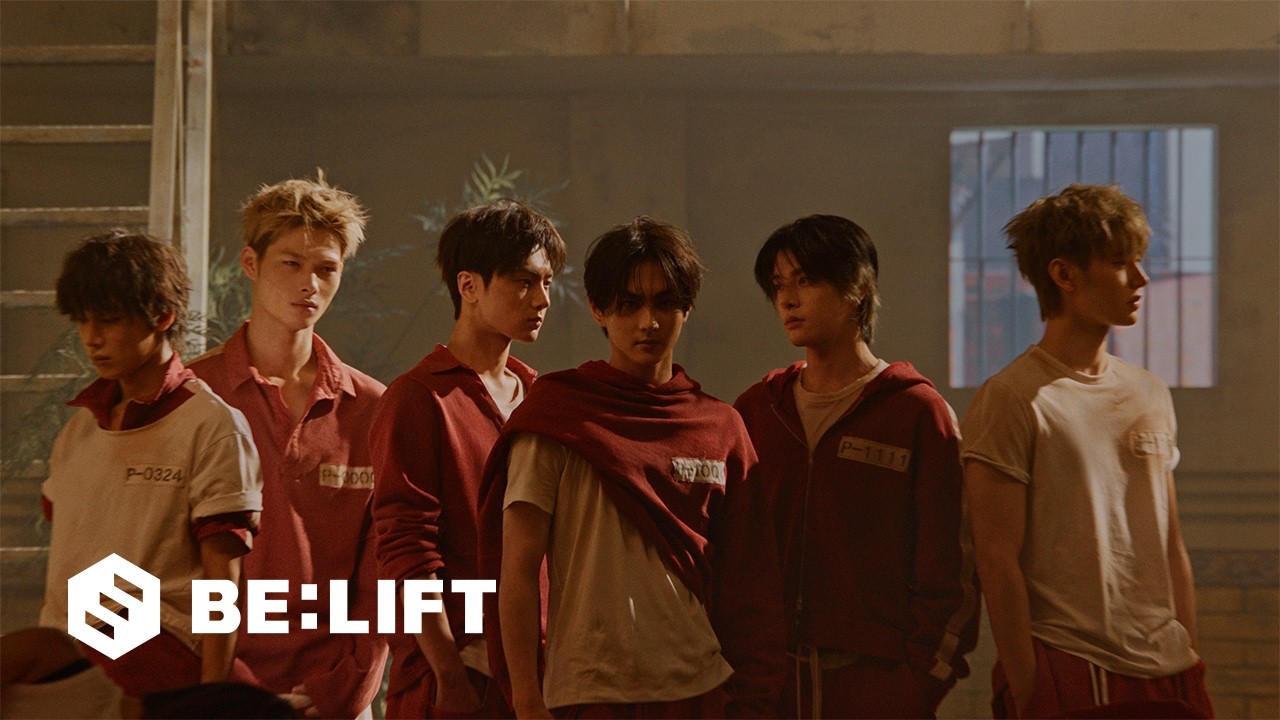
The opening group image looks like a detention or prison intake. Red and cream uniforms, identification markings and the hard interior tell us these bodies belong to a system before anybody sings. The camera then places an office desk and observation window between us and the performers. Somebody is supposed to be watching them. Somebody is supposed to be in charge.
ENHYPEN ruins that arrangement by moving. Bodies blur behind the glass. Paper scatters. The lineup stops behaving like a lineup. When the choreography moves into a larger corridor, the industrial setting becomes a stage without losing its institutional weight. The boys are still inside. They have simply made confinement look temporarily unable to contain them.
Red does obvious work here: blood, danger, heat and a uniform that marks them as one group. Green-blue institutional light pushes against it. Warm performance energy and cold control keep trading the frame. The color argument mirrors the lyric argument. Come closer. Stay back. This is paradise. This is a cage.
HATTRICK keeps the camera close enough to feel the footwork and group pressure. The performance never floats in a clean fantasy void. Walls, desks, bars, glass and hard floors keep reminding us that the dancers have limits around them. That makes every loose shoulder and sharp step feel earned.
What worked, what did not
What worked
The groove has identity. The hook is immediate without sounding childish. The six-member formation looks intentional. The video gives the choreography a real dramatic function. Most importantly, ENHYPEN’s old vampire tension survives without forcing another pile of fangs into every close-up.
What did not
The song is too short for the amount of tension it creates. The structure repeats before it develops. A bridge could have exposed a different emotional angle, and the ending could have made the paradise idea collapse or explode. Instead, the final stretch keeps the same temperature until the door closes.
I also wanted one clearer narrative consequence in the video. Who is watching? What happens when the dance rebellion ends? The ambiguity leaves room for theories, but the film gives atmosphere more attention than cause and effect. I enjoyed the room. I still wanted to know who locked it.
The first thirty seconds do almost all the recruiting
The opening does not ask for patience. It puts the rhythm in front, keeps the vocal phrases short, and lets the choreography explain the temperature before the lyric has finished introducing itself. That is why the song feels immediate without needing a giant vocal stunt. The first job is getting bodies to lean forward. ENHYPEN understands the assignment.
What I like is how little dead space sits between the setup and the hook. The production moves like somebody already pulled the alarm. Every sound has somewhere to go. The percussion pushes, the voices answer, and the bass makes the room feel smaller. That pressure fits a video built around confinement. The music does not describe the cage from a safe distance. It makes the listener stand inside it.
The risk is that speed can flatten personality. “Bloody Paradise” mostly avoids that because the members do not all attack the beat the same way. Some phrases cut. Others drag just behind the percussion. The song needs those differences because the arrangement does not give anybody a long runway. Every member has to establish a texture quickly, then get out of the next person’s path.
The chorus is catchy because it refuses to settle the argument
A weaker song would choose one clean idea. Either the lover is dangerous and must stay away, or the lover is irresistible and must come closer. “Bloody Paradise” keeps both impulses alive. That contradiction gives the chorus replay value. I did not return because the words revealed a complicated plot. I returned because the emotional position would not sit still.
That is also why the repeated touch language works better as performance than it does on paper. Read alone, the lyric can look thin. Heard against the beat and watched with bodies moving toward and away from each other, the same language becomes blocking. Distance changes. Eye contact becomes a challenge. A hand reaches, stops, and reaches again. The performance supplies the argument the lyric only sketches.
There is a real-world boundary here. Mixed signals are not consent, and a pop song does not rewrite that. The video operates inside a fictional fantasy where temptation, danger and pursuit are part of the genre. The interesting part is not pretending confusion is romantic. The interesting part is watching the members perform the moment when desire and self-preservation stop cooperating.
The production knows when to leave the vocals alone
The best decision in the arrangement is what it does not add. Nobody drops a decorative high note just because a title track is supposed to prove importance. Nobody gets buried under a choir of their own voice. The beat stays exposed enough to keep its rough edge, and the vocal layers appear where they can thicken the hook without polishing away the sweat.
That restraint matters after years of K-pop title tracks that treat every eight-count like an empty shelf that must be filled. “Bloody Paradise” has room for the rhythm to behave like an instrument with authority. The percussion is not a background assistant. It controls how the members phrase, how the camera cuts, and how the choreography distributes weight. The song belongs to the groove first.
I still want a bridge, but not a conventional one built from a slow vocal climb and one predictable belt. I want the rhythm stripped down until we can hear shoes, breath and one ugly bass pulse. Then let the final chorus come back heavier. The missing forty seconds should not make the song prettier. They should make the paradise feel harder to leave.
The six-member reset is not hiding in the margins
ENHYPEN is performing under a microscope because the group shape changed. Fans will count lines, study formations and look for every place where the old arrangement might still be visible. The video answers by making the new six-member geometry impossible to avoid. Lineups, corridor formations and tight group frames keep showing the audience the current group as a complete unit.
That does not erase Heeseung or ask fans to pretend the change carries no grief. It means the current members still have to make a working stage. There is a practical difference between honoring history and freezing a group inside it. “Bloody Paradise” chooses motion. The choreography treats six as a design problem to solve, not a hole to disguise.
The group’s strongest answer is not a speech about resilience. It is timing. Six people hit the same rhythmic idea, then separate into different textures without letting the center collapse. That is a better statement than a press release because the audience can see whether it works. Here, it works.
The camera keeps asking who owns the room
The intake imagery establishes official power. Uniforms classify the members. The lineup wall measures them. Glass separates the watcher from the watched. Desks and corridors belong to an institution that expects obedience. Even before the plot explains anything, the architecture tells us whose rules were supposed to matter.
Then performance changes the chain of command. The members do not gain legal control of the building. They gain visual control of the frame. The camera follows their rhythm instead of the institution’s order. Papers, furniture and bodies stop behaving neatly. That is a small rebellion, but the video makes it legible.
From my military brain, a formation is never neutral. Placement tells you who is accountable, who is visible, who has freedom to move and who is expected to hold the line. “Bloody Paradise” uses formation twice. The institution lines the members up to identify them. ENHYPEN lines themselves up to perform as a unit. Same basic shape, completely different ownership.
From an Asian family and Confucian lens, the tension also lands as a fight between assigned role and chosen loyalty. The system names the members as bodies under control. The group answers through collective discipline. They do not become free by turning into six unrelated rebels. They become harder to control because they move together.
The Easter-egg ledger: what is visible and what I am reading
Confirmed on screen
The video repeatedly uses lineup imagery, institutional lighting, glass barriers, red uniforms, observation spaces and group choreography inside controlled architecture. Those are visible choices. HATTRICK is credited as director. The album material connects the song to lovers running after a taboo. Those facts give us a solid floor.
My reading
I read the glass as surveillance, the choreography as temporary control of a hostile room, and the red uniforms as a shared identity imposed from outside and reclaimed through performance. That interpretation fits what the camera shows, but it is still analysis. I am not putting imaginary director quotes in anybody’s mouth.
The vampire connection
Blood, taboo, dangerous intimacy and lovers who turn exile into refuge all fit ENHYPEN’s long-running vampire language. The video does not need obvious fangs in every frame. The group’s mythology works better when it becomes emotional grammar instead of Halloween inventory.
The missing answer
The video never fully identifies the authority watching the group or the consequence waiting outside the performance. That gap keeps the imagery open, but it also limits the story. Symbolism is not a coupon that excuses cause and effect. A stronger ending would make the watchers react.
What the artistic team understood
The production team understood that ENHYPEN’s central appeal is not simply “dark concepts.” Plenty of groups can wear red under cold lighting. ENHYPEN works when attraction feels like a rule somebody is about to break. The song, video and choreography all protect that tension. Nobody has to explain the lore before the physical stakes make sense.
HATTRICK also understood that choreography can carry narrative labor. The dance is not an interruption between close-ups. It is the method the members use to change the meaning of the room. That gives performance fans something to study and gives story-minded fans an actual reason for the group to be dancing inside an institutional setting.
The writers built a hook with enough contradiction to survive repetition. The producer gave that hook a rhythm that makes hesitation sound physical. The members supplied the final layer by making six different vocal and movement textures feel like one anxious system. None of those pieces is especially complicated alone. Their alignment is the craft.
The macro problem hiding inside the hot song
“Bloody Paradise” sells a fantasy people recognize far beyond vampire lore: when the outside world becomes hostile, two people decide they can become an entire country for each other. That idea feels romantic because it promises refuge without negotiation. It also becomes dangerous when love replaces every other relationship, resource and exit.
At the interpersonal level, the song lives in the messy second before anybody admits what they need. One person reaches, retreats, and reaches again. At the group level, six members use discipline to create temporary freedom. At the industry level, a company needs a new title track to prove the changed lineup can still carry the brand. The same song is doing emotional, visual and corporate work at once.
That is why the short runtime annoys me. The concept has enough meat for a fuller argument. Instead, streaming-era efficiency wins. The hook arrives quickly, replay potential stays high, and the song ends before casual listeners can get bored. The business logic is obvious. The artistic cost is that the song never has to live with its own contradiction long enough to transform it.
RaeRae’s verdict
“Bloody Paradise” works because ENHYPEN does not treat danger like a costume rack. The song builds danger into the rhythm, the lyric and the group’s physical performance. Love becomes refuge, temptation and liability at the same time. The video understands that a paradise made inside a prison can still feel real for three minutes, even if the walls remain when the music stops.
This is the first six-member title track that makes the reset feel like a new chapter instead of a missing chair. I would have given it another forty seconds and forced that last chorus to earn its freedom. Even unfinished, the song has more personality than plenty of four-minute tracks that spend the whole runtime looking for a pulse.
Watch the official video
Open “Bloody Paradise” on HYBE LABELS ↗Daily+562KTotal views40.8M
Receipts
- HYBE LABELS: official “Bloody Paradise” music videoDaily+562KTotal views40.8M, directed by HATTRICK.
- Apple Music: “Bloody Paradise” on THE SIN : BLISS, released August 21, 2026.
- SBS: six-member comeback, Brazilian funk description and album context.
- TenAsia: track-list story, JULiA LEWiS production and Gaeko lyric credit.