
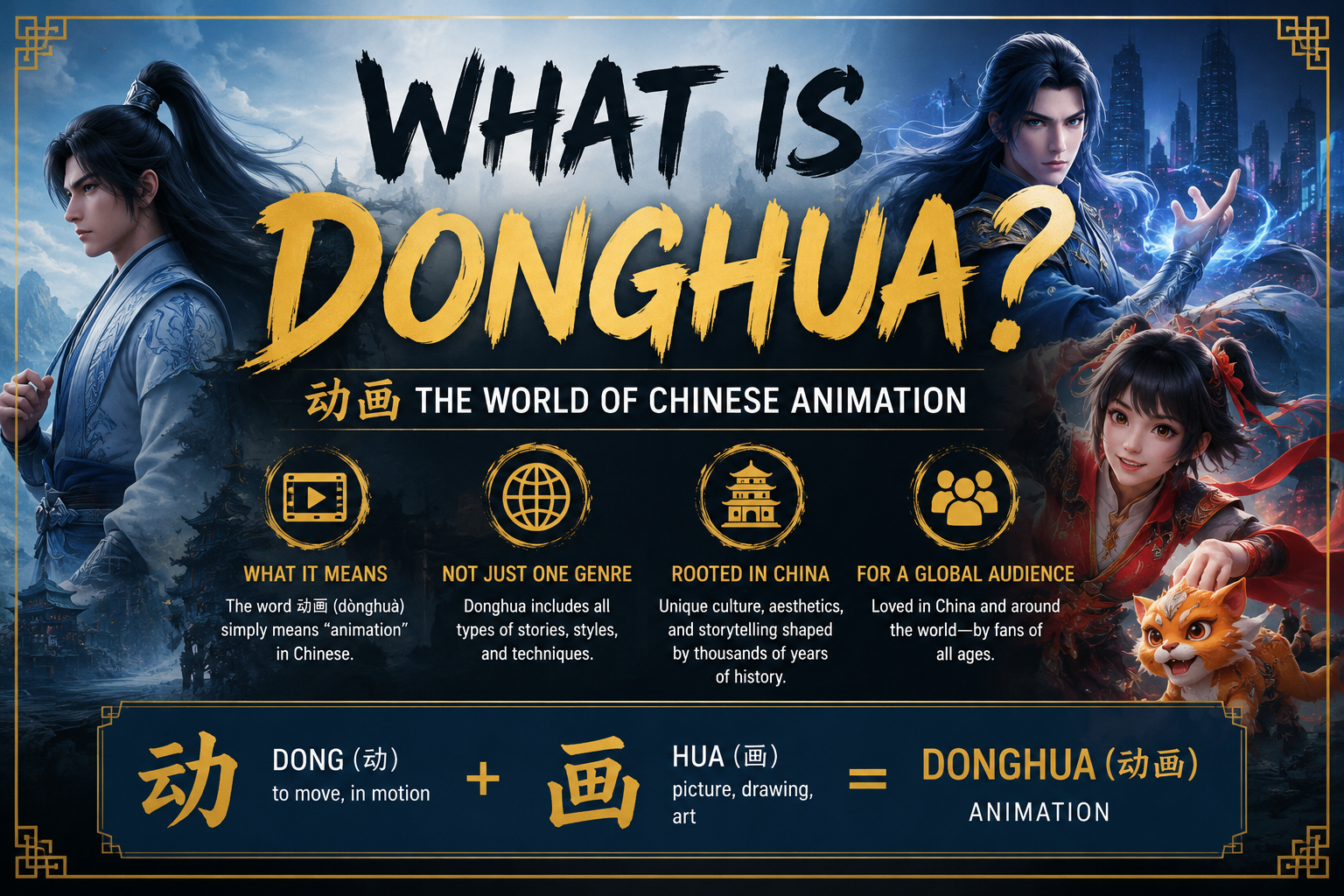
What Is Donghua?
If somebody told you donghua means “Chinese anime,” they gave you an answer that is useful for approximately thirty seconds. It gets you into the right country, and then it starts quietly causing problems. Donghua (动画 / 動畫, dònghuà) is the ordinary Chinese word for animation. International fandom often uses it more specifically for animation from China, which is why you will hear people talk about “watching donghua” as a category beside Japanese anime or Korean animation.
The important part is what the word does not mean. Donghua is not a genre, not a synonym for cultivation fantasy, not a technical term for 3D CGI, and not one visual style. Chinese animation includes 2D and 3D work, television and streaming series, theatrical films, children’s programming, comedy, science fiction, historical stories, fantasy, romance, action, experimental animation, adaptations, and original productions. The giant immortal man glowing on your screen is only one neighborhood.
- What does donghua actually mean?
- How do you pronounce donghua?
- Is donghua just Chinese anime?
- Donghua is not a genre
- Why donghua can look so different
- Where donghua stories come from
- Why web novels matter so much
- What manhua has to do with donghua
- Wuxia, xianxia and xuanhuan
- Why cultivation shows up everywhere
- Chinese cultural context
- Streaming platforms and release systems
- Why the English titles are chaos
- A very short history of Chinese animation
- Donghua outside China
- Common donghua myths
- Why this distinction matters
- Where to go next
Four things to know before somebody gives you seventeen cultivation recommendations
Donghua becomes much easier to understand once we separate the word from the most internationally visible kinds of Chinese animation. The category is broad. The fantasy vocabulary is another layer sitting inside it.
What does “donghua” actually mean?
Donghua is written 动画 in simplified Chinese and 動畫 in traditional Chinese. The Mandarin pronunciation is dònghuà. In ordinary Chinese usage, the word refers to animation broadly. It is not inherently a label for “Chinese-style animation,” any more than the English word animation tells you which country made the thing moving on screen.
International fandom narrowed the word because it needed a convenient way to distinguish animation from China when discussing Japanese anime, Korean animation, Western animation, and other traditions in the same conversation. That usage is practical. If somebody tells me they have been watching more donghua lately, I understand that they probably mean Chinese animated productions rather than every animated work available in Mandarin.
The problem appears when the convenient fandom label gets mistaken for the literal meaning. Then people start trying to identify donghua by facial proportions, flowing robes, cultivation systems, CGI character models, or Chinese fantasy settings. None of those features defines the word. They are things you may encounter inside Chinese animation, not border control.
How do you pronounce donghua?
The Mandarin pinyin is dònghuà. Both syllables use the fourth tone, which means each falls sharply. English speakers often flatten the tones and say something close to “dong-hwa,” which will usually be recognizable in an English-language fandom conversation even though it does not reproduce the Mandarin pronunciation perfectly.
The characters also help explain why translating the word as some mystical genre category makes no sense. 动 relates to movement or motion, while 画 relates to pictures, drawing, or visual art. Together, 动画 refers to moving pictures or animation. The word is wonderfully ordinary. Fandom is the one that gave it an immigration desk.
Is donghua just “Chinese anime”?
“Chinese anime” is useful when somebody has absolutely no idea what you are talking about and you need a bridge in one sentence. Both Japanese anime and Chinese donghua are animation industries with television, film, streaming, adaptations, voice performers, fandoms, merchandise, and international audiences. Viewers also encounter plenty of shared East Asian media influences and increasingly global production techniques.
But treating donghua as a regional reskin of Japanese anime erases the exact context that makes Chinese animation interesting. China has its own animation history, literary traditions, mythology, comics industry, web-fiction ecosystem, streaming platforms, audience habits, business structures, aesthetic traditions, and production pipelines. A xianxia web novel becoming a long-running 3D streaming series did not travel through the same cultural route as a Japanese manga becoming a one-cour late-night TV anime.
The two industries can influence each other, collaborate, share production labor, borrow techniques, and target some of the same international viewers without becoming the same thing. “Chinese anime” helps someone find the shelf. Donghua gives us permission to learn what is actually on it.
Donghua is not a genre
International discovery algorithms have created a funny problem. Many of the Chinese animated series that travel most aggressively through fandom spaces involve cultivation, martial fantasy, historical-inspired worlds, gods, demons, sects, elaborate robes, and people becoming powerful enough to make geography nervous. Watch five of those in a row and it becomes easy to assume that donghua means this particular kind of Chinese fantasy.
It does not. Chinese animation includes children’s programming, family films, comedy, science fiction, romance, modern urban stories, historical subjects, action, fantasy, experimental work, adaptations, educational animation, and original productions. Even inside fantasy, wuxia, xianxia, xuanhuan, mythology, science fiction, gaming worlds, and hybrid genre systems can work very differently.
This matters because calling donghua a genre makes every unfamiliar Chinese animated work seem like an exception. The broader definition fixes the problem immediately. Chinese animation can contain many genres because animation is the medium. The story still has to decide what kind of mess it wants to make.
Why can one donghua look like anime while another looks like a 3D fantasy game?
Chinese animation uses multiple production approaches, and international viewers often encounter the contrast most strongly between 2D and 3D productions. Some series use a visual language familiar to viewers of Japanese television animation. Others build characters, environments, creatures, magical effects, and action through 3D computer-generated pipelines. Hybrid productions can combine methods instead of behaving politely inside one category.
The large number of prominent 3D fantasy and cultivation series has made CG animation particularly associated with donghua abroad. Long-running serialized fantasy can benefit from reusable character models, environments, props, creatures, and effects systems, especially when stories keep returning to large sects, cities, mountains, battles, and increasingly unreasonable magical architecture. That does not mean 3D is automatically cheap, easy, or visually superior. It is simply a different production pipeline with its own strengths, limitations, labor, and artistic decisions.
Viewers also need time to adjust their eyes. Someone accustomed to one animation tradition may interpret unfamiliar motion, lighting, facial acting, compositing, or character models as inherently “wrong” when the real issue is partly expectation. Some productions are excellent. Some are rough. Some 2D animation is gorgeous, and some is a production emergency wearing a school uniform. Format does not issue quality certificates.
Where do donghua stories come from?
Chinese animation can be original, but a huge amount of modern serialized donghua lives inside a larger IP ecosystem. Web novels, print fiction, manhua, games, online literature platforms, mythology, classical stories, and existing entertainment franchises can all feed animated adaptations. Sometimes a single property exists simultaneously as prose, comics, animation, live-action drama, games, audio drama, merchandise, and several English titles nobody agreed on beforehand.
That adaptation chain matters because each medium carries different information. A web novel can spend paragraphs inside a character’s head and explain a cultivation system until you could sit the entrance exam yourself. Manhua can condense that material visually. Animation then has to decide what deserves screen time, how to visualize internal power systems, how quickly to move through chapters, and how much worldbuilding the viewer can absorb while somebody is trying to kill the protagonist.
This is one reason source readers and animation-only viewers can seem to have watched completely different stories. The source reader may know the political history of three sects, the protagonist’s exact spiritual-root configuration, and why an insult in Episode 7 was technically devastating. The animation viewer saw a man glare dramatically and then everybody flew away.
Why web novels matter so much to modern donghua
Online fiction became an enormous source of serialized Chinese storytelling, particularly for fantasy, cultivation, romance, science fiction, historical fiction, gaming stories, and genre hybrids. Web serialization encourages long narratives, frequent updates, expansive casts, escalating systems, and worlds that can accumulate extraordinary amounts of lore before animation ever enters the room.
For donghua, that creates both opportunity and a pacing nightmare. A popular novel already has a built-in audience, recognizable characters, and enough material to sustain years of adaptation. It may also contain hundreds or thousands of chapters. Animation cannot simply place every conversation, internal monologue, side quest, cultivation explanation, and minor elder on screen without eventually becoming a second occupation for the viewer.
The result is selection. Adaptations compress. They merge scenes, cut exposition, alter chronology, change emphasis, or accelerate early material to reach the parts audiences already love. Sometimes that makes the animated version cleaner. Sometimes it removes the exact explanation that would have stopped me from pausing Episode 4 to ask why somebody’s golden core is now a political emergency.
What does manhua have to do with donghua?
Manhua refers to Chinese comics. Just as manga and anime are different Japanese media, manhua and donghua are different Chinese media. One can adapt the other, share a source, or coexist inside the same franchise without becoming interchangeable terms.
Manhua can provide an animated adaptation with established visual designs, scene composition, costumes, and world imagery, but animation still has to rebuild those elements for movement and fixed timing. Other projects take a more complicated route, where both manhua and donghua adapt the same original web novel. Then the comic and animation are siblings rather than parent and child.
This is why the next Chinese Donghua 101 shelf needs a dedicated What Is Manhua? page. Manga, manhwa, and manhua look dangerously similar in English spelling while referring to different national and linguistic comics traditions.
Wuxia, xianxia and xuanhuan are not three words for the same fantasy
International donghua discovery leans heavily toward Chinese fantasy, which means new viewers quickly meet wuxia, xianxia, and xuanhuan. They overlap, influence one another, and get used loosely enough by marketing that clean borders can become slippery. They still point toward different storytelling traditions and assumptions, so collapsing all three into “people with swords flying around” destroys useful context.
Wuxia centers the world of martial heroes and traditions of xia, often working through Jianghu, martial schools, reputation, loyalty, injustice, skill, and personal codes. Xianxia moves much more openly into immortal fantasy, cultivation, spiritual transformation, supernatural beings, cosmic law, reincarnation, divine or demonic powers, and the pursuit of transcendence. Xuanhuan is a broader fantasy territory that can borrow Chinese cultivation structures while mixing them with invented worlds, foreign-inspired systems, game-like progression, unusual races, or other fantasy machinery.
None of those terms defines donghua. They define story territory inside Chinese media. A donghua can be xianxia, but donghua itself is no more synonymous with xianxia than “film” is synonymous with superhero movie.
Cultivation is a storytelling system, not the definition of donghua
Cultivation fiction turns ideas of training, spiritual refinement, transformation, longevity, internal energy, alchemy, bodily discipline, and transcendence into fantasy progression. Modern stories may organize that progression through named realms, breakthroughs, spiritual roots, cores, meridians, tribulations, techniques, artifacts, pills, sect ranks, bloodlines, and enough hierarchical terminology to make a corporate org chart look merciful.
Those systems draw from Chinese religious, philosophical, literary, medical, martial, and mythological traditions, but modern fantasy is not a documentary transcription of Daoist practice. Authors invent levels. They combine concepts. They turn metaphors into literal power mechanics, borrow language from different traditions, and construct systems for dramatic satisfaction.
Cultivation is especially animation-friendly because invisible concepts can become visible spectacle. Qi becomes light. Meridians become glowing internal pathways. Breakthroughs shake mountains. Heavenly tribulations announce themselves with the subtlety of an angry weather deity.
Chinese cultural vocabulary changes how the world reads
Chinese fantasy can move quickly because its domestic audience may already recognize ideas, relationships, imagery, historical references, literary traditions, or religious vocabulary that international subtitles cannot explain every time they appear. Jianghu, qi, Dao, sect hierarchy, heavenly mandate, meridians, reincarnation, alchemy, immortality, filial obligations, sworn relationships, and mythological figures can carry associations beyond the literal translation on screen.
That does not mean international viewers need a graduate degree before Episode 1. It means confusion is sometimes a context problem rather than a storytelling failure. Learning one concept can suddenly repair five scenes you thought were simply dramatic fantasy decoration.
Chinese streaming changed how modern donghua is produced and discovered
Modern Chinese animation is deeply connected to digital platforms. Online distribution allows serialized animation to reach large domestic audiences without copying the exact television-season structure international anime fans may expect. Platforms can participate in financing, commissioning, promotion, membership access, release scheduling, IP development, and international distribution rather than functioning as a neutral shelf that receives finished shows afterward.
That platform-first environment helps explain why donghua episode structures can feel unfamiliar. Runtime may vary substantially between titles. Seasons can be divided or labeled differently. Long-running productions may release in ways that do not map cleanly onto the Japanese cour system.
International distribution then adds another layer. A Chinese title may be renamed, subtitled differently, reorganized into seasons, released through a different service, or arrive months after its domestic premiere.
Donghua titles become chaos because translation is not one single event
A Chinese production begins with a Chinese title. International fans may encounter that title in Chinese characters, Mandarin pinyin, a literal English translation, an official English marketing title, a streaming-platform localization, or an older fan translation that became popular before the official version existed.
Literal translation creates another problem because titles often carry idioms, cultural references, poetic phrasing, names, or genre language that sounds awkward when moved word for word into English. Marketing may therefore choose a smoother title that communicates the vibe rather than reproducing every character exactly.
The result is not evidence that the series has secretly multiplied. It is usually one property traveling through several translation systems at once.
| Title Form | What It Does | Why You May See It |
|---|---|---|
| Chinese characters | The original written title. | Official Chinese marketing, databases, domestic platforms. |
| Pinyin | Romanizes Mandarin pronunciation. | International databases, fandom discussion, search. |
| Literal translation | Translates the Chinese wording closely. | Reference sites, fan translation, explanatory contexts. |
| Official English title | Markets the property to English-speaking audiences. | Streaming platforms, licensing, international promotion. |
| Fan title | A community translation that may predate localization. | Forums, old subtitles, novel fandom, search results. |
A very short history of donghua
Chinese animation has roots stretching back to the early twentieth century, long before streaming platforms and modern web novels existed. Shanghai became an important center of early Chinese filmmaking and animation, and pioneering animators experimented with techniques while responding to both international animation and Chinese artistic traditions.
The Wan brothers became central figures in that early history. Their Princess Iron Fan, released in 1941 and adapted from an episode of Journey to the West, became China’s first feature-length animated sound film.
Later Chinese animation became known for work drawing from traditional painting, paper cutting, puppetry, folklore, opera, classical literature, and other artistic traditions. The phrase “Chinese animation” therefore contains a much wider visual history than modern 3D fantasy.
Economic reforms, television, imported media, changing studio systems, and digital technology reshaped the industry again. The rise of online entertainment created new markets for comics, games, web novels, streaming, and animation.
The newest wave should therefore be understood as another chapter rather than the beginning. The technology looks different, the distribution systems are different, and the scale of international fandom is different, but Chinese animation did not suddenly materialize because somebody discovered Blender and immortality.
Donghua is increasingly global, but international discovery is still messy
Chinese animation now travels through international streaming, licensing, fan communities, social media, clips, novel fandoms, gaming communities, and recommendation algorithms.
Accessibility is still uneven. English subtitles vary in availability and quality. Titles change between platforms. Older works can be difficult to locate legally outside China. Cultural terminology may be translated inconsistently, and some subtitle tracks assume the audience already knows what a sect elder, spiritual root, qi deviation, or heavenly tribulation is.
That is exactly where a dedicated Chinese Donghua section becomes useful. The point is not merely to catalog titles. The useful version connects a series to its Chinese name, source novel, manhua, animation studio, platform, voice cast, genres, cultural concepts, adaptation history, and all the vocabulary that would otherwise require twelve browser tabs and suspiciously strong tea.
Common donghua myths
Why knowing what donghua means actually improves what you are watching
The first benefit is simple: you stop expecting Chinese animation to behave like Japanese anime with different names. That removes a surprising amount of unnecessary friction. The production pipeline may be different. The release schedule may be different. The source may come from a massive web novel rather than manga. The 3D animation may prioritize different kinds of movement and spectacle. The story may assume cultural knowledge a Japanese production would never ask from its audience because it comes from another tradition entirely.
The second benefit is discovery. If donghua is not a genre, then you do not have to like cultivation fantasy to like Chinese animation. Someone who dislikes endless power progression may love Chinese science fiction, comedy, historical animation, children’s fantasy, romance, experimental shorts, or theatrical films.
The third benefit is context. Once you recognize that xianxia, wuxia, Jianghu, qi, sects, cultivation, manhua, web novels, Chinese streaming platforms, and donghua are different layers, the vocabulary stops collapsing into one giant “Chinese fantasy” pile.
I thought donghua was basically the Chinese word for “that 3D cultivation stuff”
This is exactly the kind of terminology trap I hate because the wrong definition feels correct for a long time. If most of the Chinese animation somebody recommends to you contains cultivation, elaborate robes, impossible hair, giant sects, magical beasts, and men who need nine power levels before they can emotionally communicate, of course your brain starts connecting donghua with that genre.
Then you learn that donghua basically means animation and suddenly the whole filing cabinet has to be rebuilt. Xianxia is not donghua. Cultivation is not donghua. 3D CGI is not donghua. Those things can all exist inside donghua, which is a much bigger and much more interesting answer.
I also think calling it “Chinese anime” forever keeps China trapped inside somebody else’s frame. The phrase is excellent when explaining the concept quickly to a person who has never heard the word. After that, I want the Chinese context back.
Donghua is not China’s version of one kind of animation. It is the doorway into Chinese animation itself.
Sources and deeper reading
- Chinese Film Classics · Princess Iron Fan (1941)
- CVM Sekai · Jianghu (江湖)
- CVM Sekai · Jianghu vs. Xianxia
- CVM Sekai · Modern Xianxia Cultivation Stages
- CVM Sekai · Xuanhuan (玄幻)