
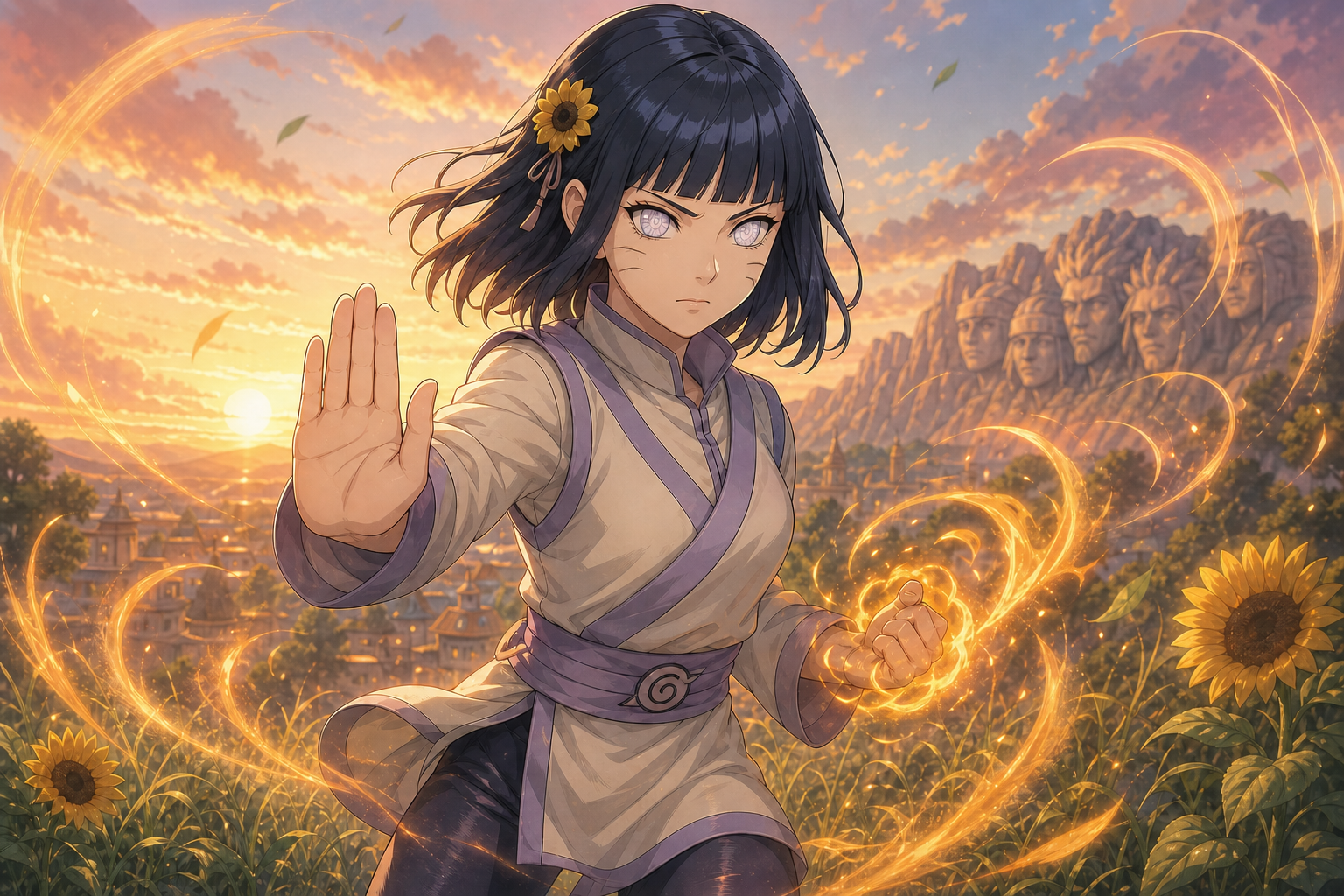
CVM SEKAI CHARACTER FILE
Himawari Uzumaki
The sweet little sister everyone treated as emotional furniture until the story placed Hyūga sight, Uzumaki life and a reborn Nine-Tails in the same girl.
RaeRae’s bottom line: Himawari is not interesting because she once knocked Naruto and Kurama out with one finger. She is interesting because care has always been her first instinct, and Two Blue Vortex finally asks what happens when that care gains enough power to terrify a Divine Tree. Kurama’s return should expand her choices, not turn her into Naruto with longer hair.
THE SHINOBI FILE
Who Himawari Uzumaki actually is
Himawari Uzumaki is the daughter of Naruto Uzumaki and Hinata Hyūga, and the younger sister of Boruto Uzumaki. She carries Uzumaki and Hyūga inheritance, has three whisker marks on each cheek and can awaken the Byakugan. Her birthday is August 1.
She grows up after Naruto’s generation has ended a world war, inside a household that should represent the peace they won. That peace is real enough for birthday parties, art, Academy choices and ordinary sibling annoyance. Peace is also fragile enough for alien vessels, sealed parents and rewritten memory to tear the household apart.
Himawari spends early Boruto material outside the formal shinobi spotlight. The franchise often uses her to measure the emotional condition of the family. That role matters, but a child should not exist only to make the boys’ conflict feel sadder. Two Blue Vortex begins giving her a power, grief and judgment record of her own.
Name, sunflowers and visual inheritance
Himawari means sunflower, and the series uses the flower openly in her clothing and imagery. A sunflower turns toward light. The symbolism fits a girl whose warmth gathers family attention, but the flower also has roots. Himawari is not passive decoration facing stronger people. She survives because tenderness and endurance are structural strengths.
Her dark blue-black hair and pale Byakugan connect her to Hinata and the Hyūga. Blue eyes, whisker marks and exuberant expressions connect her to Naruto. The design lets two lineages meet without pretending genetics must divide a child into neat halves.
Her older Two Blue Vortex appearance keeps the dark hair and family marks while presenting a teenager training with peers. Any discussion of that design needs to remember she is a minor. This profile treats her as a young shinobi, not adult glamour art.
THE FULL CHRONOLOGY
The Hokage inauguration incident
On the day Naruto is meant to attend his inauguration, Himawari’s stuffed panda is damaged during a fight with Boruto. Anger triggers her Byakugan. She targets Boruto, Naruto intervenes and Himawari strikes Naruto’s chakra point hard enough to leave him unconscious. Kurama is knocked out with him.
The scene is comedy, but the mechanics are not random. Byakugan perception and Gentle Fist can attack the chakra network rather than relying on body size. Himawari’s lack of conscious control makes the power more dangerous, not less.
The family consequence is hilariously humiliating for Naruto. Konohamaru attends the ceremony transformed as him. Beneath the gag sits a useful warning: inherited power can surface before a child has language, training or consent for the role people will assign to it.
A childhood inside the Hokage household
Himawari experiences Naruto as a loving father whose office regularly takes him away. Boruto protests that absence loudly. Himawari often adapts quietly. Quiet adaptation should not be mistaken for having fewer needs.
Her birthday becomes one of the family’s clearest pressure points. Naruto promises to attend, sends a shadow clone and allows work to exhaust the clone until it disappears with the cake. Himawari’s disappointment matters even when Boruto carries the anger. The episode measures the human cost of an office built around one man’s endless availability.
Later domestic scenes show drawing, cooking, errands and the ordinary work of keeping affection alive. Those beats are not filler beneath the “real” plot. The threat of losing the Uzumaki home only matters because the story first lets the home contain small life.
Choosing whether to become a shinobi
The anime gives Himawari an Academy trial period and time to consider whether the shinobi path fits. She shows observation, physical ability and kindness, but refuses the idea that talent automatically decides vocation. That is a quietly radical choice in a village where clan ability often becomes a job description before childhood ends.
She explores other work and eventually develops her own interest in training. The anime’s Academy material expands friendships, teamwork and her relationship with Kawaki. Those events belong to the anime continuity layer and should not be inserted into the manga record without a label.
The important principle crosses both versions: Himawari’s future should be chosen. Hyūga eyes, Uzumaki blood and a Hokage father are resources, not employment contracts.
Kawaki enters the family
When Kawaki enters the Uzumaki household, Himawari offers the least complicated form of welcome. Her broken vase becomes part of his lesson in repair. During Delta’s attack, Kawaki sacrifices his arm to shield her and Naruto.
The bond is not fake because later events become terrible. Himawari’s acceptance helps Kawaki experience family before fear turns family into something he believes must be controlled. That history makes his confinement of Naruto and Hinata more painful.
Anime episodes expand their sibling relationship through daily activities and Academy contact. Those scenes can deepen the emotional record while remaining adaptation-specific.
Loss, Omnipotence and the wrong brother in the family story
Kawaki seals Naruto and Hinata in a dimension where time does not flow. Eida’s Omnipotence then rewrites nearly everyone’s memories, placing Kawaki in Boruto’s family role and casting Boruto as the outsider accused of killing Naruto.
Himawari believes the altered story, but her feelings resist its neat logic. She cannot accept that Boruto is simply evil and senses that something in the accusation does not fit the person she emotionally recognizes. That dissonance matters. Omnipotence changes memory, not every layer of embodied relationship.
Her grief is therefore doubled. She believes her parents are dead, and she is asked to hate the person her old life taught her to love. Instead of becoming a mouthpiece for the village, she keeps room for doubt.
Two Blue Vortex training and Team 10 contact
Three years later, Himawari trains with Chōchō, Inojin and Shikadai. The arrangement does not automatically make her a formal Team 10 replacement in every institutional sense, but it places her inside active shinobi development and peer support.
She asks questions about Boruto and continues believing he may not be what the village says. That instinct is not magical proof by itself. The emotional evidence is strong enough to prevent hatred from becoming automatic.
The Divine Tree threat makes training urgent. Jura senses an unexpectedly intense tailed-beast chakra in Himawari and identifies her as a target. The girl once left outside the central power struggle becomes a priority because Kurama has returned inside her.
Kurama’s rebirth inside Himawari
The official Boruto Database confirms that Kurama revives within Himawari. Tailed beasts ordinarily reform over long periods, sometimes hundreds or thousands of years. Kurama’s return happens with astonishing speed. The cause remains unclear.
That uncertainty matters. The story has not confirmed one tidy explanation such as whisker marks, inherited chakra, destiny or a secret seal. Fans can build theories. A complete profile must keep theory out of the fact column.
Kurama recognizes that his chakra and Himawari’s have an unusually strong affinity. Their early cooperation produces significant power and healing. Himawari uses the bond during the confrontation with Jura and channels chakra to save Inojin after a devastating injury. The scene keeps her oldest character trait inside the new power: she uses strength to preserve another person.
POWERS WITH RECEIPTS AND LIMITS
Byakugan and Gentle Fist potential
Himawari’s Byakugan grants the Hyūga ocular framework of wide perception and chakra-network vision. Her inauguration strike demonstrates access to a tenketsu-targeting Gentle Fist effect. Later training gives that potential discipline.
One childhood knockout does not make her stronger than adult Naruto in ordinary combat. Surprise, precise chakra-point targeting and comedy staging all matter. Power-scaling the gag into a permanent ranking wastes the actual lesson about mechanism.
Her Byakugan development differs across manga and anime visibility. A responsible profile separates what the manga establishes from anime-expanded training and missions.
Kurama chakra, healing and physical force
Kurama’s reborn presence gives Himawari access to immense chakra, enhanced durability, speed and destructive potential. The bond also supports healing strong enough to restore Inojin from a near-fatal condition in the current battle record.
Himawari is not a conventional jinchūriki copy of Naruto’s childhood. Kurama has reformed inside her under circumstances neither partner fully understands. The relationship begins with Kurama aware, communicative and already changed by his life with Naruto.
The current manga has not finished defining transformation stages, maximum output, recovery cost or long-term risks. Naming every golden aura as a settled “mode” would run ahead of canon.
What Himawari cannot do
She lacks Naruto’s decades of battle experience and Hinata’s lifetime of formal Hyūga training. Large chakra does not supply judgment, tactics or control automatically. Her emotional willingness to protect others can also draw her toward threats beyond her current preparation.
Kurama’s help is partnership, not ownership and not an infinite battery. Himawari needs to learn what the bond can do, what it costs and how much agency each participant holds. The story should not turn Kurama into inherited equipment.
THE RELATIONSHIP ATLAS
Naruto and Hinata: two legacies, one household
Naruto gives Himawari open affection and the wound of repeated work absence. Hinata gives her domestic stability, Hyūga knowledge and a model of strength expressed through care. Neither parent should be reduced to the gene Himawari inherits.
Their disappearance creates the emotional vacuum of Two Blue Vortex. Himawari’s growth occurs while believing them dead. Returning them cannot erase the years she lost, even though no time passes for them inside Kawaki’s dimension.
Boruto: the brother memory cannot fully erase
Boruto is protective, annoying, guilty and deeply attached to his sister. Their childhood includes fights over toys and anger over Naruto missing Himawari’s birthday. Boruto’s rebellion often speaks the frustration Himawari absorbs quietly.
Omnipotence gives her a false biography, but affection leaves resistance. Himawari’s refusal to flatten Boruto into a murderer is one of the story’s best signs that lived relation exceeds a rewritten file.
Kawaki, Kurama and the people beside her
Kawaki: A foster brother who protected her body, received her welcome and later imprisoned her parents. Love and accountability belong in the same record.
Kurama: A reborn partner whose history with Naruto enters a new relationship. Himawari deserves a bond shaped for her, not a reenactment.
Inojin: A training peer whose near-death pulls Himawari’s healing power into action. Saving him makes care a battlefield ability.
Chōchō: A peer and training partner whose confidence gives Himawari social space outside family catastrophe.
Shikadai: A childhood friend and tactical peer connected to the training circle around her.
Hanabi and Hiashi: Her Hyūga relatives connect her to formal clan knowledge while also carrying the family’s history of hierarchy and reform.
WHY HIMAWARI MATTERS
Care is not weakness, and healing is not decorative support
Himawari’s first major Kurama act is healing. The choice suits her, but the story must avoid trapping girls inside care work while boys receive conquest. Healing becomes powerful when the narrative recognizes skill, risk, judgment and consequence.
Her strength does not require a personality transplant. Kindness can coexist with anger, discipline and force. The inauguration incident already showed that the gentlest child in the house has boundaries.
A Confucian lens finds family duty moving in several directions. Himawari loves parents, brothers and clan, but proper duty cannot mean obeying a false family record. Her doubt protects relationship truth when the village’s official memory fails.
Inheritance without repetition
Himawari carries Uzumaki vitality, Hyūga vision and Kurama’s chakra. Fandom can easily turn that list into a breeding-chart fantasy. The character is not a spreadsheet combining elite traits.
A Buddhist reading offers a better model. Kurama’s rebirth demonstrates continuity without an identical circumstance. The being returns, but the relationship changes. Himawari inherits causes and conditions rather than a fixed destiny.
Her task is integration. She can use family gifts while refusing the roles attached to them. Becoming herself matters more than becoming “the next Naruto” or “a stronger Hinata.”
Fandom arguments that flatten her
“She one-shot Naruto, so she scales above him.” The comedy scene uses surprise and chakra-point mechanics. A single gag is not a complete combat ranking.
“Kurama’s return ruins his death.” Tailed beasts have always been capable of rebirth. The emotional question is whether the story honors Naruto and Kurama’s farewell while building a genuinely different bond.
“She is only Boruto’s cute sister.” Two Blue Vortex gives her grief, doubt, training, a Divine Tree threat and Kurama partnership. The cute-child box is already too small.
“She must become Hokage or a perfect jinchūriki.” Neither outcome is confirmed. Let the girl choose before assigning the franchise’s leftover jobs.
“The whisker marks prove exactly why Kurama returned.” The official database says the cause is unclear. Visual inheritance supports theory, not certainty.
Japanese performance and adaptation boundaries
Saori Hayami performs Himawari in the original Japanese anime. This edition credits the verified performer without inventing scene-specific vocal technique not directly rewatched for this pass.
The manga establishes the family, Byakugan gag, Kara-era household role, Omnipotence aftermath, Two Blue Vortex training and Kurama rebirth. The anime expands Academy choices, friendships, errands, Kawaki bonding and shinobi development. Those additions are valuable when labeled.
Games and promotional appearances often freeze Himawari at a younger age or exaggerate the inauguration joke. They belong to adaptation history, not proof of her current manga ceiling.
CANON AND CURRENT STATUS
What is confirmed and what remains open
Confirmed core facts include Himawari’s parentage, August 1 birthday, Byakugan awakening, Uzumaki whisker marks, relationship with Boruto and Kawaki, altered Omnipotence memory, Two Blue Vortex training and Kurama’s rebirth within her.
The official database confirms the unusually fast rebirth and says the cause remains unclear. Current manga material confirms strong chakra affinity and healing use. Exact mode names, full limits and final combat ceiling remain unsettled.
Two Blue Vortex is ongoing. Himawari’s shinobi rank, long-term Kurama partnership, response to the restored truth and final vocation are unfinished. Updating the profile requires receipts, not prophecy.
CARE WITH TEETH
Care is not the same thing as passivity
Himawari is introduced through family warmth, which makes it easy to treat kindness as her decorative setting instead of a way she reads the world. She notices tension, tries to include Kawaki, worries about Boruto, and responds to people before she has a formal shinobi role telling her to.
That instinct does not make her harmless. The Byakugan episode becomes a joke because the gentle child can drop Naruto and Kurama in seconds. Underneath the comedy is a useful warning: quiet does not mean weak, and anger does not become less real because it appears rarely.
Two Blue Vortex gains something important by allowing care and combat capacity to remain in the same person. Himawari does not need to become colder to deserve serious power. Protection can grow from tenderness without turning tenderness into a flaw she must outgrow.
The family symbol deserves a life outside the symbol
For years, Himawari helps prove that Naruto achieved the home he never had. She appears in birthday scenes, sibling moments, domestic comedy, and the emotional stakes that make Hokage work costly. That function matters. It is not a complete life.
A child should not exist mainly as evidence that her father’s ending was happy. Himawari has her own uncertainty about training, her own friendships, her own response to loss, and now a relationship with Kurama that cannot be reduced to Naruto’s legacy. The family history gives context. It should not write every conclusion.
Her mixed inheritance also invites lazy arithmetic: Uzumaki vitality plus Hyūga vision plus Kurama equals a future combat tier. Biology is not a personality. The interesting question is what Himawari chooses to do with capacities that other people will immediately want to classify, train, fear, or use.
Omnipotence tests love with the wrong memory
Himawari’s memories place Kawaki inside the identity Boruto occupied, yet her emotional response does not settle comfortably into the official story. She feels something in Boruto’s situation that the accusation cannot fully explain. That unease matters because relationship leaves traces beyond a clean factual summary.
The profile should not turn instinct into magical immunity. Himawari is affected. She works inside altered social truth like almost everybody else. Her significance lies in refusing to let the provided story eliminate compassion before evidence arrives.
That response continues the best part of her characterization. Himawari meets people as people before categories finish the job. Kawaki can be frightening and still wounded. Boruto can be accused and still deserve investigation. Care becomes a method of resisting certainty without pretending danger is imaginary.
Kurama’s return must not create a new cage
Kurama reforming within Himawari is not the same event as a village sealing a captured beast inside a selected child. The distinction matters. The old jinchūriki system was built through containment and military planning. Himawari’s bond begins through a different mechanism that the ongoing story has not fully explained.
That uncertainty should remain visible. Fandom wants an instant label because labels make power easier to rank. The current record supports a profound affinity and a shared capacity already affecting battle and healing. It does not justify inventing every rule, ceiling, or final form.
Kurama also arrives with memory. He is not newborn equipment despite reformation. He remembers Naruto, captivity, partnership, sacrifice, and the cost of being treated as a national asset. Himawari meets a person carrying history, not a power-up waiting for activation.
The ethical standard should therefore be higher than the previous generation’s. Nobody gets to decide that Naruto’s daughter naturally inherits Naruto’s companion. Himawari and Kurama need room to establish consent, disagreement, trust, and purpose on terms belonging to this relationship.
Power does not have to make her less herself
Stories often signal that a kind girl has become serious by removing softness from her face and humor from her life. Himawari does not need that bargain. The girl who loves art, notices loneliness, and wants family safe can also train, fight, fail, and terrify an enemy.
Her growth should include anger because anger protects boundaries. It should include doubt because inherited expectations are heavy. It should include mistakes because perfect gentleness is another cage. None of those changes requires the story to punish her warmth.
The sunflower image works when the flower turns toward light by its own living process, not when everybody else decides where it should face. Naruto, Hinata, Boruto, Kawaki, the Hyūga clan, Konoha, and Kurama all shape Himawari’s world. They do not own the direction she chooses.
The ongoing story needs honest boundaries
Himawari’s current arc is moving quickly, and that creates pressure to turn every reveal into a finished character thesis. The temptation is especially strong when power-scaling conversation treats one impressive response as a complete ceiling.
A living profile should separate what happened from what fans expect next. Kurama is present. Their affinity matters. Himawari has demonstrated courage, healing force, and combat potential. Her final role, mastery, limits, and response to restored truth remain open.
Leaving those answers open is not a lack of depth. It is respect for the work. RaeRae’s voice can take a position on what the material means without pretending we already read chapters that do not exist. Himawari deserves a profile that grows with her instead of rushing ahead and replacing her choices with prophecy.
RAERAE’S FINAL TAKE
Himawari can inherit the sun without orbiting anybody
The franchise spent years using her as proof that Naruto had a family worth protecting. Two Blue Vortex finally asks what that family made inside her: grief, doubt, training, tenderness and a chakra presence the world thought it had buried.
Kurama returning through Himawari can be beautiful if the story remembers that she is not a container. He is not a weapon passed down with the house. They are two lives meeting after loss.
The sunflower is done sitting in the window. Himawari has roots, sight and teeth now. Let her decide where the light goes.
Sources and continuity boundary
The Boruto manga and Boruto: Two Blue Vortex manga control the continuing chronology. Anime-original arcs, novels, games, films, and adaptation expansions are identified instead of being blended into one false record. Ongoing developments should be dated and revised when later chapters change the evidence.
Primary franchise references: Naruto Official and VIZ Media Boruto: Two Blue Vortex. CVM Sekai’s conclusions about Himawari’s care, family role, Byakugan, Omnipotence response, Kurama bond, power, personhood, and open future are editorial analysis, not invented creator quotations.