
Naruto character dossier
Gyūki
Kumogakure counts eight tails and sees military inventory. Gyūki remembers every cage, every failed host, one broken horn and the man who finally asked him to become a partner.
One ox head, eight tentacles and a full person
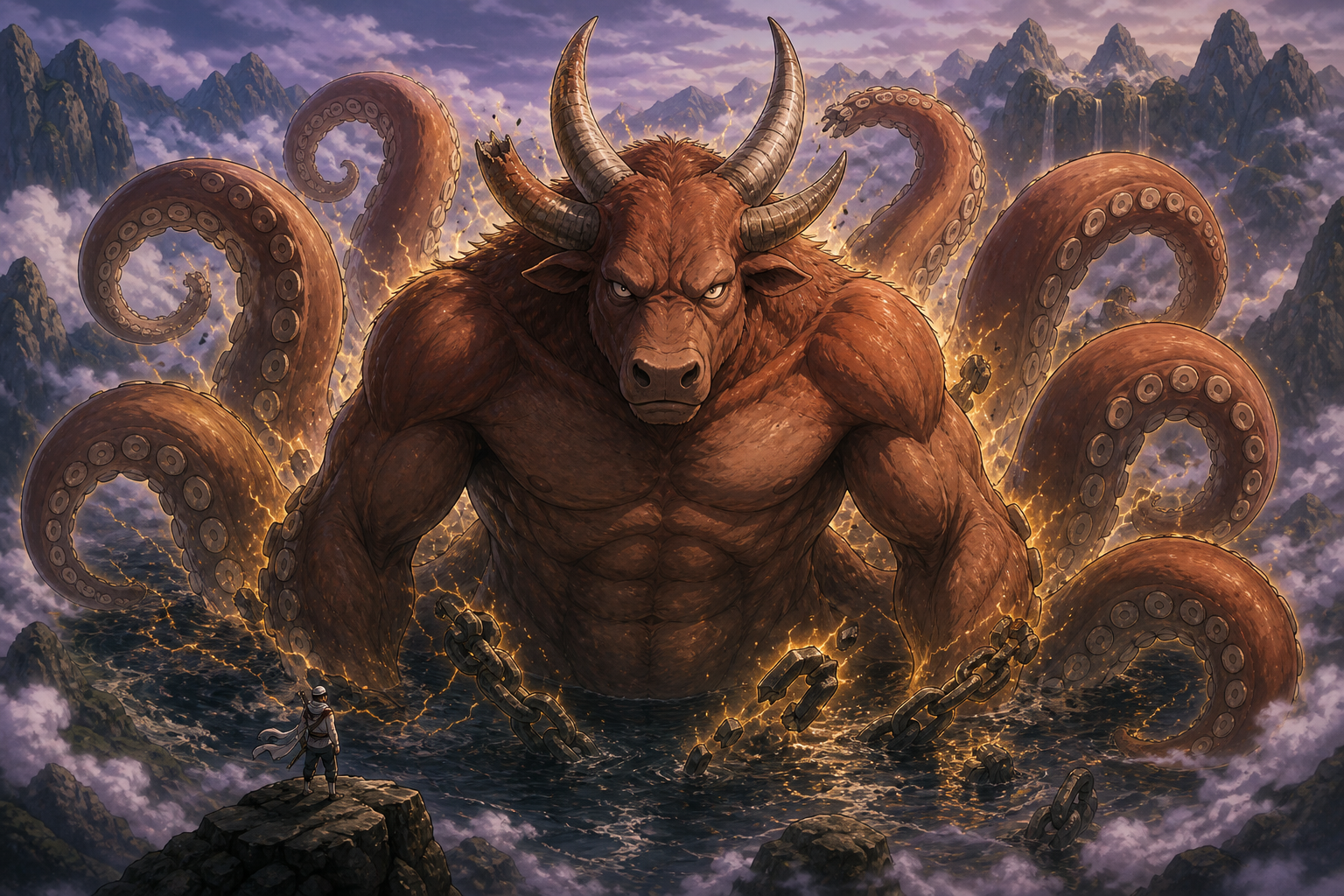
Gyūki is the Eight-Tails, one of the nine chakra beings created by Hagoromo Ōtsutsuki from the Ten-Tails. His body combines the upper form of an enormous ox with eight octopus tentacles. Multiple horns rise from his head, and one remains broken after his clashes with the Third Raikage. That missing horn is not decorative battle damage. That is a piece of history carried on the body.
His design refuses the easy elegance of a fox or cat. Gyūki is heavy, strange and built for force in several directions at once. The ox suggests stubborn power. The octopus half supplies reach, restraint, regeneration tricks and a connection to ink. Naruto loves turning mythology into mechanics without stopping to label every influence inside the panel.
Humans usually call him “the Eight-Tails” before using his name. Counting converts a person into a category and lets villages compare destructive capacity. Gyūki participates in the tail-count banter, especially when Kurama acts superior about having nine. The joke works because the beasts can reclaim the count among themselves while rejecting the ownership humans build around it. Gyūki’s personality is blunt, observant and far more patient than Killer B’s public chaos suggests. He warns, corrects and explains. He can become irritated by B’s rhymes without demanding that B stop being B. The partnership contains disagreement, which makes the trust more credible than constant harmony would.
Hagoromo gives him a name before humans give him a price
Hagoromo separates the Ten-Tails’ chakra and uses Creation of All Things to form nine individual beings. He names them, speaks to them as children and imagines a future reunion based on connection rather than forced recombination. Gyūki begins life within a family. After Hagoromo’s era, human institutions recast the tailed beasts as strategic resources. Hashirama Senju captures beasts and distributes them among villages as part of a military balance. The plan seeks peace through deterrence. The beasts pay for that peace with their freedom.
Gyūki becomes associated with Kumogakure, whose leaders value raw combat power and maintain a formal jinchūriki program. The Cloud develops methods to restrain him when a host loses control. Those methods demonstrate competence. They also normalize a cycle in which a living being is sealed, provoked, contained and transferred. The historical record often centers the humans who survive each rampage. Their deaths and injuries matter. So does the missing cause in the usual sentence. Gyūki does not repeatedly appear in populated spaces as a neutral weather event. A village keeps placing him inside people under coercive conditions and then fights the consequences.
The Third Raikage fight leaves both bodies marked
Gyūki and the Third Raikage clash multiple times when the Eight-Tails loses control. The battles are remembered as proof of the Raikage’s legendary body. He can confront a tailed beast directly, fight to mutual exhaustion and protect the village. Gyūki loses a horn during these encounters. The Raikage receives his own lasting chest scar during a confrontation. Naruto later learns that the famous injury came from the Raikage’s own technique when his hand was redirected into his body. The mystery teaches a tactical lesson about the strongest spear and strongest shield. Gyūki is the witness who remembers enough to help Naruto reach that answer.
That role complicates the old enemy image. Gyūki does not celebrate the dead Raikage’s humiliation. He provides information that allows Naruto to end the reanimated fight. Memory becomes public service even though Kumogakure once treated the memory-holder as the threat. The broken horn also resists a common fandom habit: measuring beasts only through final-form power. Gyūki can be injured. Tailed-beast bodies reform and recover in unusual ways, but pain, loss and bodily consequence still exist. Immense chakra does not turn experience into a reset button.
Blue B shows what “compatible” does not guarantee
Before Killer B, Gyūki is sealed inside Blue B, a Kumogakure shinobi connected to A’s family generation. Blue B is remembered as a jinchūriki who struggled to control the Eight-Tails despite strength and effort. The failures become village emergencies rather than private medical crises. Naruto offers limited space for Gyūki’s relationship with Blue B, so responsible biography should not invent a detailed friendship or hatred. The visible result is instability. Compatibility, training and village procedure do not automatically create trust between two people forced into one body.
Blue B’s experience matters because it prevents Killer B’s success from becoming proof that earlier hosts simply lacked willpower. The system begins with a violation. Individual excellence can manage the violation better. Excellence cannot make the original lack of consent disappear. After Blue B, village leaders select a new host and continue the program. Transfer is treated as institutional continuity. Gyūki experiences another human body, another set of fears and another political demand. The village calls the weapon preserved. The beast lives the succession.
Killer B gives him a relationship instead of a management plan
Killer B becomes Gyūki’s next jinchūriki while still young. B faces village suspicion, the grief of people harmed by earlier rampages and the expectations attached to being A’s brother. Gyūki faces another cage. Neither begins from a clean emotional slate. The pair gradually develop cooperation strong enough to share movement, strategy and transformation. Gyūki can interrupt genjutsu by disturbing B’s chakra. B can enter full Eight-Tails form without surrendering consciousness. They talk during combat rather than waiting for one mind to disappear.
That cooperation does not erase personality. Gyūki calls out reckless choices and tires of the rhymes. B ignores advice sometimes. Trust survives irritation because neither person treats disagreement as betrayal. The relationship has room for two wills. When Taka attacks, Gyūki supplies chakra, transformation and the tentacle substitution that allows B to escape. B is not dragging power from a locked vault. The two of them improvise a plan. Their false capture works because an Eight-Tails body part can hold enough transformed chakra to fool the Akatsuki’s immediate inspection.
Against Kisame, Gyūki warns B about chakra drain and the danger of prolonged transformation. Samehada can consume vast reserves and turn size into a liability. The advice shows why partnership improves performance. A second consciousness can see the cost while the fighter focuses on the opponent.
Gyūki teaches the lesson Kurama refuses to say aloud. During Naruto’s training, Gyūki becomes an instructor as much as B. He understands tailed-beast chakra from the inside and can explain why raw control fails. He also understands Kurama as a sibling with centuries of resentment.
Gyūki helps restrain Kurama while Naruto tries to separate and claim the fox’s chakra. The scene is useful and morally uneasy. One tailed beast assists a human in overpowering another. Gyūki does not pretend the method creates trust. He helps Naruto survive the technical step while the relationship remains unfinished.
He later observes Kurama responding to Naruto’s conduct. Gyūki recognizes the shift before Naruto fully understands it. The tailed beasts have their own social knowledge, grudges and ways of reading each other. Jinchūriki training becomes richer when that knowledge enters the room. Gyūki also recounts the Third Raikage encounters through B’s connection to the Allied intelligence network. Naruto uses that memory to identify the Raikage’s weakness. A being once treated as a village disaster becomes the historian whose testimony protects the village’s soldiers.
The war turns Gyūki from inventory into witness
Gyūki and B leave confinement to enter the Fourth Shinobi World War beside Naruto. A tries to stop them because the alliance is protecting its remaining jinchūriki from capture. The strategy makes military sense. That also repeats the pattern of deciding where hosts and beasts may move without treating their judgment as equal. On the battlefield, Gyūki faces reanimated jinchūriki controlled through chakra receivers and Sharingan power. The bodies dramatize the system’s endpoint. Dead hosts and captured beasts operate as remote weapons with almost no agency left. B and Gyūki counter them through the opposite structure: live negotiation.
Gyūki fights the Ten-Tails and helps protect Naruto during transformations, collisions and exhaustion. His tentacles shield, restrain and create escape opportunities. The ox-octopus body provides support work as often as direct destruction. Madara later extracts Gyūki from B. Extraction should be read as violence against both participants. B loses the chakra partner sustaining his life. Gyūki is pulled into another forced aggregation. A severed tentacle leaves enough chakra with B for survival, extending a tactic the pair used earlier under different stakes.
After Kaguya and the final conflict, the tailed beasts regain separation. Gyūki returns to B. The reunion does not receive the same emotional page space as Naruto and Kurama, but the consequence is clear. Their partnership survives a war designed to erase separate identities.
Abilities, mechanics and honest limits Immense chakra. Gyūki carries tailed-beast scale reserves and can sustain transformations, cloaks and large attacks. Enormous does not mean infinite. Samehada, the Akatsuki sealing process, war attrition and extraction can all reduce or remove access. Tailed Beast Ball. He compresses balanced chakra into a devastating sphere or blast. Charging, aim, collision and nearby allies constrain use. B’s cooperation improves control rather than abolishing risk. Eight tentacle tails. The tentacles provide reach, shielding, grappling and substitution material. Severed pieces can preserve chakra and deceive captors. Regeneration and replacement do not mean injury carries no cost. Ink production. Gyūki produces ink that supports concealment, binding and sealing tactics. The ability connects the octopus form to practical battlefield utility rather than remaining a visual joke. Partial transformation. B can manifest tentacles or other portions of Gyūki without releasing the entire body. Partial forms preserve mobility and reduce environmental damage while still exposing their shared position. Full transformation. Gyūki’s complete body delivers enormous strength and range. Size makes stealth impossible and creates a broad target for chakra-draining or restraining techniques. Chakra disruption. Gyūki can disturb B’s chakra network to break many genjutsu. Partnership supplies a second operator. The defense is powerful, not an automatic answer to every illusion or large-scale ocular technique. Memory and analysis. Centuries of combat knowledge let Gyūki identify opponents and mechanics. Memory can be incomplete, and information still needs a fighter capable of applying it under pressure. Relationship atlas. Killer B. B is Gyūki’s host, friend and combat partner. Their bond is the result of repeated mutual choice inside an arrangement neither invented. Gyūki protects B without becoming equipment. B uses Gyūki’s power without pretending ownership.
Blue B. Blue B is the previous known jinchūriki and evidence that sealing alone cannot manufacture cooperation. The limited canon record should remain limited. His struggle still establishes the cost before Killer B’s success.
A and the Third Raikage. The Third Raikage fights Gyūki during rampages and carries scars from those encounters. A later loves and protects B while viewing Gyūki through national-security logic. Both leaders show how personal care can coexist with an institution built on containment. Naruto Uzumaki. Gyūki helps train Naruto, restrains Kurama and supplies history during the war. He becomes part of Naruto’s education in treating tailed beasts as sources of knowledge rather than mute power.
Kurama. Kurama is sibling, rival and fellow survivor. Their tail-count arguments provide comic friction. Their shared experience under human control gives the rivalry a deeper solidarity when the beasts reunite. Hagoromo Ōtsutsuki. Hagoromo is creator and the first person to name Gyūki with affection. That memory becomes proof that domination was not the beasts’ original relationship with humanity.
The other tailed beasts. Shukaku, Matatabi, Isobu, Son Gokū, Kokuō, Saiken, Chōmei and Kurama form Gyūki’s first family. Reuniting as separate beings resists the Ten-Tails logic that treats individuality as a temporary mistake.
Momoshiki targets the partnership again
Momoshiki and Kinshiki attack B while collecting tailed-beast chakra. Gyūki and B appear to be defeated and taken. The pair survive through another tentacle substitution, preserving life while misleading an enemy who sees chakra volume rather than relationship.
The repeated strategy shows a mature shared vocabulary. A severed tentacle is not merely a trick B remembers. That is a solution available because Gyūki understands his own chakra body and cooperates quickly under capture pressure.
Boruto gives Gyūki less page time after the attack. The lack of new scenes does not prove death, retirement or separation. Their verified survival remains the honest boundary until the story supplies more.
Gyūki is what institutional memory refuses to hear
Kumogakure records rampages, casualties and heroic containment. Gyūki remembers why control broke, what each host felt and how leaders responded. The village’s archive centers damage. The beast’s memory contains relationship.
A Confucian lens makes the reciprocity problem visible. Villages demand service from jinchūriki and obedience from tailed beasts while offering seals and suspicion. B and Gyūki build a smaller moral order inside the larger failure. Each owes the other warning, protection and honest response.
A Buddhist reading centers the cycle of fear. Humans fear Gyūki’s power and tighten control. Confinement fuels anger and instability. Instability confirms the fear. B interrupts the cycle without pretending pain never happened. Recognition loosens attachment to the roles of monster and jailer. Creative structure gives Gyūki the mentor position usually reserved for an elder human. He knows combat history, tailed-beast psychology and jinchūriki mechanics. The franchise becomes more honest whenever he speaks long enough for humans to learn.
Fandom often reduces him to “the reasonable tailed beast” beside Kurama’s anger. Reasonableness is not a natural service personality. Gyūki’s patience is an achievement shaped by experience and partnership. Praising the calm without analyzing the cages turns survival skill into another expectation placed on the harmed person.
Masaki Aizawa and the original Japanese performance. Masaki Aizawa is Gyūki’s original Japanese voice in the anime. The role must carry scale and age while remaining conversational enough for B’s internal arguments, tactical warnings and dry reactions. This profile names the verified performer and the written demands of the role. I will not invent claims about resonance, timing or vocal texture without a lawful scene-by-scene audio comparison.
Animation gives Gyūki more physical comedy and reaction space than a pure battle summary would suggest. Tentacles can shield, gesture, recoil and punctuate B’s behavior. The visual language helps a gigantic creature function as a scene partner rather than background artillery.
Fandom misreads that need eight better answers
“Gyūki was naturally easier than Kurama”. Blue B’s history and repeated Cloud rampages contradict the easy version. Killer B and Gyūki build cooperation. The result should not be mistaken for a naturally compliant beast. “B controls the Eight-Tails”. B controls transformations with Gyūki’s cooperation. The distinction is the entire moral achievement. Domination produces earlier disasters. Partnership produces precision. “The broken horn proves the Raikage was stronger”. The Third Raikage and Gyūki repeatedly fight to exhaustion, and both bodies carry consequences. One missing horn cannot settle a simple ranking across changing circumstances. “Gyūki is only B’s inner narrator”. He supplies independent memory, strategy, warning and relationships with the other beasts. The internal setting does not make the person inside it imaginary. “Tentacle substitution makes every danger fake”. The tactic requires sacrifice, chakra and an opportunity to deceive. Madara still extracts the main beast. Momoshiki still forces a survival response. Escape does not erase danger.
The partnership that makes Naruto’s future believable. Gyūki and B prove that a jinchūriki can cooperate with a tailed beast before Naruto earns Kurama’s trust. Their example keeps Naruto’s later bond from arriving as a miracle with no social precedent. Gyūki also preserves tailed-beast history across human generations. He remembers Hagoromo, former hosts, Raikage battles, siblings and war. Every time humans listen, the franchise recovers information its official institutions failed to keep.
His legacy is therefore both relational and archival. A beast can be a friend. A host can be a partner. A battlefield witness can correct the hero’s legend. A severed horn can carry more history than a monument.
The number is not the name
Eight-Tails tells a village how much chakra it thinks it has captured. Gyūki tells us who is inside the seal. The difference looks small until every policy, battle plan, and conversation begins with the inventory label instead of the person’s name.
Kumogakure’s leaders need the number because numbers fit military comparison. One village has this many beasts. Another controls that many tails. A host succeeds when the asset becomes reliable. Gyūki’s memories do not fit the spreadsheet. Neither do his opinions about the people carrying him.
Hagoromo naming the tailed beasts establishes that separateness was part of their beginning. Humans later reverse the gift. They count bodies, divide power, and build identities around containment. B’s partnership works because he lets the name return to the center. Gyūki can advise him because somebody is finally listening for more than output.
A seal can hold chakra without earning trust
Blue B’s life shows how badly the institution can mistake containment for relationship. A jinchūriki may keep the beast from escaping and still live inside constant conflict. Kumogakure learns from failed hosts, but its first concern remains whether the weapon can be controlled.
Killer B changes the outcome by treating Gyūki as a participant in daily life. Their conversations are not sentimental decoration added after mastery. They are the mechanism that makes shared judgment possible. Gyūki warns him when confidence becomes recklessness. B gives Gyūki experience outside an endless argument with a jailer.
The result is called perfect because combat coordination looks seamless. The word hides all the imperfect work underneath: disagreement, adjustment, patience, failed jokes, tactical correction, and years of proving that neither partner will discard the other once danger passes.
The broken horn is a record, not a defect
Gyūki’s missing horn carries history in plain sight. The body remembers a battle even when official stories reduce that battle to the Raikage’s strength. A scar does not explain itself, but it refuses the fantasy that power moves through generations without cost.
Tailed beasts are repeatedly treated as renewable because their chakra eventually reforms. That fact can make human institutions careless. If the being returns, the violence starts to look temporary. Gyūki’s body argues otherwise. Survival does not make capture harmless. Reformation does not erase memory.
His willingness to help later generations therefore means more than automatic allegiance to a village. Gyūki knows what Kumogakure demanded from prior hosts. He chooses cooperation with B after evidence, not because the seal grants moral authority.
Advice is one of his most important powers
A profile can list Tailed Beast Balls, tentacle transformations, chakra scale, physical strength, and sealing resistance until the page needs its own gym membership. Gyūki’s most important contribution is often judgment. He sees dangers B cannot, remembers systems younger shinobi never witnessed, and recognizes what Naruto misunderstands about Kurama.
That knowledge changes battles before an attack launches. Gyūki helps B manage risk, identifies techniques, preserves continuity across chaos, and participates in teaching Naruto. The shinobi world spent generations trying to turn tailed beasts into weapons, then discovers that conversation was a strategic resource it kept locking away.
He also gets to be annoyed. His dry responses to B matter because personhood includes preferences that do not serve a mission. Gyūki can care deeply about his partner and still find the latest rhyme exhausting. Affection without compulsory admiration is a healthier bond than obedience dressed as friendship.
Partnership does not erase the village debt
B and Gyūki create something good inside a system built through capture. Their success does not retroactively justify every host who suffered before them. A healthy relationship can emerge from an unjust structure without proving the structure was secretly wise.
Kumogakure benefits enormously from the partnership. It gains military power, intelligence, deterrence, and a jinchūriki capable of helping save the wider world. The debt runs the other way. The village owes B and Gyūki recognition as decision-makers, not gratitude for becoming unusually cooperative property.
That lesson travels directly to Naruto. He sees what power looks like when the beast is not merely overpowered. Kurama sees another tailed beast whose voice changes the host’s decisions. Gyūki does not hand them a friendship formula. He provides proof that the cage is not the only possible relationship.
His legacy is quieter than Kurama’s because Naruto is not his host. It is foundational anyway. Before the hero and the Nine-Tails can fist-bump, an ox-octopus and a terrible rapper demonstrate that consent can make two people stronger without asking either one to disappear.
The final verdict
Gyūki survives Kumogakure’s jinchūriki program without becoming the quiet weapon the program wants. He argues, remembers, advises, fights and chooses. Killer B does not make him human. B finally treats his existing personhood as useful truth. The Eight-Tails becomes strongest when the count stops being the most important thing about him. Gyūki has a name, a family, a history and a voice. Once the story lets all four enter the fight, the cage starts losing.
Sources and canon boundary
Manga chronology controls this profile. Anime expansions, databook material, novels, games, films, and supplemental tailed-beast appearances are labeled instead of being blended into one false continuity.
Primary franchise references: Naruto Official and VIZ Media Naruto. CVM Sekai’s conclusions about Gyūki’s captivity, name, broken horn, prior hosts, Killer B partnership, advice, consent, and Kumogakure responsibility are editorial analysis, not invented creator quotations.