
Naruto character dossier
Kushina Uzumaki
Konoha remembers Naruto’s mother as love in human form. The village should also remember the displaced Uzushio girl whose body became part of its military security system.
The girl behind “Naruto’s mom”
Kushina enters the main story late, after readers already know the outline of her death. That framing can shrink her into a warm answer to Naruto’s oldest question. Kishimoto gives her a louder, messier identity than that. Kushina has a temper, a competitive streak, a country she lost, a body Konoha needed and a political dream of her own. She is affectionate without being soft-headed. She can be embarrassed, petty, funny and terrifying in the same conversation.
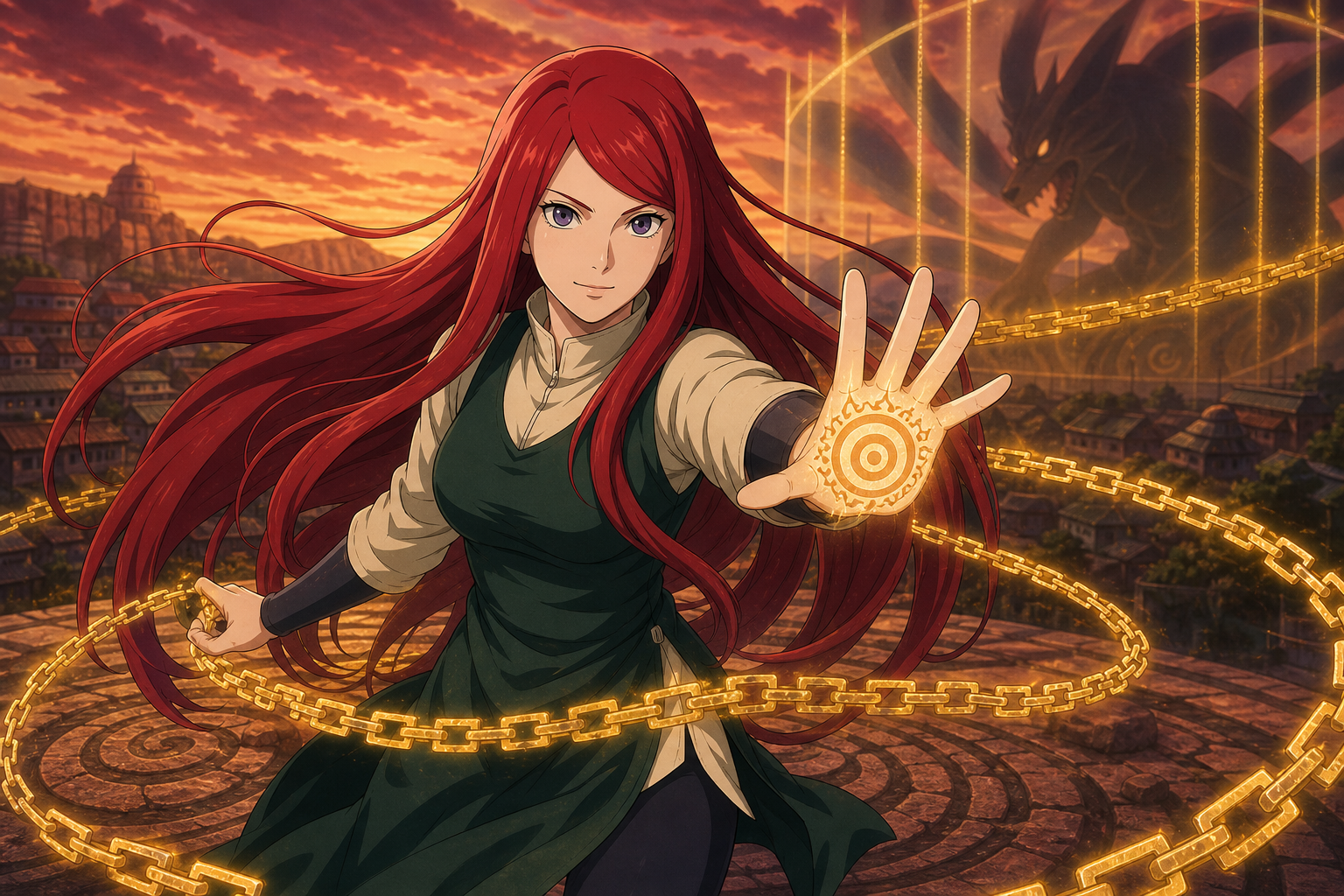
Her bright red hair makes her instantly recognizable, but the design carries biography. That hair marks her as an Uzumaki before the narrative fully explains what the clan means. Childhood bullies weaponize the feature and call her “Tomato.” Kushina answers with enough force to earn “Red-Hot Habanero.” The joke works because she refuses the passive role assigned to a new girl from somewhere else. She does not ask the village to find her harmless before allowing her to belong.
Her adult design keeps the long red hair while trading childhood defensiveness for composure. Kushina usually appears in civilian or maternity clothing rather than a standard combat uniform. Fans sometimes read that absence as proof that she lacked a shinobi career. The record does not support turning missing panel time into incompetence. She became a kunoichi, mastered elite sealing abilities and contained Kurama. Naruto simply reveals little about her mission history. An honest profile leaves that absence unfilled.
Uzushio sent Konoha a child, not a container
Kushina was born in Uzushiogakure, the Village Hidden by Whirling Tides. The Uzumaki were renowned for sealing techniques, powerful life force and a close relationship with Konoha. By the time Kushina grows up, that relationship has a brutal edge. Uzushio is destroyed, its people scatter, and Kushina is brought to Konoha because her chakra makes her suited to succeed Mito Uzumaki as the Nine-Tails jinchūriki.
The official story often dresses this transfer in the language of selection and duty. Strip away the ceremony and a harder truth remains. Adults moved a child from a ruined homeland into another village so her body could hold a weapon. Kushina received shelter and an Academy education. She also inherited a classified burden she did not design. Both facts belong in the same sentence.
Kushina responds to being the outsider by announcing that she will become the first woman Hokage. The class laughs. Her dream is not random childhood noise. The Hokage is the face of belonging in Konoha. A foreign girl declaring that she will occupy that seat is demanding more than acceptance. She wants the right to define the village that now claims authority over her life.
Uzushio remains present through more than bloodline trivia. The spiral on Konoha uniforms honors the alliance, yet Kushina’s experience exposes how symbols can outlive real reciprocity. Konoha wears the spiral while the survivors of the clan are scattered. Naruto later carries the Uzumaki name with almost no education about the people behind it. The village preserves the logo better than the history. That is not a small oversight when Kushina’s body helped keep Konoha safe.
Mito tells her what the system cannot
Mito Uzumaki is the first person positioned to explain the emotional reality of becoming a vessel. She tells Kushina that the empty space inside must be filled with love. Fans often reduce that advice to romance because Minato later becomes Kushina’s great love. Mito’s lesson is wider. A jinchūriki cannot survive by accepting the institution’s definition of her as useful containment. She needs relationships, desires and a self that exist beyond the beast sealed inside her.
The lesson is tender, but tenderness does not excuse the system. Mito helps Kushina endure a structure neither woman created. Their succession shows how Hidden Villages convert private sacrifice into stable public infrastructure. Citizens sleep safely because one woman carries a living catastrophe in silence. The village calls that arrangement protection. The women experience the physical and emotional bill.
Kushina’s bond with Kurama never becomes the partnership Naruto later builds. She restrains him. He resents imprisonment. Her chakra and sealing skill are powerful enough to hold him, but control is not mutual trust. That distinction matters. Naruto’s later achievement does not prove Kushina failed. Naruto inherits the chance to renegotiate a relationship that earlier jinchūriki were never encouraged to treat as a relationship.
The one-shot story about Minato’s youth expands this history. Kushina’s volatile chakra, Kurama’s presence and Minato’s development of the Rasengan sit inside the same emotional problem. Minato does not invent a technique in a clean laboratory. He responds to the danger surrounding someone he loves. Kushina is therefore part of the Rasengan’s history without becoming a decorative inspiration. Her reality creates the practical question the technique tries to answer.
Minato sees the trail everyone else misses
Cloud ninja abduct Kushina because they want her special chakra. Kushina cannot overpower the entire operation, so she pulls strands of red hair and leaves a trail. That choice is the core of the scene. Minato rescues her, but Kushina first makes herself findable. The romance begins with observation meeting resistance. He sees what others dismiss. She leaves evidence instead of waiting for a miracle.
Kushina had disliked her hair because other children used it to isolate her. Minato calls it beautiful after following it to her. The compliment matters because he has just treated the same trait as information, identity and survival. He does not rescue a generic girl. He recognizes Kushina through the part of herself the village taught her to hate.
Their adult relationship keeps that balance. Minato becomes Fourth Hokage, but Kushina does not disappear into “the Hokage’s wife.” She understands seals, Kurama and the risks of pregnancy better than almost anyone around her. Minato has extraordinary technique and judgment. Kushina has knowledge he cannot replace. Their strongest scenes work because love does not erase expertise.
They name Naruto after the hero in Jiraiya’s novel. The choice links private hope to a larger chain of mentorship. Jiraiya writes an ideal. Minato and Kushina give that ideal to their son. Naruto later forces the shinobi world to test whether the idea can survive contact with actual institutions, actual war and actual grief.
The night Konoha turns childbirth into a battlefield
A jinchūriki’s seal weakens during childbirth. Kushina therefore gives birth in a guarded location with Minato maintaining the seal and ANBU protection outside. The precautions show that everyone understands the risk. They also show how little privacy a jinchūriki receives at the most physically vulnerable moment of her life. Her labor is a family event, a medical event and a national security operation at once.
Obito exploits that vulnerability. He takes the newborn Naruto hostage, forces Minato away and extracts Kurama from Kushina. Extraction usually kills a jinchūriki. Kushina’s Uzumaki vitality keeps her alive for a short time, but survival in that moment is not recovery. Her body has been ripped open by a political enemy using the system Konoha placed inside her.
Near death, Kushina still restrains the full Nine-Tails with Adamantine Sealing Chains. The feat should end any lazy debate about whether she was “only a mother.” She has just given birth, lost the beast that sustained and endangered her, and suffered catastrophic trauma. She still creates enough control for Minato to act.
Kushina proposes sealing Kurama back into herself and dying with him. Minato chooses a different plan. He divides Kurama, seals one half into Naruto and leaves chakra imprints from both parents inside the seal. Minato’s decision saves the village and creates the conditions for Naruto’s later strength. His choice also places on their infant the burden Kushina spent her life carrying. The scene is loving and ethically ugly at the same time.
Kushina and Minato shield Naruto from Kurama’s claw with their bodies. Her final instructions tumble from ordinary care into impossible future planning: eat properly, bathe, sleep, make friends, study, avoid harmful habits, respect women, and remember that she loves him. The speech hurts because Kushina is trying to compress an entire childhood into minutes. She cannot raise Naruto, so she leaves him the shape of care.
Her chakra returns when Naruto needs truth
Kushina later appears as a chakra imprint inside Naruto while he trains to control Kurama’s power. The story briefly lets mother and son meet beyond the disaster of his birth. Naruto first reacts with surprise, then anger about the seal and the life that followed. Kushina does not demand gratitude before giving context. She listens, explains and tells him the truth of that night.
Her chains help Naruto restrain Kurama during the struggle. The assistance is practical, not sentimental wallpaper. Kushina gives him the same power that once contained the beast in her own body, but Naruto uses that opening to begin a different path. He eventually builds cooperation where previous generations relied on confinement.
The meeting also repairs one of Konoha’s cruelest failures. Naruto grows up without basic knowledge about his parents while adults around him know pieces of the truth. Kushina cannot fix the lonely years. She can finally tell him that his birth came with fierce love, not rejection. That knowledge does not erase harm. The truth changes the meaning Naruto assigns to himself.
Abilities, mechanics and honest limits
Adamantine Sealing Chains: Kushina manifests chakra chains strong enough to restrain the full Nine-Tails even after extraction and childbirth. The technique is her clearest combat and sealing feat. The chains provide control, barriers and suppression rather than generic “magic chains” that can do anything a later adaptation needs.
Jinchūriki containment: Her unusual chakra makes her compatible with Kurama’s seal. Compatibility is not invulnerability. Pregnancy weakens the seal, extraction inflicts fatal damage, and containment imposes a life of secrecy and risk.
Uzumaki vitality: Kushina survives the immediate extraction long enough to fight, speak and protect Naruto. That endurance is exceptional. The story still treats her injuries as fatal. Uzumaki life force is not a resurrection button.
Fūinjutsu knowledge: She understands high-level sealing practice and the jinchūriki system. Fans should resist assigning every known Uzumaki technique to her. Naruto shows enough to establish expertise without inventing a complete spell list.
Chakra presence: Her chakra is distinct and powerful enough to remain as part of Naruto’s seal according to Minato’s design. The later imprint is preserved chakra with purpose, not proof that Kushina secretly lived inside Naruto for his entire childhood.
What the record withholds: The manga does not give a complete mission ledger, rank progression or adult battle catalog. Lack of scenes is a limitation of the record, not permission to turn her into either an all-powerful legend or a helpless civilian.
Relationship atlas
Naruto Uzumaki: Kushina loves Naruto before she knows his personality. Their later meeting lets that biological love become relational. She hears his anger, gives him history and helps him fight. Naruto inherits her expressions, temper, stubbornness, chakra legacy and refusal to let humiliation decide his value.
Minato Namikaze: Minato recognizes Kushina’s survival trail, respects her strength and builds a family with her. Their marriage is loving, but the final sealing decision deserves adult analysis. Minato makes a wartime choice that Kushina does not originally propose. Love explains the trust between them. Love does not remove the consequence for Naruto.
Mito Uzumaki: Mito is predecessor, elder and the only person who can explain the vessel’s loneliness from experience. Their bond carries an informal women’s history that Konoha’s official monuments ignore. The transfer of Kurama is also a transfer of coping knowledge.
Kurama: Kushina and Kurama share a body without sharing trust. She experiences him as threat and burden. He experiences her chains and seal as imprisonment. Their conflict gives Naruto a starting point he later changes. Neither side needs to be rewritten as secretly comfortable for that evolution to matter.
Obito Uchiha: Obito turns Kushina’s labor into an opening for terror. His own grief explains the road that led him there but cannot excuse targeting a woman during childbirth, threatening her infant and extracting a beast from her body. The story’s later compassion for Obito should never blur Kushina’s victimization.
The Uzumaki clan: Kushina carries a destroyed village’s techniques, body knowledge and visual identity into Konoha. Her life proves that clan survival can continue through people while institutional memory collapses around them.
What Kushina says about the Hidden Village
The Hidden Village asks citizens to treat sacrifice as family duty. Kushina’s story makes the bargain visible. Konoha gives her a home after displacement, yet that home requires her body to serve as a lock. Confucian language about duty and reciprocity helps explain why the arrangement feels morally charged. A child may accept responsibility to a community, but the community owes care, truth and recognition in return. Konoha meets that obligation unevenly.
A Buddhist reading adds another layer. Mito tells Kushina to fill herself with love, while Kurama embodies hatred accumulated through repeated confinement and use. Love does not magically delete suffering. Love gives Kushina and later Naruto enough internal space to avoid becoming identical to the system hurting them. Attachment can trap, but compassionate bonds can also keep pain from becoming the only available identity.
Kushina’s motherhood is creative labor, political labor and bodily labor. She creates a family while carrying the village’s weapon. On the night Naruto is born, every private act has public consequences. The series understands the emotion of that collision better than the policy. We cry for the parents while the village that built the conditions mostly escapes interrogation.
Gender shapes how fandom remembers her. Male characters with limited panel time and one overwhelming feat are called legends. Kushina is often called “Naruto’s mom” first and a formidable shinobi second. Her domestic love is real, but using it to erase her political dream, sealing expertise and bodily sacrifice repeats the same narrowing the narrative sometimes performs.
Emi Shinohara and the original Japanese performance
Emi Shinohara is Kushina’s original Japanese voice in the anime. The credit matters because Kushina must move between comedy, sharp anger, remembered youth, maternal warmth and physical collapse without becoming five unrelated characters. Shinohara keeps those shifts rooted in one woman whose humor and anger survive alongside physical exhaustion and love.
The adaptation gives Kushina more time than a bare plot summary suggests, especially around Naruto’s inner meeting and the birth-night flashback. Any anime-only expansion should be labeled as adaptation rather than quietly folded into manga canon. More screen time can deepen feeling. An adaptation cannot manufacture new proof about rank, missions or abilities that the original record never supplies.
Fandom arguments that need better footing
“Kushina should have been Hokage”: Her childhood ambition deserves respect. The canon does not provide enough career record to prove she would have been selected. The sharper point is that jinchūriki duty and a male-centered political history leave little space for readers to see what that career could have become.
“She was stronger than Minato”: Power-ranking the marriage misses the evidence. Minato has a far larger combat record. Kushina performs one of the franchise’s wildest endurance and restraint feats. Different evidence does not need to become a marriage tournament.
“Minato ignored her sealing plan”: Kushina proposes dying with Kurama sealed back inside her. Minato chooses the split seal and Naruto’s future role. Readers can understand his strategic logic while still admitting that the decision transfers the burden to their newborn.
“Motherhood completed her character”: Motherhood becomes central to her final scenes. Completion is the wrong word. Kushina dies at twenty-four with ambitions, skills and political questions the story barely explores. Her love is complete. Her life is interrupted.
Legacy through Naruto, Boruto and Himawari
Naruto carries Kushina’s surname, temperament and refusal to stay socially small. The surname protects Minato’s enemies from tracing him as easily, but it also makes Naruto a public Uzumaki with almost no living clan education. Kushina’s heritage survives in plain sight while its history remains fragmented.
Boruto and Himawari extend that family line into a generation Kushina never meets. Their existence does not repair her death. They show that the family she fought to protect grew beyond the sealed room and the village attack. Himawari’s red-cheeked warmth and sudden force often invite playful comparisons, while Boruto inherits the burden of a famous family from a different direction.
Kushina’s most important legacy is not a genetic upgrade. She gives Naruto a model of love that can include anger, truth and limits. She does not tell him that suffering was secretly good for him. She tells him where he came from, helps him survive the immediate fight and trusts him to live beyond her instructions.
A village can rescue a child and still use her
Konoha gives Kushina safety after Uzushio’s destruction, but that safety arrives with an assignment attached. Her chakra and Uzumaki body make her suitable to replace Mito as Kurama’s jinchūriki. Adults choose a displaced girl because she can survive a burden the village needs somebody to carry.
That arrangement is not made humane merely because Kushina later finds friends, love, and genuine belonging. Institutions can provide real care while extracting something enormous from the person receiving it. Konoha educates her and gives her a home. Konoha also treats her body as part of its defense system. Both facts belong in the same sentence.
Kushina’s personality refuses to disappear inside the assignment. She wants to become Hokage. She gets angry, fights back against harassment, develops sealing skill, loves Minato, and imagines a family. Her life is not a waiting room between becoming a vessel and becoming Naruto’s mother.
Motherhood is not the only proof that she mattered
The birth-night material is powerful because Kushina acts with extraordinary endurance and love. It can also tempt the audience to make sacrifice her entire identity. She has just endured childbirth, extraction, and catastrophic injury when she still restrains Kurama and places her body between a claw and her son. The act deserves its emotional weight. It does not retroactively turn every earlier ambition into preparation for motherhood.
Kushina matters before Naruto exists. That is precisely why her final message lands. She is not a generic perfect mother delivering approved life advice. She speaks as the loud girl from Uzushio, the lonely transfer student, the jinchūriki who understood isolation, the woman who chose Minato, and the parent furious that time has been stolen from her.
Her advice is domestic on purpose: eat properly, bathe, sleep, make friends, study enough, watch out for bad influences, and remember that life will hurt. Those instructions refuse the village’s tendency to turn children into symbols. Naruto may be a jinchūriki and the Hokage’s son, but Kushina talks to the baby as a person who will need meals, boundaries, laughter, and somebody trustworthy beside him.
The seal saves Naruto and leaves him with the bill
Minato and Kushina choose a seal that preserves Konoha, gives Naruto access to Kurama’s power, and places fragments of both parents’ chakra where they can help him later. It works in ways neither parent lives to see. Kushina returns inside the seal when Naruto confronts the fox and gives him truth at the moment he needs it.
The plan also leaves an infant carrying a weapon and a village carrying no reliable instruction to protect him from hatred. Kushina does not control that institutional failure. She is dying while Obito’s attack destroys every available option. Still, the story becomes stronger when we admit that heroic necessity does not prevent harm. Naruto survives the night and pays for the solution throughout childhood.
Kushina’s return does not tell him the suffering was good. She names love without polishing the village’s behavior. That refusal is her sharpest inheritance. She helps Naruto face Kurama as someone with a history, not merely a cage with a power source. The woman selected because her body could contain a beast helps her son begin the relationship that containment never achieved.
The final verdict
Kushina Uzumaki is the woman Konoha needed and history almost reduced to a flashback. She was a refugee child, an aspiring Hokage, a jinchūriki, a sealing specialist, Minato’s partner and Naruto’s mother. Every role adds something. None should swallow the others.
Her story leaves a bill on the table. A village can love a person and still use her. A husband can make a loving choice with devastating consequences. A mother can give everything without existing only for motherhood. Kushina’s greatness lives in that uncomfortable whole. She held Kurama with chains, but she held Naruto with truth. The second inheritance is the one that finally changes the world.
Sources and canon boundary
Manga chronology controls this profile. Anime expansions, databook material, novels, games, films, and sealed-chakra appearances are labeled instead of being blended into one false continuity.
Primary franchise references: Naruto Official and VIZ Media Naruto. CVM Sekai’s conclusions about Kushina’s displacement, jinchūriki selection, motherhood, village responsibility, Naruto’s seal, belonging, and accountability are editorial analysis, not invented creator quotations.