
Evergreen
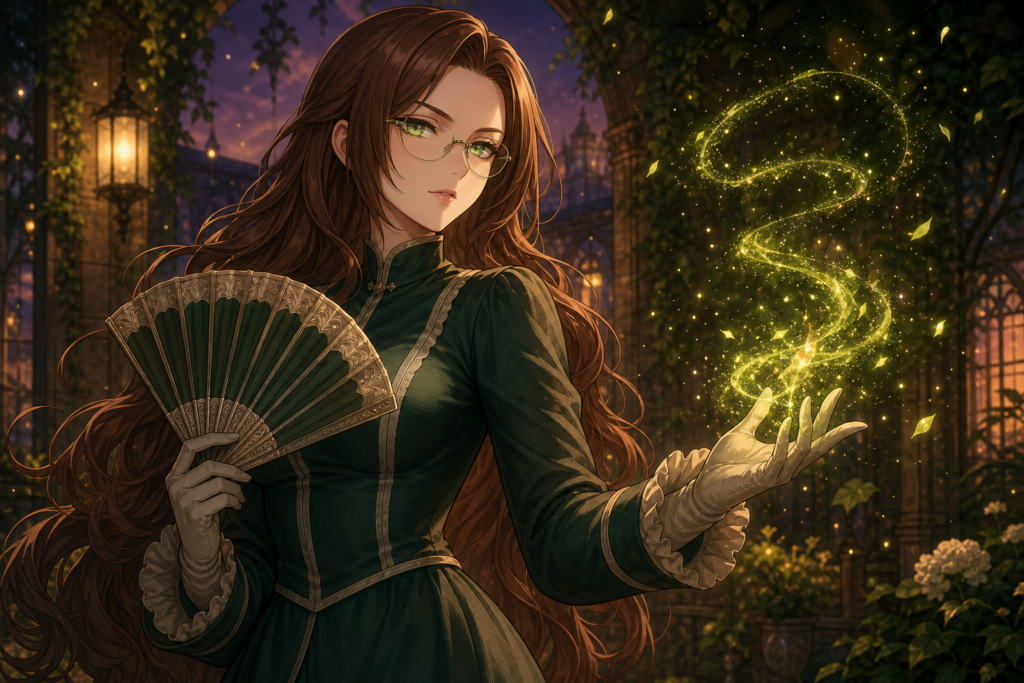
CVM Sekai character profile
Bottom line
Evergreen looks like she arrived to judge the outfit, the posture and the lighting. During the Battle of Fairy Tail, she also turns women to stone and uses their bodies as leverage. The second fact does not become less serious because the first one is funny. Evergreen is a skilled Fairy Tail mage, a member of the Raijinshū and a user of two distinct magical systems. Stone Eyes can petrify through direct sight under defined conditions. Fairy Magic gives her a separate gold-green offensive arsenal through dust, light and area attacks.
None of them travels backward in time and makes the petrified contestants volunteers. Evergreen’s strongest arc is not “mean beauty learns love.” Evergreen’s strongest arc follows a proud, competent woman learning that loyalty and aesthetic self-mythology do not excuse control.
Who Evergreen is
Evergreen is a Fairy Tail mage and member of the Raijinshū, also localized as the Thunder God Tribe. She works alongside Freed Justine and Bickslow under Laxus Dreyar.
Her magic includes Stone Eyes and a separate Fairy Magic repertoire. Her glasses help regulate exposure to her eye-based ability. Her Japanese performer is Saori Seto. This profile keeps Japanese performance scope only.
Public official pages reviewed for this package do not expose a stable full vital sheet or a directly indexed exact manga debut entry. The draft avoids importing unsourced age, height or first-chapter numbers from fan databases.
Evergreen’s useful identity facts are clear: control specialist, ranged attacker, Raijinshū member, willing Battle of Fairy Tail participant, Tenrou trial partner to Elfman, survivor of the seven-year suspension, temporary Blue Pegasus member in official spinoff material and later Fairy Tail defender.
Name, design and the fairy she performs
TV Tokyo’s official cast list identifies her as エバーグリーン, rendered Evergreen in English. The name suits the self-image. Evergreen wants beauty to look permanent, polished and naturally superior. Her design supports that performance through long chestnut hair, oval glasses, a closed emerald dress and an elegant fan.
Nothing about the silhouette says accidental. The glasses are the most important object because they connect style to restraint. They frame her face, complete the refined image and regulate access to Stone Eyes. When the glasses move, the audience understands that the social performance has become a magical threat.
The fan supports a different side of the same design. The fan makes Fairy Magic look elegant without turning Evergreen into a literal winged fairy. The magic uses fairy imagery, gold-green light and dust, but the character remains human. Theme is not biology.
Her guild wardrobe also avoids the usual shortcut where confidence has to equal exposure. Evergreen’s vanity comes through posture, language, gaze and control of the room. She does not need exaggerated cleavage or a crown to communicate that she expects attention.
That matters because the Battle of Fairy Tail already places women inside a beauty contest. The visual direction can play with pageant imagery without making Evergreen’s body the only thing fans are invited to read. She designs herself as the woman qualified to judge everybody else. Her arc begins when the story forces her to face the moral poverty of that position.
Stone Eyes counterplay and responsibility
Stone Eyes is dangerous because its rule is fast, visible and personal. The line of sight matters. The glasses matter. The target’s eyes and magical conditions matter. Those limits give an opponent something to understand instead of asking the audience to accept petrification whenever the plot wants a shortcut.
Evergreen’s knowledge of those conditions creates responsibility. She does not discover the danger accidentally during the Miss Fairy Tail contest. She uses a regulated ability on purpose, against guildmates, inside a plan that depends on their inability to move. The hostages are not collateral damage from a spell she failed to control. They are the mechanism.
That is why Erza’s counter is satisfying. Erza reads the condition, possesses a relevant artificial-eye advantage and still has to defeat Evergreen through combat. The scene respects both mechanics and agency.
The scene also prevents Stone Eyes from swallowing Evergreen’s entire profile. A conditional control technique can be powerful without becoming the answer to every opponent. Fairy Magic gives her range and area pressure when the gaze fails. Team formations give her access to trapped targets. Direct pressure can deny her the clean visual line she wants.
Evergreen is strongest when style, distance and control all belong to her. She is weakest when somebody else reads the room faster.
Stone Eyes and the meaning of the glasses
Stone Eyes can petrify targets through direct sight under defined conditions. The glasses regulate exposure. That makes them more than fashion. They are restraint, safety mechanism and tactical switch. When Evergreen reveals her eyes intentionally, she chooses to expose another person to the technique. Eye contact and visual access create counterplay. Avoidance, obstruction and special ocular conditions can affect the outcome.
The ability is neither unavoidable nor established as automatically permanent. Its power comes from speed and consequence. A successful glance can remove a person from the fight without a long exchange. Its weakness is that the rule is legible. An opponent who understands the condition can plan around it.
Control magic always raises a consent question. Evergreen’s glasses show she knows the risk. During the Battle of Fairy Tail, she removes that restraint against guildmates on purpose. That knowledge makes the choice more accountable, not less.
Fairy Magic is a separate arsenal
Evergreen also uses Fairy Magic through gold-green dust, light and area attacks. This is separate from Stone Eyes. The visual theme matches her name and self-presentation, but it does not establish literal fairy biology. She does not need wings or a secret species reveal for the magic to be valid.
Fairy Magic gives her options when petrification is blocked, resisted or tactically unwise. She can attack at range, create pressure across an area and combine elegance with real force.
Licensed editions vary in some spell wording, so this profile separates the stable Fairy Magic system from names that do not stay consistent across translations. The distinction matters because Evergreen is not a one-trick gaze user. Stone Eyes controls through sight. Fairy Magic fights through projected magical effects. One threatens agency. The other threatens your eyebrows and possibly the wall behind you.
Pride, beauty and self-authored mythology
Evergreen takes pride in beauty, refinement and fairy imagery. The performance gives her confidence and comic sharpness. That performance also creates a hierarchy in which she expects other people to recognize her superiority.
The Miss Fairy Tail setting weaponizes that hierarchy. Women are already being judged through appearance. Evergreen turns contestants into stone and converts a beauty event into a hostage display.
The arc is playing with pageant imagery, but the coercion remains real. Beauty does not make her shallow. Pride does not make her villainous forever. The problem is using both as permission to control other women. Feminine power is not automatically feminist because a woman wields it. Agency still matters.
The Raijinshū and team responsibility
Evergreen, Freed and Bickslow form the Raijinshū under Laxus. Their abilities cover different forms of control. Freed writes barriers and conditions. Bickslow uses soul-animated doll vessels and Figure Eyes. Evergreen threatens petrification and adds ranged Fairy Magic. They are distinct people, not Laxus accessories. That distinction also means each owns her or his choices.
Freed’s discipline does not control Evergreen’s body. Bickslow’s theatricality does not distract her into participation. Laxus provides the plan, but Evergreen willingly enforces it. Team loyalty explains coordination. Team loyalty does not dissolve agency into a group logo.
Battle of Fairy Tail: contestants become hostages
Evergreen petrifies the Miss Fairy Tail contestants and uses them as leverage in Laxus’s contest. The women are not simply defeated opponents. They are coercive hostages.
Their bodies become proof that the Raijinshū can punish the guild if others refuse the game. The distinction matters because fandom sometimes remembers the arc as an internal tournament with unusually personal fights. The arc is a takeover built through confinement, threats and forced participation.
Evergreen’s role is central to the threat mechanism. The pageant framing can make the sequence look decorative. The sequence is not decorative to the women who cannot move.
The scene also shows how objectification and magical control can overlap. Contestants displayed for beauty become literal objects inside somebody else’s plan. That is not subtle. Neither should the accountability be.
Erza breaks the hostage strategy
Erza confronts Evergreen and resists the petrification strategy through the properties of her artificial eye and her own combat skill.
Erza’s artificial eye gives her a relevant resistance to eye-based magic, and her combat skill does the rest. The scene does not make every artificial eye a universal anti-magic device.
The larger point is agency. Erza does not win because she is declared prettier. She wins because she understands the threat, has a relevant countermeasure and can defeat Evergreen in direct combat.
That distinction keeps the confrontation from becoming a beauty ranking between women. Evergreen’s fairy self-image collides with Erza’s practical strength. Erza breaks the hostage mechanism and restores movement to people Evergreen tried to turn into leverage. The victory is institutional too. Once the hostages are released, Laxus loses a major tool of control.
Aftermath: staying means doing the work
Laxus is expelled after the Battle of Fairy Tail. Evergreen remains. Remaining in the guild is not proof that her role was minor.
Remaining gives her a longer path of accountability. She must live among people she petrified. Later defense of Fairy Tail and sustained changed behavior become evidence that the coup does not define every future choice.
Defeat alone is not repair. Regret alone is not repair. Repair is a pattern. The series does not give Evergreen a long formal restorative process. A responsible profile can still keep the harmed guildmates visible while recognizing later conduct. Forgiveness is not amnesia with a cute guild mark.
Tenrou Island and Elfman
Evergreen partners with Elfman Strauss during the Tenrou Island S-Class trial. Their partnership is tactical before it becomes romantic implication. They use relationship and marriage language as misdirection during the encounter with Mirajane. The tactic exploits Mirajane’s emotional response and creates an opening. The tactic is not proof that Evergreen and Elfman are already married or formally engaged.
Misdirection works because the possibility feels plausible, not because the statement is a legal filing. The partnership also shows changed guild conduct. Evergreen coordinates with a person whose sister she helped endanger during the Battle of Fairy Tail. That history does not disappear inside later romantic framing. Later affection can be real while beginning from a chronology that includes harm.
Elfman relationship: suggestive, not settled by fandom
Evergreen and Elfman continue receiving comic and affectionate implication. They cooperate, show concern and become a recurring possible couple. The canon develops and jokes about the relationship without providing a stable public confirmation of marriage or a fixed final status. Fandom often treats suggestive scenes as either absolute proof or meaningless bait. The healthier middle is simple: the relationship is intentionally developed and romantically coded. Its formal end state remains bounded by canon.
Evergreen should also remain a character outside the relationship. Her magic, pride, team loyalty and accountability do not become a waiting room for Elfman. Elfman is not a prize proving she became nice. Affection is not a character-reform certificate.
Grimoire Heart and seven missing years
Evergreen and Elfman continue into the Grimoire Heart conflict as part of the Tenrou ensemble. Shared battles belong to the team rather than whichever character currently owns the profile page.
Fairy Sphere later suspends the Tenrou group outside ordinary time for seven years. Evergreen returns to a Fairy Tail that has lived through decline without many of its strongest members.
The absence matters because loyalty is not measured only by who survived the island. Macao, Romeo and the outside members carried the guild through ordinary years. Evergreen’s later place in Fairy Tail depends on rejoining a community that did not pause for her.
Grand Magic Games era
Evergreen remains part of Fairy Tail during the Grand Magic Games period. Her relationship with Elfman receives continued comic suggestion, but that material does not replace her combat role or prove formal status.
The Games turn magic and guild identity into public spectacle. Evergreen’s carefully managed image fits that environment, but her value is not limited to presentation. Stone Eyes can remove a target quickly. Fairy Magic can control an area. Those are professional tools whether a crowd applauds or not.
Tartaros and Tempester
Tempester’s attack and anti-magic particles critically endanger Evergreen, Freed and Bickslow. Laxus carries severe physical cost while protecting them. The sequence demonstrates mutual loyalty under changed conditions. Laxus no longer uses the Raijinshū as enforcers in a takeover. He risks himself for them. That matters.
Laxus’s sacrifice does not make suffering into repayment. Evergreen’s illness or injury does not cancel the petrified hostages. Victimization is not karma. The body does not become a moral receipt. The event can deepen relationships while remaining something harmful done to them.
Blue Pegasus and official spinoff scope
Kodansha’s official Fairy Tail: Lightning Gods summary confirms that after Fairy Tail disbands, Laxus, Freed, Evergreen and Bickslow join Blue Pegasus. This is official spinoff material by Kyouta Shibano.
The spinoff should be labeled as such rather than described as though every detail appears in the main manga. The Blue Pegasus period gives Evergreen a real workplace and community during displacement. The guild is not merely a joke about beauty and performance.
The spinoff also tests the group’s friendship through missions involving Ichiya’s kidnapping, rival guild conflict and an ancient magical relic. Kodansha’s official catalog proves the group, Blue Pegasus affiliation and major premise. The catalog does not turn a remembered panel into evidence for every individual action.
Alvarez and ensemble defense
Evergreen participates in the Alvarez war through Fairy Magic, Stone Eyes and ensemble defense. The war never promotes Evergreen to commander-level authority or gives her a decisive solo victory over its central threats.
Her abilities remain tactically valuable. Petrification can threaten ordinary combatants. Area magic can support a team. Glasses and line of sight create constraints. Exact opponents and outcomes belong to published receipts.
Proportional coverage is not erasure. Proportional coverage is how a supporting character keeps her own record instead of borrowing somebody else’s.
Evergreen in 100 Years Quest (spoilers)
During the Aldoron conflict, Whiteout places Fairy Tail members under coercive control. The official Episode 10 summary states that Gray faces the Raijinshū.
Evergreen’s presence creates a meaningful contrast with Stone Eyes. She has used a gaze-based ability to remove other people’s agency from a fight. Under Whiteout, her own agency is compromised.
The situations are not morally equivalent. The Battle of Fairy Tail involves willing participation. Whiteout is coercion done to her. Calling it karma would turn victimization into moral repayment. A better parallel clarifies consent and gives later conduct a sharper frame. Her sequel role remains proportional. The story does not turn her into a Dragon God or Diabolos specialist, and it does not quietly settle her relationship status offscreen.
Relationship atlas
Laxus Dreyar
Leader and friend whose coup Evergreen willingly supports. Later loyalty matters when paired with independent judgment and changed conduct. Their bond only improves when loyalty stops requiring obedience.
Freed Justine and Bickslow
Teammates with distinct roles. Shared complicity and later mutual protection do not erase separate agency. Each member owns a different part of the takeover and a different record afterward.
Elfman Strauss
Tenrou partner and romantic implication. Tactical cooperation, concern and comedy support the relationship without proving an unconfirmed marriage. Affection can grow without turning either character into evidence that the other became good.
Erza Scarlet
Opponent who breaks the hostage strategy. Their conflict is about agency and counterplay, not a final ranking of female beauty.
Mirajane Strauss
S-Class examiner and target of the Tenrou misdirection. Mirajane’s reaction is not approval of a formal relationship. The scene proves the tactic worked, not that a private romantic status became public fact.
Fairy Tail and Blue Pegasus
Accountability community, chosen home and official spinoff workplace during dissolution. The guild gives Evergreen room to change while preserving the responsibility created by what she did to its members.
Japanese performance and adaptation
TV Tokyo’s official cast page credits Saori Seto as Evergreen. The role balances hauteur, comedy, control-magic threat and later team warmth.
Seto’s measured hauteur makes Evergreen’s pride sound cultivated rather than accidental. The performance can sharpen the pageant comedy, then harden when control and loyalty turn the same confidence into threat. Animation is especially important for eye contact, lens exposure, petrification reversal and the visual separation of Stone Eyes from Fairy Magic.
Anime-expanded missions belong to adaptation continuity. Lightning Gods remains official spinoff material, while background film, OVA and game appearances are not inflated into major story roles.
Final verdict
Evergreen is beautiful, proud and dangerous. None of those traits determines whether she is right. The Battle of Fairy Tail proves the problem. She uses women as hostages because loyalty, competition and control feel more important than their consent. Erza breaks the strategy.
Evergreen’s later life gives her opportunities to act differently. She defends the guild, works with the Raijinshū under changed conditions, partners with Elfman and survives displacement into Blue Pegasus during the guild’s dissolution. The growth is real because the earlier harm remains named. Romance does not redeem her. Suffering does not repay the debt. Beauty does not create innocence. Independent judgment and sustained conduct do the work. Evergreen’s glasses regulate a dangerous gaze. Her character arc asks her to develop the same restraint over loyalty.
Source ledger and clean boundaries
- TV Tokyo official 2014/2015 cast page, including Saori Seto as Evergreen: TV Tokyo: Fairy Tail staff and Japanese cast
- TV Tokyo official character portal: TV Tokyo: Fairy Tail character archive
- Kodansha official Fairy Tail: Lightning Gods catalog: Kodansha: Fairy Tail Lightning Gods
- Kodansha official Fairy Tail Side Stories catalog: Kodansha: Fairy Tail Side Stories
- Kodansha Fairy Tail and 100 Years Quest catalogs: Kodansha: Fairy Tail series and Kodansha: Fairy Tail 100 Years Quest series
- Official 100 Years Quest Episode 10, Gray against the Raijinshū: Official 100 Years Quest episode story
- Primary chronology and magic context: Hiro Mashima, Fairy Tail, volumes 1 through 63; Lightning Gods labeled as official spinoff scope; sequel claims limited to published 100 Years Quest material and official pages above.
Public official pages do not expose a stable full vital sheet, a directly indexed exact manga debut, every Stone Eyes condition, every Fairy Magic spell’s licensed first-use name or a complete Evergreen film, OVA and game roster. Those details stay bounded instead of being imported from fan databases and dressed up as certainty.