
Naruto · Complete Character Profile
Kin Tsuchi
Kin turns bells, senbon and nearly invisible wire into a lie an opponent can hear. Orochimaru turns the promise of a village into a deadlier lie: a place where a fourteen-year-old can serve, hurt people and still be treated as disposable material.
Kin Tsuchi at a glance
| Full name | Kin Tsuchi |
|---|---|
| Japanese name | キン・ツチ |
| Birthday | July 6 |
| Age | 14 in Part I |
| Height | 150 cm |
| Weight | 39 kg |
| Blood type | O |
| Village | Otogakure, the Hidden Sound Village |
| Team | Team Dosu with Dosu Kinuta and Zaku Abumi |
| Rank | Genin |
| Specialty | Ranged deception through senbon, bells, wire and auditory misdirection |
| Nature classification | Yin Release appears in reference records; the core manga fight demonstrates tools and deceptive perception rather than a named elemental technique |
| Manga debut | Chapter 35 |
| Anime debut | Episode 21 |
| Japanese performer | Akiko Koike |
| Status | Killed by Orochimaru and used as a living sacrifice for Impure World Reincarnation |
The bottom line
Kin makes false information feel real. Orochimaru makes false belonging feel like a village. Her bells confuse an opponent for a few minutes; his system recruits a child, converts her skill into labor and finally converts her body into equipment. That does not erase Kin’s cruelty toward Sakura or her overconfidence against Shikamaru. It explains the adult structure that profits from both.
Appearance and visual identity
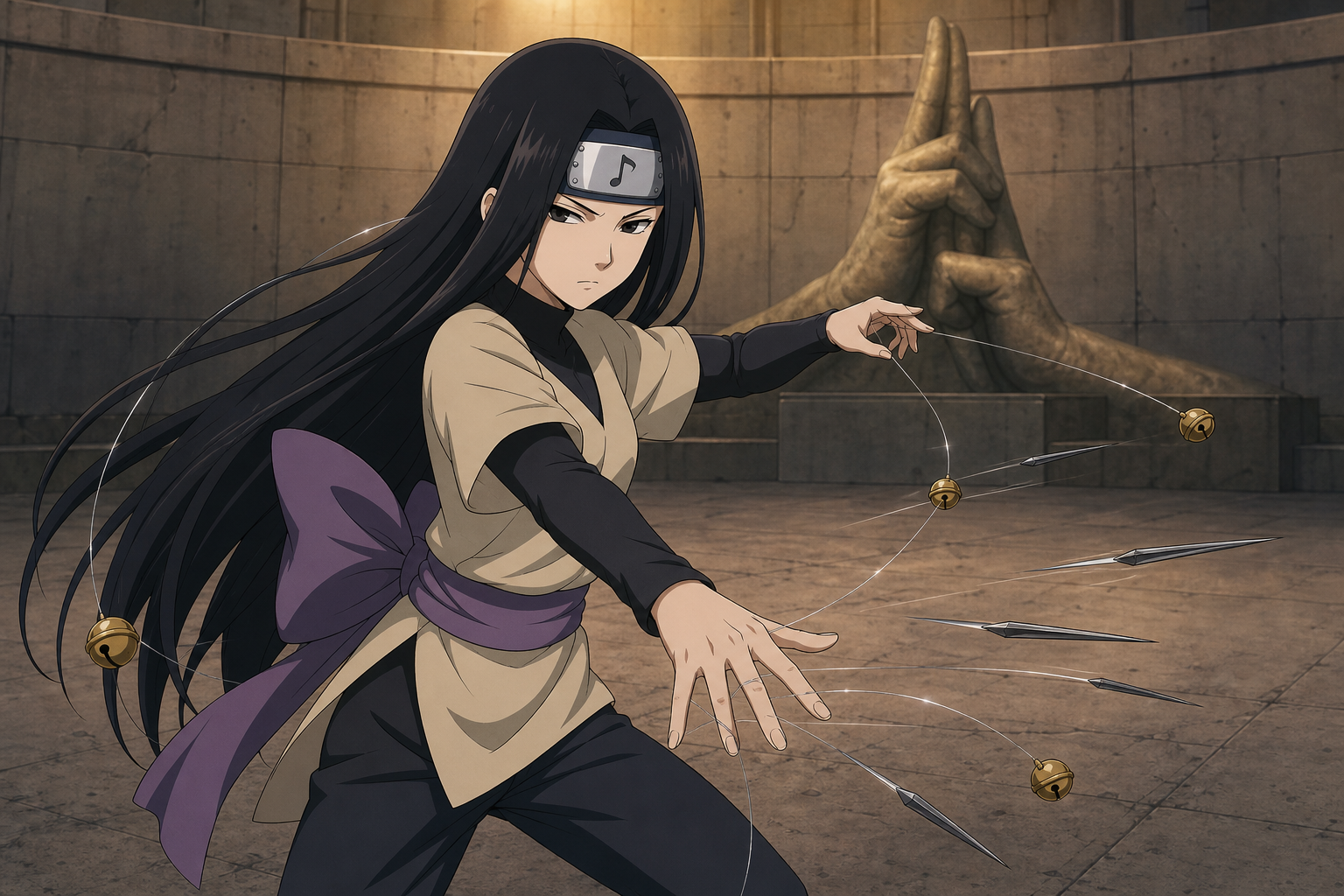
Kin has very long straight black hair, a Sound forehead protector, a pale short-sleeved tunic over dark arm coverings, dark trousers and a large purple bow tied behind her waist.
The design combines apparent simplicity with concealed complexity. Her visible tools are small: senbon needles and bells. Their tactical value comes from wire placement, attention control and the opponent’s assumption that each sound corresponds to an obvious weapon.
Her hair becomes part of the Forest of Death confrontation when she grabs Sakura’s hair. Later, Sakura cuts it to escape. The scene turns feminine presentation into both vulnerability and chosen severance.
What canon does not tell us
Kin’s surname, Tsuchi, is established. A complete pre-Otogakure family history is not. The series does not clearly document her parents, birthplace, consent to service, training chronology or private dreams outside the mission.
It is tempting to build a sympathetic origin parallel to Zaku’s anime-expanded orphan history. That would create emotional neatness, not evidence.
Responsible fandom depth distinguishes interpretation from fact. We can infer that she operates inside Orochimaru’s exploitative system and is treated as disposable. We cannot claim a specific childhood event merely because it would explain her behavior.
The blank space itself matters. Institutions erase people most efficiently when no record survives beyond utility.
Episode 23: Sound enters the data field
In the crowded exam room, Kabuto Yakushi uses Ninja Info Cards to explain the strength, affiliations and histories of other candidates.
Dosu, Zaku and Kin respond aggressively. Kabuto’s information display turns their supposedly new village into known data and threatens the intimidation created by unfamiliarity.
Kin supports the team’s public threat even though Dosu delivers the decisive sound attack. The scene establishes a group identity before the story distinguishes their individual methods.
All three appear to defend Sound’s honor while unknowingly attacking another operative connected to Orochimaru.
Senbon, bells and false location
Kin attaches bells to some senbon and can use fine threads to manipulate bells after the initial throw. The opponent sees one projectile pattern and hears another.
Visible threat
Senbon establish real puncture danger and force dodging or blocking.
Auditory threat
Bells draw attention and encourage the opponent to map sound onto specific needles.
Hidden control
Fine wires permit ringing without another obvious throw, creating false expectations.
Psychological pressure
Once the opponent believes sound predicts attack, manipulated ringing can control reaction.
Her method belongs perfectly in Hidden Sound. It does not require overwhelming volume. It turns hearing into unreliable intelligence.
Forest of Death: targeting Sakura
The Sound trio approaches Team 7 after Orochimaru has incapacitated Naruto and marked Sasuke. Sakura Haruno has remained awake through the night to protect them.
Kin participates in the attack on an exhausted opponent and grabs Sakura by the hair. She mocks Sakura’s attention to appearance, framing femininity as evidence of unseriousness.
Sakura cuts her hair and escapes the hold. The act is neither a magical power-up nor rejection of femininity. It is a tactical choice: she severs something meaningful because the enemy has converted it into control.
Kin intends the hair as proof that Sakura is weak. Sakura uses the same moment to demonstrate that attachment does not eliminate agency.
The gendered mirror
Kin and Sakura are young kunoichi inside systems that judge their bodies through usefulness and presentation. Each has learned to weaponize contempt differently.
Sakura has mocked Lee’s appearance and once defined much of her competition with Ino around Sasuke. Kin mocks Sakura’s hair and targets it physically. Neither girl invents the culture that trains them to treat feminine presentation as a hierarchy, but both reproduce it.
The fight becomes more interesting when we refuse to classify one as “real fighter” and the other as “vain girl.” Kin uses tools, deception and pain. Sakura uses preparation, endurance and sacrifice. Both are fighters. Both are also children performing identities under hostile observation.
Team 10 enters
Ino, Shikamaru and Chōji intervene as the conflict grows. Ino’s unresolved childhood bond with Sakura outweighs the exam’s competitive incentive.
Kin becomes one of the bodies through which Team 10’s coordinated clan techniques are demonstrated. Ino’s Mind Transfer temporarily takes control of Kin.
That possession exposes another layer of vulnerability. Kin’s body is already operationally owned by Orochimaru; during the fight it also becomes a tactical vessel for an opponent.
The story repeatedly moves her body between other people’s purposes while giving her little private language for herself.
Preliminary match: Kin versus Shikamaru
Kin faces Shikamaru Nara in the preliminaries. She uses senbon and bells to create an apparent auditory strategy.
Shikamaru understands that the bells can be manipulated through nearly invisible threads. Kin then reveals another layer, using sound to interfere with perception while launching attacks from unexpected positions.
She appears to control distance and attention. Shikamaru extends his Shadow Possession through the arena, using the shadow of a suspended line to reach her.
Once connected, he forces Kin to mimic his movement. Both throw shuriken backward and duck. Shikamaru has calculated their different positions: he has open space behind him, while Kin strikes her head against the wall and loses consciousness.
Why Shikamaru wins
Shikamaru does not win because Kin lacks strategy. He wins because he treats her strategy as environmental information.
Kin uses wires to extend control beyond the visible weapon. Shikamaru uses the shadow cast by that extended system as his own route. Her infrastructure becomes part of his technique.
The final wall calculation is spatial rather than forceful. Shadow Possession makes bodies mirror one another, but identical movement does not create identical consequence when surroundings differ.
This is Shikamaru’s defining intelligence: relationships matter more than isolated actions. A move cannot be evaluated without position, light, distance and terrain.
Kin loses after several good decisions because her opponent constructs a larger model of the room.
Relationship atlas
| Person | Relationship | What it reveals |
|---|---|---|
| Orochimaru | Commander and eventual killer | Her service is rewarded with conversion into ritual material. |
| Dosu Kinuta | Teammate and tactical leader | The trio coordinates under pressure, but canon reveals little private intimacy. |
| Zaku Abumi | Teammate and fellow sacrifice | Both survive the exam’s violence only to be consumed by their own organization. |
| Sakura Haruno | Forest target | Kin turns appearance into restraint; Sakura converts attachment into a conscious sacrifice. |
| Shikamaru Nara | Preliminary opponent | His spatial analysis incorporates the wires and walls her deception depends upon. |
| Ino Yamanaka | Forest opponent | Mind Transfer makes Kin’s already-instrumentalized body serve another tactical purpose. |
Death without recognition
After her preliminary loss, Kin remains under Orochimaru’s control. She and Zaku are used as living sacrifices when he summons the First and Second Hokage through Impure World Reincarnation during the Konoha invasion.
The technique replaces the living sacrifice’s appearance and agency with the resurrected dead. Kin’s body becomes the substrate through which a historically important man returns.
There is no promotion, rescue or meaningful retirement from service. The village that asks her to represent its honor does not preserve her as a citizen.
Her disappearance completes the logic of narrative and institutional erasure at once. The audience remembers the Hokage battle. The girl whose life makes the spectacle possible can vanish beneath it.
Personality
Sharp
Kin uses ridicule and confident observation to destabilize opponents.
Cruel
She targets an exhausted Sakura and converts hair into a means of humiliation and control.
Tactical
Her bell-and-wire system depends on layered expectations rather than simple projectile volume.
Composed
She maintains pressure through distance and does not fight with Zaku’s explosive emotional style.
Overconfident
She assumes understanding Shikamaru’s first observation means she has exceeded his complete plan.
Underwritten
This is a narrative condition, not a personality trait: the canon gives actions while withholding most private history.
Original Japanese performance
Akiko Koike performs Kin in the original Japanese anime. Her verified credit covers Kin’s Chūnin Exam presence, including the Forest of Death confrontation and the preliminary match with Shikamaru. Those scenes give the performer the job of carrying ridicule, confidence, tactical explanation and the shock of being outread in a compact amount of screen time.
I am not inventing pitch, breath or timing criticism without a lawful scene rewatch. A correct cast credit with honest limits is more useful than fake precision dressed up as analysis. Kin’s written and animated actions already establish the personality available for interpretation: cutting toward Sakura, controlled at range and visibly unsettled when her information advantage collapses.
Common misconceptions
“Every senbon has a bell.”
No. The deception depends on mixing visible needles, selected bells and wires that let sound continue independently.
“Kin only fights through genjutsu.”
Her method combines real projectiles, auditory misdirection and deceptive control. Descriptions vary by adaptation, but the physical tools remain essential.
“Shikamaru wins by making her copy a punch.”
He exploits their different positions. Mirrored backward movement sends Kin into the wall while he has clear space.
“Her full tragic childhood is known.”
No. Canon does not provide a detailed origin comparable to the anime-expanded material associated with Zaku.
What Kin is really telling us
Kin’s fighting style and narrative treatment revolve around controlled information.
She creates false relationships between sound and location so opponents act on incomplete models. The story offers viewers an incomplete model of Kin herself: enough behavior to classify her as threat, too little interior evidence to reconstruct a whole childhood.
Existentially, this limits how she can author herself. She speaks through mission, mockery and technique. Orochimaru’s system does not require her to possess a self beyond function, and the narrative rarely pauses to ask for one.
The answer is not to fabricate comforting lore. It is to name the erasure precisely. Kin was skilled. She made choices, including cruel ones. She belonged to a team. She entered a political examination. She was defeated, retained and murdered by the authority she served.
A complete file cannot restore the life canon never wrote. It can refuse to let utility become the only surviving description.
The physics of attention
Kin’s weapons are easy to underestimate because each component appears ordinary. A senbon is narrow, a bell is familiar and a thread is nearly invisible. Her intelligence lies in arranging those modest objects into a system that overloads interpretation.
Combatants do not react to reality in the abstract. They react to a model assembled from sight, sound, memory and expectation. Kin introduces a dependable cue, the ringing bell, then breaks the cue’s relationship with the approaching weapon. A defender who believes the sound has been decoded can become more vulnerable than one who admits uncertainty.
This makes her a useful Naruto 101 case study in information warfare. Shinobi combat is not merely the exchange of chakra and force. It is the management of what another person believes is happening, how quickly that belief hardens and whether the battlefield rewards the assumption.
Shikamaru’s counter does not invalidate Kin’s sophistication. It demonstrates a hierarchy of models. She models his attention; he models her equipment, the available light, the suspended lines, the wall and the consequences of synchronized movement. He wins by widening the frame.
Agency inside a manufactured village
Otogakure presents itself as a Hidden Village, but in this period it operates primarily as an extension of Orochimaru’s experiments, intelligence work and political ambition. The Sound genin wear forehead protectors and enter an international institution, giving exploitation the appearance of legitimate national service.
That appearance matters. A uniform can create belonging even when the institution behind it does not recognize reciprocal obligation. Kin, Dosu and Zaku act as representatives, yet Orochimaru does not treat them as citizens whose lives must be protected. Their loyalty moves upward; care never returns downward.
Kin still possesses moral agency within that system. Exploitation explains her circumstances without erasing the harm she inflicts on Sakura or the pleasure she takes in humiliation. A serious profile must hold both truths together: she is an antagonist responsible for cruel choices, and she is also a child operative murdered by the adult who organized those choices.
That tension is part of Naruto’s larger political argument. Hidden Villages call children shinobi, assign ranks to them and translate their survival into institutional prestige. Kin’s fate removes the heroic language and shows the underlying danger in its starkest form: when a village exists for one leader’s project, a subordinate’s body can become inventory.
Name, sound and the bones of the ear
Kin’s name is doing more work than the English spelling shows. Kin can point readers toward sound and ringing, while tsuchi appears inside tsuchikotsu, the Japanese term for the malleus, one of the tiny bones that carries vibration through the middle ear. That makes the name a compact design joke: this girl fights by controlling what reaches the ear, and even her surname echoes anatomy used to hear it.
That is a linguistic association, not a license to invent a grand clan history. Naruto gives Kin no confirmed clan, parentage or childhood household. The name supports the technique theme. It does not secretly prove that her family practiced bell genjutsu for generations. Fans deserve the wordplay and the boundary together.
The clever part is how thoroughly sound organizes Team Dosu. Dosu attacks the inner ear with amplified vibration. Zaku weaponizes air pressure through modified arms. Kin uses ordinary-looking metal, bells and wire to detach sound from location. The team is not three copies of one gimmick. Each member approaches perception and the body from a different angle.
The only unmodified body on Team Dosu
Reference material distinguishes Kin as the only member of Team Dosu whose body is not described as physically modified for combat. Dosu carries a Melody Arm that concentrates sound. Zaku’s arms contain tubes Orochimaru altered into weapons. Kin arrives with tools she can put down: needles, bells and wire.
That difference matters, but it does not make her free. Fans sometimes treat bodily modification as the only proof that Orochimaru exploited a subordinate. Kin shows the wider system. A commander does not need to cut open every child personally to own the conditions of her work. He chooses the mission, withholds the real objective, sends the team against dangerous targets and later takes Kin’s life for a technique she did not volunteer to fuel.
Her unmodified body becomes the final horror. The girl who appeared to possess the most physical autonomy is still reduced to a vessel. Impure World Reincarnation covers her face, silences her voice and lets a dead Hokage occupy the space where Kin was. Orochimaru’s control moves from command to literal replacement.
Complete ability and equipment shelf
| Tool or skill | What Kin actually demonstrates | Limit |
|---|---|---|
| Senbon | She throws narrow needles accurately at range and mixes direct attacks with decoys. | Senbon remain physical projectiles. A skilled opponent can dodge, block or trace their route. |
| Bells | Selected needles carry bells that train the target to associate ringing with incoming metal. | The cue works only while the opponent trusts the relationship between sound and location. |
| Nearly invisible wire | Kin suspends and manipulates bells away from the true line of attack, extending the deception across the arena. | Wire creates its own evidence. Shikamaru notices the system and uses its shadow as a path. |
| Auditory misdirection | She makes a defender read the wrong attack from a real sound cue. Anime and game labels sometimes package this as a named move, but the manga mechanics are tools, timing and perception. | It is not total mind control. Wider battlefield analysis can break the false model. |
| Composure and observation | Kin studies reactions, changes layers after an opponent catches the first trick and keeps pressure at distance. | She mistakes revealing a second layer for exhausting Shikamaru’s analysis. |
| Basic shinobi movement | She survives the Forest of Death, coordinates with teammates and reaches the preliminaries. | Canon does not establish exceptional strength, stamina, medical skill or close-range mastery. |
This shelf is deliberately narrower than a game move list. Games may give a playable character extra attacks so the controller has buttons to press. That is adaptation design, not automatic manga biography. Kin’s real combat identity is already specific. She does not need a fake elemental arsenal pasted onto it.
Shikamaru versus Kin, move by move
Kin begins the preliminary match by establishing a readable rule: hear a bell, expect the attached senbon. That rule is useful because it makes the opponent feel informed. Once Shikamaru believes he has decoded the sound, Kin can ring bells through wire while throwing needles from another path. The first lesson becomes the trap.
Shikamaru does not answer with speed or a bigger explosion. He watches the apparatus. Nearly invisible wire still exists in light, and existing in light means casting a shadow. He extends Shadow Imitation through the available darkness and reaches Kin along the infrastructure she built to control him.
The finishing sequence is geometry with consequences. Bound by the technique, Kin mirrors Shikamaru. Both throw a weapon backward and both duck. Shikamaru has empty space behind his head. Kin has a wall. Matching motion therefore produces unequal damage. Her head hits the surface and she loses consciousness.
That victory does not prove Kin is stupid. It proves Shikamaru is better at expanding the frame. She models his hearing and expectation. He models her tools, the room, the shadows, their relative positions and what identical movement will do to two bodies standing in different places. Naruto makes intelligence visible through environment, not through a narrator announcing an IQ score every thirty seconds.
Kin, Sakura and the politics of humiliation
Kin’s attack on Sakura is not just another exchange of weapons. She grabs Sakura by the hair and turns a visible part of the girl’s feminine identity into a handle. Sakura cutting that hair is tactical escape, emotional choice and symbolic break at the same time. The scene is remembered because the body, the relationship history with Ino and the immediate danger all collide in one action.
That does not turn Kin into a simple anti-girl symbol. Both are fourteen-year-old kunoichi performing strength while adults have organized the battlefield around them. Sakura is protecting Naruto and Sasuke after taking on exhausting care work alone. Kin is carrying out an assignment for a commander who regards her team as usable inventory. Their positions are not morally equal, because Kin chooses ridicule and violence. Their vulnerability to shinobi institutions is still shared.
The writing gives Sakura interior memory, friendship conflict and a choice whose cost we understand. Kin receives the attacker’s function. That imbalance shapes fandom memory. One girl becomes a person having a turning point. The other becomes the scissors in somebody else’s development. Calling out that narrative economy is not absolving Kin. It is asking why a named child can matter so intensely for one scene and then be denied a life beyond it.
Team Dosu as subcontracted labor
Team Dosu enters the Chūnin Exams under Otogakure’s symbol, but the village is not operating like a reciprocal civic home. Orochimaru uses the examination as cover for surveillance, testing and the larger invasion plan. Dosu, Zaku and Kin supply deniable labor inside an international event.
The team receives orders without the full truth. They believe they can prove themselves, eliminate targets and advance. Orochimaru benefits whether they succeed, expose Sasuke’s cursed seal response, injure competitors or die. That is the ugliest kind of labor arrangement: every outcome creates data or tactical value for management, while the workers absorb all bodily risk.
A Confucian reading makes the failure of hierarchy plain. Rank can demand duty, but legitimate authority also owes care downward. Orochimaru wants obedience without reciprocal obligation. A Buddhist lens adds the danger of attachment to recognition. Team Dosu reaches for the status of chosen servants inside a system built to discard them. The desire to become valuable does not protect them when value is defined only by usefulness.
Kin is not a passive angel trapped in machinery. She mocks, harms and competes. The point is sharper than innocence. An exploited person can also do harm, and an institution can cultivate that harm because it serves the institution. Accountability travels in more than one direction.
Death, vessel and stolen narrative space
Kin and Zaku survive the exam fights only to be used as living sacrifices for Orochimaru’s Impure World Reincarnation during the Konoha invasion. Their living bodies provide the vessels through which the First and Second Hokage return. The famous spectacle literally stands on two subordinate lives the battle barely pauses to name.
This is not promotion, battlefield death or even punishment after a fair hearing. It is murder by a commander who treats a child operative as ritual material. Kin’s appearance is overwritten by a historically powerful man. Her voice disappears. Even the audience’s attention is redirected toward what her death produces instead of what was taken.
Reanimation in Naruto repeatedly raises questions about consent, grief and the ownership of a body after death. Kin reaches the technique from the opposite side. She is not the celebrated dead person forced back into service. She is the living person erased so somebody more famous can return. That position deserves to stay visible when fans discuss how forbidden the jutsu really is.
Media and continuity shelf
Kin’s core manga record begins with chapter 35 and runs through the Chūnin Exam material and her sacrifice in the Konoha invasion. The television anime introduces her in episode 21 and expands the staging, timing and visual readability of the Forest of Death and preliminary fights. Anime presentation can make a trick look more overtly supernatural, so named technique labels should not be allowed to blur what the manga physically shows.
She also appears in the OVA Finally a Clash! Jōnin vs. Genin!! Indiscriminate Grand Melee Tournament Meeting!!. That bonus production is part of the franchise’s adaptation shelf, not a missing manga chapter. Her game debut is recorded in Naruto: Path of the Ninja, and later games may make her playable or assign battle commands for mechanical completeness. A game move set describes a game system. It does not create unspoken canon history.
Kin has no confirmed later adulthood, Boruto career or secret survival route. Impure World Reincarnation does not preserve the sacrificed vessel as a separate restored person. Once the technique consumes her, canon does not provide Kin with a return that repairs the loss.
Eight fandom shortcuts that flatten Kin
“She is just the bell girl.”
The tools are small; the information system is not. She manipulates the target’s confidence in their own senses.
“Shikamaru beats her because she is dumb.”
He wins by modeling more of the environment. Her layered deception is exactly what makes the counter worth showing.
“Every needle carries a bell.”
The strategy depends on mixing cues, projectiles and remotely moved sound. One obvious setup would not sustain the lie.
“She has a fully documented tragic childhood.”
She does not. Zaku receives anime-expanded childhood material; Kin’s missing past must remain an honest gap.
“No body modification means no exploitation.”
Orochimaru controls missions, information and life itself. A scalpel is not the only instrument of ownership.
“Being exploited makes her innocent.”
No. She harms Sakura and takes pleasure in humiliation. Explanation and accountability can occupy the same paragraph.
“The Hokage resurrection is all that matters.”
The spectacle matters, and so do the living children murdered to produce it.
“A game technique proves manga ability.”
Games need complete control schemes. Continuity labels keep adaptation mechanics from becoming counterfeit biography.
Where to continue
Sources and canon boundary
Manga chronology controls this profile. Anime staging, databook material, novels, films, games, and later franchise appearances are labeled instead of being blended into one false continuity.
Primary franchise references: Naruto Official and VIZ Media Naruto. CVM Sekai’s conclusions about Team Dosu, bells and senbon, the Chūnin Exams, Orochimaru’s exploitation, and Kin’s use as an Edo Tensei sacrifice are editorial analysis, not invented creator quotations.