
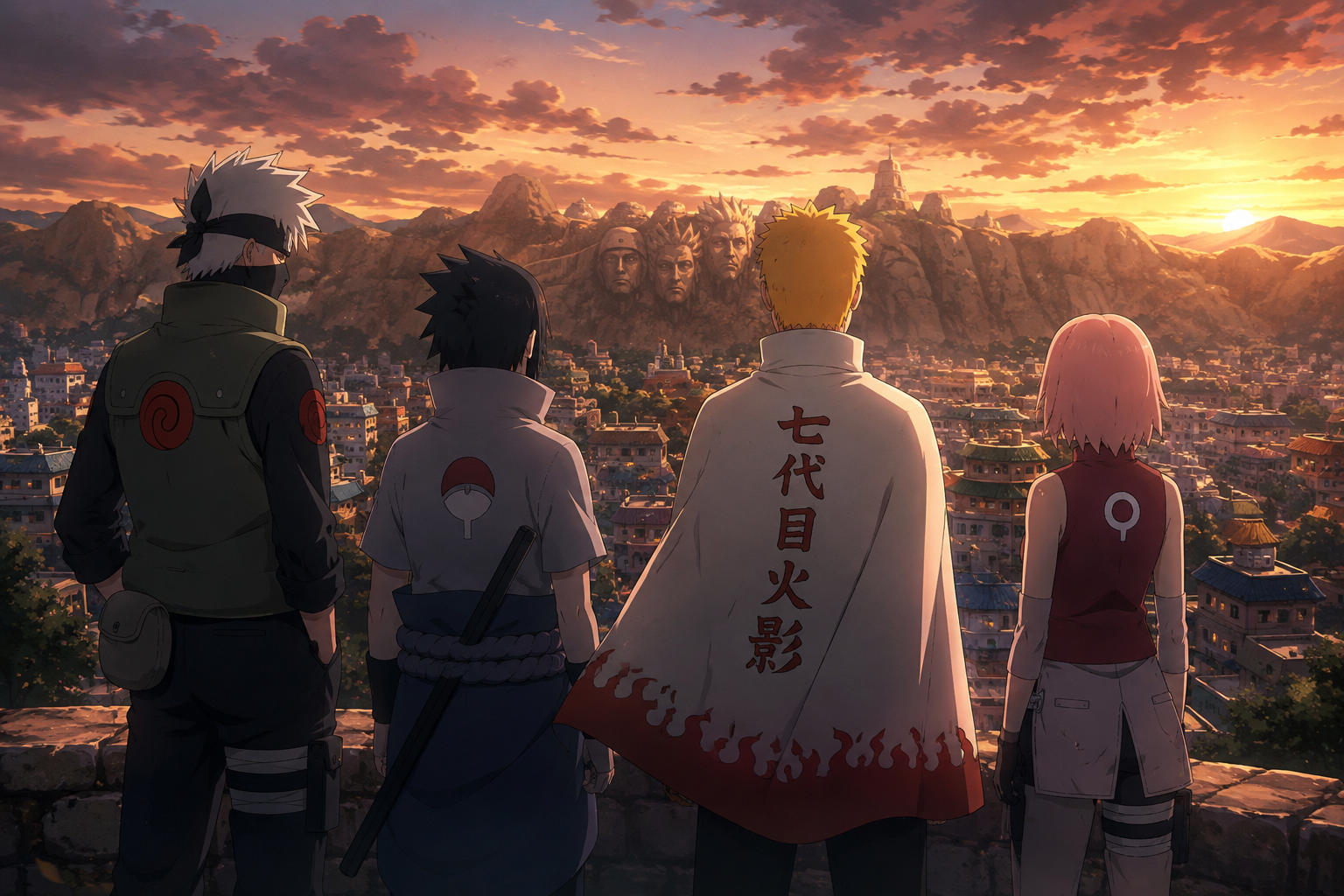
Shinobi, Kunoichi & Nindō
“Ninja” sounds like a costume. “Shinobi” names a profession, a history of concealment and a person trained to endure. “Kunoichi” appears to name its women. “Nindō” turns the entire system inward: when orders, loyalty and conscience separate, what kind of ninja will you choose to be?
The one-sentence truth
Shinobi and ninja name the same profession through different Japanese readings; kunoichi is a gendered label with a debated history; nindō is Naruto’s idea of a personally chosen ninja way, not a formal rank or universal oath.
忍者 · ninja
The familiar on-reading commonly translated as ninja: a person associated with covert military work, intelligence, infiltration, and unconventional warfare.
忍び · shinobi
A native Japanese reading linked to shinobu: to conceal, endure, or bear. In Naruto, it is the ordinary in-world term for professional ninja.
くノ一 · kunoichi
A word for a female ninja, popularly explained through strokes forming 女, “woman.” Its historical development is less certain than fiction often suggests.
忍道 · nindō
Literally “ninja way”: a personal creed about how one will live as a shinobi. The series uses it as moral self-authorship inside compulsory service.
Translation matters because English has turned “ninja” into costume, aesthetic, and marketing category. Naruto puts the word back inside labor, hierarchy, nationality, and childhood. A shinobi does not merely possess techniques. A village can assign, rank, pay, discipline, deploy, and hunt them.
The language also carries interpretation, not one secret dictionary key. The character 忍 can suggest concealment and endurance, but a word’s visual components do not automatically dictate every scene. Good cultural reading uses linguistic resonance as evidence, then checks what the story actually does with it.
Ninja and shinobi: two readings, one profession
The characters 忍者 can be read ninja. The series frequently uses shinobi, written 忍, as a noun. English localization favors “ninja” because the word is globally recognizable; subtitles and fandom retain “shinobi” when Japanese texture matters.
The overlap should not become a false hierarchy. A shinobi is not a more advanced ninja, a special class, or a rank. Genin, chūnin, jōnin, and Kage handle formal standing. Ninja and shinobi handle the occupation and identity.
The root association with concealment and endurance is thematically powerful. Naruto’s world trains people to hide location, intention, fear, grief, and sometimes civilian identity. It praises the ability to bear loss. The same vocabulary can describe useful discipline and dangerous silence.
Concealment is not only sneaking behind bushes. Shinobi conceal information, allegiance, strength, wounds, techniques, and emotion. A transformation hides a body. A code name hides a person. ANBU masks hide identity while advertising state authority. Even an ordinary smile can become operational cover.
Endurance is equally double-edged. It keeps Naruto training, lets Tsunade rebuild care, and helps survivors continue. It also becomes the word adults use when they need traumatized children to stop inconveniencing the mission schedule. Endurance is a capacity. The moral question is who benefits from it.
What a shinobi actually does
A shinobi is a trained military worker attached to a hidden village, clan, organization, or independent interest. Combat is only one part. Missions involve escort, intelligence, surveillance, capture, assassination, sabotage, courier work, guarding, investigation, disaster response, barrier maintenance, medicine, and logistics.
The Academy standardizes literacy, chakra basics, tactics, and loyalty. Genin enter teams supervised by experienced leaders. Missions convert training into paid service for clients and strategic value for the village. The headband says a young person has become employable, deployable, and accountable to a military institution.
That is why “child soldier” is not edgy exaggeration, even though Naruto’s fantasy world does not map perfectly onto a modern legal category. Children receive ranks, weapons, contracts, hostile targets, and orders from state leaders. The series knows this is costly because its founding history begins with adults wanting children off battlefields, then rebuilding a system that sends them back under new administration.
The profession also includes invisible care. Medical-nin keep units alive. Sensory teams create awareness. Intelligence analysts turn fragments into decisions. Barrier crews protect borders. Teachers produce every future worker. A fandom that calls only the person making the crater “useful” has confused spectacle with infrastructure.
Read beside the rank guide and mission guide, shinobi identity looks less like an adventurous label and more like a labor system with uniforms, clients, promotions, secrets, and bodies absorbing forecasting errors.
Is kunoichi simply “female shinobi”?
Within modern popular culture, yes: kunoichi distinguishes women who perform ninja work. Naruto uses female ninja throughout its forces, and official character materials may classify them with the term.
The commonly repeated explanation divides the written character 女 into strokes resembling く, ノ and 一. That visual wordplay is memorable, but claims that it proves a deep medieval operational category should be treated cautiously. Modern fiction has done much to popularize and stabilize the word.
The distinction also raises a structural question. If “shinobi” can include anyone, why is a separate marked term needed for women? Gender-neutral professional language often treats men as the unmarked default and women as a special subtype.
Kunoichi are not a separate combat species
Naruto does not give all women one technique class. Sakura Haruno becomes a medical-nin and close-combat powerhouse. Tsunade is a legendary Sannin and Hokage. Hinata uses Gentle Fist and Byakugan. Temari fights through Wind Release. Tenten specializes in weapons. Ino develops mind techniques, sensory work and battlefield communication.
Historical-fiction clichés often reduce kunoichi to seduction and disguise. Espionage can exploit gender expectations, but treating every female operative as an erotic infiltrator erases the tactical variety that male characters are allowed automatically.
The better critical question is not whether women “count” as shinobi. It is whether the narrative gives their ambitions, training, rivalries and philosophies the same interior weight granted to its boys.
Gender inside the hidden village
Formal opportunity
Girls attend the Academy, become genin, lead squads, enter ANBU, practice medicine, and attain Kage office. The institution does not reserve shinobi status for men.
Narrative attention
Equal entry does not guarantee equal storytelling. Women are more often routed through romance, support, or healing while male rivalries drive the central history.
Care as strategy
Medical ninjutsu and communication are not lesser work. Armies collapse without survival, intelligence, and coordination. Gendered support can make essential labor look secondary.
Body expectations
Tsunade’s age, Sakura’s appearance, and Hinata’s femininity receive scrutiny male authorities escape. A guide should analyze that framing rather than reproduce it.
Sakura becomes the easiest fandom target because the series gives her enormous technical growth while repeatedly returning her emotional framing to Sasuke. Both facts belong in the same sentence. Her medical mastery, poison work, strength, war labor, and motherhood are real. So is the writing’s unequal appetite for her interiority.
Tsunade makes the institutional argument strongest. She reforms team survival through medical rules, trains successors, protects the village at scale, and serves as Hokage. The story still jokes about her age, chest, gambling, and appearance technique more freely than it jokes about Hiruzen’s body. Leadership does not remove the gendered gaze.
Kunoichi discourse also risks forcing every woman into one feminist scorecard. Hinata’s quietness, Temari’s command, Ino’s social intelligence, Tenten’s weapons, Chiyo’s puppetry, and Konan’s organization do not need to become the same personality to count. Equality should widen the range of women allowed to matter.
Nindō: a creed chosen inside compulsory service
Nindō combines nin, the ninja or shinobi character, with dō, “way” or “path.” Naruto characters use the idea to state the principle by which they intend to live as shinobi.
Naruto Uzumaki declares that he will not run away and will not go back on his word. The slogan sounds like stubborn bravado because it begins that way. Its deeper function is continuity: a despised child creates a promise he can recognize when social approval changes by the hour.
Nindō is not the Academy’s official code. It can support village loyalty, contradict an order, or expose professional doctrine as morally empty. A personal way matters precisely because institutional commands cannot answer every crisis.
The idea resembles Japanese dō language used for cultivated paths such as judō, kendō, or shodō, but Naruto’s nindō is its own dramatic construction. We should not pretend every historical ninja carried a personalized anime creed in a pocket scroll. The cultural resonance is discipline-as-way; the story turns it into existential authorship.
A creed can also become a trap. Naruto’s refusal to break promises gives him moral force, yet a promise made by a hurt child may need revision. The test is not whether he repeats the sentence forever. It is whether the sentence keeps serving life, accountability, and other people’s agency.
Naruto’s ninja way: stubbornness becoming ethics
At first, Naruto’s refusal to quit is a survival habit. Mischief guarantees attention; boasting protects a self that rejection has made fragile. During the Land of Waves, his creed meets Haku and Zabuza, people whose loyalty has been distorted into usefulness and disposal.
Naruto begins to ask whether shinobi should be tools. He does not abandon endurance; he changes what endurance serves. Persistence becomes the refusal to let another person’s humanity disappear behind their assigned function.
His promise to bring Sasuke home later tests the creed’s limits. Loyalty can become care, denial, obsession or resistance to a political system too willing to classify a child as enemy. The series keeps the slogan alive by making it costly.
Other ninja ways,and their contradictions
| Character | Claim or governing principle | What it protects | What it risks |
|---|---|---|---|
| Kakashi | Those who abandon comrades are worse than scum | Human bonds against rigid mission logic | Guilt and self-sacrifice replacing healthy grief |
| Haku | Strength comes from protecting a precious person | Devotion and chosen purpose | Accepting oneself as another person’s tool |
| Rock Lee | Hard work can prove a splendid ninja without ninjutsu or genjutsu | Dignity beyond conventional talent | Destroying the body to earn recognition |
| Neji | Early belief in inescapable destiny, later revised | Psychological defense against family control | Turning oppression into a universal law |
| Sasuke | Restoring his clan through vengeance, then repeatedly redefining revolution | Memory and accountability | Allowing trauma to dictate every future relationship |
The shinobi rules,and why Kakashi breaks them
Kakashi’s father Sakumo chooses comrades over mission success and is socially destroyed for it. Obito later tells Kakashi that those who abandon friends are worse than scum. Kakashi carries that claim into Team 7’s bell test.
The lesson is not that rules never matter. A military team needs coordination, secrecy and judgment. The lesson is that rules can become moral camouflage when success requires treating people as replaceable components.
Kakashi tests whether his students will feed Naruto despite a direct prohibition. Team 7 passes by disobeying together. Their first genuine act as shinobi is an ethical breach of authority.
“A shinobi is one who endures”
Jiraiya connects shinobi identity to endurance. The formulation resonates because 忍 carries associations of bearing, concealing, and persevering. Yet endurance is morally incomplete without an answer to “for what?”
Villages praise endurance when asking traumatized children to return to work. Clans praise it when preserving harmful hierarchy. Antagonists endure pain too. Suffering does not automatically produce virtue, wisdom, or a claim on somebody else’s body.
Naruto’s contribution is to make endurance relational. He persists not merely to withstand injury but to keep open the possibility that another person can return, be heard, or choose differently. Endurance becomes hopeful when it protects future agency.
A Buddhist reading adds useful suspicion toward attachment. Refusing to abandon a person can be compassion. Refusing to release the exact outcome you demand can become clinging. Naruto’s pursuit of Sasuke stays ethically alive because the story eventually requires him to listen to Sasuke’s grief, not simply drag a body back to Konoha and declare friendship complete.
Confucian duty adds reciprocity. Students owe teachers effort; teachers owe students care. Shinobi owe teammates discipline; leaders owe them competent judgment. A hierarchy asking endurance without returning responsibility has broken its own moral claim.
Missing-nin: when profession becomes permanent ownership
A shinobi who abandons a village may become a missing-nin, hunted because their body contains classified techniques, intelligence, and biological assets. Defection is not treated like resigning from employment.
Scratching a village symbol announces severed allegiance while preserving the object as proof of what has been rejected. The mark says identity changed; the village answers that identity remains recoverable property.
This is why Sasuke’s departure is personal, military, and political. Naruto experiences loss as friendship. Konoha experiences a security failure. Sasuke experiences the village as part of the structure that produced his grief. One body means different things to each system claiming it.
Zabuza carries Mist knowledge and Kubikiribōchō into mercenary labor. Itachi wears missing-nin status while performing a secret Konoha assignment. Orochimaru defects and builds his own research state from stolen bodies. The category identifies danger, but it can also hide who authorized the conditions that made leaving rational or unavoidable.
Hunter-nin practices reveal the material stakes. A corpse can expose techniques, bloodlines, and secrets. The village claims the dead body because knowledge remains inside it. Shinobi identity therefore survives death as institutional property. Babes, that is not a job. That is a subscription nobody can cancel.
Common translation and fandom confusions
Is shinobi a higher rank than ninja?
No. The words overlap. Rank is expressed through categories such as genin, chūnin and jōnin.
Does kunoichi mean seductress?
No. Popular stories may emphasize infiltration through gender roles, but the word broadly identifies a female ninja and does not prescribe one tactic.
Is nindō an official law?
No. It is a personal path or creed. Characters can hold incompatible ninja ways while belonging to the same institution.
Does “endure” mean obey?
No. Endurance can sustain obedience, but Naruto repeatedly endures in order to oppose classifications, orders and cycles he believes are wrong.
What these words are really telling us
“Shinobi” makes violence sound like identity rather than temporary work. “Kunoichi” reveals which bodies become a marked variation. “Nindō” gives the worker language to claim an interior life larger than the job.
Naruto’s central existential struggle is not whether he can become a ninja. The Academy certifies that in Episode 1. The harder question is whether he can perform the profession without letting inherited definitions, weapon, tool, host, enemy, failure, exhaust who he is.
The series repeatedly stages that struggle through names. Naruto learns Kurama’s name. Haku’s personhood survives the word tool. Sai learns relationship language after Root trains it away. A name does not free anyone by magic, but it interrupts the category pretending to be the whole truth.
A personal ninja way is therefore promise and resistance. It cannot erase institutional power, and it should not become a motivational poster covering structural harm. It gives a person a standard from which to judge the role they inhabit.
The character still performs shinobi labor. The role no longer owns the whole person. That is why one small word like nindō can carry more weight than a thousand dramatic titles. It asks who is speaking when the uniform speaks through you.
Translation can clarify a role and still flatten its history
“Ninja” gives English-language audiences an immediate category, but shinobi carries the series’ own military, social, and ethical weight. The characters are not merely stealth specialists from a pop-culture costume box. They are trained workers inside hidden-village institutions, assigned ranks, missions, clients, loyalties, and legal status. Keeping shinobi visible in the vocabulary helps preserve that world.
Kunoichi creates a different problem. The term identifies a female ninja, yet the series sometimes treats that label as if gender naturally determines a separate kind of duty. Women fight, heal, interrogate, command, teach, research, and govern across the franchise. A translation should not exaggerate division that the scene does not establish, and an explanation should not turn a historical or genre term into proof that every woman shares one role.
A “ninja way” is a claim a character has to keep proving
Nindō is often translated as a ninja way or personal creed. Naruto’s refusal to go back on his word becomes the most famous example because it turns stubbornness into an ethical identity. The phrase matters only when action tests it. A creed repeated without cost is branding. A creed maintained when obedience, fear, grief, or ambition offers an easier exit becomes character.
That does not make consistency automatically good. A destructive promise can be kept with perfect discipline. Sasuke’s commitments change as new truth changes his understanding. Neji begins with a fatalistic account of destiny and is forced to confront the choices hidden inside it. The moral value belongs to what the path protects, not merely to refusing every revision.
Gendered language can reveal the speaker more than the target
Forms of address, pronouns, honorifics, name order, titles, and degrees of politeness shape relationships in Japanese performance. They can signal intimacy, hierarchy, mockery, distance, or a sudden shift in respect. English subtitles and dubs must choose which parts to carry directly and which to express through tone or sentence structure.
That is why this archive does not treat one localized line as a complete language lesson. We compare context, performance, and reliable reference material. We also keep the editorial question visible: who receives a title, who gets reduced to a gendered role, and who is allowed to define their own path?
RaeRae’s bottom line
Use shinobi, kunoichi, and nindō precisely, then let characters remain larger than the labels. Vocabulary should open the scene, not close it. If a definition makes the people flatter, the definition needs more work.
Source shelf and language boundary
Japanese terms are presented with their standard written forms and broad lexical meanings. Official Naruto pages and licensed translations support the character and story contexts. The official Iruka retrospective supports Naruto’s Academy recognition, while the official anniversary retrospective supports Team 7 and the bell-test rule conflict. Interpretation and judgment are original to CVM Sekai.
Etymology is not destiny. Popular stroke explanations, historical-ninja claims, subtitles, dubs, and fan translations can differ. This guide distinguishes secure modern usage from debated origin and does not turn a kanji component into proof of creator intent.