
Chōji Akimichi
Chōji does not become worthy when his body gets smaller
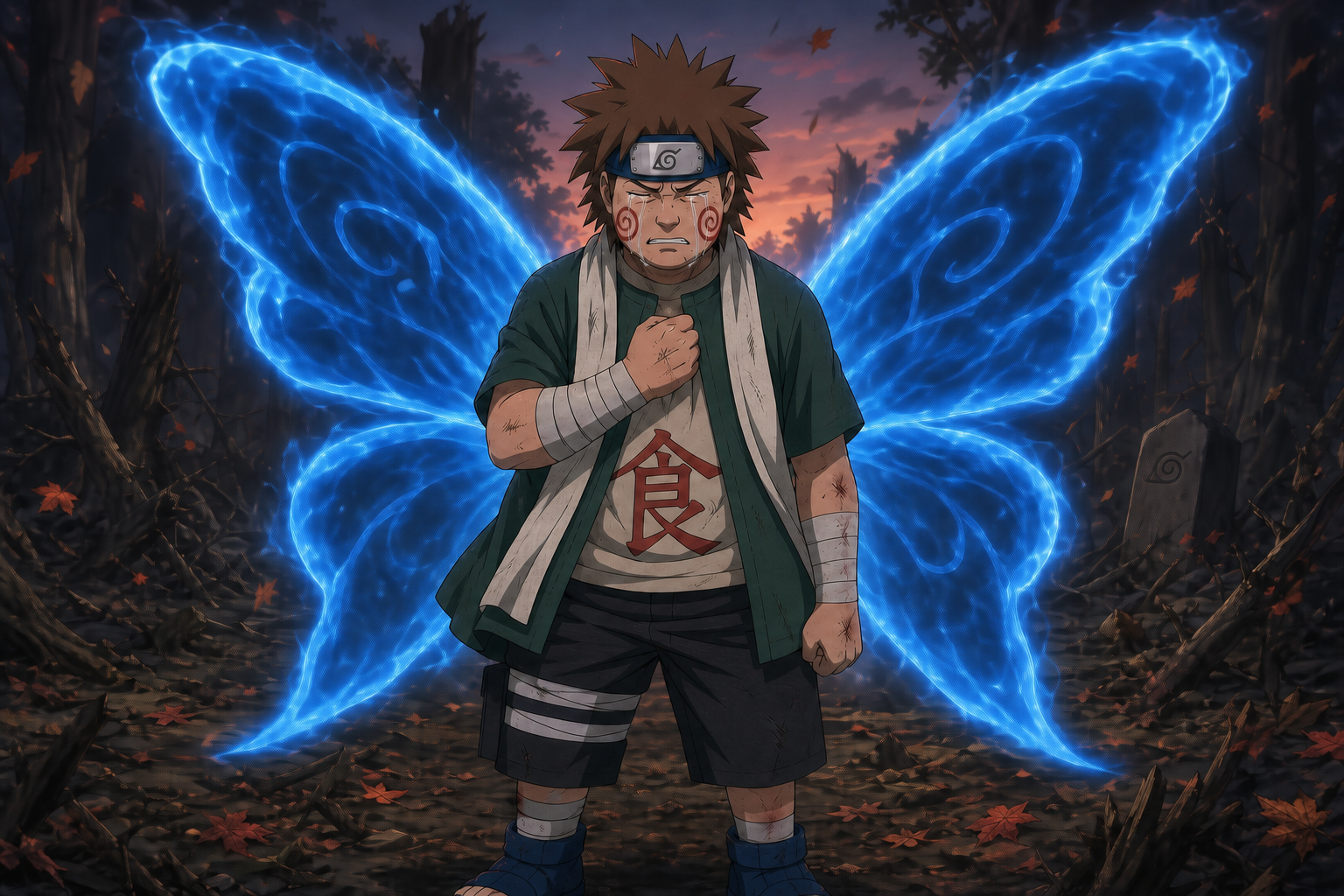
Chōji Akimichi is not a motivational poster about a fat child finally revealing a thin hero underneath. Kill that reading with fire, then use the ashes to season the barbecue. Chōji is worthy before Butterfly Mode. He is kind before the red pill. He is loyal before Jirōbō approves of nothing. His large body is already a shinobi body, a clan body, a child’s body, and his own body.
The transformation matters because Chōji stops letting shame decide what strength can look like. Akimichi techniques convert stored calories into chakra, enlarge flesh into force, and turn food into military energy. The butterfly is not a diet reward. The butterfly is the visible release of power his body was carrying.
His story has more meat than one fight. Shikamaru recognizes him when other children mock him. Chōza protects his gentleness without calling gentleness weakness. Asuma trains him inside an inherited team. Chōji risks death during the Sasuke mission, grieves Asuma, hesitates to strike a reanimated teacher, learns Butterfly Mode without pills, becomes a clan head, marries Karui, and raises Chōchō inside a franchise still arguing with fatness.
The bottom line is simple. Chōji’s softness and strength are not opposites. The story gets better whenever the camera remembers that.
His name carries an autumn road toward a butterfly
Akimichi can be read through characters associated with autumn and road. Chōji’s given name contains the butterfly character and a common masculine name element. The family name, food imagery and butterfly transformation create a seasonal cycle: stored abundance, conversion, change and movement.
The metaphor works because the caterpillar does not apologize for eating. Food makes transformation possible. The body accumulates energy, and the energy becomes wings.
That creative logic does not make the clan a nutrition lesson. Chakra conversion is fantasy physiology. Real fat people do not owe anyone super-strength, a tragic sacrifice, a thinner reveal or medical proof of usefulness.
Design chronology: stop treating size as the costume flaw
Part I Chōji has spiked brown hair, spiral cheek markings, a Konoha forehead protector, green outer clothing, shorts, bandages and the Akimichi food kanji across his chest. The round silhouette is immediate and belongs to the design rather than hiding beneath the outfit.
Part II changes his clothing, armor and proportions while keeping the cheek spirals, clan imagery and recognizable mass. War imagery adds larger transformations, butterfly chakra and adult resolve. Later designs show an older Chōji with longer hair and facial hair, then a father and clan leader whose body remains large.
The red Chilli Pill sequence rapidly consumes stored calories and makes him visibly slimmer. That body is a medical emergency, not his “true form.” The series places beauty-coded butterfly wings behind a body undergoing dangerous depletion. Viewers keep cropping away the danger because the thin reveal fits a familiar makeover story.
Butterfly Mode later becomes accessible through trained Calorie Control without the pills’ near-fatal shortcut. The key development is mastery. Chōji no longer needs to poison his body to access the clan’s highest conversion state.
Childhood body shaming teaches him to expect friendship as a trick
Other children exclude Chōji, mock his weight and dismiss the Akimichi. The insults do more than hurt feelings. Repetition teaches him that visibility is dangerous and acceptance may disappear as soon as his body becomes the subject.
Chōza understands that his son is unusually kind and worries that cruelty will make him withdraw. He does not demand that Chōji become harder to deserve protection.
Shikamaru watches the group judgment and rejects the premise. He shares food and time with Chōji, looks at clouds, and becomes his closest friend. The friendship starts before combat ranking makes Chōji useful.
That origin matters during the Sasuke mission. Chōji trusts Shikamaru’s leadership because Shikamaru recognized his humanity when no mission required the choice.
Food is pleasure, fuel, culture, commerce, and a lazy punch line
Chōji loves barbecue and snacks. Team 10 gathers around meals. Food becomes celebration, social glue, sensory pleasure and a visible part of how the Akimichi body stores combat energy.
The clan’s Calorie Control converts stored calories into chakra. Expansion techniques require enormous energy. Eating therefore belongs to world mechanics, not only appetite comedy.
The franchise still uses food and weight for jokes. Chōji becomes angry when people call him fat, and surrounding characters sometimes use euphemisms or deliberately push the trigger. Comedy can reveal insecurity, but repetition can also make one child’s body the public toy everybody touches with words.
Merchandising loves chips because a snack bag creates an easy prop. A complete profile has to put Chōji’s tactical, emotional and family life back beside the food. Appetite is a trait. Appetite is not a biography.
Shikamaru gives him recognition without a condition
Shikamaru never requires Chōji to eat less, become faster or prove courage before friendship begins. He understands that Chōji’s hesitation comes from gentleness and fear of hurting people, not absence of ability.
Chōji understands the loyalty beneath Shikamaru’s boredom. Their relationship works because each sees what the village misreads. The supposed lazy boy is responsible. The supposed weak fat boy is brave.
During the retrieval mission, Shikamaru leaves Chōji against Jirōbō because the matchup and Chōji’s insistence make tactical sense. The choice also carries intimate risk. Leadership means trusting a friend’s agency while knowing the trust may end at a grave.
The later rescue report nearly breaks Shikamaru because Chōji is not a chess piece. That is the point of the shōgi metaphor fandom keeps abusing. Strategy matters because pieces are people.
Team 10 makes inherited formation into chosen trust
Chōji forms one third of the sixteenth Ino-Shika-Chō with Shikamaru and Ino. Their clans transmit a cooperative system across generations.
Shikamaru restrains and plans. Ino senses, communicates, heals and targets minds. Chōji supplies mass, coverage, protection and destructive force. None of those roles makes one person the only brain or one person disposable muscle.
Asuma builds relationship through meals, missions and individual attention. He recognizes that Chōji’s kindness can become hesitation and that shame can limit access to power. Training has to create confidence without murdering gentleness.
The formation’s political value is obvious. Three clans maintain an alliance inside Konoha across generations. The children inherit belonging and duty before adulthood can negotiate either.
The Chūnin Exams show a boy with power but little confidence
Chōji enters the Chūnin Exams with Team 10 and uses expansion techniques during the Forest of Death and preliminaries. His match against Dosu ends quickly when sound-based attack bypasses the physical answer Chōji brings.
The loss establishes limits. Human Bullet Tank creates momentum and force, but sensory disruption, control counters and technique mismatch matter. A larger attack is not a universal key.
Chōji remains a genin after the exam. Shikamaru advances because command judgment, not team affection or strength alone, defines the promotion decision.
Later growth does not require rewriting the early loss as hidden dominance. Chōji was underdeveloped. Then he trained.
Jirōbō attacks his body because shame is the cheapest available weapon
During the Sasuke Retrieval Mission, Jirōbō traps and drains the team, then stays behind as Chōji’s opponent. Both fighters use size and force, but Jirōbō repeatedly insults Chōji’s weight, eating and worth.
The taunts are tactical because Jirōbō notices the wound. He wants Chōji angry, ashamed and easy to control.
Chōji stays because the team has to move. He opens the container holding the Akimichi Three Coloured Pills. Chōza warned him that the final pill can kill.
This is not a triumphant supplement routine. A child uses a clan emergency drug because the mission has no safe reserve.
The three pills convert a body into a countdown
The green Spinach Pill begins the escalation. The yellow Curry Pill forces greater power with harsher physical cost. The red Chilli Pill converts the body’s remaining calories into an enormous chakra release, multiplies power and creates the butterfly state.
Each stage spends more of Chōji’s safety. Energy becomes force faster than the body can tolerate. The red pill is described as effectively fatal without intervention.
Chōji uses expansion and Human Bullet Tank variants, endures Jirōbō’s Cursed Seal strength, and finally concentrates butterfly chakra into Butterfly Bullet Bombing. The strike defeats Jirōbō.
Victory leaves Chōji collapsed and near death. Medical rescue, Tsunade’s expertise and Nara-clan medical knowledge help save him. Friendship motivates the sacrifice. Institutions and other people make survival possible.
The sequence becomes uglier when treated as a makeover. Chōji does not nearly die so viewers can compliment his jawline.
The butterfly means released capacity, not a better body
Butterfly Mode forms visible chakra wings, presented as blue for Chōji in the Japanese anime. The user converts calories into chakra, dramatically increasing combat ability and allowing the energy to be compressed into attacks.
The wings make interior reserve visible. The metaphor honors what was stored rather than condemning storage.
Early access depends on pills and dangerous depletion. Later Chōji learns Calorie Control well enough to enter the mode without the same shortcut. That distinction is his technical growth.
The slim appearance results from energy conversion. The story’s emotional truth should remain attached to agency and mastery. If the only praise arrives after his body shrinks, the audience has repeated Jirōbō’s premise with prettier lighting.
Complete ability shelf: expansion has mechanics and a bill
Multi-Size Technique enlarges Chōji’s whole body. Partial Multi-Size enlarges selected limbs, often hands or arms, for targeted force and reach. Super Multi-Size takes the transformation to battlefield scale.
Human Bullet Tank retracts the limbs and turns the expanded body into a rolling attack. Spiked Human Bullet Tank adds weapons or hair-based spikes to increase damage and traction. Double Human Bullet Tank pairs him with another Akimichi user. Later variations change direction, momentum and coordination.
Super Open Hand Slap uses enlarged palms and chakra to strike across a broad area. Giant scale makes Chōji useful against summons, massed enemies, barriers and targets conventional taijutsu cannot cover.
Butterfly Bullet Bombing compresses the chakra wings into a fist for a decisive impact. The technique spends the visible reserve rather than granting permanent free strength.
The Fourth Databook associates Fire and Yang Release with Chōji. The manga also shows Earth Release: Practice Brick Technique, creating a rock wall, while the nature list omits Earth. That record deserves a boundary instead of pretending official catalogs never disagree.
Calorie Control is clan knowledge, not a joke metabolism
The Akimichi build combat around converting calories into chakra. Stored energy supports expansion, movement at altered scale and Butterfly Mode.
The technique explains why food, body mass and clan training sit together. Chōji’s body is prepared for a combat discipline outsiders reduce to eating.
Control matters more than raw supply. Early pills force conversion chemically and dangerously. Later mastery lets Chōji regulate access without the same death sentence.
The limits remain physical. Chakra runs down. Enlarged movement costs energy. A larger target can become easier to hit. Speed, terrain, balance, resistance and coordination affect success. Butterfly Mode cannot stay open forever because the wings are the reserve leaving his body in public.
Part II gives him training instead of pretending trauma was enough
Chōji returns older, stronger, quicker and more capable with clan techniques. His Third Databook growth reflects improved taijutsu, strength, stamina and ninjutsu.
The important change is access. He develops Butterfly Mode through Calorie Control rather than relying exclusively on the Three Coloured Pills.
That improvement rejects the idea that the Jirōbō crisis permanently solved him. One near-death victory creates evidence and motivation. Training creates repeatable skill.
His reaction speed and movement also improve enough to work inside more complex team plans. Chōji becomes more than a stationary impact device.
Asuma’s death puts gentleness inside a revenge team
Chōji and Ino arrive after Hidan’s curse fatally wounds Asuma. Team 10 watches their teacher die and receives his final words.
Shikamaru designs the rematch. Chōji joins despite grief and the danger posed by Hidan and Kakuzu. Kakashi accompanies them.
Chōji uses expansion and force against Kakuzu’s bodies and hardened defenses. His role is not the final clever reveal, so edits often crop him out. The larger operation still needs restraint, sensing, pressure, separation and survival.
Team 10’s revenge depends on collective labor. Shikamaru isolates Hidan. Kakashi obtains Kakuzu’s blood. Ino supports. Chōji attacks. Naruto and Yamato enter the Kakuzu endgame. Sakura and village medical systems remain part of the survival structure.
Grief does not make every choice wise. Pursuing Akatsuki while emotionally raw is dangerous. Tsunade and Kakashi create institutional containment around the team instead of demanding that teenagers mourn quietly and return to filing.
Pain reminds Konoha that durable bodies still need protection
During Pain’s assault, Chōji fights beside Chōza and Kakashi against the Deva and Asura Paths. Family technique and battlefield communication help create openings against abilities whose rules are still being learned.
Chōza is severely injured. Kakashi sends Chōji to deliver critical information about Deva Path’s interval to Tsunade.
The choice turns physical endurance into intelligence delivery. Chōji wants to remain with his father, but the village needs the message. Chōza tells him to go.
Chōji survives the destroyed village and learns that Chōza remains alive. The sequence avoids making fatherly sacrifice automatically terminal while preserving the terror of leaving an injured parent behind.
Reanimated Asuma asks whether kindness can strike the person wearing a corpse
During the Fourth Shinobi World War, Team 10 confronts a reanimated Asuma. Kabuto’s technique returns the teacher’s body and skill under coercive control.
Chōji freezes. He knows the target is reanimated. Knowledge does not make Asuma’s face emotionally neutral. His refusal to attack is not cowardice. The technique weaponizes attachment.
Ino and Shikamaru cover for him. Chōza confronts his son with clan duty and confidence. Asuma himself urges his students to stop him.
Chōji remembers promises to Asuma, his father and the next generation. He enters Butterfly Mode without the pills and expands to enormous scale. Team 10 completes the Ino-Shika-Chō formation against their teacher.
The moment works because courage includes tenderness. Chōji does not become strong by ceasing to love Asuma. He acts because love cannot permit Asuma’s body to keep killing people.
War-scale Chōji is not the same child with a larger slider
Giant Butterfly Mode gives the alliance a mobile wall and striking force. Chōji can cover teammates, restrain large targets and damage enemies whose scale overwhelms ordinary bodies.
Ino and Shikamaru remain essential. Mind communication, possession, shadow restraint and battlefield planning place Chōji’s force where force matters.
The war also kills Shikaku and Inoichi at headquarters. Team 10 inherits strategy and communication while fighting continues. Chōji’s promise to protect the next generation becomes immediate rather than ceremonial.
His kindness has matured into protective violence under consent and duty. The story never needs to call cruelty strength.
Chōza gives him faith without demanding a crueler son
Chōza is the fifteenth Akimichi clan head and a veteran member of the previous Ino-Shika-Chō. He understands technique, leadership, body judgment and the pressure attached to succession.
He tells Shikamaru that Chōji is kinder than anyone and believes that kindness can belong to a shinobi. Later he pushes Chōji during the Asuma battle because the battlefield requires action.
Those moments are not contradictory. Parenting changes with context. Chōza protects the child’s core and challenges the adult capacity growing around the core.
Chōji later becomes identified as the sixteenth head. Clan succession recognizes more than destructive force. A leader also carries food systems, medicine knowledge, technique instruction, alliance relationships and family care.
Karui and Chōji are canon; the courtship is mostly a blank page
By the epilogue, Chōji has married Karui of Kumogakure and they have Chōchō. The marriage creates an inter-village family after a war built around multinational alliance.
The main manga does not provide a full courtship chronology. A profile should not invent one from matching lunch orders and vibes. Later anime and novel material shows the family after formation more clearly than the path into marriage.
Karui is a Cloud kunoichi with her own village history, temper, skill and relationships. She is not a surprise prize handed to the funny fat guy. Chōji is not a consolation husband selected because the cast needed pairing.
The missing bridge is a legitimate industry criticism. The epilogue announces several adult couples faster than the story develops them. Honest uncertainty respects the characters better than fanfiction smuggled into biography.
Chōchō inherits body discourse and refuses to carry every old shame politely
Chōchō Akimichi inherits Akimichi techniques, Cloud and Leaf family ties, confidence, appetite and a world still eager to comment on girls’ bodies.
Chōji teaches her Calorie Control and Butterfly Mode within a parent-child relationship that the New Era explores more directly in anime material. Karui contributes discipline, cultural connection and her own approach to confidence.
Chōchō’s body stories sometimes challenge fatphobia and sometimes reproduce makeover logic through temporary slimming. Each episode needs analysis rather than a blanket “body positivity” sticker.
Chōji’s parenting matters because he knows what ridicule does. The test is not whether he can stop every cruel comment. The test is whether Chōchō learns that technique, beauty, appetite and belonging do not require self-hatred.
Masculinity does not need Chōji to stop crying
Chōji is sensitive, affectionate, food-loving, afraid, physically huge and capable of lethal force. The combination threatens a narrow masculinity model that accepts big men only when they are emotionally blunt.
His tears do not cancel courage. His hesitation around Asuma proves attachment. His loyalty to Shikamaru proves relational strength. His willingness to risk himself proves bravery and also raises questions about self-worth.
The Jirōbō fight becomes dangerous if masculinity says Chōji earns manhood by consuming a fatal pill. His real growth arrives later when he accesses power through mastery and team support.
Strength without gentleness would make him less Chōji, not more heroic.
Kentarō Itō and the original Japanese performance boundary
Kentarō Itō performs adult and primary-era Chōji in the original Japanese anime. Yūmi Kawashima is credited for childhood material.
Performance contexts worth lawful observation include food comedy, Jirōbō’s insults, the pill sequence, Shikamaru friendship, Asuma’s death, the reanimated-Asuma hesitation, butterfly resolve and family scenes with Chōchō.
The credits are verified. I am not inventing pitch, breath, comic timing, crying texture or vocal transformation without the heard Japanese scenes. A cast list is better than fake criticism hiding behind adjectives.
The anime controls color, sound, duration, music and body-motion timing differently from the manga. Those choices need episode-specific receipts whenever performance or adaptation craft enters the article.
Manga, anime, novels, films, OVAs, and games
The manga establishes Chōji from chapter 34 through Team 10, the Chūnin Exams, Sasuke Retrieval, Asuma/Hidan/Kakuzu, Pain, war, epilogue and later family status. The anime introduces him in episode 1 and expands childhood, missions, food comedy, Team 10 and New Era parenting.
His novel debut is cataloged in Kakashi Hiden. Blank-period and wedding-era prose uses the wider Konoha cast around the leadership transition. A named appearance belongs to the shelf only when the role is confirmed; Chōji’s presence in a cast list does not make every novel his subplot.
His film debut is Naruto Shippuden the Movie. He also appears in The Will of Fire, Blood Prison and Road to Ninja. Road to Ninja presents an alternate Chōji with different body and personality choices for contrast. That alternate is not mainline character development.
His OVA debut is Hidden Leaf Village Grand Sports Festival!. Games make him playable across Ultimate Ninja, Clash of Ninja, Ultimate Ninja Storm, Kizuna Drive and mobile titles. Game-only moves, damage multipliers, team ultimates and Chōza Butterfly Mode do not rewrite manga continuity.
Fandom arguments that need more than one snack-sized thought
“Chōji is useless except for the Jirōbō fight.”
Audit Team 10, Kakuzu, Pain, war-scale formation, reanimated Asuma, giant combat, clan succession and New Era family work. One iconic fight does not erase the rest.
“He only got strong because of drugs.”
The pills unlock dangerous forced conversion during Part I. Later Chōji enters Butterfly Mode through trained Calorie Control. The distinction is the character development.
“The thin form is the real Chōji.”
No. The slim state reflects calories converted into chakra. Chōji’s identity does not wait behind fatness like a before-and-after advertisement.
“He is just Team 10’s muscle.”
Chōji provides power, coverage, protection, timing, emotional cohesion and inherited formation knowledge. Ino and Shikamaru also exceed their easiest labels. Teams are not RPG slots with one personality each.
“His sensitivity makes him a bad ninja.”
Sensitivity delays action against reanimated Asuma and helps Chōji remain humane. Team support lets him act without amputating empathy. That is a stronger military ethic than emotional anesthesia.
“Karui marrying him came from nowhere, so the marriage is fake.”
The courtship is underwritten. The marriage and Chōchō are canon. Criticize missing development without denying the family’s existence or treating Chōji as inherently unbelievable as a partner.
“Chōchō proves the body arc got fixed.”
Chōchō adds confidence and new perspective. Some material still uses slimming, beauty and appetite inconsistently. Representation is a continuing argument, not a certificate framed after one episode.
“Blue wings are less symbolic than red wings.”
Symbolic preference does not outrank the adaptation record. Chōji’s anime wings are blue. An editor cannot repaint canon because autumn red looks moodier on a card.
Confucian reciprocity makes food and formation into duty
Chōji receives clan knowledge, Chōza’s faith, Asuma’s teaching, Shikamaru’s friendship, Ino’s support and village protection. Those relationships create reciprocal duties.
He repays friendship through risk and presence. He carries Asuma’s next-generation promise. He later leads the clan and teaches Chōchō.
Reciprocity does not mean self-destruction on command. A clan that gives a child fatal pills without medical systems would fail its side of the relationship. The Sasuke mission survival depends on other clans’ knowledge and Tsunade’s medicine, showing that duty has to be institutional and mutual.
Ino-Shika-Chō embodies reciprocity as technique. Shadow restraint, mind connection and enlarged force work because nobody performs the whole system alone.
Buddhist impermanence lets the butterfly stay temporary
Butterfly Mode is beautiful because the wings spend themselves. The form cannot become permanent without erasing the conversion that makes the image meaningful.
Chōji loses Asuma. The child body changes. Team roles shift. Chōza yields clan leadership. Shikamaru becomes an adviser. Ino becomes a mother and sensory leader. The formation persists through change rather than freezing one perfect era.
Non-attachment does not ask Chōji to stop loving food, friends or teachers. The lesson is refusing to make one body state, one victory or one relationship the only acceptable form of life.
The final verdict: the body was never the apology
Chōji’s greatest victory is not becoming thin enough to glow. His greatest victory is building enough trust and control that shame no longer owns access to his strength.
Shikamaru saw him before the village valued him. Chōza protected his gentleness. Asuma trained a team rather than a weapon. Ino and Shikamaru held the line when grief froze him. Chōji then chose action without pretending the grief vanished.
He becomes a husband, father, clan head and veteran without trading softness for authority.
Chōji was never the caterpillar everybody had to tolerate until the butterfly arrived.
The butterfly was proof of what the caterpillar had been carrying all along.
Sources and canon boundary
Manga chronology controls this profile. Anime staging, databook material, novels, films, games, and later franchise appearances are labeled instead of being blended into one false continuity.
Primary franchise references: Naruto Official and VIZ Media Naruto. CVM Sekai’s conclusions about Chōji’s body politics, clan techniques, friendship with Shikamaru, Team 10 bonds, grief, war service, and family legacy are editorial analysis, not invented creator quotations.