
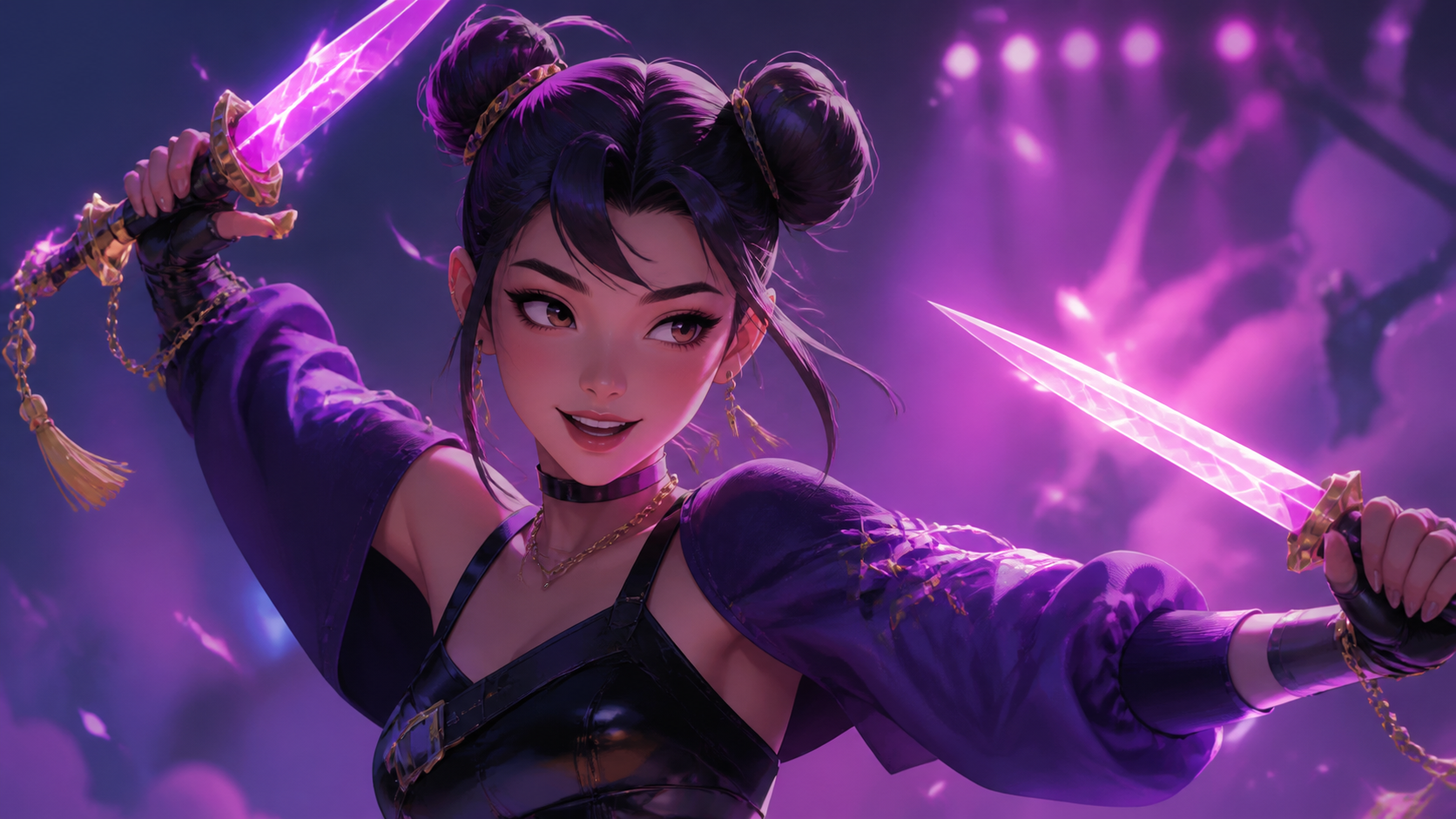
Zoey in KPop Demon Hunters
Profile
| Field | Detail |
|---|---|
| Name | Zoey |
| Age | 22 to 23 in Netflix’s official character file |
| Group | HUNTR/X |
| Group role | Rapper, lyricist, and maknae |
| Cultural background | Korean American, raised in Burbank, California |
| Hunter role | Demon hunter and ranged-weapon specialist |
| Weapon | Shin-kal, magical throwing knives |
| Speaking performer | Ji-young Yoo |
| Singing performer | REI AMI |
| Closest partners | Rumi and Mira |
| Saja Boys connection | Immediately attracted to Mystery Saja |
| Central conflict | She tries to make herself irreplaceable because belonging never feels guaranteed |
| Status after the film | Alive, reunited with HUNTR/X, and helping create the transformed Honmoon |
Zoey is the bright one, which means people keep trying to treat brightness as if it arrived without maintenance. She is funny, affectionate, distractible, creative, and openly impressed by the Saja Boys when she is supposed to be planning their destruction. Under all that sparkle sits a quieter calculation. If she keeps bringing ideas, lyrics, energy, and emotional glue, maybe nobody will notice she still feels between worlds.
Netflix’s official profile calls her the rapper and maknae of HUNTR/X, a Korean American who grew up in Burbank and struggled with belonging across the United States and Korea. That history gives her enthusiasm a sharper edge. Zoey is not simply eager because she has the youngest-member assignment. She has learned that visible usefulness can answer the fear of being the extra person in the room.
Her arc is not becoming less cheerful. It is learning that cheerfulness does not have to pay rent for her place in the group.
The visual file
Zoey’s design moves quickly. Expressions arrive before she has time to filter them. Her body can pivot from stage precision into a full reaction without losing character continuity. That speed makes her readable inside HUNTR/X and gives the animators room for comedy.
She often carries the most openly animated enthusiasm of the trio. Mira may answer nonsense with a look. Rumi may redirect the room. Zoey lets the entire feeling cross her face. That visibility makes her easy to love and easy to underestimate.
Her styling supports a youthful group position without turning her into a child. Maknae means youngest member, not baby. Zoey can be cute, sexually aware, professionally skilled, and dangerous with a knife in the same film.
The throwing knives fit her rhythm. Rumi and Mira use weapons that keep the hand connected through a longer strike. Zoey releases hers. Accuracy depends on reading distance, timing, and where the target will be after the weapon leaves her control. That is an excellent physical metaphor for a lyricist. She sends something outward and cannot decide exactly how the audience will receive it.
Her fan-art hero should show the face clearly and preserve the knives as part of character identity. The image belongs inside CVM Sekai’s purple system. A bright character does not require a random neon website.
Burbank and the between-worlds problem
Zoey grew up Korean American in Burbank, California. The film does not give a complete immigration or family chronology, so a profile should not invent one. The official context is enough to understand the tension. She moves into a Korean group while carrying a relationship to Korea shaped partly from outside it.
People often talk about being between cultures as if two complete boxes sit on either side and the person failed to choose. Real identity is messier. Language, family habits, food, humor, beauty standards, media, school, race, nationality, and other people’s assumptions do not line up on one clean scale.
Zoey may feel too American in one room and too Korean in another. That does not make her half of two people. It means belonging is repeatedly judged by different tests.
HUNTR/X gives her a place where the Korean American perspective becomes creative material rather than an error. Her notebooks, words, and odd ideas contribute to the group. Yet success does not automatically delete the old anxiety. A person can receive applause from millions and still watch the two closest people for signs that the invitation has expired.
Ji-young Yoo told Netflix that Zoey keeps offering ideas because she wants to seem irreplaceable, even though she already is. That statement explains the emotional engine better than any generic “she is insecure” label. Zoey does not merely want praise. She wants proof that the group cannot continue without her.
Maknae is a relationship, not a personality
Maknae identifies the youngest member. K-pop content often turns the position into a package of expectations: cuteness, mischief, care from older members, and permission to behave in ways that would read differently from the eldest. Real group relationships are more complicated.
Zoey enjoys parts of the role. Her enthusiasm and comic timing fit the energy audiences expect from a younger member. Rumi and Mira protect her, tease her, and absorb some of her chaos. She also protects them.
The danger appears when the role makes her emotional work invisible. The cute youngest member may be expected to restore the mood, accept guidance, and remain easy to love. Zoey can begin treating discomfort as a failure to perform her position.
Her notebooks and songwriting challenge that reduction. She is not only the energy reacting to decisions made by older members. She produces ideas that shape HUNTR/X’s voice. Lyrics give her authority even when group hierarchy places her last by age.
The final conflict forces Zoey to act beyond the safe version of maknae loyalty. She cannot simply follow Rumi, agree with Mira, or keep everybody happy. She has to decide what she believes about the secret and the friendship.
Twenty-three notebooks are not a cute side detail
Zoey mentions having twenty-three notebooks filled with demon insults. The joke works because the number is absurd and completely believable for the character. The notebooks also provide the strongest receipt that creativity is how she organizes the world.
Writing turns observation into material. A frightening demon can become a line. A ridiculous enemy can become a rhyme. An uncomfortable feeling can sit on paper before Zoey knows whether the group wants to hear it.
Before HUNTR/X, she believed the thoughts and lyrics were useless and weird. Inside the group, they mean something. Her statement that the work gives her meaning reveals both the gift and the danger. Creative belonging saved her. She may also believe belonging disappears if the work stops.
That belief can produce enormous output. It can also make rest frightening. A blank notebook page begins to look like evidence that she is no longer necessary.
A sequel should treat her as a songwriter, not just the member who suggests a diss track. Let us see how she revises, argues about a line, responds to a producer, and decides which truth belongs in a public song. Her identity conflict should affect language choices without reducing bilingual or diasporic writing to a classroom lesson.
The notebooks are a private archive. They may contain jokes, fears, unfinished songs, terrible rhymes, and observations about Rumi and Mira nobody else has seen. Zoey deserves privacy even inside a story that celebrates sharing truth.
Zoey and Rumi
Zoey looks to Rumi as leader, older group member, friend, and proof that HUNTR/X is stable. Rumi’s control can feel reassuring to somebody who worries about belonging. If the leader knows what to do, Zoey can keep contributing without asking whether the foundation is secure.
Rumi’s secret breaks that reassurance. Zoey learns that the person she trusted was suffering and did not believe the group could hold the truth. The hurt contains guilt. Why did she not see it? Were her emotional instincts fake? Did constant enthusiasm make it easier for Rumi to redirect her?
Gwi-Ma can use those questions to turn care into self-accusation. If Zoey failed to notice, perhaps she is not truly connected. If Rumi did not tell her, perhaps her place was never as important as she believed.
The film’s official character material notes that she never fully turns against Rumi. That does not mean the reveal does not injure her. It means loyalty remains available while she is angry and confused.
Her return gives Rumi something essential. Zoey chooses the whole person with new information. The warmth is no longer based on an edited version.
Rumi owes her more honesty after the battle. Zoey also needs to stop treating Rumi’s need as proof that she failed to be useful enough. Friends are not mind-reading services.
Zoey and Mira
Mira gives Zoey a counterweight. Where Zoey produces possibilities, Mira tests them. Where Zoey expresses the feeling immediately, Mira may hold it under a sharper surface. Their differences make the trio functional.
Zoey can help Mira remain open after suspicion activates. Mira can help Zoey recognize that keeping the peace is not the same as protecting the relationship. Each has a defense the other can interrupt.
During the fracture, shared hurt could pull them into a false unity against Rumi. That would feel stable for a moment. It would also make Gwi-Ma’s work easier. The two women need enough independent thought to avoid using agreement as a substitute for judgment.
Their decision to return should be read as a relationship between them too. They help each other cross back toward Rumi. Neither woman has to complete the moral reasoning alone.
A sequel needs scenes where Zoey and Mira create without the leader. Songwriting and choreography naturally connect. Zoey can bring lines; Mira can test how those lines move. Their disagreements would reveal both crafts.
The friendship could also address cultural belonging from different positions. Mira’s traditional-family black-sheep history and Zoey’s Korean American between-worlds history are not the same wound. The contrast deserves conversation without one becoming the authentic judge of the other.
Zoey and Mystery
Mystery Saja is Zoey’s type, which is a very funny problem when her job is killing demons. The attraction works because the film lets desire remain embarrassing and specific. She knows the Saja Boys are suspicious and still gets distracted by excellent hair and withheld information.
Mystery’s persona is designed around absence. His face stays concealed, so the viewer supplies attention. Zoey, who fills notebooks and social space with ideas, becomes attracted to a character offering a blank she can interpret.
The pairing also exposes how the Saja Boys’ strategy works. They do not need to hypnotize fans before the performance has ordinary appeal. Zoey is already responsive to the product. Supernatural manipulation intensifies a route built through styling, choreography, persona, and curiosity.
Her final confrontation with Mystery matters because she destroys the fantasy after admitting its appeal. Strength does not require pretending she never found him attractive. It requires refusing to let attraction make the moral decision.
Mystery receives less interiority than Jinu. A profile should not invent a secret love story between them. Zoey is attached to the persona. The film gives no evidence that Mystery forms an independent bond with her.
The joke stays better when we keep the asymmetry. She had a type. The type barked, served a soul-eating demon king, and needed to go.
Zoey and Bobby
Bobby manages HUNTR/X’s celebrity career and responds to crisis with frantic professional energy. Zoey may be the member most willing to follow one of his ideas long enough to discover why Mira is staring at both of them.
The manager relationship matters because Zoey’s need to contribute can make her easy to overload. A creative young member who always has another notebook may be treated as an endless source of content. Bobby needs to distinguish enthusiasm from capacity.
Zoey also offers management a bridge to the audience. She understands shareable moments, emotional tone, and the kind of strange detail fans remember. That skill should not be reduced to accidental cuteness.
If Bobby does not know about demon hunting, he lacks the information required to protect her schedule and safety. The transformed Honmoon should force the trio to reconsider who inside their working team receives the truth.
Their comedy can continue. So should the labor conversation. Being the youngest does not make Zoey the default volunteer for every promotional idea nobody else wants.
Ji-young Yoo’s speaking performance
Ji-young Yoo gives Zoey speed without making every line sound frantic. The character’s thoughts often reach her mouth quickly, but the performance still distinguishes excitement, nervous contribution, attraction, fear, and genuine certainty.
Yoo told Netflix that Zoey is the only Korean American member and is trying to understand what that means and where she belongs. She connects the character’s constant ideas to a desire to seem irreplaceable. That interpretation gives purpose to the rhythm. Zoey fills space because empty space may allow somebody to decide she does not fit.
The performance lets warmth remain strong rather than naive. Zoey can be eager to please and still fight with total commitment. She can become enchanted by the Saja Boys and still recover enough judgment to oppose them.
Her comedy depends on sincerity. The Mystery Saja attraction works because Zoey is not standing outside the joke. She really does begin describing his supposedly disgusting beauty until the plan collapses under her own honesty.
During the group fracture, speed changes. A character accustomed to generating another idea meets a problem no clever line can solve. Yoo allows confusion and hurt to interrupt the familiar momentum.
The final return sounds earned because brightness comes back with a decision underneath it. Zoey is not resetting to the opening personality. She is using warmth after learning warmth cannot control every response.
REI AMI’s singing performance
REI AMI supplies Zoey’s singing voice and helps define her as HUNTR/X’s rapper. The performance needs rhythmic personality strong enough to remain distinct beside Rumi and Mira while supporting the group’s unified sound.
Rap inside a fictional idol group carries several story jobs. It can accelerate a song, change texture, deliver attitude, and give the lyricist character a place where words arrive with visible ownership. Zoey should sound like somebody who keeps notebooks.
REI AMI’s vocal energy supports the character’s quickness without turning her into a novelty break between larger choruses. Distribution gives Zoey authority. She moves the song rather than commenting from its edge.
The contrast between singing and speaking performers also reflects the production’s collaborative body. Yoo builds Zoey’s conversational timing and emotional life. REI AMI carries musical identity. Songwriters, vocal producers, choreographers, animators, and editors align both performances into one person.
Credits should remain exact. A page that calls Ji-young Yoo the singer erases REI AMI. A page that treats REI AMI as the full speaking character erases Yoo. The audience hears one Zoey because multiple artists completed different parts of her.
The final song gives the singing performance moral weight. Zoey’s voice rejoins the group after her fear of being useless and blind has been activated. She sings because she belongs, not to purchase belonging.
The shin-kal and the decision to let go
Netflix’s official Zoey file identifies her weapons as shin-kal, magical throwing knives. The film adapts the term and weapon into its own supernatural action design. A careful profile can name the official label without pretending every glowing move reproduces a living ritual practice.
Throwing knives fit her because they turn timing into trust. Zoey releases the weapon before impact. She must understand distance, motion, and what will happen after control leaves her hand.
Lyrics behave similarly. A writer can choose the words and performance, then the audience carries them into contexts the writer cannot supervise. Meaning continues after release.
The knives also let Zoey fight across space. Rumi and Mira may define a closer physical boundary around their bodies. Zoey watches the field, identifies an opening, and intervenes from another position. That role resembles the way she monitors group emotion.
Accuracy matters more than size. The weapons do not need to be the largest objects in the frame to change the fight. Zoey’s contribution follows the same principle. The youngest member does not need to become the leader to be essential.
Her final confrontation with Mystery turns attraction into aim. She stops feeding the blank persona with attention and makes a decision about the actual threat occupying it.
People pleasing can look exactly like generosity
Zoey is genuinely generous. She wants the group to feel better, brings ideas, shows affection, and protects her friends. People pleasing does not make those actions fake. It adds a hidden condition inside the giver.
If everybody is happy, Zoey feels safer. If her idea solves the problem, her place feels measurable. If she remains cute and useful, rejection seems less likely. The behavior helps the group while quietly teaching Zoey that need is dangerous unless transformed into service.
That is why Rumi’s secret destabilizes her. Zoey offered constant attention and still did not receive the truth. The result can feel like proof that her best skill failed.
The healthier conclusion is not that she should stop caring. She needs to allow care without making another person’s response a verdict on her value. Rumi’s secrecy came from Rumi’s history and Celine’s teaching. Zoey could not perform enough warmth to remove a fear she did not know existed.
The final reunion allows her to give care as a choice rather than a bargain. The next step is receiving care without first presenting another solution.
Her attraction to the Saja Boys is not evidence that she is stupid
Zoey falls under the Saja Boys’ charm early and remains affected longer than the others. The official character file acknowledges it directly. The joke works because she is visibly trying to maintain professional disgust while her senses file a different report.
Treating that response as stupidity would weaken the villains. The Saja Boys are designed to attract attention. Their music, styling, choreography, personas, and supernatural influence operate together. Intelligent people respond to pleasure.
Zoey may be especially vulnerable because fandom and creativity are open systems for her. She notices hooks, faces, gestures, and performance choices. The same receptiveness that helps her write can make an expertly designed distraction effective.
Recovery does not require shame. She can admit the song was good and still oppose the purpose behind it. Moral judgment becomes stronger when it survives attraction rather than denying attraction occurred.
The film also protects fans from becoming the punchline. If a trained demon hunter can get distracted, ordinary listeners are not uniquely foolish. The predator built a convincing product.
The group fracture attacks her authorship
Zoey tells Rumi and Mira that her thoughts and notebooks gained meaning through HUNTR/X. That confession exposes what Gwi-Ma needs to target. If the group bond was false, then perhaps the songs were never truly hers either.
Creative people often attach identity to the community that first receives the work seriously. Losing the community can feel like losing the evidence that the work mattered.
Zoey’s fear of replaceability turns the group conflict into an authorship crisis. Another rapper could perform a verse. Another lyricist could bring a hook. If usefulness purchased her place, the market can always find another useful person.
The final song provides a different answer. Zoey contributes after the polished group image has failed. Her value does not depend on maintaining the image. The words matter because she made them and because the relationship can hold her beyond output.
A sequel should test that answer gently. Let Zoey write something the group does not use. Let a bad draft remain a bad draft without becoming evidence that she is disposable. Creative safety includes surviving ordinary failure.
Idol labor and the youngest-member tax
HUNTR/X expects all three women to sing, dance, travel, promote, and fight demons. Zoey’s age position may add another layer of availability. The youngest member is often expected to bring energy, accept teasing, try the embarrassing challenge, and remain grateful for care from older members.
Zoey appears to enjoy performance and fan connection. Enjoyment can hide exhaustion because other people interpret enthusiasm as unlimited capacity.
Her lyricist role means work may continue after rehearsal. Ideas arrive in transit, at night, or during the rest period that becomes another notebook session. Twenty-three notebooks are funny. They also suggest a brain that does not clock out cleanly.
Demon hunting makes recovery harder. Throwing weapons, dodging attacks, and generating Honmoon power share a body with recording and choreography. If Bobby does not know the full workload, the public schedule cannot account for it.
Zoey needs permission to be the quiet member sometimes. A group should not require its warmest person to regulate everyone else after every crisis.
The ending gives her belonging without a citizenship test
Zoey’s cultural conflict does not receive a speech declaring she has become Korean enough or American enough. Good. That answer would preserve the test.
She belongs to HUNTR/X because of relationship, work, history, love, argument, and choice. None of those require deleting Burbank from her story or proving perfect fluency in an imagined authentic identity.
The transformed Honmoon carries that conclusion at a larger scale. Protection no longer depends on one pure category. Different histories can participate without becoming identical.
That does not solve every diasporic discomfort. Zoey will still enter rooms where people measure her. Fans may project identity arguments onto her. Media may ask her to translate an entire country or diaspora through one charming answer.
Belonging gives her a home from which to face those pressures. It does not make the pressure imaginary.
The sequel should let her define Korean American identity through ordinary detail as well as conflict. Food preferences, language habits, jokes, family calls, music references, and minor misunderstandings can do more than another speech about two worlds.
Questions the sequel should answer
What is inside the notebooks beyond demon insults? The material should reveal craft, private thought, bad drafts, and parts of Zoey that never became HUNTR/X content.
How did she join the group and hunter tradition after growing up in Burbank? Training history would connect the cultural and professional parts of her identity.
What relationship does she have with family in the United States and Korea? The answer should avoid turning one side into the source of authenticity.
How does she respond when HUNTR/X rejects one of her ideas? Creative disagreement is a useful test of belonging that does not require another apocalypse.
Can she rest without interpreting silence as replaceability? The group’s future depends on separating love from constant output.
How will she relate to fans after experiencing supernatural attention capture? A lyricist may become more careful about the promises songs make.
What does she want beyond being useful to Rumi and Mira? A complete character needs desire that remains hers even inside chosen family.
RaeRae’s character verdict
Zoey is not comic relief with knives. She is a writer who turned weird notebooks into group language, a Korean American woman whose belonging has repeatedly been measured, and a youngest member who learned to make usefulness look like sunshine.
Her brightness is real. So is the fear underneath it. The movie respects her when it lets both exist without announcing that one cancels the other.
Ji-young Yoo makes speed, warmth, and insecurity belong to the same speaking voice. REI AMI gives the rapper musical weight inside HUNTR/X rather than treating her verse as an accessory. The shin-kal completes the pattern. Zoey creates, releases, and trusts the thing to reach its target.
Mystery Saja remains an extremely embarrassing type, and I support the film for letting her have eyes before making her use judgment. Attraction was not the failure. Letting Gwi-Ma decide what attraction required would have been.
Zoey’s ending works because she returns to the group without proving she is irreplaceable through one final brilliant idea. She belongs before the next notebook opens.
Official sources
Netflix Tudum’s official Zoey character file provides her age range, group position, Korean American and Burbank background, shin-kal weapon, speaking and singing performers, Mystery connection, notebooks, people-pleasing tension, and story arc.
Netflix’s official cast feature includes Ji-young Yoo’s explanation that Zoey keeps offering ideas because she wants to seem irreplaceable while struggling with where she belongs. Netflix’s soundtrack coverage identifies REI AMI among HUNTR/X’s singing performers and documents the collaborative music process.
These sources establish credits and character facts. The analysis of diaspora, creative labor, group hierarchy, attraction, and belonging is RaeRae editorial interpretation of the completed film.