
STITCH! CHARACTER PROFILE · IZAYOI · KARATE · ALL THREE SEASONS
Yuna Kamihara Character Profile: The Girl Who Made Stitch Earn the Word Friend
Yuna did not replace Lilo. She made Stitch prove that a new friendship could carry its own place, rules, mistakes, and history.
Profile record
Full name: Yuna Kamihara
Japanese name: 加美原ユウナ
Home: Izayoi Island; later New Town
Family: Obaa, grandmother and caregiver; father and mother central to the family history
Known skills: Karate, island navigation, spirit-world knowledge, crisis improvisation
Japanese voice: Motoko Kumai
Appears in: All three Japanese television runs and later branch specials
Yuna before the space storm
Yuna Kamihara is a child of fictional Izayoi Island, a karate student, and Obaa’s granddaughter before Stitch crashes into her life. She already has discipline, local knowledge, friendships, grief, and a temper. The alien does not arrive to give an empty girl a personality. He enters a household whose rules and memories existed without him.
That distinction keeps Yuna from becoming a replacement slot for Lilo. Both girls are stubborn and lonely enough to confront Stitch. Yuna’s story is built through Okinawan and Ryukyuan cultural signals, martial arts, the Chitama Stone, island spirits, parental absence, and a later move to New Town. Similar narrative work does not make their lives interchangeable.
Karate is character structure, not a cute combat gimmick
Yuna’s karate training gives her physical confidence around a creature who can lift vehicles and survive weapons. She cannot overpower Stitch, but she understands stance, repetition, attention, boundaries, and the humiliation of being corrected in public. Those habits shape how she argues and how she teaches.
Discipline can become control when Yuna assumes that knowing the rule means she has fully understood the person. Her strongest moments connect technique to responsibility. Her weaker moments demand obedience because she is frightened or embarrassed. Karate makes her capable. It does not make her morally perfect.
The forty-three-good-deed bargain puts too much labor on a child
Stitch wants the Chitama Stone to grant him the greatest power in the universe. Jumba builds the counter. Yuna becomes the person expected to explain which actions qualify as good and to manage the disasters Stitch creates while optimizing the number. The arrangement is funny and deeply unfair.
A child can be a friend and moral witness without becoming a created person’s full-time rehabilitation program. Jumba understands Stitch’s design. Pleakley understands galactic systems. The adults repeatedly leave Yuna with the supervision, repair, and emotional translation. Her anger often reflects workload before it reflects personality.
Why Yuna accepts Stitch
Yuna recognizes that Stitch is dangerous and displaced. She does not wait for proof that he will become convenient. Her household offers food, rules, conflict, and continued presence. That is closer to family than a reward for completed behavior.
She also wants companionship. The wish does not make her care false. It makes the relationship mutual. Yuna can need Stitch and still be responsible for how she uses his loyalty. Several episodes become strongest when her desire to keep him close conflicts with his right to choose or with another person’s safety.
Obaa gives Yuna roots and an authority she can argue with
Obaa is caregiver, household leader, keeper of stories, and the adult who understands that a strange guest cannot be managed through fear alone. Yuna loves her and pushes against her. Their home feels credible because respect does not eliminate disagreement.
Obaa’s knowledge also prevents Yuna from becoming the sole cultural translator. A child should not have to represent an entire island. When Obaa remembers a story, interprets a place, or recognizes a pattern, the series distributes knowledge across generations. The branch needs that structure whenever its invented mythology approaches real Okinawan references.
Kijimunaa is Yuna’s friend, not local decoration
Yuna’s relationship with Kijimunaa predates many of Stitch’s island adventures. She does not meet the spirit as an exotic obstacle requiring capture. He belongs to her social world. That familiarity teaches Stitch that personhood on Izayoi cannot be limited to humans and registered experiments.
Yuna can still take Kijimunaa for granted. Friendship with a local spirit does not make every cultural claim correct, and the anime’s recurring character is not a definitive map of Okinawan tradition. Her profile keeps the bond inside the story while the guide supplies external context.
Parents who are absent still shape every room
Yuna’s family history includes separation from her father and the loss or absence surrounding her mother. The series reveals pieces across its run instead of placing one explanatory speech at the beginning. Her independence often looks impressive because nobody has asked what necessity built it.
Stitch’s presence can ease loneliness without repairing parental absence. He is another childlike being with enormous needs. Yuna sometimes gains a companion and another dependent at the same time. The branch becomes emotionally honest when it allows affection and exhaustion to coexist.
New Town changes the terms of belonging
Season three moves Yuna away from the daily environment that made her confidence legible. In New Town, school status, unfamiliar routines, and new social groups replace the island’s established relationships. The move does not erase Izayoi. It reveals how much of Yuna’s identity had been supported by place.
Her struggle to make friends can look like ordinary school comedy, but relocation has removed her local competence from public view. Classmates see a new girl with an unruly alien. They do not automatically see the martial artist, granddaughter, community member, and experienced protector the audience already knows.
The adult-Lilo episode should not turn Yuna into a rival child
When adult Lilo appears, franchise grief enters Yuna’s story directly. The episode attempts to explain why Stitch left his first human family. Fans often respond by asking which girl belongs with him. That question turns two children into competing owners of a person.
Yuna is not responsible for the script’s continuity bridge. Her bond with Stitch can be real while the explanation for Lilo remains painful or insufficient. A serious React judges the episode’s treatment of memory, abandonment, adulthood, and reunion without blaming Yuna for existing after an earlier promise.
Yuna’s mistakes matter because she is allowed to be a full character
She can be jealous, controlling, impulsive, proud, and too certain that her solution is the responsible one. Those flaws produce consequences for friends who have less physical power or less authority in the household. The profile should not excuse every decision because she is young.
It should also refuse the opposite error. Children learn through incomplete judgment. Yuna repairs, listens, apologizes, and sometimes repeats a pattern under new pressure. Growth appears across choices rather than through one perfect speech. Her sharp edges are evidence that the anime wrote a protagonist instead of a morality mascot.
Motoko Kumai’s Japanese performance
Motoko Kumai voices Yuna in the Japanese production. Her performance gives the character a sturdy, forward attack that suits karate training and island confidence, then makes vulnerability audible when family questions or social rejection break through. The voice does not ask the audience to treat Yuna as delicate in order to recognize that she can be hurt.
This profile uses the Japanese performer record because Stitch! is a Japanese anime branch. International dub performances belong in distribution and version notes. They do not replace Kumai’s work on the central character page.
What Yuna changes in the franchise
Yuna demonstrates that Stitch can form another chosen family without repeating the original film beat for beat. She brings martial discipline, island spirit relationships, a measurable good-deed system, different family absence, and an urban relocation arc into the franchise’s argument about belonging.
She also exposes the danger of portability. A famous character can travel more easily than cultural responsibility. The branch succeeds when Izayoi, Obaa, Kijimunaa, karate, and community practices change how the story works. It weakens when local meaning becomes decoration around a familiar blue mascot.
The burden hidden inside being the capable child
Yuna is frequently the person who notices the danger, understands the local warning, runs toward the emergency, and then translates the lesson for Stitch. That competence makes the episodes move, but it also creates a quiet emotional burden. Adults can begin treating a dependable child as if she needs less care. Friends can assume she will forgive chaos because she has survived it before. Even Stitch can mistake her willingness to help for an unlimited supply of patience.
The strongest Yuna stories let that pressure become visible. Her anger is not automatically a failure of kindness. Sometimes it is the only available signal that everybody else has allowed the work of keeping the group together to settle on her shoulders. When an episode rushes past that anger so Stitch can perform one good deed and collect another mark, the emotional accounting feels incomplete. Repair requires attention to what Yuna carried before the apology arrived.
Friendship with a creature who can overpower the room
Stitch is funny, affectionate, and physically dangerous. A profile that focuses only on cute companionship misses the imbalance Yuna has to negotiate. She cannot win every disagreement by force, and karate does not magically erase the difference between a trained child and an engineered alien. Her real leverage comes from trust, knowledge of his habits, family rules, and the willingness to tell him when affection has become an excuse.
That makes their bond more interesting than a simple owner-and-pet arrangement. Yuna does not merely command Stitch, and Stitch does not merely protect Yuna. They bargain, provoke, disappoint, rescue, and re-evaluate each other. The relationship works when both characters retain the power to say no. It becomes shallow whenever an episode treats Yuna as the person assigned to absorb whatever destruction makes the comedy land.
The unanswered questions
The complete Japanese branch leaves Yuna with more history than a short synopsis can hold. How does she understand Stitch’s earlier family after meeting Lilo? What does she retain from New Town when she returns to island life? How does a child set boundaries with a friend whose body can become a public emergency?
A profile does not need to invent canon answers. It keeps the questions attached to the episodes that created them. Yuna remains the girl who welcomed Stitch, challenged his reward-driven idea of goodness, carried too much adult labor, made selfish mistakes, and demanded that friendship become something practiced rather than announced.
Sources and image record
Character identification and the Japanese cast use the official TV Tokyo character archive, Disney Japan release records, and Japanese episode evidence across the three production runs and later specials.
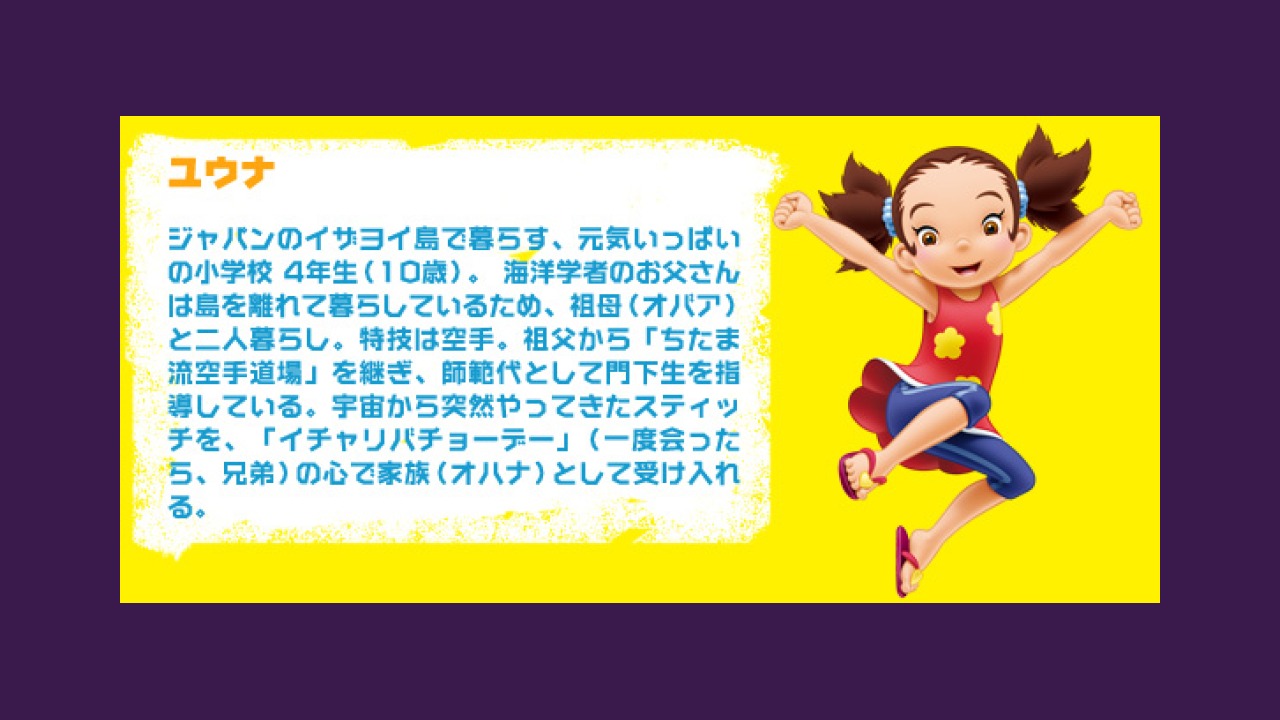
The hero uses official TV Tokyo Yuna artwork retained locally and placed on a CVM Sekai 16:9 canvas without altering the figure. It serves as the post’s featured image, hero, and directory card. Metadata preserves the original source and editorial-use note.
Keep exploring
Return to the Stitch! anime hub, open the world and lore guides, or return to the complete franchise.
Yuna is not the person Stitch meets before he has a history
Lilo meets a destructive experiment who has never experienced family. Yuna meets Stitch after he has already been adopted, learned repair, found cousins, and lived through several endings. That difference shapes every conflict. She is not teaching personhood from the beginning. She is dealing with somebody whose growth should already exist and whose relocation history the branch does not explain cleanly.
A complete profile must therefore judge regression as regression. When Stitch repeats an old lesson, the anime should provide pressure, context, or a changed problem rather than pretending the Hawaiian continuity never happened. Yuna deserves a partner with history, and Stitch deserves a story that does not erase it to make the new child seem important.
Family absence organizes her independence
Yuna’s self-reliance is partly skill and partly adaptation to adults who are not always physically available. Obaa provides continuity, knowledge, discipline, and affection, while Yuna still carries questions about parents, belonging, and the difference between being trusted and being left to manage too much alone.
That pressure can make Stitch’s presence feel immediate and enormous. He is trouble, company, responsibility, and somebody who also fears abandonment. Their bond works because neither child needs a lecture about being left behind. The story becomes weaker when companionship is used to avoid the adult conversation both of them still need.
Karate is training, not a personality shortcut
Yuna’s karate establishes physical confidence and links the character to Okinawan martial history. It should not be reduced to a visual signal that she is tougher than Lilo or capable of solving every argument through a strike. Technique exists inside instruction, restraint, repetition, etiquette, and decisions about when not to attack.
Her temper creates the useful contradiction. Yuna may know disciplined movement and still react before listening. Growth appears when training changes judgment, not only when it wins a fight. The official Okinawa karate record emphasizes peace-seeking principles, which gives the profile a standard more substantial than counting how many villains she knocks down.
Island knowledge gives her authority Jumba does not have
Yuna understands people, paths, routines, local stories, weather, family relationships, and the social cost of Stitch’s behavior in ways an alien scientist cannot. Jumba can identify created biology and technology. He cannot automatically define every being or sacred place the branch encounters.
The strongest episodes let those forms of knowledge test one another. Yuna should be wrong sometimes, ask Obaa for help, and learn that local familiarity is not universal expertise. Authority becomes credible when it has limits and sources.
The Good Deed Counter turns her into an unwilling auditor
Yuna repeatedly watches Stitch perform actions for points and has to decide whether the deed actually helped. That can place her in the exhausting role of moral supervisor, the child expected to translate community consequences for a powerful friend and a magical system.
She should not become a human replacement for the counter. Yuna has her own bias, fear, impatience, and incomplete information. Their best judgment comes through conversation, evidence, and the affected person’s account rather than treating her approval as another score.
Her rivalry with Piko needs rules larger than pride
Piko can challenge Yuna’s status, skill, belonging, or sense that she understands the island better than anybody else. Rivalry exposes insecurity and can sharpen competence. It becomes harmful when public humiliation, group pressure, or danger is treated as the natural price of competition.
Yuna’s profile should track what she wants in each rivalry episode. Winning, recognition, fairness, protection, and control are not interchangeable. She can remain competitive while learning to refuse stakes that require somebody else to become smaller.
Kijimunaa is a friend, not cultural decoration
Yuna’s relationship with Kijimunaa gives the branch a recurring connection to the island’s supernatural world. The anime version is a character with specific habits and plot functions. It should not become the only source readers use for broader Okinawan traditions.
Within the story, Yuna owes Kijimunaa the same consent and accountability she expects for human friends. Supernatural ability does not make him public infrastructure or a source of information available on demand. Friendship includes respecting fear, illness, privacy, and refusal.
New Town should change more than the background
Moving Yuna into a new-town environment alters school, neighbors, transport, privacy, access to Obaa, and the social consequences of Stitch’s chaos. The profile should track what routines disappear and which relationships require more effort.
If the branch keeps every old support instantly available, relocation becomes cosmetic. A real transition creates grief and possibility at once. Yuna may gain opportunities and still resent the loss of competence she felt on Izayoi.
The Lilo reunion is not a contest Yuna has to win
When Lilo returns, the branch risks framing two girls as competing owners of Stitch. That repeats the property logic the franchise should reject. Stitch can have a history with Lilo and a present bond with Yuna without either relationship becoming fraudulent.
Yuna’s fear of replacement is understandable because the anime has made her central. The repair is accurate history, not forcing Stitch to choose the child who matters more. Both girls deserve to know what separation occurred, what each person believed, and why contact failed.
Japanese voice performance shapes her character
Motoko Kumai’s Japanese performance gives Yuna energy, bluntness, vulnerability, and comic rhythm inside the branch’s intended language context. The profile should identify that performance rather than treating a later dub as the default voice.
Translation can alter politeness, family address, intensity, and the balance between confidence and childishness. When analyzing a line reading, the site should name the Japanese track used and keep dub credits separate.
Leadership requires a plan other people understand
Yuna often acts first because she knows the terrain or sees danger before adults respond. Leadership becomes more than courage when she explains the goal, asks what others know, assigns work according to ability, and changes course after new evidence.
Stitch’s durability can make reckless plans look successful. Yuna needs standards that would still protect ordinary children. A plan is not good because the strongest participant survived it.
Anger carries information and can still cause damage
Yuna’s anger often appears when adults dismiss her, Stitch ignores consequences, or a rival threatens status. The emotion identifies a boundary. It does not automatically justify the action that follows.
A complete arc lets her name the threat, repair specific harm, and preserve the original concern after apologizing. “Calm down” should not erase the issue, and being right about the issue should not erase responsibility for how she handled it.
School life should remain visible beside the alien plot
Yuna needs classmates, assignments, embarrassment, ordinary achievement, and conflicts that do not become experiments or yōkai. Those scenes show who she is when the franchise engine stops demanding rescue.
They also reveal whether Stitch supports her life or consumes it. Friendship becomes unhealthy if every school event turns into another crisis she must manage. He should learn to participate without making himself the center.
What she needs from adults
Yuna needs honest information about danger, predictable contact with family, help supervising Stitch, and the freedom to be a child rather than the local representative for every island problem. Obaa’s care matters and should not excuse wider adult absence.
Jumba and Pleakley also owe labor. They cannot deliver a powerful experiment into Yuna’s life and appear mainly when science or comedy is required. Created-person support remains an adult responsibility.
Official image and metadata standard
Yuna’s featured image, 620-pixel hero, and landing card must use the same local official Japanese character art. The crop needs a visible face and should not replace her with generic island scenery or generated approximation.
Metadata must include Japanese-source provenance, alt text, credit, source page, and editorial-use note. The character is less familiar to many readers than Disney’s Hawaiian cast, so visual accuracy is part of basic identification.
Profile verdict
Yuna Kamihara is an independent lead with karate training, family absence, island knowledge, temper, loyalty, and a relationship with Stitch formed after his original coming-of-personhood story. She should never be reduced to “the Japanese Lilo.”
Her strongest future keeps the continuities honest, lets local culture exist beyond her explanations, and gives her growth that survives season resets. Let Yuna learn, lead, fail, repair, and meet Lilo without becoming a replacement or rival for ownership. Then the Japanese branch can add family instead of rewriting it.
The final receipt
Yuna’s defining receipt is not the number of times she controls Stitch. It is the moment she can protect their relationship without controlling the people inside it.
That means asking for truth, accepting that Stitch has other family, preserving her own needs, and choosing boundaries that allow love to expand without demanding erasure.
Care labor should not disappear because Obaa performs it quietly
Meals, cleaning, scheduling, supervision, cultural teaching, medical care, and repair keep the household functioning while Yuna and Stitch create the visible plot. Obaa carries much of that labor, and Yuna likely contributes in age-appropriate ways. The profile should keep the work visible instead of treating home as a reset location.
Stitch needs assigned responsibilities that do not earn Good Deed points. Chores matter because he lives there. Yuna should not have to translate every task into a lesson or reward before he participates. Belonging includes maintenance nobody applauds.
Money and property damage belong in the episode aftermath
Stitch breaks objects, disrupts work, and attracts emergencies that cost time and resources. Yuna is a child and cannot be the financial plan. Jumba, Pleakley, and whatever institutions remain responsible for Stitch should fund repair and prevention.
The absence of money from a comedy does not make damage free. Tracking who rebuilds a wall, replaces equipment, or loses work would deepen the branch without removing humor. It would also stop Yuna’s household from absorbing alien risk as the price of friendship.
Life after the wish needs a goal that belongs to Yuna
The Chitama Stone gives Stitch a season engine. Yuna still needs ambitions that do not exist to support his wish: education, karate development, friendships, family relationships, travel, or a community role she chooses.
A future season should ask what she wants when no magical counter sets the schedule. That answer would prove the branch built a protagonist rather than a caretaker assigned to the franchise mascot.
Continuity evidence note
Where the anime leaves parental timelines, off-screen communication, or the exact reason for separation unclear, this profile should identify the gap. Emotional interpretation can remain strong without converting a plausible theory into official history.
Future standard
Yuna remains central when the story gives her informed choices, visible support, Japanese cultural specificity, and a future that does not depend on managing Stitch forever.