
CVM Sekai Naruto Character File
Yashamaru
Gaara’s caregiver taught him that love protects another person, then obeyed the order that turned those exact words into a weapon.
The verified record already contains a contradiction
Yashamaru debuts in manga chapter 129 and the original anime in episode 50 through Gaara’s childhood memories. Published reference data lists a May 23 birthday, age 27, height 170.1 centimeters, weight 50.1 kilograms, blood type AB, registration number 32-049, and Academy graduation at age 11.
The second databook identifies him as a chūnin and medical-nin. Manga chapter 548 later describes him as part of Sunagakure’s covert forces under Rasa. Rather than pretending the sources say one perfectly tidy thing, the profile keeps both records visible. His practical role combines caregiving, medical knowledge, covert obedience, and an assassination assignment.
The databook mission ledger credits 734 official missions: 384 D-rank, 240 C-rank, 96 B-rank, 14 A-rank, and no S-rank missions. That total proves long service. It does not tell us which missions involved medicine, intelligence, or combat. “Experienced” is supported. A detailed invented career chronology is not.
Yashamaru is Karura’s younger brother and Gaara’s maternal uncle. He is male in the Japanese source record. Several international localizations historically presented him as female, a change encouraged by his androgynous design and caregiving role. Localization history should be explained, not used to override the character’s documented identity.
Verified data: rank conflict, mission ledger and the numbers behind the apron
Yashamaru first appears in manga chapter 129 and anime episode 50. His birthday is May 23, he is 27 at death, stands 170.1 centimeters tall, weighs 50.1 kilograms and has blood type AB. His Sunagakure registration number is 32-049. He graduates from the Academy at 11 and becomes a chūnin at 16.
The second databook initially lists his current rank as chūnin, while chapter 548 identifies him as ANBU and Rasa’s right-hand man. The later story statement is the stronger endpoint, so this profile records the contradiction instead of pretending the two sources were always perfectly aligned. He is also explicitly classified as a medical-nin. Domestic clothing and caregiving do not cancel covert-service training.
His official mission ledger totals 734: 384 D-rank, 240 C-rank, 96 B-rank, 14 A-rank and zero S-rank missions. That is an experienced working shinobi record, not a secret god-tier résumé. The second databook stat sheet totals 22.5: ninjutsu 3, taijutsu 1.5, genjutsu 2.5, intelligence 4, strength 3, speed 2.5, stamina 2.5 and hand seals 3.5. Intelligence and control lead; close-combat taijutsu is the weakest column.
His favorite word is affection. That fact would be sentimental if the story were kinder. Here it becomes an indictment. Yashamaru understands the language of care well enough to explain it to Gaara, then uses the same language as the sharpest part of Rasa’s test.
Gender, design, and why so many viewers were confused
Yashamaru has soft facial features, light hair, a gentle voice, and a caregiving position that many audiences code as feminine. His resemblance to Karura makes the connection even stronger. Some translated manga and dubbed editions presented him as a woman. The original character is Karura’s younger brother and Gaara’s uncle.
The confusion exposes a cultural shortcut. A man who treats wounds, cooks, explains feelings, and looks delicate gets moved into a female box because audiences expect care labor to belong there. Naruto’s original design is more interesting. Yashamaru embodies tenderness and violence without assigning either trait to a gender.
His Sand clothing and restrained palette visually connect him to village service rather than a flamboyant combat identity. That choice helps the betrayal land. Gaara does not see a monster approaching. He sees the familiar adult associated with home, medicine, and emotional translation.
Appearance chronology: Karura’s face, the caregiver apron and the ANBU mask beneath it
Yashamaru strongly resembles Karura through sandy-blond hair, fair skin and violet eyes. The feminine resemblance led many viewers to assume he was a woman, especially when localization choices reinforced it. Canon identifies him as male. His name ends in maru, a common masculine name element, and several European and Brazilian manga editions nevertheless portray him as female. That is a localization history issue, not gender ambiguity inside the Japanese character record.
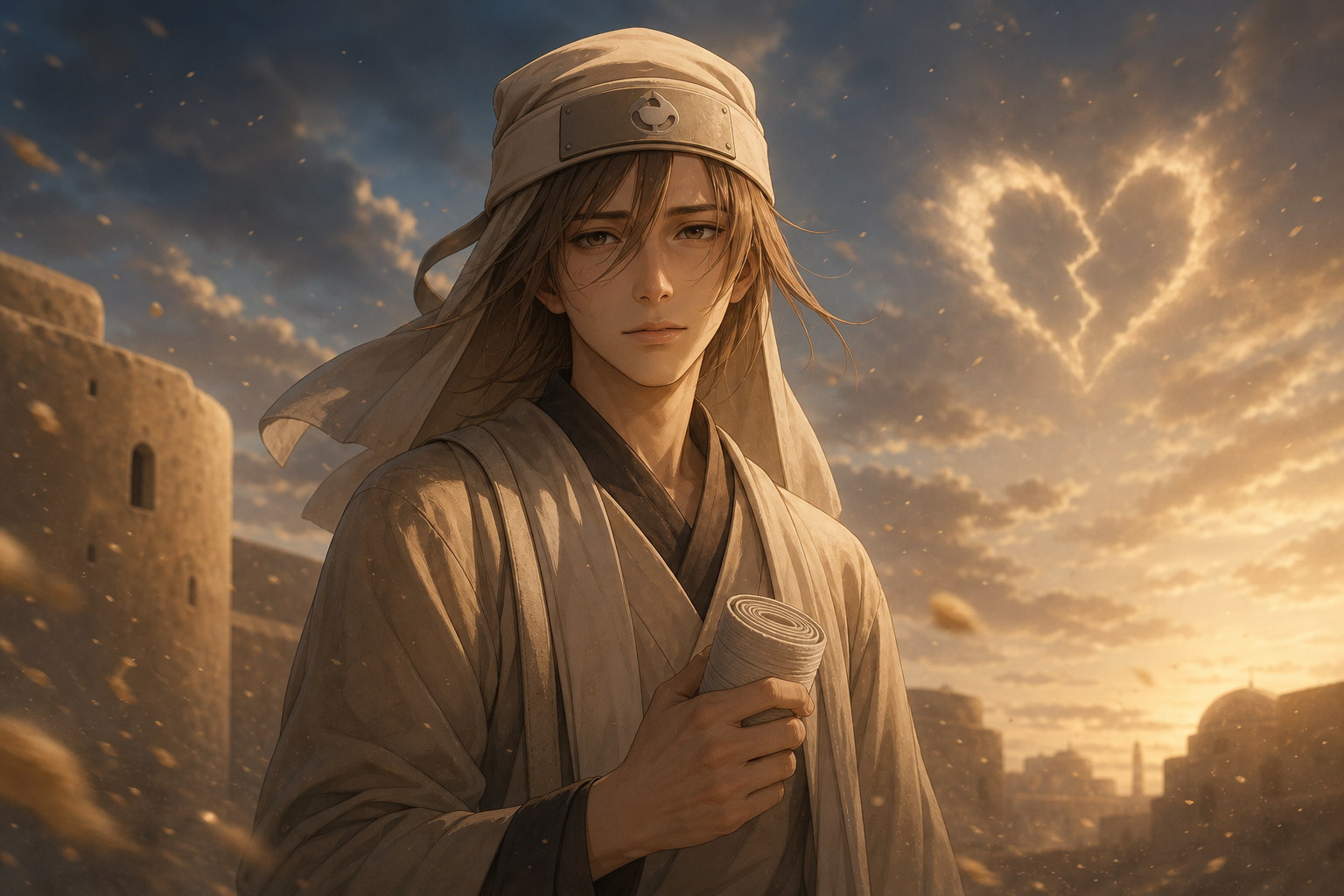
As Gaara’s caregiver, he wears a dark-blue kimono-style shirt with white trim, gray pants, black shinobi sandals, head bandages and sometimes a beige apron marked with the Suna symbol. The apron tells viewers to read nurture, food, bandages and household steadiness. That is exactly why the assassination scene hurts. The body associated with ordinary safety arrives dressed for covert violence.
His ANBU equipment includes Suna’s turban, forehead protector, flak jacket and a cloth covering the lower face. The shift is not a secret transformation. It reveals that caretaker and operative were always the same employee under different assignments. Rasa did not recruit a random assassin who happened to know Gaara. He weaponized the trusted caregiver already inside the child’s home.
Medical work makes the betrayal more precise
Yashamaru is identified as a medical-nin. Gaara’s automatic sand defense limits ordinary injury, but the child still needs someone who can recognize pain, explain wounds, and provide daily care. Yashamaru fills that gap.
His famous distinction between a wound of the flesh and a wound of the heart comes from medical language. Physical injuries can receive ointment. Emotional injuries may not heal so neatly. The explanation gives Gaara a framework for feelings that nobody else has helped him name.
That framework later becomes part of the weapon. Yashamaru knows where Gaara’s emotional wound is located because he helped the child understand it. Rasa’s test depends on more than a sharp kunai. The operation uses a caregiver’s diagnostic access.
The mission ledger and medical classification make Yashamaru an experienced professional, not a random relative pulled from a kitchen. His obedience carries institutional weight. He knows what injury looks like.
Complete chronology: care, command, Sand Binding Coffin and the explosive ending
After Karura dies following Gaara’s premature birth, Rasa appoints Yashamaru as caretaker. Yashamaru tries to understand the boy’s isolation and accidental attacks when most of Suna treats Gaara as a threat. He teaches Gaara that bodily wounds and wounds of the heart behave differently, and that love is the wish to cherish another person. For a child avoided by siblings, villagers and his own father, Yashamaru becomes the only adult explanation for why connection might still exist.
Rasa later orders him to attack Gaara physically and psychologically to test control over Shukaku. Yashamaru accepts. During the encounter, Gaara’s automatic sand defends him, and Sand Binding Coffin gravely injures Yashamaru. The mission becomes suicidal, but the psychological component continues after the tactical test has already failed.
Yashamaru tells Gaara that he never loved him, blamed him for Karura’s death and served only because Rasa commanded it. He claims Karura hated the village, named Gaara through a phrase about self-loving carnage and believed nobody would love the child. He then reveals explosive tags beneath the flak jacket and detonates them while asking Gaara to die. The sand protects Gaara. Trust does not.
Years later, Rasa admits that Yashamaru lied under direct orders and that Karura truly loved Gaara. The correction arrives after Gaara survives assassination, becomes Kazekage and forms relationships the test told him were impossible. Yashamaru’s earlier care was real. His final words were false. The attack still happened. Naruto refuses the lazy comfort of making only one column true.
Karura is the grief underneath every choice
Karura is Yashamaru’s elder sister. Rasa orders Shukaku sealed into her unborn child, and Karura dies around Gaara’s birth. During the war revelation, Rasa states that Yashamaru’s resentment was directed toward him, not Gaara, because he had placed Shukaku inside his pregnant sister.
That correction matters. The dying Yashamaru tells Gaara that he could never stop blaming the child for Karura’s death. Rasa later identifies that story as part of the lie. The person Yashamaru had reason to hate was the Kazekage who authorized the sealing.
Sibling grief does not excuse the assassination. It clarifies the pressure point. Yashamaru serves the man he resents because that man is also his village leader. Sunagakure turns private mourning into obedient labor for the same hierarchy that caused the mourning.
For young Gaara, Yashamaru is love before love becomes a trap
Gaara grows up feared by villagers, watched as a jinchūriki, and judged by Rasa as a military asset. Yashamaru gives him food, treatment, conversation, and attention. The uncle’s presence is valuable because daily care is the closest thing Gaara has to safety.
Gaara asks why pain exists and what love means. Yashamaru answers in language a child can carry: love is the desire to protect someone precious, and emotional pain is harder to heal than a physical wound. Those lessons are not false merely because the teacher later betrays him.
That is what makes the scene cruel. A stranger’s hatred would confirm the village’s fear. Yashamaru’s attack destroys the exception. Gaara concludes that no relationship is safe because the one person who taught him about love has used that knowledge against him.
The lesson about love survives the man who violates it
Yashamaru tells Gaara that Karura’s spirit lives in the sand and protects him. That early lesson contains more truth than the dying speech that follows. The war-era reveal confirms that Karura loved Gaara and that her protection persists through the sand.
Gaara spends years interpreting love as self-preservation. He carves the kanji for love into his forehead and decides to live only for himself. Naruto later helps him build a wider definition through friendship, sibling bonds, and public responsibility.
Yashamaru’s original words remain part of that evolution. A compromised teacher can still supply a true concept. The tragedy is that he demonstrates the opposite conduct when ordered.
Rasa’s assassination order is a test designed around a child’s breakdown
Rasa wants to know whether Gaara can control Shukaku and remain useful to Sunagakure. He assigns Yashamaru to attack the child and provoke emotional instability. The choice of assassin is the test. Yashamaru can reach Gaara physically and psychologically.
The command comes from the Kazekage, Yashamaru’s political leader and brother-in-law. Refusal would carry serious consequences inside a military village. Those constraints matter. So does the fact that the target is his nephew.
Naruto repeatedly examines what happens when shinobi define obedience as virtue. An order can be legal inside a village and still be abusive. A subordinate can face coercion and still make a morally consequential choice. If the story wanted viewers to stop at “orders are orders,” it would not spend so much time showing the bodies left behind.
The lie about Karura is worse than the blade
Yashamaru tells Gaara that Karura never loved him, named him as a curse, and died resenting him. He also claims that his own care could not overcome hatred for the child who caused his sister’s death. Rasa later admits that Yashamaru delivered those statements under direct order to provoke Gaara.
The lie rewrites Gaara’s origin. A child can survive believing the village fears him. Believing his mother hated him before he could speak makes rejection feel natural and permanent.
Yashamaru’s position gives the claim authority. He knew Karura. He is the trusted caregiver. Gaara has no living witness he values more. The operation uses family testimony as psychological warfare.
During the war, Rasa finally corrects the record. Karura loved Gaara. Yashamaru’s true resentment pointed toward Rasa. The correction does not make the earlier words harmless. It reveals how deliberately they were chosen.
The final attack is not a noble sacrifice
Yashamaru attacks with concealed blades and then uses explosives at close range. Gaara’s sand protects him. Yashamaru dies, and Gaara’s emotional world collapses.
Some readings turn the death into martyrdom because Yashamaru obeyed a dangerous order and paid with his life. That framing centers the adult’s sacrifice over the child’s target status. He did not die shielding Gaara. He died while trying to trigger or complete a test against him.
Other readings turn him into a secret villain who never cared. That also fails. The war reveal confirms the lie was ordered and Karura’s love was real. His earlier caregiving does not need to be fake for the final act to be wrong.
The scene works because a loving person commits a devastating betrayal inside a coercive institution. Naruto does not need a cartoon monster when ordinary obedience can do the damage.
The war-era correction restores Karura and reclassifies Yashamaru
When reanimated Rasa faces Gaara, he sees Karura’s form emerge through the sand. Rasa admits that the automatic defense comes from Karura’s love and that Yashamaru lied under his order.
Rasa also says Yashamaru hated him for sealing Shukaku into Karura. That information separates the uncle’s real grief from the speech he delivered to Gaara. The child was not the rightful target of that anger.
Gaara receives the truth after he has already become Kazekage and built meaningful bonds. The revelation offers medicine, not a reset. Yashamaru remains part of both the wound and the chain of evidence that eventually helps Gaara understand it.
Coercion, agency, and accountability can occupy the same sentence
Rasa holds greater power and designs the operation. The Kazekage bears primary responsibility for turning Yashamaru into the instrument of Gaara’s emotional destruction. That hierarchy should remain visible.
Yashamaru is also an experienced adult shinobi with medical knowledge, hundreds of missions, and a familial bond to the target. He participates. Naruto does not show a refusal, warning, escape plan, or attempt to redirect the order. Coercion narrows choices. It does not erase their consequences.
Accountability is not the same as declaring him irredeemably evil. Accountability names the action, the available context, the power imbalance, and the victim. Gaara’s suffering cannot become a footnote to an adult’s difficult workplace.
Abilities, mission experience, and honest limits
Yashamaru’s medical classification indicates treatment knowledge. His attack on Gaara uses concealed or controlled bladed weapons and explosives. Reference sources credit a substantial mission history across D through A ranks.
His covert-service designation in chapter 548 complicates the earlier chūnin listing. The safest conclusion is that he served Sunagakure in both medical and clandestine capacities. The profile does not promote him to a rank the sources do not consistently establish.
Yashamaru cannot overcome Gaara’s automatic defense. The failure is tactical and thematic. Karura’s protection defeats the operation built around lying about her love.
Game appearances can turn him into a more complete combat unit, but licensed mechanics do not become manga canon simply because a player can select them.
Medical skill, Manipulating Attack Blades and honest combat limits
Yashamaru’s medical classification implies fine chakra control and practical treatment knowledge, but the story does not show a named catalogue of surgery or battlefield healing techniques. His most visible ninjutsu is Manipulating Attack Blades, which guides and launches kunai through chakra control rather than relying only on hand-thrown trajectories.
He is intelligent, experienced and suited to covert work. The stat sheet supports that reading with intelligence 4 and hand seals 3.5. Ninjutsu 3 is competent, while taijutsu 1.5 warns against imagining him as a close-range powerhouse. Gaara’s sand crushes him during the test, and his final destructive option depends on prepared explosive tags.
The move listed as Heavenly Punishment describes the explosive suicide attack in licensed naming. It is not sacred judgment and it does not prove a separate supernatural affinity. It is an ANBU operative using hidden tags, his own body and Gaara’s trust as delivery systems. The emotional camouflage is more effective than the physical disguise.
His 734 missions prove a long professional record with many routine assignments and some high-level work, but zero S-rank completions. Rank, intelligence and experience explain why Rasa trusted him with sensitive duty. They do not erase the fact that the final mission fails to kill Gaara and succeeds only at creating years of psychological damage.
Relationship atlas
Gaara
Yashamaru is Gaara’s maternal uncle, caregiver, emotional teacher, attacker, and source of the lie that shapes his childhood identity. The relationship is affectionate and catastrophic.
Karura
Karura is his elder sister. Her death and the sealing decision drive his resentment toward Rasa. Her continuing love ultimately disproves his final words to Gaara.
Rasa
Rasa is Yashamaru’s Kazekage and brother-in-law. He holds command authority, caused the grievance around Karura, and orders the test. Yashamaru obeys the man he has reason to resent.
Temari and Kankurō
They are also his sister’s children, though canon gives Yashamaru far less direct material with them. A complete family record should name the relationship without inventing scenes.
Duty, hierarchy, and the gendered politics of care
A Confucian lens places Yashamaru inside competing obligations: loyalty to ruler, duty to elder sister, care for nephew, and service to village. Ethical failure arrives when obedience to office destroys the relationships that give hierarchy moral purpose.
A Buddhist lens highlights attachment and suffering. Yashamaru cannot release grief around Karura, yet the institution directs that grief toward service. The assassination does not resolve pain. It multiplies pain across Gaara and the village.
Gender expectations shape audience response. Yashamaru’s medical work, beauty, and gentleness led some localizations to make him female. That choice reveals how easily viewers classify care as women’s labor. The original male character makes the combination more disruptive.
The macro argument is about labor discipline. Sunagakure takes a grieving medical worker and converts his trust into a covert weapon. The village does not need him to stop loving Gaara. It needs him to act against that love.
Yasha, affection and the two-sided name symbolism
Yashamaru’s name begins with characters read as yasha, connected to yaksha figures carried through South and East Asian religious traditions. Popular explanations often emphasize a benevolent and a fearsome side. That duality fits his story, but mythology should not be used like a personality test. The character is not cruel because his parents selected ominous kanji.
The useful connection is structural. Yashamaru appears as caregiver and attacker, healer and bomber, teller of love’s meaning and author of the lie that love never existed. Those halves are not separate personalities. They are one man operating under grief, affection, command hierarchy and a catastrophic choice.
His favorite word, affection, sharpens the contradiction. He knows the concept. He offers it to Gaara sincerely. Rasa’s order then forces the word into an interrogation tool. A village can corrupt care without proving the care was fake from the beginning.
The maru ending supports the Japanese male identity. Foreign editions that recast him as female create a distinct localization history and may change how readers interpret domestic care. CVM Sekai keeps the original male record visible without mocking viewers who encountered a different official translation.
What fandom gets wrong about Yashamaru
“Yashamaru was secretly a woman.”
No. The Japanese source identifies him as male and Karura’s younger brother. Some international localizations changed the presentation.
“He never loved Gaara.”
The later reveal establishes that the hateful speech was ordered and that his resentment focused on Rasa. Love does not excuse the attack, but the relationship was not a complete performance.
“He had no choice, so he has no responsibility.”
He acted under Kazekage authority and serious coercion. He still became the adult who attacked and lied to a child in his care.
“He chose death to protect Gaara.”
The scene does not show a protective sacrifice. His final actions are part of the assassination test.
“Rasa’s confession redeems Yashamaru.”
The confession corrects the lie and clarifies motive. It does not undo the attack or give Yashamaru a later life of repair.
Manga, anime, game and adaptation boundaries
Manga chapters 129 through 131 provide the Part I attack, the lesson about love, the lie and the explosion. Chapters 547 and 548 supply the war-era correction through Rasa. The original anime stages those events beginning with episode 50, while later Shippūden material reinforces the truth and includes Yashamaru among deceased-character cameos.
He appears as a playable character in Naruto Shippūden: Ultimate Ninja Blazing and is present in Naruto: Rise of a Ninja. Game systems can package attack blades and explosive tags into a move set. They do not create additional canonical medical feats or secret missions.
No major film, OVA or novel supplies a separate Yashamaru biography that outweighs the manga spine. A complete media shelf can be short when the record is short. Padding it with every Gaara flashback menu would turn indexing into pretending.
Localization is the largest adaptation issue. Some translated manga editions identify Yashamaru as female, while the Japanese manga, databooks and original performance credit identify him as male. That discrepancy belongs in the reader-facing profile because fans were not all given the same text.
Sōichirō Hoshi and the original Japanese performance
Sōichirō Hoshi performs Yashamaru in the original Japanese anime. The credit covers the caregiver whose explanation of love becomes inseparable from the attacker who destroys Gaara’s trust.
Hoshi’s verified role belongs here without fabricated claims about breath, pitch or timing beyond scenes heard closely enough to support them. The Japanese credit also anchors Yashamaru’s male identity against foreign localizations that changed the character to female. Correct casting information is more useful than performance analysis invented from a name on a list.
Why Yashamaru still matters
Yashamaru matters because Naruto refuses the comforting idea that only hateful adults hurt children. He hurts Gaara precisely because Gaara loves him. Trust gives the lie access.
The profile also shows how institutions weaponize care workers. Yashamaru knows medicine, pain, family history, and the child’s emotional language. Rasa turns those skills into an assassination method.
RaeRae’s take? Yashamaru gave Gaara a perfect explanation of love and then became the village’s demonstration of why Gaara should never trust it. That is not “complicated” in the vague prestige-TV way. That is specific institutional harm. Rasa wrote the order. Yashamaru carried it. Gaara paid for both men’s choices.
Yashamaru also matters because his failure cannot be quarantined as one evil night. The child he cared for uses the betrayal to define love, selfhood and danger for years. Every later relationship has to negotiate damage created by an adult who knew exactly where the wound would open. That does not mean Yashamaru intended every future consequence. It means trained adults are responsible for predictable harm when they choose methods designed to break a child. Rasa gave the order. Yashamaru supplied credibility. Gaara paid the compound interest.
The final verdict
Yashamaru was Gaara’s first trusted caregiver and the adult who helped destroy that trust. His love for Karura and Gaara was real enough to make the betrayal devastating. Rasa’s authority was real enough to make refusal dangerous. The attack was real enough to shape years of Gaara’s life. A mature reading does not choose one truth and discard the rest.
Sources and canon boundary
Manga chronology controls this profile. Anime staging, databook material, novels, films, games, and later franchise appearances are labeled instead of being blended into one false continuity.
Primary franchise references: Naruto Official and VIZ Media Naruto. CVM Sekai’s conclusions about Gaara, Karura, Rasa’s assassination order, medical work, love, coercion, the fatal lie, agency, and accountability are editorial analysis, not invented creator quotations.