
Naruto character dossier
Yahiko
The boy builds the first Akatsuki as a peace movement, then has his face turned into the symbol of everything he tried to prevent. Yahiko matters because a living organizer disappears underneath the corpse that becomes Naruto’s most famous image of Pain.
Who Yahiko is before the corpse starts talking
Yahiko is an Amegakure shinobi, a war orphan, Jiraiya’s student, and the founding leader of the original Akatsuki. That last phrase needs emphasis because the later criminal organization tends to swallow the first one in fandom memory. Yahiko’s Akatsuki is not a collection of S-rank missing-nin hunting tailed beasts. His group begins as a local movement of Rain shinobi who want to stop larger nations from using their country as a battlefield.
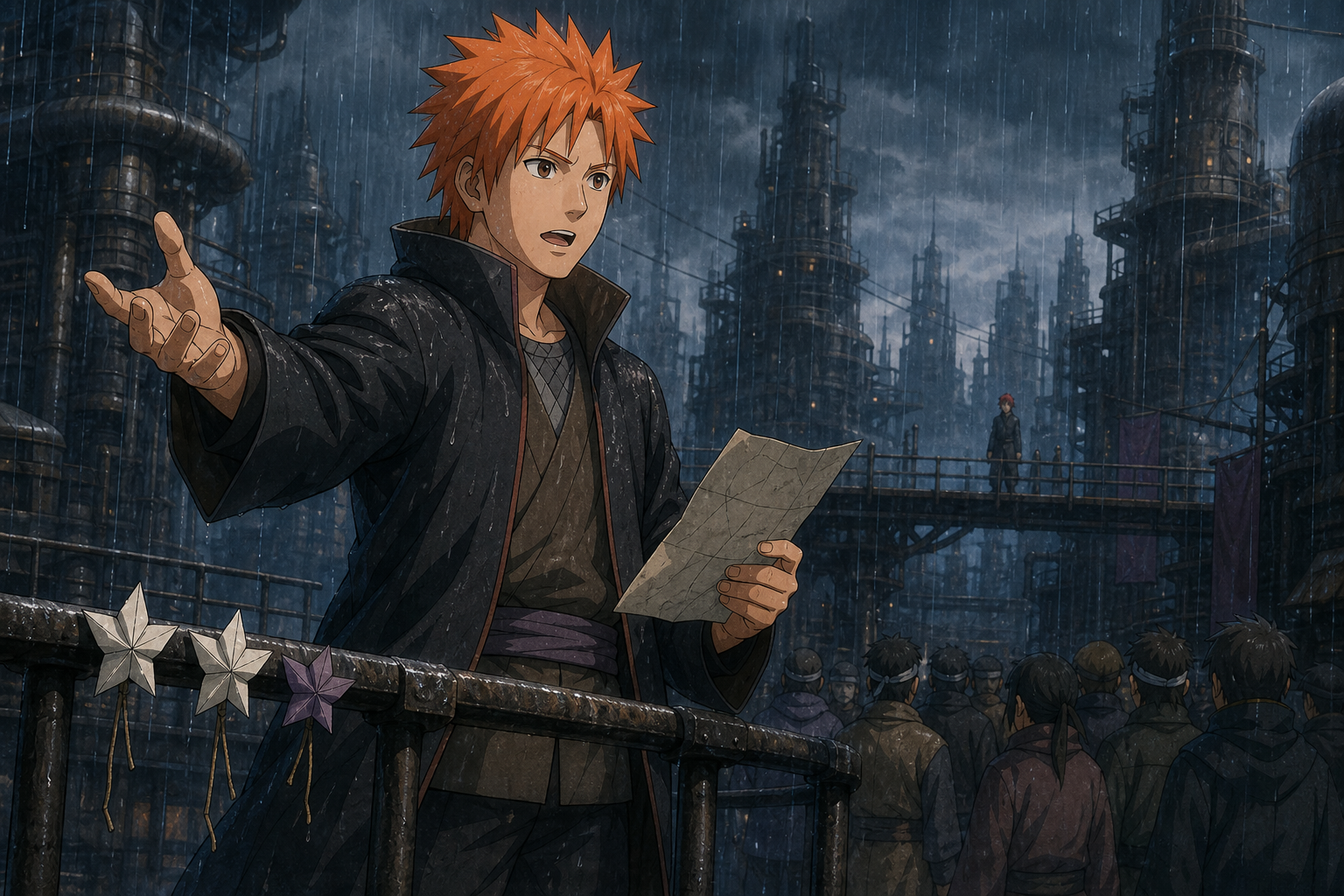
He has bright orange hair, brown eyes, a loud mouth, a quick temper, and a habit of putting motion where Nagato puts doubt. The resemblance to Naruto is deliberate without making Yahiko a Naruto copy. Both boys respond to abandonment by demanding recognition. Both gather people around an impossible promise. The difference is structural. Naruto grows up inside a powerful village that harmed him but still had institutions he could eventually inherit. Yahiko grows up in a small country whose institutions are trapped between a dictator at home and military powers outside. He cannot dream about taking over a stable office. He has to create the political vehicle first.
His name is written 弥彦. Readers can find translations that attach broad meanings to those characters, but names do not become personality tests because a kanji dictionary exists. The safer reading is narrative: Yahiko is the public face of a movement, then his face is taken from him. Kishimoto makes identity itself part of the violence.
A war orphan in a country everybody uses
Yahiko meets Konan while both are surviving the Second Shinobi World War. They later find Nagato, whose parents were killed by Leaf shinobi. The three children steal food, search ruins, dodge soldiers, and build a family because the adult world has already failed every normal definition of care.
The Rain is not background decoration. Amegakure sits in the path of powerful countries that can export violence and then go home. Children like Yahiko absorb the cost. Food becomes scarce. Homes become temporary. Death arrives wearing somebody else’s village symbol. When the series talks about the cycle of hatred, Yahiko’s childhood supplies the invoice.
Yahiko still refuses pure victimhood. He complains, protects, organizes, and dreams out loud. That energy keeps the trio moving, but his courage is not magic. Hunger still weakens them. Fear still shapes their choices. A child can be resourceful and still deserve adults who do their jobs.
Jiraiya teaches skills, then leaves a political question behind
The three orphans seek out Jiraiya, one of the Leaf’s legendary Sannin. He chooses to remain in the Rain and train them. Yahiko learns ninjutsu, discipline, teamwork, and a language for the peace he already wants. Jiraiya also gives the children a home for a time. That care matters. So does the limit.
Jiraiya cannot stay forever. He returns to Konoha believing his students can continue without him. From his perspective, the training succeeds. From Yahiko’s perspective, the people who control the world still come from the same great villages that keep turning Rain into a corridor for war. The students inherit a philosophy without inheriting protection, money, diplomatic access, or a state strong enough to shield them.
This is one of Naruto’s sharper lessons about mentorship. A good teacher can change a life and still leave a student inside a rotten system. Love does not erase logistics. Training does not replace infrastructure.
The original Akatsuki is a movement, not a murder club
After Jiraiya leaves, Yahiko, Nagato, and Konan form Akatsuki. The name is commonly translated as dawn. The first organization wants a new beginning for the Rain, peace without surrender, and enough local power to negotiate with forces that normally ignore small countries.
Yahiko becomes the leader because he can turn private pain into a public message. Nagato has the Rinnegan and frightening potential, but Yahiko has the political instinct. He recruits. He speaks. He makes the goal legible to other Rain shinobi. Konan supplies judgment, steadiness, and operational support. Calling Yahiko the sole author would erase the team. Calling him merely Nagato’s inspirational friend would erase the labor he actually performs.
The movement grows. That growth proves two things at once. Yahiko’s message works, and the conditions in Amegakure are bad enough that many people are ready to risk themselves for another future. Hope is powerful. Hope also becomes threatening once enough workers, fighters, and civilians can act together.
Small-nation politics: the part fans skip when they call him naive
Hanzo rules Amegakure from above while larger nations shape the battlefield around it. Yahiko’s organization challenges both levels of power. He wants peace among nations, but he also wants the Rain to stop functioning as disposable land. That is not childish. That is a demand for sovereignty.
Could the original Akatsuki have survived through optimism alone? No. Yahiko lacks intelligence networks equal to Danzo’s, institutional protection equal to Konoha’s, and military power equal to Hanzo’s. His movement is vulnerable to infiltration, hostage tactics, and false negotiation. Those are strategic weaknesses. They do not prove the goal was foolish. They prove moral legitimacy and operational security are different jobs.
Hanzo sees popularity as competition. Danzo sees instability in the Rain as useful. Their cooperation exposes how authoritarian power behaves when a grassroots movement becomes credible. Leaders who claim to preserve order often manufacture chaos to make alternatives look dangerous.
Yahiko’s abilities, and the limits that matter
Water Release
Yahiko is associated with Water Release, a natural fit for a Rain shinobi and a practical combat nature in Amegakure’s wet environment. The manga gives him far less technique detail than it gives the later Six Paths of Pain. The anime expands his action record, especially in material centered on Team Jiraiya and the early Akatsuki. Those scenes help define his fighting style, but anime expansion should not be quietly relabeled as manga evidence.
Frontline combat
He fights beside Nagato and Konan rather than treating leadership as a safe position. His knife, standard shinobi tools, mobility, and basic ninjutsu support the picture of a capable young field leader. Nothing in the record makes living Yahiko equal to the Deva Path. The godlike gravity techniques belong to Nagato’s Rinnegan operating Yahiko’s corpse.
Political charisma
Charisma is not a chakra nature, but the story treats Yahiko’s ability to recruit and unify people as his most consequential power. Nagato can overwhelm a battlefield. Yahiko can persuade frightened people to imagine a shared future. Hanzo understands that distinction well enough to fear him.
Limits
Yahiko is mortal, young, and working without the protection of a great village. He misjudges the negotiation trap. He cannot prevent Konan from becoming a hostage. He cannot outmuscle Hanzo and Danzo’s combined operation. Those limits make the tragedy concrete. They do not make him weak.
Relationship atlas
Konan
Konan is Yahiko’s fellow orphan, teammate, co-founder, and one of the two people closest to him. Their bond includes affection, trust, and a shared political project. Romance is strongly suggested in parts of the franchise, but reducing Konan to the girl he saves insults both of them. She helps build Akatsuki, survives the trap, governs beside Pain, and finally chooses Naruto as the inheritor of their hope.
Nagato
Yahiko sees Nagato’s gentleness before the world turns the Rinnegan into a weapon. He pushes Nagato forward and believes Nagato may become the bridge to peace. His death then becomes Nagato’s central wound. Love, guilt, grief, and manipulation fuse until Nagato speaks through Yahiko’s dead face.
Jiraiya
Jiraiya gives Yahiko training and language for his dream. Yahiko proves that the lesson took root. The tragedy is not that he forgot his teacher. The tragedy is that he tries to apply the lesson in a political landscape designed to punish independent Rain power.
Hanzo
Hanzo is not merely the man present at Yahiko’s death. He is the ruler who treats a popular peace movement as a rival. He weaponizes negotiation, takes Konan hostage, and forces Nagato into an impossible choice. Yahiko’s suicide interrupts the immediate hostage demand but cannot stop the larger massacre.
Danzo
Danzo helps turn Rain politics into a covert Leaf operation. His involvement shows the great-village hypocrisy Yahiko is fighting. Konoha can speak of peace while one of its senior officials supports the destruction of a foreign grassroots movement.
Naruto
Yahiko never builds a living relationship with Naruto, yet Naruto inherits the argument. Nagato sees Yahiko in Naruto’s refusal to surrender. Konan later entrusts the trio’s hope to Naruto. The connection matters because Naruto succeeds partly by receiving lessons that Yahiko paid for with his life.
Hanzo’s trap and the choice that was never fair
Hanzo presents a negotiation, then takes Konan hostage. Nagato is ordered to kill Yahiko if he wants her released. The demand is designed to break the trio no matter what Nagato chooses. Kill Yahiko, and Nagato carries the guilt. Refuse, and Konan dies in front of them. Fight, and Hanzo’s forces attack from prepared positions.
Yahiko moves onto the kunai in Nagato’s hand. The act saves Konan from the immediate demand and prevents Nagato from having to decide. Fandom often labels this pure self-sacrifice, which is true but incomplete. Yahiko also makes a choice for Nagato that Nagato never consented to carry. The guilt becomes catastrophic. A loving act can still leave terrible harm behind.
The scene does not prove Yahiko wanted Nagato to become Pain. He asks Nagato to continue the mission. Nagato interprets that duty through trauma, Obito’s manipulation, and a world that has just murdered the peaceful route. The later ideology of mass pain is Nagato’s answer to Yahiko’s death, not Yahiko’s program.
When Nagato turns Yahiko’s body into the Deva Path
Nagato preserves Yahiko’s corpse and uses it as the Deva Path, the public face of Pain. Chakra receivers pierce the body. The Rinnegan replaces the brown eyes. The orange hair remains. The face that once recruited people for peace now issues divine judgments and destroys Konoha.
That appropriation is one of the franchise’s ugliest and smartest visual ideas. Nagato cannot release Yahiko, so he converts grief into government. The corpse becomes a throne, a mask, a memorial, and a weapon. Nagato claims to have killed the person he was, yet he cannot stop speaking through the person he lost.
Yahiko does not perform Almighty Push, Planetary Devastation, or the other Deva Path techniques as a living shinobi. Nagato performs them through the body. Profiles that dump Pain’s ability list into Yahiko’s personal skill set confuse ownership of a corpse with ownership of power.
What Yahiko means in Naruto
Peace needs institutions
Yahiko has the right moral demand and an organization strong enough to attract attention. He does not yet have safeguards strong enough to survive state violence. Naruto repeatedly celebrates individual conviction, but Yahiko’s story quietly warns that conviction without durable institutions can be murdered in a room labeled negotiation.
The hidden-village system exports its sins
Amegakure suffers because the great villages can treat smaller countries as buffers. Yahiko makes that cost visible. Konoha’s later pain is not random cosmic punishment. Nagato directs violence back toward a village connected to the wars and covert policies that destroyed Rain families.
Confucian duty and broken hierarchy
Read through a Confucian lens, rulers owe moral conduct to the people beneath them. Hanzo fails that duty. Danzo abuses office for secret advantage. Yahiko behaves more like a legitimate leader because he accepts responsibility for people who cannot reward him with status. The hierarchy is upside down.
Buddhist attachment and the refusal to release
Nagato’s attachment to Yahiko hardens grief into identity. He cannot accept impermanence, so he preserves the body and makes the dead friend speak. The result is suffering multiplied across thousands of lives. This is an interpretation, not a claim that Naruto presents a formal Buddhist lesson. The imagery still fits: refusing loss does not restore the lost person. Refusing loss can imprison everyone else inside the mourner’s pain.
The original Japanese performances
Ken’yū Horiuchi voices adult Yahiko and the Deva Path in the original Japanese anime. Wataru Hatano voices Yahiko as a child. The split matters because the character exists in two registers: the living boy whose warmth and urgency help form a family, and the preserved adult face through which Nagato performs divine distance.
The credited distinction makes the adaptation’s intent visible: childhood and the later Pain identity are not treated as one uninterrupted performance state. Specific judgments about breath, pitch or timing belong beside specific Japanese-audio scenes, while the casting structure already separates warmth from performed divine distance.
Manga, anime expansion, movies, OVAs, and games
The manga supplies Yahiko’s essential canon: the Rain orphan trio, Jiraiya’s training, the original Akatsuki, Hanzo’s trap, his death, and the use of his body as the Deva Path. Naruto Shippuden expands the trio’s childhood, early missions, recruitment, and Team Jiraiya material. Those additions can deepen the emotional and operational picture, but they remain adaptation material when the manga does not contain the same scene.
Yahiko also appears across licensed games and supplemental animation, often through flashbacks, Pain-related material, or alternate presentation. A game costume or playable variation does not create a new canon ability for living Yahiko. Road to Ninja uses an alternate-world framework. Supplemental appearances belong on the media shelf, not inside the main chronology as if every version happened to one person.
Seven fandom misreads that flatten Yahiko
1. “Yahiko is only Nagato’s dead friend.”
No. Yahiko founds and leads the original Akatsuki. Nagato’s grief matters because Yahiko already mattered publicly, politically and personally. Reducing him to a dead friend erases the movement that made his loss dangerous to more than one household.
2. “He was naive, so failure was inevitable.”
Yahiko was strategically exposed. Hanzo and Danzo used a hostage and false diplomacy because the movement had become politically effective. The trap proves the organizers threatened a monopoly on power, not that grassroots peace was childish by definition.
3. “Pain completes Yahiko’s dream.”
Pain keeps the language of peace and abandons Yahiko’s method. Terror through shared suffering is Nagato’s program, built after coercion convinces him that public trust and negotiation cannot protect the people he loves.
4. “Konan is just Yahiko’s love interest.”
Konan is a co-founder, combatant, administrator, survivor and final guardian of the trio’s original hope. Calling her only Yahiko’s love interest deletes the political labor, tactical skill and independent loyalty she carries after both men are gone.
5. “Yahiko had Deva Path powers.”
Living Yahiko did not possess Deva Path powers. Nagato used Rinnegan techniques through Yahiko’s corpse, turning a familiar body into the public center of the Six Paths while the actual source remained hidden.
6. “His sacrifice solved the hostage crisis.”
Yahiko’s sacrifice broke Hanzo’s immediate demand. The sacrifice did not stop the ambush, protect the movement or spare Nagato from trauma. A coerced death can reveal love and courage without becoming evidence that the hostage strategy was solved.
7. “Naruto replaces Yahiko.”
Naruto inherits a question Yahiko helped define: how can people harmed by the village system build peace without reproducing its violence? Inheritance should not erase the person whose failed future created the lesson or the Rain community that first carried it.
Consequence ledger
What Yahiko builds
Yahiko builds a chosen family, a trained team, a grassroots organization and a language of Rain self-determination. Those achievements survive beyond his limited combat record because organization gives private grief a public direction before revenge takes over.
What kills him
Hanzo’s fear of rivals, Danzo’s covert intervention, hostage coercion and the military weakness of a small-country movement kill Yahiko. The list matters because his death is a political operation built around unequal power, not a clean duel.
What survives
Konan, Nagato, the Akatsuki name and the belief that peace must answer the suffering of places like the Rain survive Yahiko. Each survivor carries part of the original project, even when grief bends the method into something he would not recognize.
What gets corrupted
Nagato corrupts Yahiko’s body, the organization’s structure and the promise of peace through collective action. The result keeps the founder’s face and vocabulary while replacing voluntary organizing with obedience enforced by spectacular violence.
The movement existed before the martyr
Yahiko’s death is so dramatically useful to Nagato’s story that it can swallow Yahiko’s actual life. That is backwards. Hanzo does not arrange the hostage trap because Yahiko might someday become a meaningful symbol. He acts because Yahiko has already helped build a movement capable of attracting people outside the ruler’s control.
The original Akatsuki is political work: finding people, earning trust, keeping them aligned, moving through dangerous territory, and translating personal suffering into a demand larger than revenge. Yahiko supplies the public confidence, but the organization belongs to a network. Konan and Nagato are co-founders. Rank-and-file Rain shinobi take risks. Residents have to believe cooperation offers more than Hanzo’s order. None of that happens because one charismatic boy gives a good speech and everybody claps.
This distinction protects Yahiko from the inspirational-dead-friend trap. His value is not that his corpse motivates better-known characters. He identifies the small-nation problem correctly: Amegakure cannot wait for the villages benefiting from its instability to volunteer a fair solution. Rain residents need their own organized power. That analysis survives even after Nagato corrupts the method.
A hostage choice is not free consent
Yahiko chooses to die, but the scene is built to make every available choice violent. Konan is held at knifepoint. Nagato is ordered to kill his friend. Armed forces surround them. Calling the result a noble sacrifice without naming the coercion turns Hanzo’s design into background scenery.
Yahiko acts to spare Konan and remove the decision from Nagato’s hands. He succeeds for one instant and leaves Nagato holding the weapon, the body, and the belief that peaceful organizing got the person he loved killed. The act is courageous. It is also traumatic for the survivor in a way Yahiko cannot control. Love does not guarantee a clean inheritance.
Nagato later treats Yahiko’s final trust as permission for Pain. It was not. Yahiko asks his friend to continue pursuing peace; he does not authorize corpse control, jinchūriki extraction, collective punishment, or the destruction of Konoha. The gap between request and interpretation is where grief becomes ideology.
A face can be stolen without being forgotten
The Deva Path preserves Yahiko’s most recognizable features while stripping away everything that made the living man politically dangerous: choice, argument, growth, and the ability to disagree with Nagato. Pain can wear the founder’s face because a corpse cannot challenge how the brand is being used.
That makes the body more than a memorial. It is a hostile takeover of the original Akatsuki’s legitimacy. People see the leader they knew. Nagato supplies a new voice, new eyes, and a new program. The image says continuity while the method says rupture.
Remembering Yahiko alive restores the conflict Nagato tries to close. The founder could have changed strategy, criticized a comrade, apologized for a mistake, or rejected the premise that terror teaches peace. A corpse can do none of those things. Pain looks certain because Yahiko’s uncertainty has been physically removed.
Final verdict: Yahiko deserved to be remembered alive
Yahiko’s corpse becomes one of Naruto’s most famous faces. That is exactly why the living boy needs his file back, complete with political judgment, friendship, leadership work and the mistakes that never received enough time to mature.
He is a war orphan who learns to fight, but fighting is never his largest ambition. He wants the Rain to speak for itself. He builds a movement with Nagato and Konan. He turns grief into recruitment instead of revenge until stronger men decide that peace outside their control is a threat.
His last act is loving, desperate, brave, and devastating. The series refuses to let the choice end cleanly. Nagato carries the body, the guilt, and the dream until all three become Pain. Naruto eventually persuades Nagato to trust hope again, but that victory rests on a road Yahiko began building long before Konoha noticed Amegakure’s children.
Remembering Yahiko only as Pain’s original face repeats the theft. Remember him as the founder who understood the real problem: a country used by everybody else will never know peace until its own people gain the power to choose what happens next.
Sources and canon boundary
Manga chronology controls this profile. Anime expansions, databook material, games, films, and alternate-world appearances are labeled instead of being blended into one false continuity.
Primary franchise references: Naruto Official and VIZ Media Naruto. CVM Sekai’s conclusions about Yahiko’s organizing, Amegakure sovereignty, coercion, Nagato’s use of his body, consent, and political legacy are editorial analysis, not invented creator quotations.