
Why Naglimund Is Called Nail-Fort
The fortress’s name is a defense system, an occupation history, a material taboo, and a warning about the people who built on Sithi ground.
The name and layout
Naglimund means Nail-Fort because the nails were once the outer defense
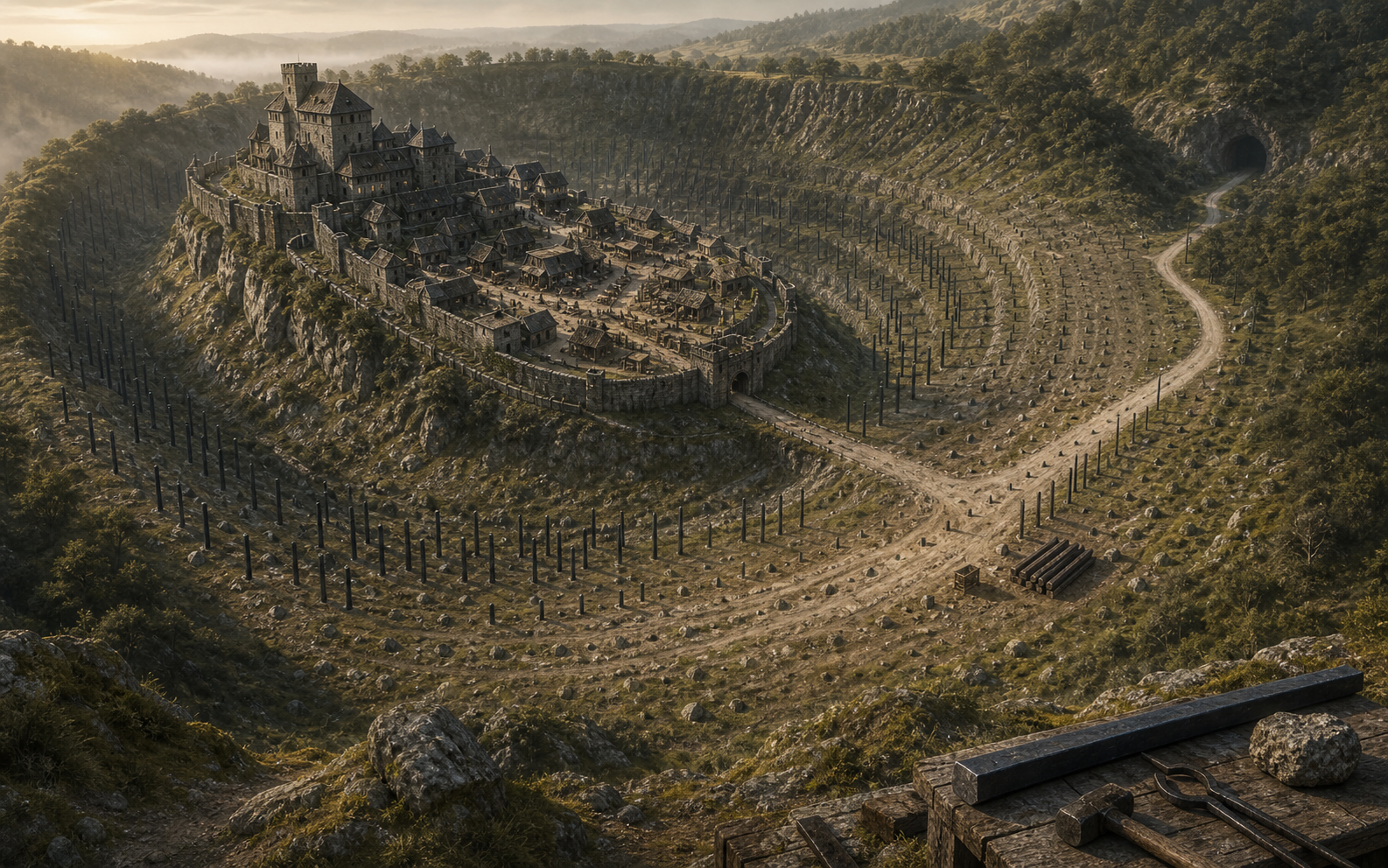
Duke Aeswides, Nabban’s governor before the Rimmersmen came south, surrounded the fortress with one thousand steel bars. The original system encircled every side rather than decorating one scenic slope. Long black nails transformed the approach itself into a weaponized boundary, extending the fortress beyond masonry into the ground travelers had to cross.
By Simon’s visit, the most legible remnant runs symmetrically from near the eastern ditch toward the Wealdhelm hills. The twisting road from a cavern in the western face descends through this field toward the eastern gate. Reading the current landscape without the historical plan makes the nails look incomplete; reading the missing sockets reveals a once-continuous ring.
Material and maintenance
Dverning steel made the defense possible; market life later made parts of it impossible
The bars are identified as Dverning-made steel, giving the system a specific craft and supply history rather than treating “iron” as generic fantasy scenery. Aeswides believed metal would repel or kill the Sithi because of their vulnerability to iron. The engineering logic is therefore material, cultural, and political at once: acquire exceptional metalwork, place it where feared bodies must pass, and make taboo part of the wall.
Settlement changes the machine. Market wagons need usable approaches, so Josua removes nails obstructing commerce while preserving the hillside field because he values old things. The surviving arrangement is not exactly Aeswides’s design and not a simple rejection of it. It is adaptive reuse: daily life cuts corridors through inherited fear while leaving much of the monument standing.
The Sithi-name boundary
“Trap That Catches the Hunter” is an approximate gloss, not a license to invent a lost battle
Sangfugol says the Sithi name meant something like “Trap That Catches the Hunter.” Book 1 does not supply the exact Sithi wording, and no recorded Sithi assault on Aeswides is offered as the origin story. Sangfugol even allows that the duke may have trapped himself inside his own fear.
That bounded uncertainty matters. The phrase can illuminate the fortress’s paradox without becoming proof that a specific Sithi counterattack occurred. A defense designed around imagined return can restrict trade, fix suspicion into landscape, and force later generations to live inside its priorities. Naglimund is called Nail-Fort because the technology was real. Its other name survives as interpretation: perhaps the hunter was trapped not by an enemy crossing the field, but by the world he built to prevent one.
On the record
Full-spoiler reading receipt
Return to The Dragonbone Chair hub → · Open every Book 1 Story 101 guides → · Open the series hub →