
Character File · The Little Mermaid · Full Franchise
Ursula
She hears the wish, identifies the wound, writes herself into the fine print, and makes exploitation sound like the first honest conversation Ariel has had all day.
Quick file
Franchise: The Little Mermaid. Primary screen appearances: the 1989 animated feature, related television appearances and games, stage adaptations, and the 2023 live-action reinterpretation. Primary performers: Pat Carroll in the animated film and many later animated projects, Sherie Rene Scott in the original Broadway production, and Melissa McCarthy in the 2023 film. Separate continuities use other performers and backstories.
Core tools: contracts, transformation magic, stored voices, disguise, surveillance through Flotsam and Jetsam, and a gift for locating the desire somebody is too desperate to examine. Core objective in 1989: use Ariel’s bargain to take Triton’s crown and rule the sea. Defining contradiction: Ursula speaks the language of liberation while building every offer around ownership.
The villain who actually listens
Triton enters Ariel’s grotto determined to stop disobedience. Ursula approaches after the destruction and names Ariel’s desire without mocking it. That does not make Ursula kind. It makes her effective. Manipulators rarely succeed by misunderstanding the person in front of them. They succeed by recognizing a real wound, validating it just enough, and presenting exploitation as the only adult solution.
Ursula’s first advantage is therefore emotional intelligence. She knows Ariel feels unheard, knows the surface represents more than one prince, and knows anger has weakened the daughter’s trust in her father. She does not create the family rupture. She arrives with paperwork after Triton widens it. Any analysis that treats Ariel as hypnotized misses the precision of Ursula’s timing.

Poor unfortunate souls, profitable vulnerable clients
The souls in Ursula’s entrance sequence are not proof of a charitable practice that went wrong. They are her portfolio. Each body demonstrates that a wish can be turned into leverage and that failed clients become property. The spectacle lets Ursula advertise both her power and the consequences while pretending failure belongs entirely to the customer.
Her sales method alternates sympathy, ridicule, urgency, and staged expertise. She claims reform, performs hurt at the idea of mistrust, then mocks Ariel’s hesitation. The speed matters. A person in crisis gets little time to consider alternatives, consult an ally, or ask who benefits if the deadline fails. The song is a contract closing disguised as confession.
The contract is not fair because Ariel signs it
Ariel places her name on the scroll. That fact matters, but it does not settle consent. Ursula has targeted a sixteen-year-old immediately after a destructive confrontation with her father. She controls the magical service, drafts every term, withholds her plan to sabotage performance, and sets a three-day deadline tied to permanent bodily captivity. Formal assent sits inside a structure designed to remove meaningful bargaining power.
The bargain also contains an impossible contradiction. Ariel must convince Eric to recognize and love her while surrendering the voice he remembers as proof of identity. Ursula then keeps that voice available for her own disguise. She is not testing whether Ariel can succeed. She is selling a game in which the dealer owns the evidence and intends to enter as a competing player.
Voice theft is identity theft
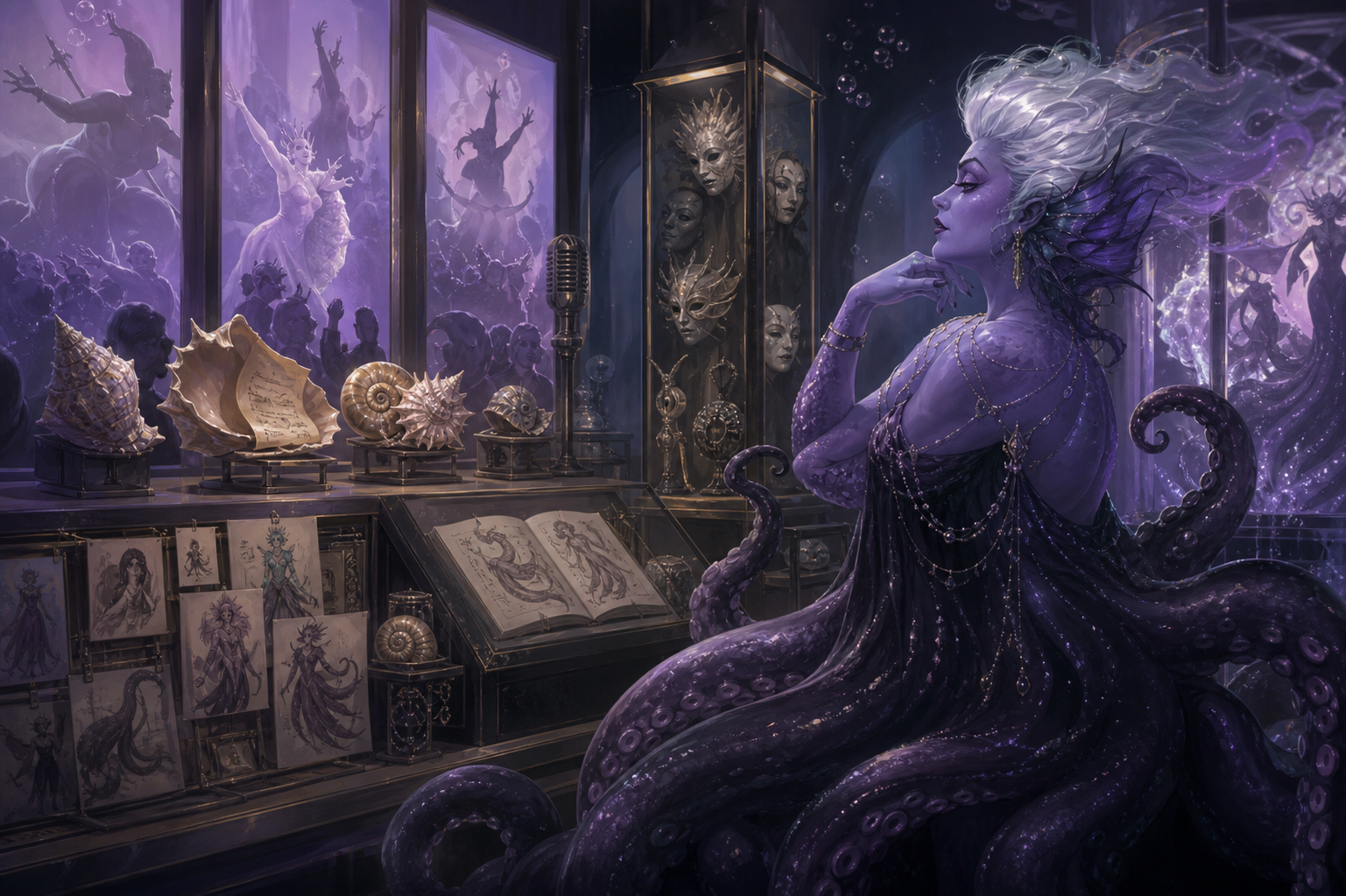
The shell does more than record sound. Ariel’s voice carries memory, self-expression, artistic labor, and the marker Eric associates with the woman who saved him. Ursula extracts all of that into a portable object. The theft becomes complete when she wears the voice as Vanessa and lets Eric attach recognition to the wrong body.
This is why calling the loss a simple payment undersells it. Ursula converts personhood into transferable property. Ariel remains fully herself without speech, but the surrounding systems cannot verify what she knows. The villain exploits that gap. She controls both the communication channel and the cultural assumption that a familiar voice proves an authentic identity.
Body politics: the villain who refuses to shrink
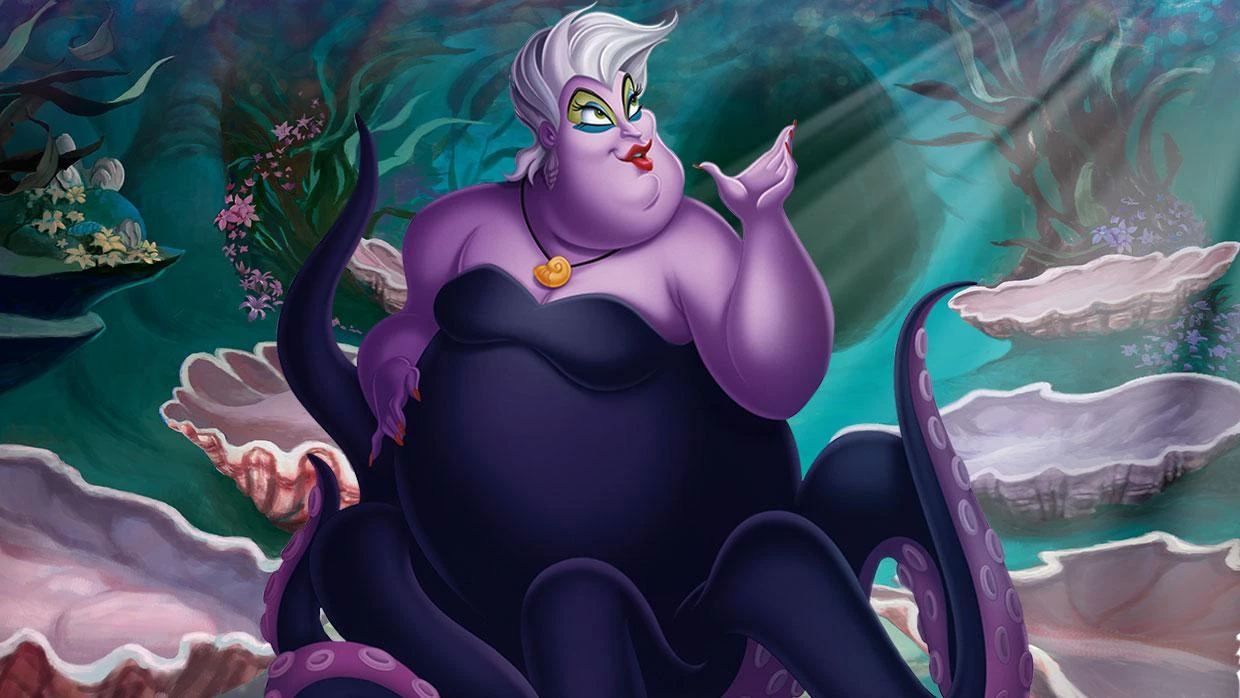
Ursula occupies space with pleasure. She touches her body, commands the frame, performs glamour, eats, laughs, and treats theatrical excess as authority. Those qualities have made her beloved among viewers who rarely see large feminine bodies presented with sexual confidence or visual power. The complication is that the film still assigns this body to predation and monstrosity.
Criticism has to hold both truths. Ursula’s size is not the reason she is evil. Her coercive contracts, stolen voices, political conspiracy, and attempted killings are. At the same time, audiences can reclaim the confidence and camp the narrative uses to mark her as excessive. Enjoying that reclamation does not require pretending the character runs an ethical legal clinic.

Drag lineage and the architecture of camp
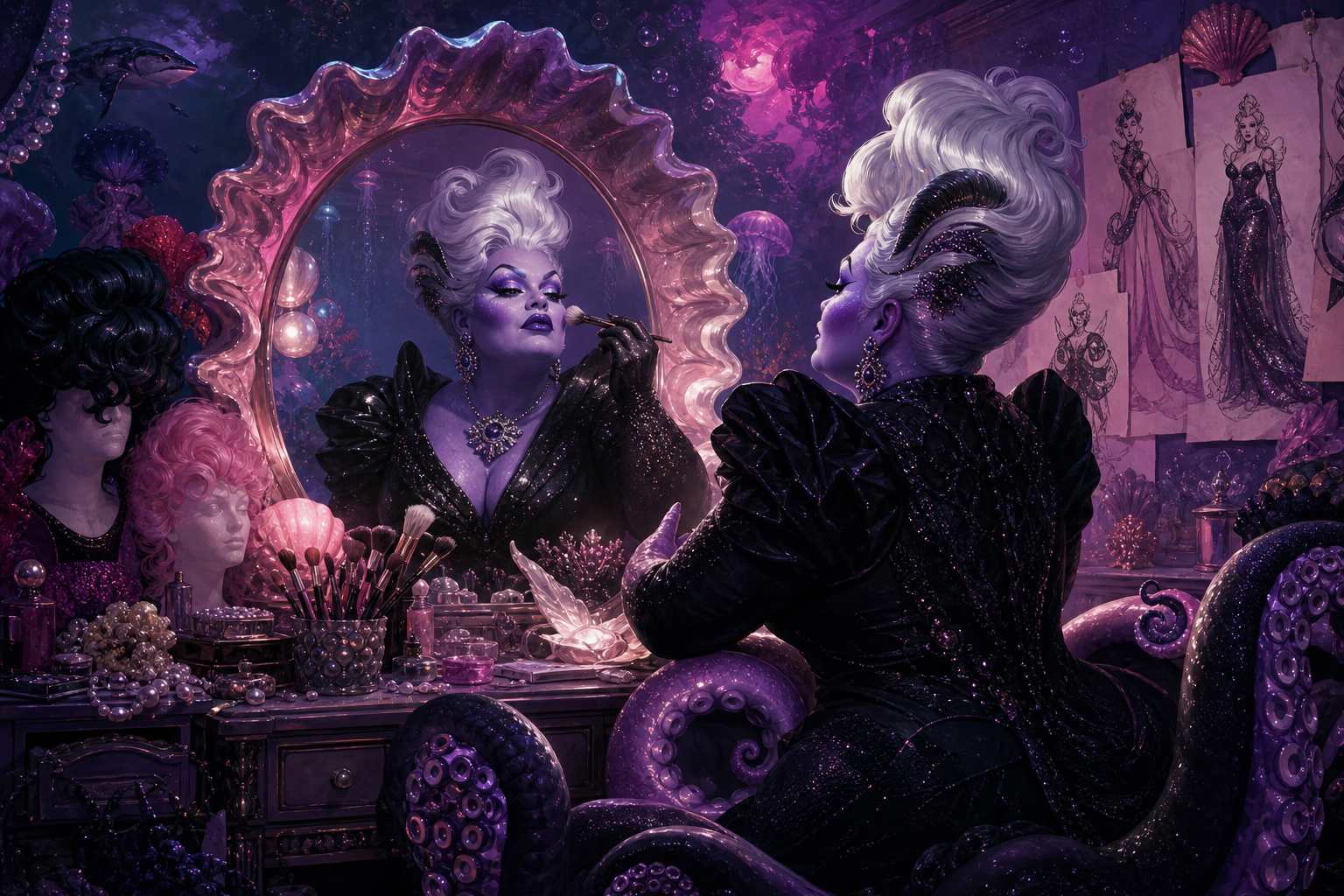
The 1989 design is widely discussed in relation to Divine, the drag performer and actor associated with filmmaker John Waters. The influence lives in the high-arched brows, hair, makeup, body confidence, and confrontational glamour rather than in a literal portrait. Howard Ashman’s theatrical sensibility and the animation team’s revisions helped turn those ingredients into a sea-witch design built for musical performance.
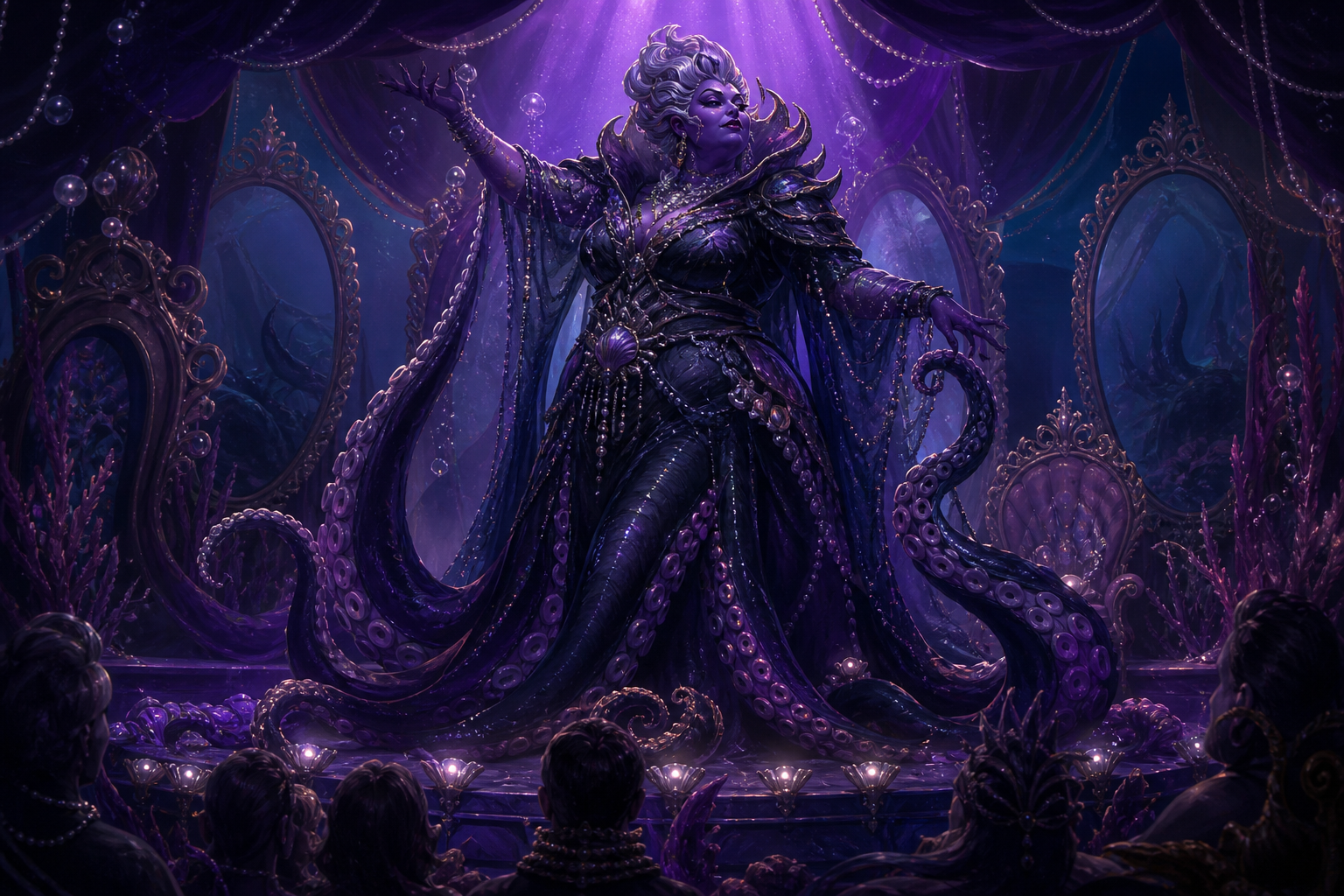
Camp is not merely bright makeup or a big gesture. It is knowing performance, exaggeration that exposes social rules, pleasure in artifice, and a refusal to behave at the volume polite society assigns. Ursula uses camp as persuasion. She turns the sales pitch into a show where she controls lighting, chorus, props, pace, and the meaning of every body on stage.
Pat Carroll makes every line sound chosen in the moment
Pat Carroll’s performance gives Ursula warmth, rasp, mock sincerity, booming command, and comic timing without splitting them into separate characters. She can sound like a trusted aunt for one phrase, a nightclub emcee for the next, and a furious sovereign when the mask drops. The transitions are the character.
Carroll also understands that loudness only works when contrasted with control. Ursula often lowers the voice to draw Ariel closer, stretches a word until it feels indecently pleasurable, or pauses as if the conclusion just occurred to her. The performance makes a rehearsed scam feel improvised for this exact client.

Flotsam and Jetsam are surveillance, not pets
The moray eels function as Ursula’s remote eyes, field agents, recruiters, and saboteurs. They watch Ariel before the contract, guide her to the lair, interfere with the kiss, and help preserve the asymmetry of information. Their fused magical vision lets Ursula operate across distance without exposing herself.
Calling them sidekicks misses the system. Triton has Sebastian reporting from inside Ariel’s life. Ursula has Flotsam and Jetsam spying from outside it. Both adults respond to the girl’s independence with surveillance. The difference is that Ursula never claims the spying is parental love. She treats intelligence as a weapon and rewards the eels as extensions of her will.
Exile, grievance, and the missing political history
The 1989 film tells us Ursula once lived in Triton’s palace and was banished, but it leaves the precise history vague. That ambiguity gives the villain a grievance without requiring the story to decide whether any part of it was legitimate. Later versions often invent sibling relationships, court positions, or rival claims. Those additions belong to their own continuities unless a specific text connects them.
What the original does establish is political competence. Ursula knows the crown’s power, understands Triton’s emotional weak point, and prepares a contract that can convert paternal sacrifice into legal ownership. She does not want revenge alone. She wants the trident, crown, and public authority that come with the king’s surrender.
Vanessa is a weaponized performance of acceptable femininity
As Vanessa, Ursula becomes young, conventionally slim, human, and socially legible inside Eric’s kingdom. The disguise demonstrates that she understands the beauty standards she earlier described to Ariel. She can inhabit them whenever they are useful. The body is a costume. The stolen voice supplies authentication.
Vanessa also exposes how little the court knows about the woman Eric intends to marry. Enchantment accelerates the decision, but the surrounding institution accepts a sudden stranger because she fits the expected shape and sound of a bride. Ursula weaponizes not only magic but the social eagerness to recognize femininity through appearance, voice, and availability.
The wedding plot is a hostile takeover
Preventing true love’s kiss is only the immediate task. The disguised wedding buys enough time for the sun to set and the contract to mature. Once Ariel becomes a polyp, Triton arrives exactly as Ursula expects. She turns his love into a forced exchange and converts custody of one daughter into the surrender of a kingdom.
That sequence reveals the romance as infrastructure for a coup. Ursula is not obsessed with Eric. He is a deadline mechanism, a source of recognition, and a location where the disguised voice can operate. Ariel is not merely a romantic rival. She is the asset whose distress can compel sovereign transfer.

The giant form makes appetite political
After taking Triton’s power, Ursula expands to colossal scale and controls the sea around her. The image literalizes what the film has associated with her all along: appetite, space, and refusal to remain contained. Now those qualities are joined to state power and environmental force. She does not simply sit on a throne. She makes the ocean itself answer her body.
The climax can be exhilarating while still relying on the old visual language that makes a large woman more monstrous as she becomes more powerful. Eric defeats her with a ship’s splintered bow, using human wreckage against the sea sovereign. Ariel contributes throughout the struggle, but the 1989 staging gives the final physical blow to the prince.
The 2023 interpretation changes performance scale
Melissa McCarthy’s 2023 Ursula works inside a more naturalistic visual environment and a live-action camera that reads small facial changes differently from drawn animation. The performance retains camp, salesmanship, and cruelty while negotiating effects-heavy movement and a design that cannot stretch shape in the same way hand-drawn animation can.
The film also creates an explicit family connection between Ursula and Triton, which changes exile from vague court history into sibling conflict. That choice can add personal grievance, but it also narrows mystery. Viewers should evaluate it as this adaptation’s political story rather than retroactively treating it as a fact about the 1989 character.

Pat Carroll and Melissa McCarthy are solving different villains
Carroll can transform a drawn face with vocal pressure while animators exaggerate timing, volume, and shape around her. McCarthy has to make the body present on camera while visual effects extend it. One interpretation can snap instantly between poses. The other carries physical continuity through a space designed to resemble an ocean.
Comparison becomes useful when it names those medium problems. Which version makes the contract feel most predatory? Which balances humor and threat? How does each stage “Poor Unfortunate Souls”? Which lets the villain command silence? Declaring one the real Ursula skips the craft that makes adaptation worth discussing.
Stage Ursula owns the audience in real time
The Broadway musical expands Ursula’s material, gives performers additional songs and comic beats, and asks costume, lighting, puppetry, choreography, and vocal design to suggest a body no actor literally possesses. Sherie Rene Scott originated the Broadway role and built a version calibrated for a live house rather than a camera.
Stage camp has a special advantage. Ursula can acknowledge the audience’s appetite for her before returning to Ariel’s danger. Applause becomes part of the scene’s power exchange. The performer must enjoy the villain without allowing charisma to erase what the contract will do to the girl standing beside her.

Separate continuities keep rewriting the grievance
Television, games, novels, comics, and alternate-universe series have supplied Ursula with relatives, histories, alliances, and moral revisions. Some make her Triton’s sister. Some connect her to other villains. Some give her descendants or alternate identities. These branches demonstrate the character’s adaptability, not one seamless biography.
A reference profile should name the source before naming the fact. “Ursula is Triton’s sister” is true in some versions and false or unconfirmed in others. Collapsing every branch into one biography creates a wiki-shaped soup that hides the interesting question: why does each adaptation need a different reason for this woman to stand outside the palace?
Easter eggs and callbacks need receipts
Ursula’s design, lair, shell, eels, contract scroll, and performance gestures are quoted throughout Disney media and fan culture. Cameos, silhouettes, merchandise details, theme-park versions, and visual echoes can be genuine. They can also be audience pattern matching. Every review on this site must verify a claimed Easter egg in the frame or a production source before presenting it as intentional.
The best callback does more than prove somebody remembered the movie. A shell that stores a voice recalls the conversion of identity into property. A mirror or disguise image can reopen the question of socially acceptable femininity. A contract motif can connect Ursula to a later villain who also monetizes desire. Meaning comes after verification.
Why audiences love her without endorsing her
Ursula gives viewers pleasures the heroes often cannot. She is funny without seeking approval, glamorous without becoming delicate, sexual without waiting to be chosen, and ambitious without pretending power arrived accidentally. She states appetites the kingdom represses. The performance offers release even while the plot condemns her methods.
Fandom can love a villain as art, representation, camp, or emotional permission without treating the character as an ethical model. The interesting conversation begins after that distinction. What does the villain make possible on screen? What stereotypes does the design inherit? Which viewers find freedom in the performance, and why did the story reserve that freedom for the antagonist?
Final character receipt
Ursula does not win trust because Ariel is foolish. She wins access because Triton has made honest exploration impossible and because the sea witch understands exactly how to translate injury into urgency. She validates a desire, hides the sabotage, stores the payment, and turns a family crisis into sovereign transfer.
Her lasting power comes from contradiction. She is liberating to watch and committed to ownership. She exposes restrictive femininity while exploiting it. She occupies a marginalized body and preys on vulnerable bodies. She gives the film its loudest performance while taking another woman’s voice. Any profile that reduces her to fabulous villain or evil fat witch leaves the real character untouched.
The lair is a business model made visible
Ursula’s lair contains the results of prior transactions, the tools of new transactions, and the architecture of isolation. The entrance forces visitors through a place where transformed clients reach toward them. That is intimidation presented as disclosure. Ariel sees the cost before signing, but she sees it while frightened, grieving, and surrounded by Ursula’s agents. The warning becomes part of the sales theater rather than a genuine opportunity to leave safely.
The lair also contrasts with Triton’s palace. The palace is bright, public, ceremonial, and governed by hierarchy. Ursula’s chamber is dark, intimate, improvisational, and governed by private contract. Both spaces concentrate power in one adult. One calls itself a kingdom and the other calls itself help. Ariel moves between political authority that refuses her desire and market authority that monetizes it.
That contrast is bigger than good parent versus bad witch. It asks what happens when a public system offers no legitimate route for change. Private actors can sell access on predatory terms. Ursula’s business depends on Triton keeping the border closed because prohibition creates desperate clients who cannot appeal to a transparent institution.
Animation design makes her persuasive before the dialogue finishes
Hand-drawn Ursula is built from curves, sudden extensions, controlled stillness, and explosive changes in scale. Her tentacles allow the frame to remain active even when her torso barely moves. Hands, mouth, brows, jewelry, and the shell create multiple focal points. She can surround Ariel without crossing the room like a conventional human villain.
The design team also uses silhouette as argument. Ariel is small and upright while Ursula spreads across the chamber. The contrast does not prove moral value, but it instantly communicates who controls the environment. When Ursula contracts herself into false sympathy, the body does not become harmless. It becomes a large instrument playing quietly.
Color separates her from Atlantica without letting her disappear into generic darkness. Black, lavender, blue, and red accents make her readable against the cave and connect glamour to danger. The shell’s gold becomes a portable point of control. Once it holds Ariel’s voice, the warmest light in Ursula’s world belongs to stolen labor.
A legal reading of sabotage and performance
Even if a magical court accepted the contract’s stated terms, Ursula’s interference should destroy any claim to fair performance. Flotsam and Jetsam overturn the boat before the kiss. Ursula then assumes another identity, uses the consideration Ariel paid, enchants Eric, and schedules a marriage designed to consume the remaining time. The service provider actively prevents the customer from satisfying the condition.
The bargain contains no neutral judge, appeal, cooling-off period, disclosure of sabotage, or remedy for fraud. Ursula holds the contract, interprets the contract, enforces the contract, and benefits from breach. Triton responds by accepting another coercive exchange rather than challenging jurisdiction. Magic stands in for law, but the scene still dramatizes what happens when one party owns the entire dispute system.
This legal framing does not make the story dry. It makes the horror more specific. Ursula does not defeat Ariel with greater love or even greater magic at first. She defeats her by writing power into procedure and then acting as if procedure makes the outcome righteous.
Queer reception is not an accidental footnote
Ursula’s drag-informed design, camp performance, outsider status, transformation skills, and refusal of respectable femininity have made her meaningful to queer audiences. That reception does not require a corporate statement declaring the character queer. Viewers recognize performance languages, coded histories, and pleasures that mainstream family storytelling often assigns to villains because heroes must remain socially acceptable.
The difficult part is that queer coding can produce both identification and stigma. The fabulous outsider gets wit, glamour, appetite, and freedom, then becomes a threat to family, marriage, and reproductive continuity. Audiences can reclaim the performance while criticizing the structure that repeatedly makes gender nonconformity or camp evidence of danger.
A serious profile should not flatten this into “Ursula is a queer icon” and move on. Who gets liberation from the image? Which traits are celebrated in fandom but punished by the plot? How did drag aesthetics enter the design? How do later performers honor or dilute that lineage? Those questions preserve the pleasure and the politics together.
Why “Poor Unfortunate Souls” keeps working outside the film
The song functions as character introduction, sales pitch, backstory claim, comedy routine, magical demonstration, and plot turn. It begins by inviting sympathy for Ursula, expands into proof of her practice, redirects attention toward Ariel’s insecurities, and ends with the actual transfer of voice. Few villain songs carry this much procedural work without feeling like instructions.
Its spoken rhythms matter as much as melody. Ursula interrupts herself, comments on Ariel’s body, changes tone, and rushes the final choice. The music gives the impression of spontaneity while tightening toward inevitability. By the time the contract appears, the number has already trained the audience to enjoy the predator’s control of the room.
Covers and stage performances often fail when they pursue volume alone. The song needs sales technique. The performer must make a dubious claim sound intimate, let a joke lower resistance, and reveal that every apparent digression was moving Ariel toward the pen.
The crown exposes the difference between grievance and justice
Ursula may have been wronged before the film begins. Banishment may have involved palace politics the original refuses to explain. None of that makes her treatment of clients just or her claim to Ariel’s body legitimate. A grievance can be real while the chosen remedy harms people who did not cause it.
This distinction matters because villain revision often confuses explanation with acquittal. Giving Ursula a sibling relationship, childhood wound, or experience of rejection can deepen character. It should not erase the transformed souls in her lair or convert predatory contracts into misunderstood activism. Backstory tells us how a person organizes pain. Ethics asks what they do with power afterward.
When Ursula obtains the crown, she does not free her clients, open the border, or reform the kingdom. She enlarges herself and imposes control. The political program is personal sovereignty. Her rhetoric of helping outsiders was a customer-acquisition strategy, not a movement.
Performance history belongs in the biography
Pat Carroll recorded a character that animators then embodied through timing, shape, and gesture. Sherie Rene Scott originated a Broadway interpretation that had to command a theater and carry added musical material. Melissa McCarthy brought the role into a live-action effects environment where facial proximity, physical continuity, and camera realism changed the available tools. These are not interchangeable credits at the bottom of a trivia box.
Each performer determines how much warmth survives beneath the threat. Carroll can make a growl comic and a laugh dangerous in the same breath. A stage actor can hold a pause until the audience becomes part of the pressure. McCarthy can use a small look that animation might exaggerate into a full pose. Performance history shows why the character remains recognizable even when the body, costume, family history, and medium change.
It also gives credit where fandom often gives everything to the brand. Ursula did not arrive as a complete corporate symbol. Writers, lyricists, composers, actors, animators, designers, directors, musicians, costumers, and effects artists built each version. A reference-grade profile keeps those human decisions visible.
What an ethical reinterpretation could change
A reinterpretation can preserve Ursula’s camp, size, sensual confidence, rage, and theatrical skill without treating those qualities as the source of evil. It can make the contracts more explicitly political, show the clients’ circumstances, and examine why Atlantica has no public remedy for the desires Ursula exploits. It can also give the villain a credible grievance without pretending exploitation becomes justice.
The story could ask whether any client ever receives what was promised, whether Ursula began as a legitimate practitioner, and when help turned into ownership. It could let transformed souls testify rather than remain set decoration. It could show Ariel challenging both the monarchy and the predatory alternative instead of restoring one authority after defeating the other.
None of this requires turning Ursula into a harmless mentor. Villains are allowed to be villains. The goal is sharper causality. Let her be dangerous because she understands systems, controls contracts, and chooses domination. Stop relying on fatness, age, loud femininity, or queer-coded performance to do the moral labeling for the script.
Keep exploring The Little Mermaid
Return to The Little Mermaid hub for film branches, reviews, Reacts, rants, lore, guides, and the full character directory.