
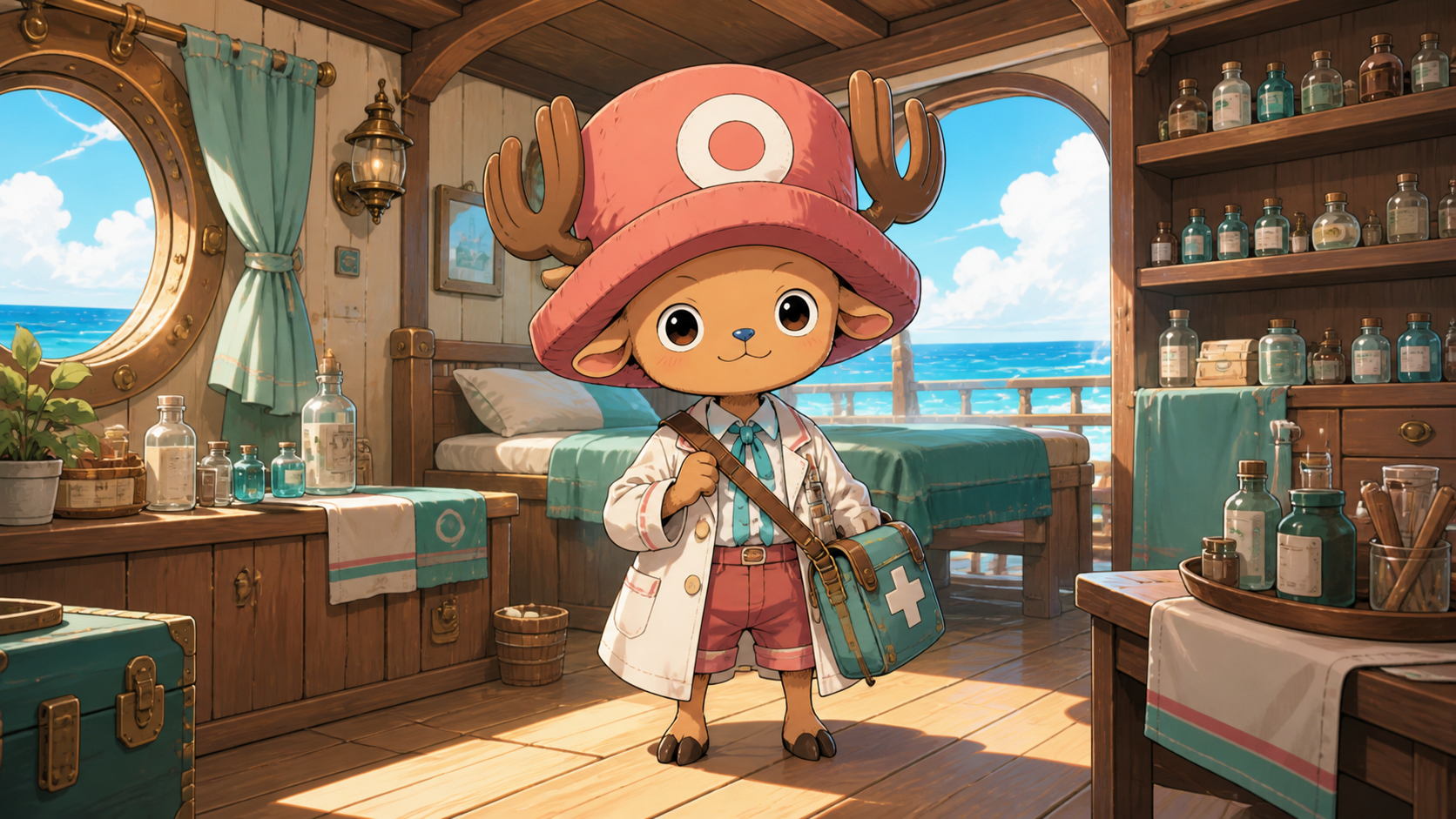
Tony Tony Chopper: One Piece Character Profile
Quick profile
Tony Tony Chopper is a reindeer who ate the Human-Human Fruit, trained as a doctor under Dr. Hiriluk and Dr. Kureha, and joined the Straw Hats after years of being rejected by both reindeer and humans.
Monster is a political word
Chopper’s body does not fit a stable category, so communities repeatedly treat him as a threat before he acts. One Piece is strongest when the story shows that monstrosity is assigned by power, not discovered through appearance.
Medicine is more than kindness
Chopper studies diagnosis, pharmacology, anatomy, infection, and emergency response. His gentleness matters, but compassion without competence cannot stop a disease. The series gives him both emotional care and technical authority.
Hiriluk, Kureha, and inherited practice
Hiriluk gives Chopper hope and a dangerously romantic idea of medicine. Kureha gives him training rigorous enough to keep patients alive. Chopper’s vocation grows from holding inspiration and evidence together without confusing one for the other.
Rumble Ball and bodily risk
His Rumble Ball changes the transformations available through his Devil Fruit. Monster Point exposes the cost of turning the body into an emergency tool. Later control does not erase the question of how often the youngest-looking crew member is expected to become a weapon.
Cuteness can shrink a character
Chopper’s design became increasingly mascot-friendly. That commercial appeal should not crowd out the doctor who confronts epidemics, researches cures, and makes difficult triage decisions under pressure.
Japanese performance
Ikue Otani moves between innocence, professional urgency, comic denial, and grief. The performance keeps Chopper emotionally open without making medical authority sound like a costume.
RaeRae’s verdict
Chopper’s dream to cure every disease is impossible in the way the best One Piece dreams are impossible: the dream creates a direction for a lifetime of work. He deserves to be remembered as a physician who is cute, not a mascot who occasionally practices medicine.
Hiriluk, Kureha, and two different lessons about care
Hiriluk gives Chopper belonging before Chopper has the medical knowledge to save anyone. The quack doctor teaches that hope can change a patient’s will to live, but good intentions cannot replace diagnosis. Chopper’s poisonous mushroom proves the cost. Hiriluk accepts the gift because he understands the love behind the mistake, then keeps his larger confrontation away from Chopper.
Kureha supplies the discipline Hiriluk lacked. She teaches anatomy, pharmacology, diagnosis, treatment, and the refusal to confuse sentiment with competence. Chopper needs both inheritances: a reason to care and the training to make care safe.
Medicine is labor, not a healing button
Chopper examines bodies, identifies disease, prepares drugs, monitors recovery, and tells stronger crewmates when their plans are medically foolish. The doctor cannot guarantee survival. Supplies run out, unfamiliar illnesses require research, and battlefield treatment happens under pressure.
Punk Hazard and Wano expand his responsibility beyond the crew. Chopper treats children used in experiments and develops a countermeasure during Queen’s Ice Oni outbreak. Healing an enemy does not erase accountability. Medical care stops preventable death so justice is not replaced by infection.
Human-Human Fruit forms and Monster Point
The Human-Human Fruit gives a reindeer human traits and multiple transformation points. Brain Point supports analysis, Walk Point returns him toward reindeer movement, Heavy Point emphasizes humanoid strength, and specialized forms alter guard, jumping, horns, arms, or speed. The Rumble Ball manipulates those transformations beyond the ordinary three Zoan forms.
Early Monster Point destroys control and leaves severe exhaustion. Training later lets Chopper use the form deliberately, while extended duration still carries a physical cost. A larger body does not make the doctor disposable. Every transformation must leave enough judgment and strength to treat the injuries after combat.
Reindeer, human, monster, and person
Chopper is rejected by reindeer after his blue nose already marks him as different, then rejected by humans after the Human-Human Fruit gives him a body they read as monstrous. Hiriluk is the first person to treat him as a child rather than a specimen. The Straw Hats later make room for every form without requiring him to choose one body as the real Chopper.
The running mascot treatment can hide that history. Cute merchandise does not erase a doctor who has faced plague, chemical weapons, forced experimentation, and his own fear of losing control.
Medical ethics and impossible promises
Chopper wants to become a doctor capable of curing any disease. The dream is emotionally honest and medically impossible if read as a literal guarantee. Good medicine includes prevention, diagnosis, palliation, uncertainty, and knowing when a cure does not exist yet.
His best work avoids promising miracles. Chopper gathers evidence, tests a countermeasure, distributes treatment, and recruits help. A doctor can fight the system causing harm while still treating the body in front of him.
Relationships and accountability
Luffy sees a potential friend where others see emergency food. Nami teaches boundaries and travel discipline. Usopp and Chopper share wonder, fear, and belief in impossible stories. Robin treats him with calm affection. Sanji manages nutrition that supports his medical work. Zoro and Luffy repeatedly create the injuries he must repair.
Hiriluk gives him purpose. Kureha gives him competence. The crew gives him daily responsibility. Chopper sometimes lets praise overwhelm judgment, and his innocence can make deception easier. Experience should sharpen caution without punishing kindness.
Design chronology
Chopper’s blue nose, antlers, hat, backpack, and shifting proportions keep every form connected. The pink hat carries Hiriluk’s mark. After the time skip, the larger hat and rounder default form increase mascot appeal, while Heavy Point and Monster Point preserve the scale of his physical range.
The strongest designs show function. A medical bag, instruments, protective clothing, or a form chosen for a specific job tells more about Chopper than another costume built only around cuteness.
Ikue Otani’s Japanese performance
Ikue Otani gives Chopper curiosity, panic, professional focus, pride, and grief. The performance can sound young without making medical authority unbelievable. During an outbreak, the voice tightens around decisions rather than becoming a generic heroic shout.
Comedy works because praise embarrasses him even while his body performs the opposite reaction. Serious scenes keep that recognizable voice while letting the doctor take command.
RaeRae’s verdict
Chopper matters because care needs training. Hiriluk’s love saves his sense of self, but Kureha’s discipline gives future patients a chance. One Piece gets medicine right when compassion and competence work together.
I want the story to remember that the mascot is also the professional who handles everybody’s consequences. Chopper can be adorable, frightened, powerful, and medically responsible at the same time.
Limits, recovery, and the doctor who also needs care
Chopper cannot diagnose every illness on sight, carry unlimited medicine, or restore a body after every injury. Treatment needs time, sterile tools, ingredients, rest, and cooperation from patients who often ignore him. His own transformations create exhaustion and sometimes leave him unable to perform medical work immediately after battle.
The crew must protect their doctor too. Medical competence does not make Chopper an endless resource. Recovery becomes more believable when the ship respects sleep, supplies, follow-up care, and the fact that the person treating everyone else can also become sick or injured.
The doctor cannot heal a political system with medicine
Chopper dreams of curing every disease, which is beautiful until the promise is treated like a magic answer to problems that are not diseases. Drum Island suffers because Wapol monopolizes doctors and turns health care into royal property. The population does not need a more talented miracle worker alone. People need access, training, supplies, public trust, and protection from a ruler who understands illness as leverage.
Kureha teaches medicine as disciplined practice. Hiriluk teaches that hope can alter what a patient believes life still contains. Chopper needs both lessons and also needs to recognize their limits. Hiriluk’s intentions do not make every treatment safe. Kureha’s technical skill does not make tenderness unnecessary. The little reindeer grows when he stops choosing between science and compassion and begins asking what responsible care requires in the present case.
I wish the anime spent more time showing the ordinary work. Diagnosis is not a glowing hand placed over a wound. Chopper studies symptoms, controls contamination, makes triage decisions, prepares compounds, monitors recovery, and admits when he needs information. Punk Hazard and Wano become stronger when medicine is collective labor involving nurses, local knowledge, captured supplies, and frightened patients who still need consent.
A mascot body can hide a serious interior life
Chopper’s cuteness is part of his design, but merchandise-friendly framing often shrinks the character. Early Chopper is angry, suspicious, lonely, medically curious, and capable of terrifying physical transformation. He wants acceptance while expecting rejection from humans and reindeer alike. That conflict cannot survive if every reaction becomes a squeak attached to a plush toy.
Monster Point originally makes the body a crisis. Chopper takes a drug that forces transformation beyond control because the crew may die without the power. The cost matters. Later control shows training and maturity, yet control should not erase the frightening question underneath: how much bodily damage does a healer permit himself to absorb for everyone else? A doctor also deserves recovery and care.
My favorite Chopper scenes let competence and vulnerability share the frame. He can be delighted by praise, manipulated by obvious flattery, and still become the person everybody follows when poison enters the room. The joke that he is hiding backward behind a wall works because he wants love so badly. The larger character works because love finally gives him enough safety to keep learning rather than enough approval to stop.
Belonging should not require Chopper to become less strange
The crew welcomes Chopper without demanding that he choose human or reindeer, yet the wider world keeps reading his body through categories that decide who deserves protection. Humans call him a monster. Reindeer reject the blue nose. The bounty system reduces him to a pet because institutions can misread a harmless-looking body as easily as frightened villagers can misread a powerful one.
That misclassification is funny until we remember what categories do. A “pet” bounty erases his medical expertise and combat choices. A “monster” label excuses violence against him. Neither word asks how Chopper understands himself. I want his eventual recognition to be more than a bigger bounty poster. Recognition should mean the world has to acknowledge a doctor, pirate, reindeer, Devil Fruit user, and person whose identity cannot be made administratively convenient.
His crew already practices that recognition imperfectly. They tease him, depend on him, protect him, and trust him with their bodies when illness strips away bravado. Chopper belongs because relationships make room for contradiction. He does not need to become ordinary. He needs a world where strange bodies are not automatically evidence of danger.
Chopper also changes what bravery looks like inside the crew. He is the youngest Straw Hat in experience, yet emergencies can place him above older fighters because medical authority cannot wait for age-based permission. When Chopper orders rest, identifies a toxin, or refuses a reckless treatment, friendship has to make room for professional judgment. The crew does not always listen gracefully. That friction is useful. Care is not obedience to whatever an injured hero wants. Care can mean taking control away from somebody who would rather reopen a wound than miss the next fight.
The search for a universal cure should end with Chopper building knowledge other people can use. A medicine locked inside one brilliant doctor repeats the fragility Drum Island exposed when Wapol controlled access to physicians. Chopper has traveled through climates, species, poisons, viruses, and bodies no single island could teach. The humane conclusion is not a bottle labeled for everything. The humane conclusion is a network of methods, records, apprentices, and locally adaptable treatments that survives him. Hiriluk wanted a flag capable of changing hearts. Chopper can leave behind medical practice capable of changing who receives care after the pirate crew sails away.
That medical future deserves resources, not only applause. Chopper needs laboratories, libraries, clean instruments, preserved samples, and colleagues who can challenge a diagnosis. Calling him a genius should never become an excuse to leave one small doctor carrying a world-sized promise alone.
Official sources and routes
ONE PIECE.com: Tony Tony Chopper official character profile
ONE PIECE.com: anime staff and Japanese cast
Watch One Piece on Crunchyroll
Browse One Piece character profiles