
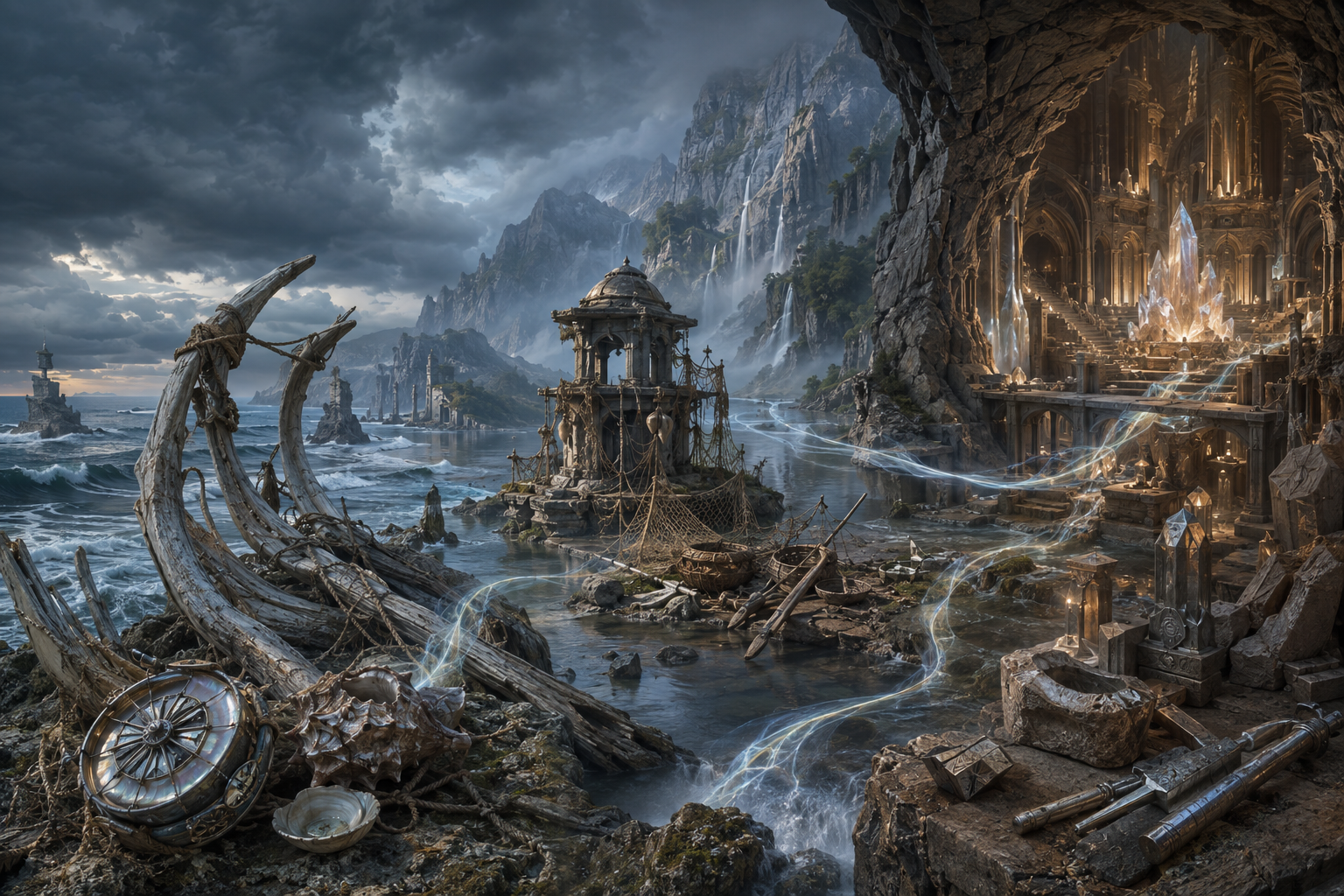
The Tinukeda’ya Are a Family of Peoples, Not One Fantasy Species
Niskies, dwarrows, sea-watchers, Dawn Children, and Cloud Children share an origin shaped by migration, habitat, exploitation, and survival. Kinship connects them. It does not make their cultures interchangeable.
The short answer
The Tinukeda’ya are Gardenborn descendants of Ruyan Vé whose peoples changed across generations through different relationships with sea, river, mountain, and other environments. The series later connects Niskies, dwarrows, sea-watchers, Dawn Children, and Cloud Children within that ancestry.
Their mutability helped dispersed communities survive. It also developed inside a history of displacement and use by more powerful Sithi families. Adaptation is therefore both gift and wound.
The family without the flattening
Niskies
Sea-watchers and navigators whose communities stretch from Abaingeat to Naraxi and Harcha. Gan Itai insists they are free people, not shipmasters’ property.
Dwarrows
Mountain-associated descendants whose stonecraft, Shards, cities, and guarded knowledge reflect generations of separate survival rather than a costume change.
Sea-watchers and other water-shaped kin
Related communities retain shared ancestry while developing distinct bodies, practices, and identities through life near different waters.
Dawn Children and Cloud Children
Later testimony places them inside the larger Tinukeda’ya family. The names preserve branches the main human histories barely understand.
Ys-fidri’s later explanation makes the principle explicit: kinship is real, and generations of divergence are also real.
Ruyan Vé and the crossing nobody survives alone
When the Two Families left Venyha Do’sae across the Great Sea, Ruyan the Navigator and the Tinukeda’ya made the crossing possible. Neither Zida’ya nor Hikeda’ya would have reached Osten Ard without the Ocean Children.
That indispensable labor did not produce equality.
The Sithi families carried older cruelty out of the Garden. Ruyan’s people were controlled, their great ships burned, and knowledge withheld. Gan Itai’s account remembers Ruyan chained when he tried to take those ships away. The official reason—saving the ships or their people from Unbeing—does not erase who retained authority and who became stranded.
Once stranded, Tinukeda’ya communities became available for exploitation by younger powers too. Gan Itai’s work aboard the Eadne Cloud is skilled navigation performed inside a structure that treats her people as useful, dwindling, and subordinate.
Gan Itai makes history immediate
Gan Itai is not a walking glossary. She is a great-grandmother twenty times over, a member of fewer than two hundred surviving Niskie families, and a woman who recognizes Miriamele’s captivity because her own people know the difference between service and freedom.
Her crawlspace inside the ship turns hidden architecture into resistance. Her knowledge of supplies makes escape survivable. Her song calls kilpa at a terrible cost. She remains behind because freedom has reached a point where every available action carries guilt.
The history of Ruyan’s chains becomes immediate ethics when Gan Itai sees Cadrach chained and Miriamele treated as property.
Craft, Witnesses, and the knowledge somebody wanted controlled
Tinukeda’ya history connects directly to the world’s magical infrastructure. Mezutu’a, Hikehikayo, and sea-collared Jhiná-T’senéi were given to Ruyan’s people as partial restitution by Jenjiyana, while other Sithi opposed even that payment.
The crystalline Shard of Mezutu’a is a Master Witness. Dwarrows recognize the work and material histories surrounding the Three Great Swords. They did not simply forge every blade, but their people’s knowledge touches star-stone shaping and the diminished Words of Making.
That makes withheld knowledge political. Some Sithi explicitly preferred servants laboring in ignorance. Gifts of cities cannot settle bondage while the dominant culture still controls history and preserves living factions that want the exploited people returned to service.
Why their bodies change
The series describes Tinukeda’ya bodies and bones adapting over generations to habitat. This is not a ranking system in which one branch is the “original” and the others are degraded copies.
Change is survival intelligence. Sea life produces one set of capacities; stone and mountain another. The cost is that displacement becomes written into descendants. A blessing enables survival inside the conditions imposed by an older injustice.
That double meaning is essential. Mutability can be wondrous without making the violence that demanded it beautiful.
Why “creatures” is the wrong shortcut
When Eolair uses “creatures,” Jiriki corrects him and names the Tinukeda’ya fellow Gardenborn. The correction is not etiquette. Classification carries the history of who was considered fully entitled to knowledge, autonomy, cities, and remembrance.
Jiriki also calls Sithi treatment of them a great shame. His honesty matters because he does not pretend the harm belongs only to dead ancestors. Pro-servitude beliefs remain among living Sithi, and dwarrow fear remains rational.
What this explains in the larger story
The Tinukeda’ya connect the Great Sea crossing, Niskie navigation, Gan Itai’s sacrifice, the dwarrow cities, Witness craft, Bright-Nail’s concealed heritage, star-stone, the Words of Making, and the moral failure inside Sithi memory.
They are not side-lore attached to the “real” conflict. Their labor made the migration possible. Their exploitation shaped the world. Their knowledge becomes necessary to understand the objects everybody else calls destiny.
On the record
This guide originates in the complete owner-accessed Kindle pass through Stone of Farewell page 589, where Gan Itai names her people and history. It incorporates reconciled Books 3–4 evidence from Jiriki, Ys-fidri, the Shard of Mezutu’a, and the Three Swords. Later evidence expands the canonical guide rather than creating duplicate volume profiles.