
LION KING CHARACTER · SURVIVOR, PERFORMER, ADOPTIVE FAMILY, AND THE SIDE CHARACTER WHO KEPT INTERRUPTING ROYAL HISTORY
Timon: The Meerkat Who Turned No Worries Into a Home, Then Followed Simba Back Into the Mess
Timon runs from a role that never fit, builds a family with Pumbaa, helps raise Simba, and learns that freedom stops being freedom when it abandons somebody you love.
The quick file
Timon is a meerkat, Pumbaa’s closest companion, Simba’s adoptive family, comic strategist, singer, survivor, reluctant caretaker, and one of the supposed side characters whose life keeps colliding with royal history. Nathan Lane defines the 1994 animated performance and returns across major film branches. Billy Eichner voices the 2019 photoreal Timon and returns in Mufasa: The Lion King.
The Lion King 1½ expands animated Timon’s background through his mother Ma, Uncle Max, the meerkat colony, his exile or departure, and the friendship with Pumbaa that precedes Simba. Timon & Pumbaa creates a broad comic television world with loose continuity. The character also appears in Simba’s Pride, The Lion Guard, games, attractions, and the stage adaptation.
Name, species, family, and branches
Timon’s biological family is absent from the 1994 film and developed in The Lion King 1½. Ma loves him, defends him, and eventually follows him. Uncle Max embodies colony anxiety and the belief that survival depends on rules, tunnels, vigilance, and staying within the group’s established system. Timon’s unnamed father does not become part of the film’s story.
The television series and later shorts often place Timon and Pumbaa in exaggerated global adventures that do not fit neatly beside every feature-film event. Those stories remain part of the franchise without requiring one perfect calendar. Comedy branches can preserve character relationships while treating geography, consequence, and return as flexible.
Nathan Lane makes speed sound like self-defense
Lane gives Timon a voice that can sell an idea before anybody has time to test it. The patter is fast, precise, theatrical, defensive, affectionate, and occasionally cruel. Timon fills silence because silence might allow fear, embarrassment, or somebody else’s plan to take control of the scene.
The performance lets bravado and devotion coexist. Timon complains while helping, insults while worrying, and presents collective decisions as if he invented them alone. Lane makes the contradiction readable: the meerkat wants credit, wants safety, and will still run into danger for the people he has claimed as family.
A meerkat built around lookout anxiety
Real meerkats live in social groups, forage, dig, raise young cooperatively, and use sentry behavior to monitor danger. Timon’s obsession with predators, shelter, food, and escape draws comic energy from recognizable survival pressures. The character is stylized and should not be treated as a complete account of meerkat behavior.
His small body matters in a world of lions, hyenas, and open plains. Intelligence, noise, speed, distraction, and partnership become ways to survive without physical dominance. Timon’s confidence often looks oversized because the threats around him are genuinely larger.
The Lion King 1½ gives Timon a before
The midquel places Timon inside a colony where his attempts to contribute repeatedly become disasters. He wants a role that fits and cannot accept tunnel digging as the only possible future. His mistakes endanger others, while the colony’s response convinces him that belonging requires becoming somebody he cannot sustain.
The movie complicates the familiar drifter. Timon does not begin free of responsibility. He begins ashamed, restless, loved by his mother, and desperate to find a place where his difference can become useful. Hakuna Matata grows from a real need for relief before it becomes an avoidance philosophy passed to Simba.
Relationship with Ma
Ma sees Timon’s failures and refuses to reduce him to them. She argues for him, worries about him, follows his path, and eventually recognizes the community he built beyond the colony. Her love does not erase the damage his mistakes cause. It keeps one bad fit from becoming a final verdict on his worth.
Timon’s relationship with Ma reveals a tenderness the 1994 film leaves implicit. He can be impatient, embarrassed, and hungry for independence while remaining shaped by somebody who believed he could find a better role. Chosen family does not require biological family to have been loveless.
Relationship with Uncle Max
Uncle Max represents justified fear hardened into pessimism. Predators threaten the colony, and one collapsed tunnel can matter. His criticism of Timon comes from survival pressure and becomes personally cutting. He cannot imagine difference as an asset because the environment has trained him to see deviation as danger.
Their later cooperation shows that neither worldview is sufficient alone. Timon needs preparation and collective responsibility. Max needs evidence that unconventional thinking can save lives. Family reconciliation arrives through action rather than a speech declaring every earlier conflict mistaken.
Meeting Pumbaa
Pumbaa approaches Timon when both are outside expected belonging. Timon initially recognizes practical benefits: size, protection, warmth, and a companion willing to follow. Pumbaa recognizes somebody who stays after learning about the smell that drove others away. Their friendship begins with unequal assumptions and grows beyond them.
Timon often calls himself the brains, yet Pumbaa supplies emotional intelligence, moral clarity, physical courage, and the trust that lets plans become shared life. The partnership works because each gives the other a social home. The joke hierarchy never fully captures the actual balance.
Hakuna Matata before Simba
For Timon, no worries is a response to colony anxiety and repeated shame. A life focused on food, comfort, song, and immediate companionship feels revolutionary after constant surveillance and failure. The philosophy restores pleasure and gives him enough distance to imagine himself as more than a problem.
Relief can become avoidance when it refuses every obligation regardless of consequence. Timon does not yet distinguish between burdens imposed by a bad fit and responsibilities created by love. Simba’s arrival will test whether no worries can include caring for somebody whose past remains dangerous.
Finding Simba
Timon and Pumbaa find a collapsed lion cub in the desert. Pumbaa wants to help. Timon sees a future predator and then notices the strategic advantage of raising a lion who might protect them. The reasoning is comic, self-interested, and attached to a genuinely lifesaving decision.
They move Simba into shade, give him water, food, companionship, and a place where nobody accuses him of murder. Whatever Timon’s first calculation, the care becomes real. Adoption can begin in messy motives and still create a durable family through repeated action.
Fear of lions before loving one
Timon’s first response to Simba is fear grounded in the food chain. A lion can kill a meerkat, and the unconscious cub will eventually grow into an adult predator. Pumbaa’s willingness to help asks Timon to risk more than inconvenience. Their household begins by refusing to let a category decide what one vulnerable child deserves.
The fear does not vanish instantly. Timon converts it into a plan where raising Simba might provide protection. Self-interest gives him a bridge toward care before trust exists. Over time the protective fantasy reverses: Timon becomes one of the adults willing to protect Simba emotionally and physically, even when the lion is far larger than he is.
Raising a lion on bugs and jokes
Timon teaches Simba to eat insects, sleep safely, sing, explore, and live outside royal expectation. The montage compresses years of caregiving into pleasure. Feeding a carnivore without prey also protects nearby animals, turning jungle abundance into a strange ecological compromise built around friendship.
The adults do not ask why the cub is alone with enough depth. That omission preserves the comedy and lets Scar’s lie remain untouched. Timon gives Simba safety and helps him avoid the story that made safety necessary. Care heals and delays healing at the same time.
Food changes the relationship with the jungle
Teaching Simba to eat insects is comic because the audience knows lions as hunters. It is also a household food policy. Timon and Pumbaa find a way to feed a growing carnivore without turning their neighbors into prey. The arrangement allows a predator and smaller animals to share one community with less fear.
The film does not calculate how many insects an adult lion would need or what that appetite would do to the ecosystem. The montage belongs to musical fantasy. Still, the idea carries moral weight: family requires adjusting ordinary consumption when one member’s body creates danger for everybody else living nearby.
Timon as an adoptive parent
The label parent fits parts of the relationship and should not erase friendship, sibling energy, or the shifting equality that arrives when Simba becomes an adult. Timon feeds, teaches, protects, corrects, worries, and later struggles when the child he helped raise chooses a life beyond their routine.
Adoptive love does not require Timon to replace Mufasa. Simba can carry a dead father and a living chosen family together. The franchise is strongest when it resists forcing one bond to cancel another. Different caregivers meet different needs across a life interrupted by violence.
Timon’s jokes at Pumbaa’s expense
Timon frequently uses Pumbaa’s size, smell, appetite, and supposed slowness as punch lines. The friendship survives because Pumbaa pushes back, Timon’s affection is visible, and their shared history contains trust. Survival of the bond does not make every joke harmless.
Comedy reveals hierarchy. Timon calls himself the brains and assigns Pumbaa the embarrassing body. A better reading can enjoy the timing and notice that Pumbaa repeatedly demonstrates judgment Timon lacks. The text itself undermines the insult by showing who understands people first.
Relationship with adult Simba
Adult Simba is physically capable of protecting Timon and emotionally dependent on the life they built. Timon treats the jungle arrangement as permanent because it solved his own belonging problem too. Nala’s arrival threatens more than routine. It could take away the family that confirmed Timon’s reinvention worked.
His resistance to Simba’s return contains fear beneath selfishness. Timon knows little about the Pride Lands, Scar, or the false guilt. He hears duty asking someone he loves to enter danger. The later decision to follow proves that love becomes responsibility even when no-worries language cannot contain it.
Can You Feel the Love Tonight
Timon and Pumbaa watch Simba and Nala reconnect, then mourn the apparent end of their trio. The comedy treats romance as theft because the friends assume one relationship must displace another. Their sadness is funny and emotionally credible for caregivers facing a changed family structure.
The fear does not become prophecy. Simba’s partnership with Nala expands his life and eventually brings Timon and Pumbaa into a larger family system. Chosen family can survive romantic love when the story allows connection to multiply rather than rank every bond.
Following Simba home
Timon initially rejects the idea of confronting Scar and then chooses to help after Simba leaves. The change is the moral completion of Hakuna Matata. Freedom from unnecessary shame cannot mean abandonment when someone you love faces the source of that shame.
He does not become fearless or suddenly reverent toward monarchy. He remains Timon, complains, strategizes, and contributes through the skills available to a small animal. Responsibility becomes compatible with personality rather than requiring a heroic transformation into somebody solemn.
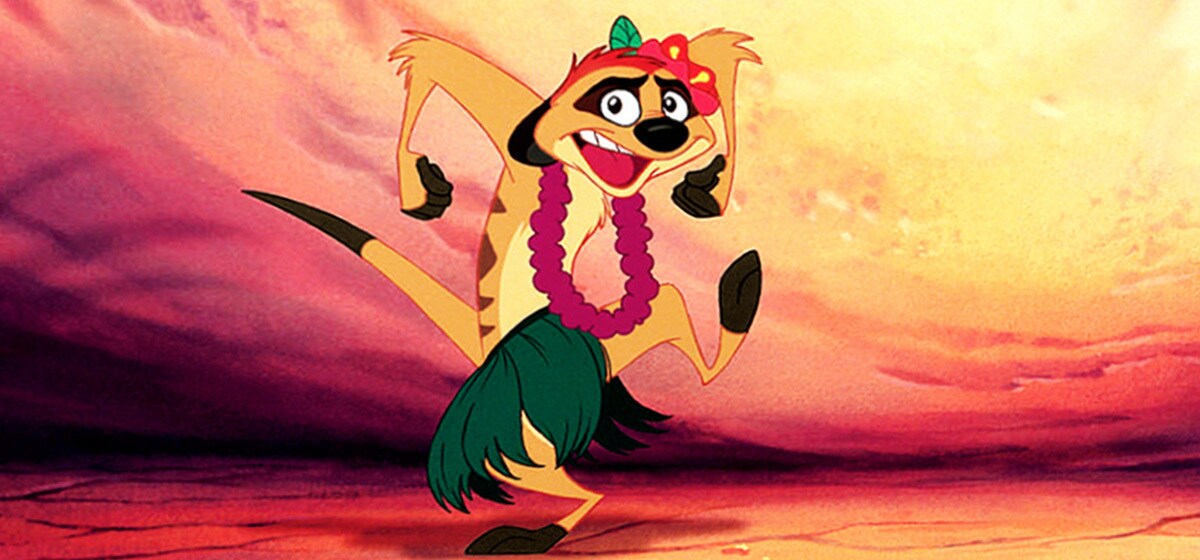
The hula distraction
Timon performs as bait while Pumbaa waits inside the plan. The sequence converts theatrical confidence, speed, costume, and comic shamelessness into tactical value. A character dismissed as noise weaponizes attention against hungry enemies.
The gag also borrows a generalized hula image for an African-set fantasy, reflecting the franchise’s willingness to mix cultural references for comedy. The sequence is iconic and culturally imprecise. Enjoyment does not require pretending the visual shorthand came from the Pride Lands.
The battle for Pride Rock
Timon joins Pumbaa, Rafiki, Simba, Nala, Sarabi, and the lionesses against Scar’s regime. He is small enough to be vulnerable and useful enough to matter. Distraction, movement, and coordination support fighters with greater physical power.
The battle proves the side characters were never outside history. Timon’s jungle home and daily pleasures mattered, but Scar’s violence eventually reached the people he loved. Neutral distance becomes impossible once political harm crosses into family.
Simba’s Pride and babysitting Kiara
Timon and Pumbaa become watchers, companions, and comic guardians for Kiara. Simba trusts the friends who raised him with the next generation, even though their surveillance style is not subtle. Their family role survives his kingship and partnership with Nala.
Kiara resists being managed, repeating Simba’s childhood frustration with escorts. Timon now occupies the adult side of the problem he once helped Simba escape. The reversal is funny because chosen family eventually inherits the very worries its philosophy tried to leave behind.
The Lion King 1½ changes the camera
The midquel replays famous events from Timon and Pumbaa’s viewpoint, exposing how royal history can make everybody outside the central family look like background. The pair searches for home while ceremonies, stampedes, songs, and battles happen nearby. Their lives do not begin when Simba notices them.
The framing also lets Timon exaggerate his importance. He becomes narrator, editor, and unreliable claimant to hidden influence. Comedy and correction operate together. The film recenters a side character without requiring every boast to become literal canon.
Timon & Pumbaa television series
The television branch sends the duo through a world of comic antagonists, jobs, scams, travel, friendship conflicts, and impossible resets. Quinton Flynn and Kevin Schon are among the performers who voice Timon in parts of the franchise beyond Lane’s primary film work. Credits change by production and episode.
The series amplifies Timon’s greed, competitiveness, cleverness, insecurity, and loyalty because episodic comedy needs conflict that can resolve quickly. Feature-film emotional continuity becomes looser. The branch is valuable as character play and should not be forced into one exact chronology with every royal event.
The Lion Guard
Timon appears as part of the extended royal family and community around Kion. The series can draw on his history with Simba while giving him daily contact with another generation. Humor remains the entry point, but experience makes him an adult who has already survived exile, adoption, coup, and restoration.
His presence also keeps Hakuna Matata in conversation with a child whose identity centers on duty. Kion does not need Simba’s escape route in the same way, yet rest, friendship, and perspective still matter. A philosophy can change function when inherited by somebody with a different wound.
Billy Eichner and the photoreal branch
Billy Eichner voices Timon in the 2019 remake and returns in Mufasa: The Lion King. The performance preserves rapid speech, theatrical complaint, and partnership with Seth Rogen’s Pumbaa while adjusting timing to photoreal bodies and a more improvisational vocal texture.
The 2019 branch makes the duo’s home feel populated by more animals and slightly revises the philosophy around the Circle. Timon’s comedy becomes less dependent on imitating Nathan Lane exactly. The role remains recognizable through rhythm, self-importance, fear, and love rather than one fixed vocal copy.
Timon as an interrupter in Mufasa: The Lion King
Older Rafiki tells Mufasa’s history to Kiara while Timon and Pumbaa interrupt from the present. Their commentary prevents legend from becoming a sealed monument. The family story arrives through solemn memory and the people who cannot resist questioning how it is being told.
The device suits Timon because he has always challenged official framing. The Lion King 1½ already made him a counter-narrator to royal history. Interruptions can be annoying and democratically useful when they remind an audience that every epic is selected by a storyteller.
The stage puppet
The stage adaptation presents Timon through a visible performer and a bunraku-influenced puppet system. The actor controls the mouth and movement while remaining part of the audience’s perception. Character emerges from the relationship between human body, puppet, voice, costume, and choreography.
The design fits Timon’s theatricality. He is visibly constructed and fully alive at once. The production does not need to hide the mechanism to sustain feeling, echoing how Timon performs confidence without ever completely hiding the anxious person operating it.
Queer and chosen-family readings
Many viewers read Timon and Pumbaa’s domestic partnership and co-parenting of Simba through queer or chosen-family experience. The films do not label their sexuality or formally define their relationship as romantic. Interpretation should remain open without treating mannerism, performance history, or cohabitation as proof.
The reading persists because the pair builds a household outside bloodline expectations, raises a child together, fears being displaced by heterosexual romance, and remains family afterward. Those themes can matter deeply to audiences even when canon uses friendship language. Emotional recognition does not require a forced label.
Common fandom misconceptions
Timon is a meerkat, not a mongoose in the narrow zoological sense, though meerkats belong to the mongoose family. He did not raise Simba alone. Pumbaa is an equal caregiver and friend. Hakuna Matata helps Simba survive and also supports avoidance of unresolved guilt.
The television adventures do not form a perfectly stable travel calendar. Billy Eichner’s photoreal Timon and Nathan Lane’s animated Timon belong to related but distinct productions. Queer readings are interpretations rather than an officially stated identity.
What future stories owe Timon
Animated stories could deepen his relationship with Ma and Uncle Max, show how the colony relates to his chosen family, explore aging beside Pumbaa, and let him advise younger characters without losing comic selfishness. Growth should not sand away the traits that made responsibility difficult.
Photoreal stories can develop the present-day household around Kiara and show what Timon thinks of the legend he keeps interrupting. Let him be wrong, protective, observant, culturally messy, and indispensable. A comic character earns depth without needing a tragic reinvention.
Profile conclusion
Timon is survivor, runaway, son, friend, adoptive parent, performer, strategist, complainer, and proof that a side character may be living an entire story beside the one labeled important. He gives Simba a home and eventually follows him into the history they tried to escape.
Return to The Lion King hub for films, series, reviews, Reacts, rants, guides, and the complete character directory. Timon’s feature, television, stage, and photoreal branches remain connected there without pretending every comic detour shares one calendar.
The character receipt Pride Rock cannot flatten
Timon cannot be reduced to a place in the royal family tree. The profile’s central problem is chosen family, comic self-protection, and the limits of a survival philosophy that works until somebody else’s home needs defending. That argument becomes visible through decisions, not biography labels. The story tells us who belongs near Pride Rock, but the character receipt asks who has information, who controls movement, whose fear is believed, and who performs the work after a public decision becomes a private emergency.
The relationship map includes Pumbaa, Simba, Nala, Rafiki, the meerkat colony developed in later branches, and the Pride Lands crisis he initially regards as somebody else’s problem. Each connection places a different demand on Timon. Love may require truth, friendship may require interruption, leadership may require listening, and family may require a boundary that ceremony cannot override. A complete profile follows what changes between two people after conflict. Repeating the word family is not evidence that repair occurred.
The performance matters at the same level as plot: Nathan Lane gives Timon speed, vanity, panic, and affection, making every joke sound partly like entertainment and partly like a plan to stay ahead of fear. Breath, tempo, silence, posture, and distance frequently carry what the screenplay leaves unspoken. The Lion King uses animals with highly readable human emotion while preserving movement drawn from observation. That balance lets a lowered head or delayed step become moral evidence without translating every feeling into dialogue.
The 1994 film also places Timon inside an African-inspired world assembled by an American studio through research, music, language, landscape photography, theatrical tradition, and fairy-tale structure. The result is culturally meaningful to many viewers without becoming a documentary map of one country or people. The profile names specific influences where evidence supports them and does not use “Africa” as a decorative adjective that ends the inquiry.
Later films, television series, stage productions, photoreal remakes, and the Mufasa branch revise Timon through different continuities. More screen time can expose a missing motive, but it can also tidy a contradiction that made the original performance interesting. The comparison asks what each version permits Timon to know, choose, refuse, remember, and repair. Visual realism alone does not make a characterization more truthful.
The final JIN test is whether Timon leaves behind a person rather than a symbol. Symbols can carry grief, monarchy, exile, ecology, parenthood, or chosen family, but people contradict the role assigned to them. The best future scene would let Timon make an ordinary choice with no ceremony watching, then allow that choice to matter later. Continuity begins when the franchise remembers what the character already paid to learn.
The scene after the applause
Timon also deserves the scene after everybody else believes the problem is solved. That is where duty becomes visible: checking on the injured, sharing food, naming the lie, sitting with grief, or admitting that the restored landscape did not restore every relationship. The Lion King often moves through magnificent public images. A private aftermath would show whether Timon can live the values the ceremony just announced.
What the next branch must remember
Timon should enter the next branch carrying the information already earned here. A new visual style, performer, timeline, or target audience can reinterpret behavior without erasing its cost. The useful comparison is not whether every detail matches. It is whether the adaptation understands which choice defined the relationship and what would have to happen before that choice could honestly change.
The person outside the lesson
Timon is larger than the lesson another character learns from knowing them. The profile keeps one space for appetite, humor, fatigue, pleasure, and private preference because personhood cannot be measured only through service to Simba’s arc. That space is small on screen, but naming it stops the ensemble from collapsing into tools arranged around the heir.