
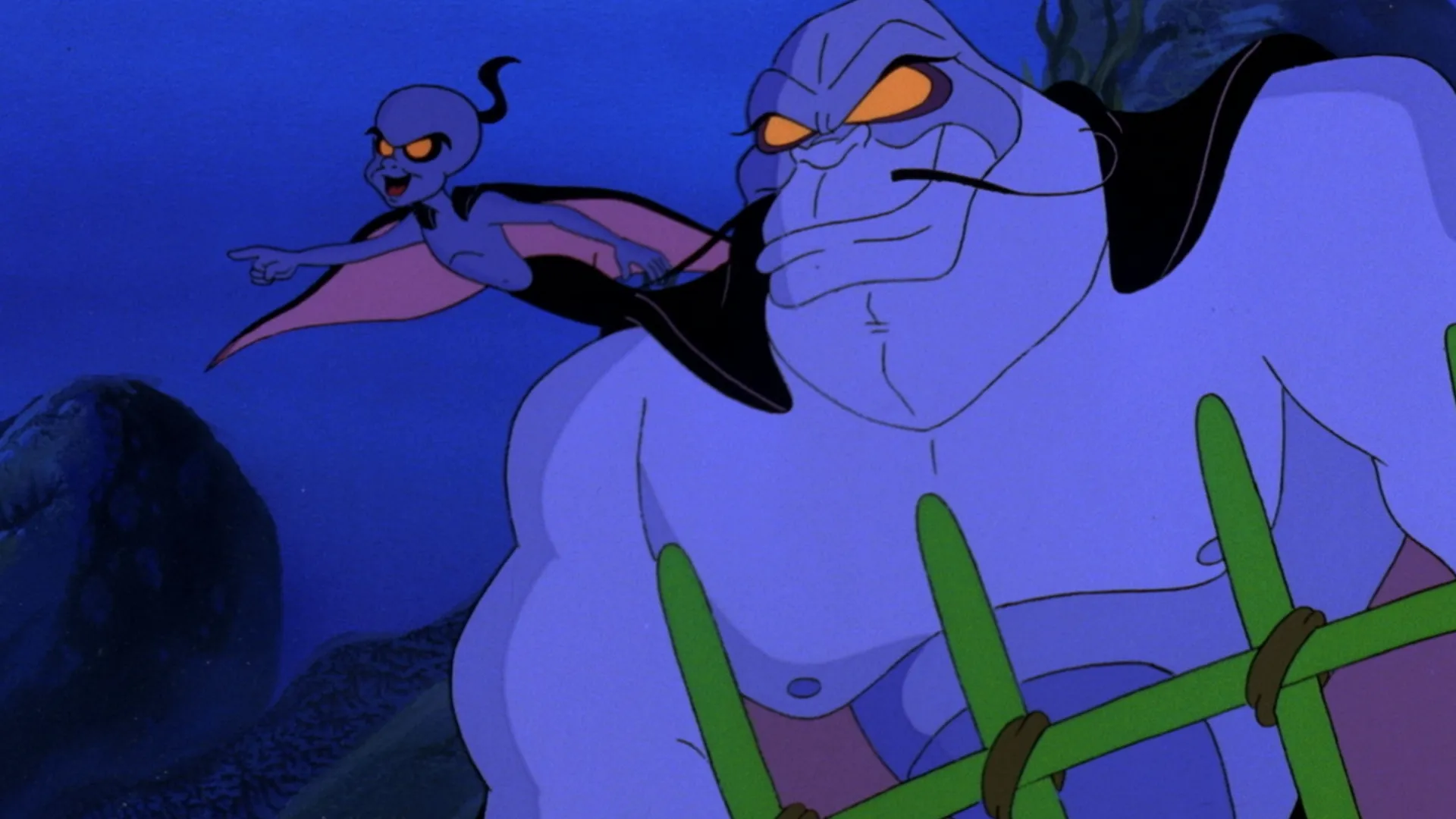
RaeRae Reacts · S3E8 · 1992 Animated Series
A Little Evil
The Evil Manta introduces his son and tries to turn inherited resentment into a family duty, forcing the child to decide whether legacy must become repetition.
The episode receipt
Series: The Little Mermaid (1992). Episode: S3E8 “A Little Evil.” Broadcast-order position: 31 of 31.
What happened
The Evil Manta introduces his son and tries to turn inherited resentment into a family duty, forcing the child to decide whether legacy must become repetition.
What the episode is really testing
Where to watch
Disney+ currently lists this episode. Regional catalogs and numbering can differ because the pilot is omitted from the service.
First reaction: calling a child Little Evil does not describe him. It gives him a job
Evil Manta returns with a son he expects to reproduce his hatred. Little Evil meets Ariel and her friends, discovers that helping and playing feel better than performing cruelty, and forces his father to confront a possibility the villain cannot tolerate: the child is a person, not an extension.
“A Little Evil” ends the series with parental grooming disguised as destiny. The father gives his son a name, ideology, and emotional script before the boy can compare them with another way of living. Friendship becomes radical because it gives Little Evil evidence about himself.
The name is the first cage
“Little Evil” tells everybody what the child is supposed to be before he acts. It turns a moral judgment into an identity and makes disobedience sound like failure to be himself.
Children often internalize the names powerful adults repeat. Defiant, bad, weak, difficult, gifted, perfect, and evil can all become assignments that narrow what a child believes is available.
Evil Manta mistakes reproduction for legacy
He wants his son to be “just as evil” as he is, treating villainy like a family craft that proves paternal success. The child’s future is valuable only if it confirms the father’s past.
That is not mentorship. It is using a new life to protect an old identity from examination.
The son begins with attachment, not ideology
Little Evil wants his father’s attention and approval. He learns the performance expected of him because dependence makes parental values feel like survival rules.
A child complying with a caregiver’s worldview is not proof the worldview arose naturally. It may show how effectively love and fear have been braided together.
Teaching harm through play makes it feel normal
Evil Manta frames destructive behavior as training and shared family purpose. If cruelty produces praise, it can feel less like a moral choice than a game with the parent finally paying attention.
Grooming often works by making boundary violations incremental, rewarded, and ordinary before the child understands the larger system.
Ariel offers an experience instead of a counter-lecture
She does not need to win a philosophical debate about whether Little Evil is inherently bad. She and her friends include him, play with him, and let prosocial behavior produce joy.
Direct experience gives the boy a comparison his father’s closed world tried to prevent.
Friendship creates a second mirror
At home, Little Evil sees himself reflected as a future villain. With Ariel, he sees curiosity, humor, helpfulness, and belonging answered with affection rather than contempt.
Identity expands when a child encounters people who respond to capacities the family refused to recognize.
Enjoying kindness does not make him secretly perfect
Little Evil is learning. He may imitate harmful behavior, test boundaries, or repeat his father’s language because those habits were taught before safer relationships arrived.
Healing should not require instant purity. A child leaving indoctrination needs room to make choices, repair harm, and develop without every mistake being treated as proof the parent was right.
Evil Manta calls friendship mind control because autonomy threatens him
He accuses Ariel of “messing with” his son’s mind when the boy begins choosing differently. The father interprets independent thought as outside corruption because he experiences obedience as the natural state.
Controlling adults frequently describe any relationship they do not command as manipulation. The accusation protects their monopoly on influence.
Ariel’s influence is not neutral, but it is less coercive
She has values and hopes Little Evil will help rather than harm. The difference is that friendship leaves him space to discover pleasure, disagree, and act without punishment for failing to reproduce her identity.
No relationship is influence-free. The ethical question is whether influence expands agency or replaces it.
Evil Manta’s earlier defeat explains his desperation
Ariel previously disrupted his attempt to divide Atlantica through prejudice and lies. Her success proved that connection could undo the social hatred on which his power depends.
Seeing his own son respond to her turns political defeat into intimate terror. The enemy’s worldview has entered his family and made sense to the person meant to continue him.
The father built his power through division
In “The Evil Manta,” he inflamed differences among Atlantica’s residents and creatures. His method requires categories to become permanent enemies whose fear can be directed.
Little Evil’s friendship crosses exactly the boundary his father needs to preserve. The child does not merely disobey. He disproves the business model.
The series finale returns to its strongest political idea
Atlantica survives when different creatures cooperate and becomes vulnerable when fear is organized into hostility. The last episode brings that argument into a parent-child relationship.
Peace is no longer only a kingdom’s policy. It is a child refusing inherited hatred at home.
Little Evil should not be responsible for redeeming his father
A son’s goodness may move Evil Manta, but the child does not owe moral labor to the adult who groomed him. His safety and development matter whether or not the father changes.
Redemption stories become harmful when they make abused children prove enough love to rescue the person who harmed them.
Parental love is not proven by possession
Evil Manta may sincerely care about his son while still treating him as property. Protectiveness becomes control when the parent cannot tolerate a self that chooses different values.
Love must make room for separation, consent, and surprise or it remains domination with warmer language.
A villain can love and still be unsafe
Recognizing attachment does not excuse indoctrination, threats, or attempts to isolate Little Evil. Emotional complexity should improve risk assessment, not erase it.
The child needs boundaries and support even if his father cries, apologizes, or performs one generous act.
The brain sponge makes coercion literal
Evil Manta’s pet, the Brain Sponge, turns mental control into a visual gag and a concrete danger. It fits an episode already concerned with who gets to shape a child’s thoughts.
The creature externalizes what the father has been doing socially: attaching himself to another mind and treating control as care.
Mind control is the accusation and the method
Evil Manta claims Ariel is corrupting his son while his own household includes a creature associated with controlling brains. The hypocrisy is nearly architectural.
Authoritarian parents often accuse outsiders of the coercion they normalize at home because naming the threat elsewhere prevents scrutiny of their own behavior.
Little Evil needs protection from both magic and retaliation
Once the father realizes the boy has changed, emotional pressure may escalate. A safe plan needs trusted adults, somewhere to stay, clear permission to seek help, and protection against magical recapture.
Telling a child to “choose good” without building material safety turns courage into abandonment.
Triton cannot solve this by imprisoning the father and claiming the child
Royal intervention may be necessary, but replacing one controlling patriarch with another institution does not automatically respect Little Evil’s needs. Placement and guardianship should center stability, voice, and ongoing relationships.
The kingdom must treat him as a child with rights, not a symbolic prize proving Atlantica defeated evil.
Ariel is a friend, not a caseworker
Her connection helps Little Evil imagine another life, but a teenage princess should not carry sole responsibility for housing, treatment, education, and protection.
Adults and institutions must build the structure that lets friendship remain friendship.
Urchin is the natural peer for this story
Urchin knows what it means to enter palace society with a history adults may judge. He also knows that belonging can emerge through chosen relationships rather than blood alone.
His perspective could help Little Evil understand that leaving one assigned role does not require becoming somebody else’s perfect child.
Flounder models gentleness without weakness
After surviving his own imposed monster identity in “The Beast Within,” Flounder is especially suited to reject the idea that appearance or origin determines morality.
The broadcast order creates a useful echo: one child is called a beast because his body changes, and another is called evil because his father says so.
Sebastian can teach structure without inherited hatred
He values rules and responsibility, which can help a child whose boundaries were built around pleasing a dangerous parent. The challenge is making rules transparent and revisable rather than another obedience test.
Healthy structure explains whom a rule protects and allows questions without threatening attachment.
Little Evil deserves a name he chooses
Keeping the old name may reclaim it, or it may force him to repeat his father’s verdict every time he introduces himself. The decision should belong to him.
Renaming can mark freedom, but adults should not impose a “good” replacement that simply flips the label and creates another performance.
The title leaves room for ordinary imperfection
“A Little Evil” can describe the father’s miniature successor, but it also jokes about the small selfishness, anger, mischief, and harm present in everyone. Moral life is not divided into flawless children and born villains.
Little Evil’s freedom depends on being allowed complexity. He should not need sainthood to prove he escaped destiny.
Bradley Pierce gives the child vulnerability without making him empty
The performance has to carry learned bravado, curiosity, pleasure, and conflict within a short runtime. Little Evil feels capable of choice even while his choices are heavily conditioned.
That balance keeps the episode from presenting him as either a tiny villain or a passive object Ariel fixes.
Tim Curry lets Evil Manta’s theatricality become paternal insecurity
His voice gives the villain enormous confidence, but the son’s independence exposes how fragile that identity is. A man who can terrorize a kingdom becomes panicked by a child enjoying kindness.
The performance helps us hear control underneath the grand villain language.
Jodi Benson makes kindness active rather than delicate
Ariel’s welcome is not passive sweetness. It directly interferes with a cycle of inherited harm and places her between a controlling father and the child he claims.
Compassion becomes political action when someone’s worldview depends on isolation.
The finale does not need a larger war to matter
There is no requirement that the last episode threaten every tower in Atlantica. One child choosing a different inheritance can carry the whole series’ argument about curiosity, prejudice, and connection.
Small relational change may be less spectacular than a battle and more consequential across generations.
The episode is a chosen-family story with necessary cautions
Ariel’s circle offers belonging beyond blood, which is vital for a child whose biological family uses love as control. Chosen family can make survival imaginable.
It should not be romanticized as effortless. Trust, trauma, boundaries, housing, education, and continued consent still require work after the closing scene.
Evil Manta’s redemption must include accountability
If he changes because he loves his son, he still owes Atlantica repair for division, coercion, and prior attacks. Private tenderness cannot settle public harm.
A redeemed parent must also accept that forgiveness and contact belong to the child, not to the adult’s preferred timeline.
No-contact can be loving and morally legitimate
Little Evil may eventually choose distance even if his father improves. Protecting himself would not mean Ariel poisoned the relationship or that the boy lacks compassion.
Reconciliation is one possible outcome, not the price of being considered healed.
Atlantica needs a program for children leaving dangerous households
Safe residences, trauma-informed healers, education, peer support, legal advocates, and guarded contact options would keep future rescues from depending on royal friendship.
A kingdom proves its values by what happens after the dramatic child says no.
The episode quietly challenges biological destiny
Little Evil resembles his father and comes from the same household, but neither blood nor species fixes his moral future. Experience, relationship, reflection, and choice matter.
That argument is especially important in a fantasy world where visual design often tells viewers who is good before anyone acts.
The manta form should not equal wickedness
The father’s title and design encourage a species-shaped association between manta traits and evil. Little Evil’s kindness breaks that visual shorthand from inside the same body type.
The child does not need to become less manta-like to become safer. Morality changes through action, not resemblance.
The finale completes Ariel’s growth as a bridge
Across the series she befriends whales, deaf mermaids, orphans, humans at a distance, creatures feared by Atlantica, and now a villain’s son. Her curiosity repeatedly reaches people official categories exclude.
The gift and danger are the same. She opens contact before institutions are ready, then needs better adult support to keep connection from becoming reckless exposure.
The series began by expanding Ariel’s world and ends by expanding somebody else’s
The television project gives Ariel adventures before the film, but its final movement belongs to a child who has known only his father’s definition of life. Ariel becomes the doorway rather than the destination.
That is a generous ending for a heroine built around wanting another world. She learns to offer worlds too.
The Princess Collection home-video pairing is a strange little afterlife
“A Little Evil” was later paired with “Tail of Two Crabs” on a Princess Collection volume. One story studies inherited villainy; the other uses rivalry and identity performance around Sebastian.
The pairing is not a hidden canon statement, but it shows how home video repackaged a politically sharp finale as princess-branded family entertainment.
The finale date matters
The episode aired November 26, 1994, after a gap from “Ariel’s Treasures.” It became the thirty-first and final broadcast story rather than a conventional ceremony-heavy farewell.
Its ending feels thematic instead of administrative. The characters do not know the series is over, which lets the world remain open beyond the episode.
What Little Evil needs next
A chosen name, safe housing, patient friends, education beyond propaganda, private counseling, play that is not training, and the right to feel love, anger, grief, and relief about his father at the same time.
He also needs ordinary days. A childhood cannot be rebuilt entirely through moral tests.
What Evil Manta must do next
Stop pursuing control, surrender coercive tools, disclose what he taught and did, accept supervision, repair public harm, and respect whatever contact boundary his son chooses. Feeling moved is the beginning, not the proof.
If he wants to become a father rather than an owner, he must allow the child’s life to stop being about him.
Where this sits in broadcast order
“A Little Evil” is season three, episode eight and episode thirty-one overall. It aired November 26, 1994, was written by Tedd Anasti and Patsy Cameron, and was directed by Jamie Mitchell.
It returns Evil Manta from his earlier appearance and ends the series on the same anti-prejudice argument that made him effective: hatred is taught, connection can interrupt it, and institutions must do more than celebrate the interruption.
Final reaction
“A Little Evil” refuses the lazy idea that a villain’s child is a smaller villain waiting to grow. The boy has been named, trained, and emotionally recruited into his father’s identity, yet one sincere friendship gives him room to hear his own preference.
That is hopeful without making harm simple. Episode grade: A, with Little Evil allowed to choose a new name, Ariel kept in the friend role instead of the rescue-system role, and Evil Manta denied any reunion until accountability, safety, and his son’s consent exist outside a twenty-two-minute ending.