
RaeRae Reacts · S3E2 · 1992 Animated Series
King Crab
Sebastian’s parents visit after he has exaggerated his status, turning family pride into a panic about who he became after leaving home.
The episode receipt
Series: The Little Mermaid (1992). Episode: S3E2 “King Crab.” Broadcast-order position: 25 of 31.
What happened
Sebastian’s parents visit after he has exaggerated his status, turning family pride into a panic about who he became after leaving home.
What the episode is really testing
Where to watch
Disney+ currently lists this episode. Regional catalogs and numbering can differ because the pilot is omitted from the service.
First reaction: Sebastian writes himself a crown and his parents arrive ready to believe it
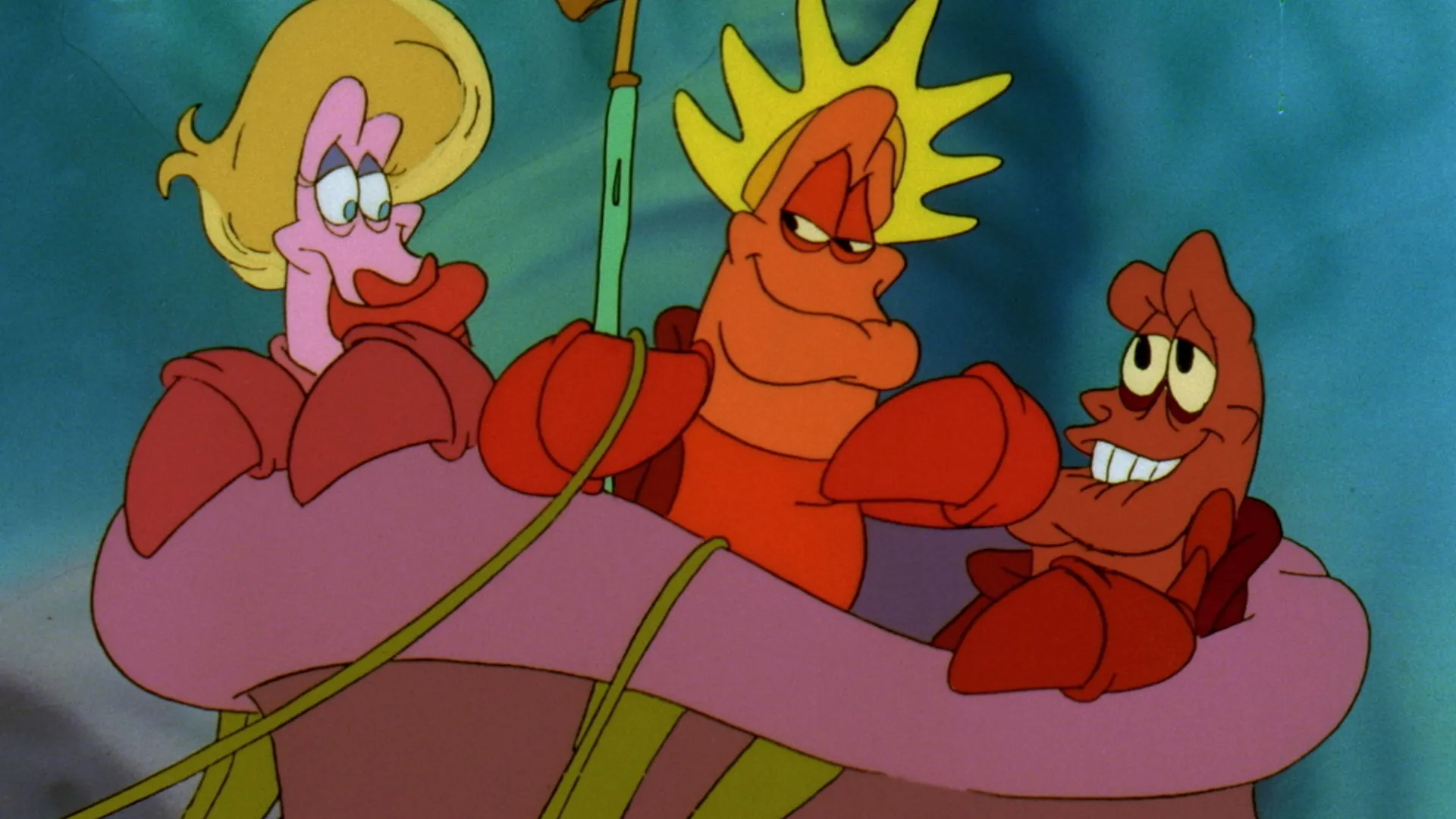
Sebastian’s parents visit Atlantica after reading letters they understood to mean their son is king. He intends to correct them, sees how proud they are, and accepts Ariel, Flounder, and Urchin’s plan to pretend for one day. Then Emperor Sharga hears a little crab has taken the throne and attacks.
“King Crab” turns family pride into a national-security incident because Sebastian cannot survive one honest sentence: “I have an important job, but I am not the king.”
The lie begins in letters, not at the palace door
Sebastian insists his parents misunderstood his extremely modest correspondence. Maybe he never wrote the literal words “I rule Atlantica.” Repeated descriptions of advising Triton, managing crises, and caring for the kingdom may have been polished until the distinction disappeared.
Ambiguity can be intentional deception when the writer benefits from the obvious conclusion.
Distance lets Sebastian curate a version of success
Letters travel without the daily texture of his work. His parents do not see Triton issuing orders, Ariel ignoring him, or the panic behind each emergency. They receive the accomplishments Sebastian selects.
A curated life can remain plausible until somebody visits the set.
His parents’ pride is loving and creates pressure
Mr. and Mrs. Crab cared for him when he was a baby and want to celebrate the adult he became. Sebastian remembers that care and feels he owes them an impressive return.
Love becomes pressure when a child believes ordinary truth will retroactively disappoint every sacrifice a parent made.
Sebastian already has a career worth describing honestly
He advises King Triton, composes and conducts royal music, manages court duties, helps protect Ariel, and responds to threats across Atlantica. That is not failure hiding behind a crown.
The need to call himself king reveals how status can make meaningful labor feel insufficient.
Class aspiration changes the meaning of “doing well”
His family may come from a community far from royal power. Court access, formal titles, a palace home, and proximity to Triton represent extraordinary mobility. Sebastian enlarges the achievement into sovereignty because proximity to power is not enough once comparison begins.
Status hunger has no natural finish line.
The family’s speech and warmth enter a palace built around formal hierarchy
The repeated family hugs and visible enthusiasm contrast with Sebastian’s controlled court persona. He loves them and feels exposed by the cultural distance between home and work.
That is respectability pressure: believing professional legitimacy depends on editing the people who made you.
Sebastian is not ashamed that they are bad people
His parents are affectionate, trusting, and delighted to see him. The embarrassment comes from how their openness might look inside an elite environment.
Class shame often attaches to warmth, accent, clothing, food, or familiarity rather than any actual harm.
Code-switching can be skill without becoming self-erasure
Sebastian adjusts language, posture, and behavior for Triton’s court. That flexibility helps him work across settings. The problem begins when the professional version is treated as the only self worthy of respect.
He should not have to choose between competence at court and belonging to his family.
The palace should be capable of receiving working-class family without spectacle
Sebastian’s parents should not need royal manners, expensive presentation, or fluency in court procedure to visit their son. Staff families need clear invitations, accessible lodging, introductions, and enough context to understand the workplace without being treated as entertainment.
When an institution makes ordinary family presence feel socially dangerous, employees will hide origins, avoid visits, or perform status they do not possess. Inclusion is not only inviting people into elite space. It is changing the space so they do not have to impersonate its preferred class.
Ariel’s plan protects feelings by expanding the deception
She sees parents overflowing with pride and suggests one day of pretending. The intention is tenderness. The result recruits friends, props, public space, and royal symbols into a lie that can be observed by enemies.
Kindness without a boundary becomes conspiracy surprisingly fast.
The fake crown and trident are not harmless costume pieces
Royal objects signal command, legitimacy, and military authority. Wearing them in public changes what outsiders reasonably believe about Atlantica’s leadership.
A private family performance becomes state misinformation the moment it leaves the room.
Flounder becomes infrastructure for somebody else’s image
The royal chariot gag places physical and emotional labor on friends maintaining Sebastian’s fantasy. They must carry, announce, improvise, and absorb risk while he receives praise.
Support should not require making another person’s lie operational.
Urchin understands performance because he once lacked status
An orphan who fought for belonging may recognize why Sebastian wants his parents to see security and importance. He also knows found family can love a person before titles arrive.
His participation is compassionate, but he could have offered the more durable truth: these people are proud of Sebastian, not the crown.
The lie begins to feel good and changes Sebastian’s posture
At first he appears trapped by misunderstanding. Praise, ceremony, and command soon become enjoyable. He starts performing kingship for himself as much as for his parents.
A reluctant lie can still reveal a desire the liar was waiting for permission to enjoy.
Power is seductive when it arrives as family approval
Sebastian does not seize the role through open ambition. His parents hand him an image of greatness, friends construct the stage, and he steps into it to preserve love.
That path feels morally cleaner than wanting power and can therefore be harder to interrupt.
The performance also teaches the children a dangerous model of authority
Ariel, Flounder, and Urchin assemble kingship from a crown, trident, chariot, attendants, and confident orders. The joke works because those symbols are enough to persuade observers. It also reveals how little the public sees of actual governance.
Young participants learn that authority can be manufactured through staging before they learn budgets, law, diplomacy, care, or accountability. Helping Sebastian should not require normalizing the idea that looking royal and governing are the same act.
Triton’s absence creates a governance vacuum the children treat as theater
The actual king is away, leaving royal space available for a pretend inspection. That suggests weak delegation, unclear interim authority, and no protocol preventing counterfeit command.
A stable kingdom should not depend on everyone recognizing Triton’s face.
The Sharkanian scout makes the reasonable wrong inference
He sees Sebastian with crown, trident, chariot, attendants, and royal behavior. Reporting that a crab has taken over is inaccurate, but the evidence was deliberately staged to produce that conclusion.
Sebastian cannot blame the observer for believing the performance.
Emperor Sharga attacks perceived weakness, not injustice
Sharga hears that Triton is gone and a “stupid little crab” rules Atlantica. He interprets leadership change as vulnerability and opportunity.
The attack exposes a geopolitical environment where adversaries monitor symbols more closely than intentions.
Calling Sebastian little is part of the military assessment
Sharga reduces the crab’s body and status into proof that the kingdom can be taken. The insult echoes Sebastian’s size anxiety from the previous season.
His actual response will show that strategic capacity has never depended on physical scale.
The magical monster is Sharga’s outsourced violence
Rather than risk himself, the emperor conjures or directs a creature toward Atlantica. Distance lets the ruler create destruction while preserving command safety.
Leadership becomes cowardice when subjects and summoned bodies absorb every consequence.
Sebastian is forced to perform the authority he falsely claimed
The fantasy was enjoyable while it required speeches and a chariot. An attack turns costume into expectation. His parents believe their son can defend the realm because he encouraged that belief.
Titles are promises about responsibility, not only access to admiration.
Crisis reveals that Sebastian does possess leadership capacity
He understands Atlantica, works with friends, reads danger, and helps save the kingdom. The resolution proves he is more capable than his shame allowed him to say honestly.
It does not prove the lie was necessary. Competence could have been recognized under his real title.
Leadership is coordination, not impersonation
Sebastian’s useful actions depend on listening, sharing tasks, and using local knowledge. The crown contributes nothing to the solution except the danger that summoned it.
He becomes most kinglike when he stops needing to look like the king.
His parents deserve the truth before they leave
Letting them return home believing a false title preserves immediate pride while guaranteeing future deception. Every later letter would need maintenance, and another visit could expose the lie more cruelly.
Respect means trusting family to update their understanding.
A confession should not blame their misunderstanding
“You read my letters wrong” avoids Sebastian’s role in writing them to sound grand. A full confession admits exaggeration, explains the fear beneath it, and names the friends recruited into the performance.
Accountability begins where passive grammar ends.
His parents may be proud of service rather than sovereignty
They celebrate him because they believe he built a meaningful life and matters to others. Once they see the actual responsibilities he carries, the title may become less important than he fears.
Children often underestimate parents by assuming love follows the résumé headline.
Their misunderstanding may also reveal what Sebastian failed to explain about collective work
His letters seem to center everything he does for Atlantica without naming the king, colleagues, guards, musicians, citizens, and young friends who share responsibility. A self-promotional account can make collaboration sound like personal rule even without a direct lie.
Honest pride includes the team. Sebastian’s achievements do not shrink when he credits other people, and his parents gain a clearer picture of the relationships that keep their son safe.
Parental pride should not be a debt paid through achievement
Sebastian remembers their care and wants to repay it by becoming someone impressive. Parenting is not an investment that matures into a throne.
Gratitude can include attention, honesty, support, and shared life rather than status theater.
The episode does not require Sebastian to reject ambition
He may want higher office, more autonomy, or formal recognition. Those desires can be discussed with Triton and pursued through real responsibility.
The problem is not wanting influence. It is substituting performance for a legitimate path.
Triton should examine why his advisor feels invisible
Sebastian’s exaggeration is his responsibility, but the court may rely on him heavily while keeping his title, compensation, and recognition vague. Invisible labor breeds fantasies of unmistakable authority.
A leader should know when a trusted advisor feels that only the crown would make family understand his worth.
The attack demonstrates an intelligence leak
A single Sharkanian observer can approach, identify apparent leadership, and report to Sharga without detection. Atlantica’s counterintelligence is weaker than the royal pageantry suggests.
The kingdom needs perimeter awareness that does not depend on Sebastian noticing every threat personally.
Diplomacy with Sharkania requires more than episodic defense
Sharga remains an enemy across “The Great Sebastian” and this return. Repeated attacks suggest unresolved borders, incentives, grievances, and power calculations.
Defeating one monster restores the status quo that produced the next invasion.
Sebastian’s family becomes a security vulnerability through secrecy
Because the visit is hidden inside a lie, officials cannot protect guests appropriately or explain the political environment. His parents wander through a performance while an emperor mobilizes.
Personal shame can create public blind spots when institutions are involved.
Family privacy and state secrecy are not the same thing
Sebastian deserves boundaries around personal history. He does not have the right to misrepresent the head of state in public space and call it private family business.
The scale of the deception changes its ethical category.
Samuel E. Wright lets Sebastian sound younger around his parents
The court official’s confidence shifts under family attention. Pride, panic, affection, and the need to be a good son crowd the voice at once.
That regression makes the lie emotionally legible even while the consequences become absurd.
The family-hug repetition is more than a visual gag
Sebastian is physically surrounded by affection he cannot manage through protocol. His parents collapse distance repeatedly while he tries to maintain a royal image.
The hugs expose the tender thing beneath the embarrassment: he is loved in a way the court does not express.
The state-of-the-kingdom speech makes counterfeit authority farcical
By the time “the grand high crab guy” is expected to address Atlantica, the children’s improvisation has expanded beyond one private misunderstanding. Language fails because nobody designed an actual office.
Institutions cannot be recreated convincingly through props alone.
This is not only a lesson about bragging
A simple moral would say do not exaggerate. The richer story asks why Sebastian believes his real life cannot make the people who love him proud, and why his workplace identity feels so fragile without supreme rank.
Stopping the lie matters. Repairing the shame prevents the next version.
What Sebastian should write next
Describe his actual duties, include failures with successes, explain the chain of command, and ask about his parents’ lives rather than using every letter as a performance report.
Reciprocal correspondence can restore family relationship where self-promotion took over.
What Ariel should learn about protective lying
A lie that preserves one happy afternoon may create larger danger, require other people’s labor, and deny the person being protected a chance to respond truthfully.
Compassion can help someone confess instead of building a prettier falsehood.
What Triton should repair after returning
Clarify interim authority, secure royal symbols, review Sharkanian surveillance, recognize Sebastian’s actual service, and create space for staff families to visit without feeling culturally out of place.
The incident is personal, political, and administrative at once.
Where this sits in broadcast order
“King Crab” is S3E2 and episode twenty-five in the complete thirty-one-episode inventory. It aired September 24, 1994. Tedd Anasti and Patsy Cameron are credited as writers, with Jamie Mitchell credited as director.
It follows Scuttle’s story about trust migrating into false expertise with another case where real achievement expands into a false claim because the relationship makes skepticism difficult.
Final reaction
“King Crab” is painfully accurate about the distance between a life and the version mailed home. Sebastian already matters. He advises a king, conducts a kingdom, and survives Ariel’s schedule. None of that feels impressive enough once his parents arrive believing he wears the crown, so the entire friend group converts affection into state fraud.
Sharga’s attack is the absurd consequence the lie needs. Episode grade: A minus, with Sebastian’s parents invited back for an honest visit, the royal trident removed from the costume closet, and every future family letter reviewed for suspiciously modest claims of sovereignty.