
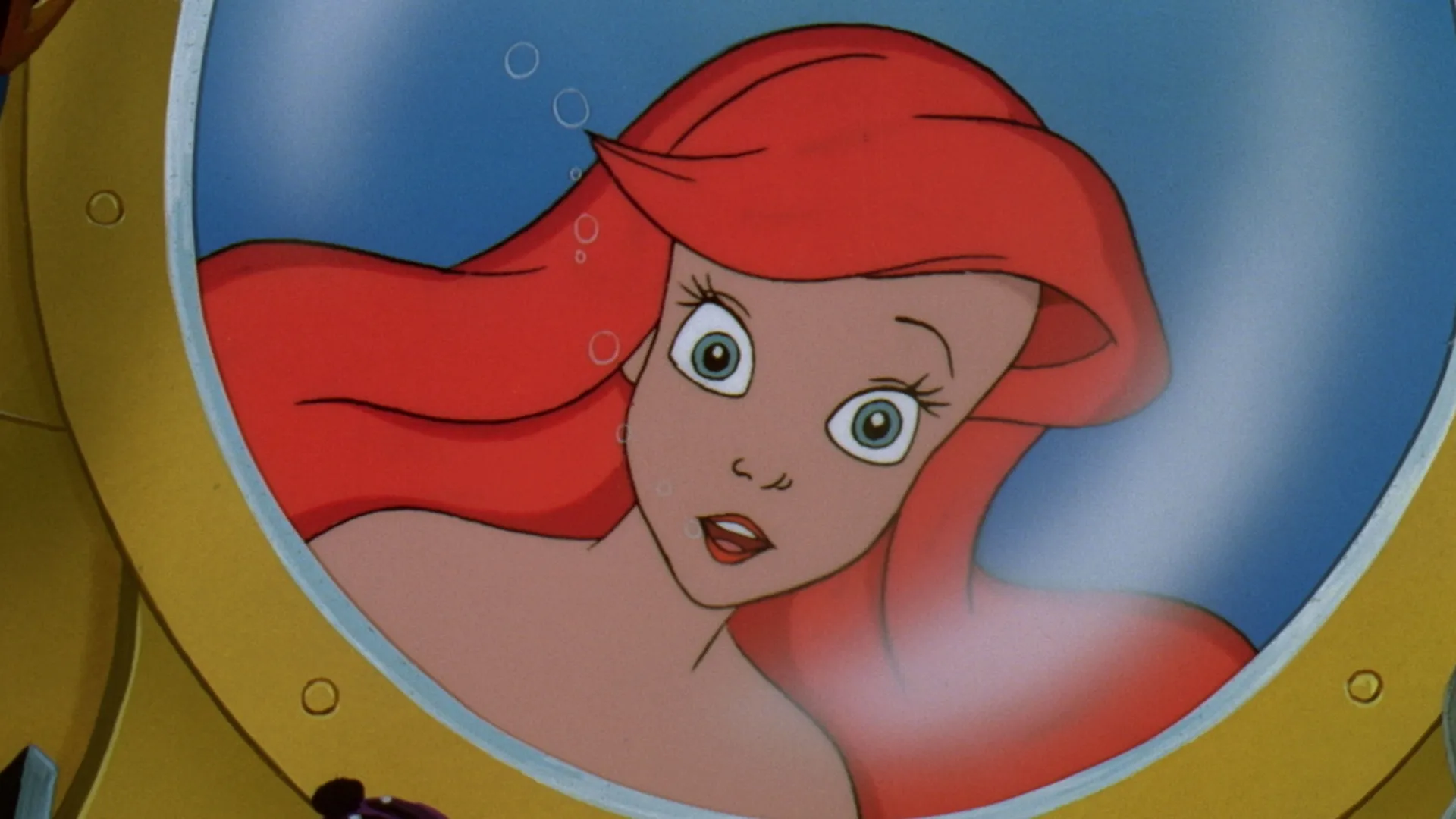
RaeRae Reacts · S2E8 · 1992 Animated Series
Metal Fish
A human explorer crosses into Ariel’s world, making curiosity travel in both directions and placing Hans Christian Andersen inside the franchise’s own adaptation joke.
The episode receipt
Series: The Little Mermaid (1992). Episode: S2E8 “Metal Fish.” Broadcast-order position: 22 of 31.
What happened
A human explorer crosses into Ariel’s world, making curiosity travel in both directions and placing Hans Christian Andersen inside the franchise’s own adaptation joke.
What the episode is really testing
Where to watch
Disney+ currently lists this episode. Regional catalogs and numbering can differ because the pilot is omitted from the service.
First reaction: Ariel saves the author and he gets the byline
A human explorer descends in a fish-shaped submarine, nearly drowns, encounters Ariel, survives because she repairs his vessel, and later writes a story about a little mermaid. The final reveal names him Hans Christian Andersen.
“Metal Fish” is clever franchise mythology and an authorship problem wrapped in the same twenty-three minutes. Ariel supplies the life, danger, labor, and image. The man returns to land with the story.
The metal fish reverses Ariel’s usual gaze
Ariel normally studies forks, boots, music boxes, and shipwreck debris without access to the humans who made them. Here a human enters her environment inside an object she must interpret in motion.
The submarine makes humanity observable while the human operator remains dependent on technology that Atlantica can understand better than he expects.
A fish-shaped submarine is camouflage and confession
The machine imitates marine anatomy because its inventor knows the sea requires a different body. It admits that a human cannot simply enter underwater space unchanged.
Technology becomes a temporary translation between environments, not proof that humans naturally belong everywhere they can reach.
Archimedes gives Ariel the teacher Scuttle cannot be
The merman scholar studies human culture with methods and knowledge far more reliable than Scuttle’s improvised guesses. Ariel finally meets someone who treats her curiosity as a field of inquiry rather than a dangerous phase.
Good mentorship does not only provide answers. It shows how to test claims, preserve uncertainty, and distinguish an artifact from a fantasy attached to it.
Humanology needs ethics as much as accuracy
Archimedes may identify objects correctly and still face questions about provenance, collecting, observation, and contact. Knowledge about another culture can become extraction when the people being studied never shape the account.
Ariel’s excitement should grow into reciprocal inquiry, not merely a better catalog of human things.
The explorer enters as a researcher and a trespasser
Curiosity is not automatically innocent because it sounds scientific. He descends into an inhabited world without consent, local guidance, rescue coordination, or a clear plan for what happens if the machine fails.
Exploration can produce knowledge while shifting danger onto the people whose home becomes the field site.
The leaking submarine turns discovery into emergency labor
Once the vessel is damaged, Ariel and her companions have to solve a human engineering failure before its occupant drowns. The explorer’s ambition creates work for residents who did not authorize the expedition.
Rescue remains the right response. It should not erase responsibility for preventable risk.
Ariel repairs what the inventor cannot reach
Her knowledge of underwater movement, pressure, materials, and the machine’s exterior gives her an advantage the human operator lacks. The supposed subject of observation becomes the technical expert.
That reversal exposes how often researchers appear self-sufficient only because local labor is left outside the published account.
The human is a fish out of water while fully underwater
The episode enjoys the inversion: Ariel belongs in the environment, and the human can survive only inside metal. His fragility is not moral inferiority. It is ecological fact.
Every body has conditions under which it becomes dependent.
Penny the cat adds another unwilling passenger
The explorer’s cat accompanies the expedition despite having no control over the vessel or mission. Her skepticism reads as comedy, but the animal bears risk created by a human dream.
Adventure stories often treat pets as proof of charm while forgetting they cannot consent to the danger.
Ariel’s rescue does not grant the explorer ownership of her image
Saving somebody can create gratitude, inspiration, and an urgent need to describe what happened. It does not automatically transfer the rescuer’s identity into public-domain material inside the story world.
A respectful author would consider what details expose Ariel, how the account affects her community, and whether she wants humans searching for her afterward.
The story is framed as inspiration, but inspiration can still extract
Andersen sees a mermaid, returns home, and writes. The episode treats the chain as tribute. Yet inspiration is often the polite word used when one person’s life becomes another person’s cultural capital.
Credit does not require denying artistic transformation. It requires naming the encounter and the asymmetry.
Ariel cannot read the book that remakes her
The human publication circulates on land while its supposed source remains beneath the surface, excluded by language, geography, and secrecy. She cannot correct the ending, challenge the themes, or claim royalties.
Representation becomes power when the represented person cannot answer.
Andersen’s 1837 tale is not Ariel’s biography
The historical fairy tale follows an unnamed mermaid whose desire for the prince is entangled with obtaining an immortal soul. She suffers severe pain, loses her voice, fails to marry him, refuses to kill him, and becomes a daughter of the air rather than Disney’s married princess.
“Metal Fish” uses Ariel as the spark while skipping the enormous transformation between encounter and text.
The Disney version writes itself backward into the source
By making Ariel inspire Andersen, a twentieth-century adaptation becomes the fictional origin of the nineteenth-century work it adapted. The corporation’s character appears to precede the public-domain tale.
That loop is funny, audacious, and worth examining as cultural ownership rather than accepting as harmless canon decoration.
This is franchise mythology doing brand consolidation
Disney does not merely adapt The Little Mermaid here. It stages its Ariel as the real mermaid behind the story and allows Andersen to become a witness to her authenticity.
The move flatters viewers who love Ariel while narrowing awareness that many adaptations, translations, illustrations, and cultural readings exist outside Disney.
The episode still points children toward Andersen’s books
Kenneth Mars closes with a message identifying the historical author and encouraging viewers to find his work at a local library. That gesture sends children beyond the television brand toward a text with a radically different emotional and religious structure.
The library invitation is one of the episode’s best acts of humility, even after the plot has centered Disney’s heroine inside the origin story.
The Copenhagen statue image completes the cultural loop
The ending evokes Ariel posed on a rock in the manner of the Little Mermaid statue in Copenhagen harbor. The visual connects Disney’s character, Andersen’s tale, and a famous public monument in one frame.
It is a genuine Easter egg and another example of adaptation folding older cultural objects into Ariel’s visual identity.
The implied timeline points toward the early nineteenth century
Andersen’s tale was first published in 1837. If this fictional meeting precedes composition, the episode places Ariel’s world around the early-to-mid nineteenth century, regardless of other franchise details that resist precise dating.
The date is suggestive, not a master key that makes every ship, costume, or later continuity align.
The primitive submarine is deliberate historical fantasy
The machine looks experimental, fragile, and shaped by imagination rather than modern engineering. It allows Andersen to enter the sea without pretending he had access to a contemporary research vessel.
Historical fantasy works here as a bridge between literary biography and animated adventure, not as documentary evidence that the real writer built the craft.
The episode fictionalizes Hans Christian Andersen heavily
The real Danish author did not document this mermaid rescue. “Metal Fish” uses his name, profession, and literary legacy as story material. Mark Hamill voices a playful animated construction, not a biographical portrait.
Readers should enjoy the conceit without repeating it as history.
Mark Hamill makes the author sound curious rather than canonical
Hamill gives the explorer enthusiasm, vulnerability, and wonder. The performance prevents Andersen from entering as a solemn monument who already knows the meaning of everything he sees.
That openness makes the later authorship feel like response to an encounter, even when the ethics remain complicated.
Rod McKuen gives Archimedes the pleasure of serious curiosity
Archimedes is knowledgeable without becoming a scolding encyclopedia. McKuen’s performance lets expertise feel adventurous, which matters for Ariel’s intellectual development.
The character shows her that accuracy does not have to kill wonder.
Ariel meets a human before Eric and continuity breaks loudly
In the 1989 film, her close observation of Eric is staged as an extraordinary first encounter with a human body. “Metal Fish” places her near Andersen and makes her his rescuer earlier.
No careful wording can make the emotional framing perfectly consistent. The series prioritizes a wonderful standalone idea over seamless prequel continuity.
The contradiction does not make the episode worthless
Canon debates can identify mismatches without reducing stories to pass or fail. “Metal Fish” offers valuable themes about curiosity and authorship even if it cannot occupy the same timeline literally.
Franchise coherence is one reading practice, not the only reason art matters.
Triton’s human ban looks porous in practice
A human vessel can descend close enough to require rescue, and a scholar can build a field around human culture. The boundary between worlds is already full of objects, technologies, and observation.
Prohibition without monitoring or diplomacy leaves Ariel to manage contact unofficially.
Atlantica needs a first-contact protocol
Residents should know how to approach unfamiliar vessels, signal occupants, assess leakage, preserve evidence, protect locations, and determine whether contact can remain confidential.
A teenage princess improvising every encounter is not a sustainable international policy.
The explorer owes Atlantica more than a book
After rescue, he could warn other humans against reckless descent, improve safety, keep identifying details private, and acknowledge that a marine civilization assisted him. Publication should not be the only legacy of gratitude.
Stories can repay attention by protecting the lives that made them possible.
Archimedes should document Ariel’s expertise
Within Atlantica, Ariel’s role could become evidence that her artifact study and curiosity create practical knowledge. She repaired a human machine under pressure and interpreted behavior across a cultural boundary.
Her contribution should not disappear because the human author receives the more famous ending.
Ariel’s desire for humans becomes more informed, not less
She sees invention, bravery, fragility, ambition, and dependence in one explorer. Humans stop being an abstract world of beautiful objects and become bodies capable of error and gratitude.
Curiosity matures when the subject can disappoint the fantasy without destroying interest.
The title names the machine through mermaid perception
“Metal Fish” describes a submarine using the categories available underwater. The human calls it technology. Ariel first sees an impossible creature. Neither label is complete alone.
Cross-cultural understanding begins by noticing how perception organizes the same object differently.
Knowledge travels unevenly across the surface boundary
A human can return with a globally circulating tale. Ariel cannot travel with equal freedom, access publishing, or see how her world is translated. The direction of cultural movement favors the surface.
That inequality anticipates the film’s larger question about who must change bodies to cross worlds.
A field note is not the same thing as informed consent
The explorer may believe documenting an extraordinary encounter serves knowledge. Scientific or literary importance does not remove Ariel’s interest in privacy, especially when public proof of merpeople could send hunters, collectors, governments, and more fragile submarines into her home.
Consent would require explaining what he plans to record, where it will circulate, which identifying details remain, and what risks publication creates. A hurried rescue cannot provide that conversation. The ethical default should therefore be restraint rather than assuming gratitude includes permission.
The episode turns folklore into eyewitness testimony and changes its meaning
Mermaids existed in human stories long before this fictional expedition. By letting Andersen see Ariel directly, the episode reframes a literary tradition as a report derived from contact. Myth becomes evidence, then returns to readers disguised as fairy tale.
That loop asks a delicious question about every legend: did imagination create the creature, or did somebody transform an encounter until only the story remained? It also warns that eyewitness status does not guarantee accuracy. Seeing Ariel once would not make Andersen an authority on mermaid culture.
The library message invites comparison, which is better than brand obedience
A child who reads Andersen after watching Disney will encounter different sisters, motives, spiritual stakes, bodily pain, and an ending without the same romantic reward. The contrast teaches that a familiar title can hold competing moral worlds.
That is more valuable than deciding which version is the one true story. Comparative reading reveals adaptation as choice, and choice makes creators accountable for what they keep.
The original tale’s pain should not be hidden behind the library invitation
Children who follow the episode’s advice will find a story where walking feels like knives, the prince marries another woman, and the mermaid faces a lethal choice. That difference is not proof Disney lied. It is evidence adaptation makes arguments.
A good guide prepares readers for the emotional and theological distance rather than calling one version simply darker.
Authorship is creation and selection
Andersen does not transcribe Ariel’s adventure. He selects, transforms, moralizes, and builds a different mermaid around longing, sacrifice, soul, and loss. Disney later selects again.
Every adaptation tells us what its makers believe must remain, disappear, or be rewarded.
The episode can inspire children to ask who told the story
The cheerful reveal opens a serious media-literacy question: if the mermaid had written the account, what would the human explorer look like? What details would matter? Where would the ending begin?
Changing the narrator reveals the power hidden inside familiar plots.
Penny deserves her own version
The cat sees her human enter a fragile metal fish, experiences the danger, and returns to a land audience that may never know she was there. Like Ariel, she is part of the event without controlling the publication.
Her silent skepticism may be the most accurate risk assessment in the episode.
Where this sits in broadcast order
“Metal Fish” is S2E8 and episode twenty-two in the complete thirty-one-episode inventory. It aired November 6, 1993. Jamie Mitchell is credited as director, with Tedd Anasti, Patsy Cameron, and Tom Mitchell appearing in writing records.
It follows Sebastian’s crisis about recognition with a story where Ariel performs the essential labor and another figure becomes historically famous for what he makes from the encounter.
Final reaction
“Metal Fish” is one of the series’ smartest ideas because it allows Disney’s Ariel to meet the author whose tale Disney transformed. It is also gloriously presumptuous. Ariel saves a man from his own risky machine, and he returns to land with a byline, a literary legacy, and a version of mermaid life she cannot review.
The ending earns affection because it points children toward the library and invites them to discover how different Andersen’s text is. Episode grade: A, with Archimedes promoted, Penny placed in charge of expedition safety, and Ariel added to the acknowledgments before the next edition goes to press.